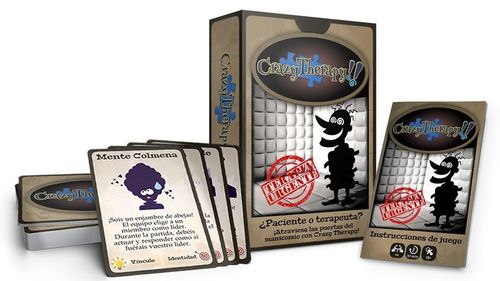
Crazy Therapy!!
Crazy Therapy!! Rulebook
Table of Contents
Table of Contents
Before You Begin
The players form two teams. Members of the same team sit together and always keep eye contact with their rivals. Be warned: in Crazy Therapy!! unexpected situations can arise that force you to change seats frequently. Don't forget! (See the section ¡¡THERAPY!!.)
Next, both teams draw a card from the Crazy Therapy!! deck without letting the rival team see it. This will be the pathology that each team must act out on its turn as patients, and that the opposing team must decipher on its turn as therapists. The team that has the youngest player of all begins the game as therapists, while the other team acts as patients. When the players are seated correctly and know how to act out their pathologies, the game begins.
Playing as Therapists
- At the start of the turn, and before asking questions, the therapist team may request the light-bulb clue (pista bombilla) from the rival patients. (See the section CLUES.)
- Each therapist may ask one question of any patient they wish. Questions must be phrased so that the answer is YES or NO.
- Therapists must keep in mind that patients may suffer from pathologies involving: personality disorders, behavior, obsessions, tics and other strange mental conditions.
- Once all the therapists have asked their question, they may issue a diagnosis to try to solve the rival's pathology (only one diagnosis per turn).
- At the end of the turn, the therapists become patients.
Think very carefully about which questions to ask, and analyze the patients' answers down to the millimetre. Don't lose track of their gestures and movements either: the key to deciphering the rival's pathology may not always be in their answers, but in their reactions.
Playing as Patients
- Patients must answer YES or NO honestly to the therapists' questions, unless the card of their pathology says otherwise.
- They must not misinterpret their pathology, in order to avoid cases of therapy (see the section ¡¡THERAPY!!).
- At the end of the turn, the patients become therapists.
You are supposed to be out of your minds, so let the madness of your pathology consume you without fear. Cause a mental explosion in the therapists!
End of the Game
Turns are played as many times as necessary until one of the teams deciphers the rival's pathology with a correct diagnosis (solving the pattern and/or functioning of the pathology).
If a diagnosis is correct, the rival team may take one last turn of questions as therapists and issue a final diagnosis. If that team solves the pathology, the game ends in a tie. Otherwise, the team that made the correct diagnosis wins the game.
To decipher a pathology, the therapists must explain what the pattern and/or functioning of the pathology consists of. Naturally, it is not necessary to know the name of each one. That really would be madness!
Cards
The Crazy Therapy!! deck consists of 48 cards of delirious pathologies. The contents of the cards must remain hidden from the rival team at all times. If there is any suspicion that a card has been seen by the rival, it must be discarded and replaced with another.
Each card represents a pathology with unique gameplay. Despite this diversity, there are synergies between the patterns and clues of all of them, which means great replayability even for the most advanced players.
All the cards in the game share the same structure:
- Name (at the top of the card).
- Illustration (in the middle of the card).
- Description (below the illustration), which tells the patient how to act out the pathology.
- Clues (at the bottom of the card): two clues, the light-bulb clue and the bullseye clue.
For example, the card Mente Colmena ("Hive Mind") has the description: "You are a swarm of bees! The team chooses one member as leader. During the game, you must act and answer as if you were your leader." Its two clues are Vínculo ("Bond") and Identidad ("Identity").
Clues
Each pathology card includes two clues at the bottom. These are keywords that help the therapists decipher their rivals' pathologies, and they also add an extra strategic component to the game. Their timing and manner of use can drastically change how a game unfolds. The peculiarities of these clues are as follows:
- Light-bulb clue (pista bombilla): you may request it from the rival team at the start of any therapist turn, but this has a price: you automatically lose the turn, and furthermore, any incorrect diagnosis from that moment on forces you to reveal your bullseye clue (pista diana) to the rival team.
- Bullseye clue (pista diana): revealed to the rival team as described above.
Think carefully about the moment you request the light-bulb clue! Its effects can turn against you!
¡¡Therapy!!
Throughout the game, cases of therapy may occur. This peculiar situation begins when a patient shouts "¡¡THERAPY!!" (¡¡TERAPIA!!), and it forces all the members of their team to stand up and randomly swap seats. A case of therapy occurs in the following situations:
- When the pathology itself indicates it.
- When it is impossible to carry out the instructions of the pathology for some reason.
- When the answer to a therapists' question is unknown.
- When a member of the team makes a clear mistake while interpreting the pathology.
Shouting ¡¡Therapy!! is MANDATORY if you detect that a teammate has broken a rule while interpreting the pathology. Don't be cheaters!