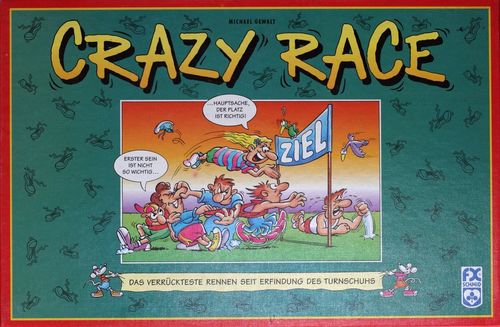
Crazy Race (1994)
Crazy Race (1994) Rulebook
Table of Contents
Table of Contents
Spelmateriaal (Components)
- 1 game board
- 56 track cards
- 27 action cards
- 20 bet cards
- 10 cup cards
- 5 pawns
- 2 dice
Note on the cup count: the components list above says 10 cup cards, but the cup section below says 15 cup cards, and the printed illustration shows five cups for each of the three stages (1 to 5). Fifteen is the count that matches the three stages, so the component list appears to contain a misprint. Both figures are transcribed as printed.
The game board
The game board shows five identical race tracks, each divided into three stages (purple, blue and red). Each stage is in turn divided into five track pieces with four spaces each. The stages are labelled "1st stage", "2nd stage" and "3rd stage", and each race track starts at a coloured start space (the five start spaces are coloured red, green, blue, yellow and white).
Track cards
The 56 track cards each show a track piece with 0 to 8 spaces. During play they are placed on the game board, where they lengthen or shorten the race track.
Action cards
The 27 action cards can be played by the players either for themselves or against their opponents.
- Cards marked with a black circle are cards for the player himself.
- Cards marked with a black triangle are cards against an opponent.
Bet cards
The 20 bet cards show the assignment that the players must fulfil in the three stages. Each bet card has a row of three placings, one for each stage (the arrows at the top of the bet card are purple for the 1st stage, blue for the 2nd stage and red for the 3rd stage). The row used depends on the number of players:
- The top row applies to 3 players: 1st stage 1st place, 2nd stage 3rd place, 3rd stage 2nd place (example printed on the card: 1, 3, 2).
- The middle row applies to 4 players: 3, 3, 4.
- The bottom row applies to 5 players: 2, 2, 4.
Tip: in a race with 5 participants there is no assignment for the first and the fifth place.
Cup cards
The 15 cup cards show the placing (from 1 to 5) in the three separate stages. During the race they are handed out to the players.
Pawns and dice
There are 5 pawns. For simplicity, the colour may be distributed in turn as indicated on the game board. The two dice also play a role.
The Basic Game (Het basisspel)
We suggest first playing the basic game as practice and as a warm-up. The basic game is played without the action cards. It is very useful for getting to know the game, and has the advantage that young children can also take part.
Setup
Place the game board in the middle of the table.
Each player receives:
- 1 pawn. The pawn is placed on the start space of the same colour. This pawn moves along the connected race track, so it never changes race track.
- 1 bet card. The bet card is kept face down, hidden from the curious eyes of the other players. Each player knows only for himself which positions he must hold in the three stages in order to win the game. The remaining bet cards are not used and are returned face down to the box.
- 4 track cards. The four track cards are held in hand, face down to the other players. The other track cards are thoroughly shuffled and placed as a face-down draw pile next to the game board.
The action cards are not used in the basic game and are put back in the box.
The cup cards are sorted by stage and placed next to the game board.
The "fastest" player may begin the game. The dice are given to the starting player.
Playing the game
The starting shot has been fired. The "fastest" player begins, and play then proceeds in turn order, clockwise.
The player whose turn it is has two successive options:
- He may play one track card.
- He must roll the dice and move his pawn forward.
1. Playing a track card
Before rolling the dice, the player may play one track card per turn. He may do this, but he does not have to.
A track card may be placed on any free location. This means that a track card may also be placed on a free location of an opponent's race track. A free location is one where there is neither a pawn nor a track card.
Instead of placing it on the game board, a track card may also be placed on the discard pile, in the hope of drawing a more interesting card.
At the end of his turn, a player who has played a track card may draw a new track card from the draw pile, so that he always has 4 track cards.
2. Rolling the dice and moving the pawn forward
The player must roll both dice and move his pawn forward the same number of spaces. Each space counts for one pip of the dice.
If a player crosses the finish line of a stage, the remaining pips are simply carried on into the new stage.
If the player crosses the finish line of the last stage, the surplus pips are lost. The race is finished for this player, and he places his track cards on the discard pile.
As soon as a player crosses the finish line of a stage, he receives the matching cup card and lays it face up in front of him. In this way, at the end of the game it is known what position each player reached in each stage.
Example: a player who crosses the finish line of the second stage in third place receives the cup card shown in the rulebook (cup "3", 2nd stage).
Tip: it is of the utmost importance not to reveal during the game which position your bet card says you should achieve. This makes it too easy for your opponents to anticipate.
End of the race and scoring
The finish is reached. When the second-to-last player crosses the finish line, all positions have been decided.
The bet cards are revealed and compared with the positions actually achieved by the players. To do this easily, the cup cards, in the order of the stages, are laid on the bet card so that the two numbers can be compared immediately. If the numbers do not match, the cup card is removed.
Example: a game with three players. The positions in the first and third stages were correct, so the numbers on the bet card match the numbers on the cup cards. The cup cards that are correct remain on the bet card; the incorrect cup card is put away.
The points are determined. A player receives 1 point for each correct position in a stage, and also, because this makes it harder, 1 point for each other player who had to achieve the same position in that stage.
Worked example of a game with 4 players:
Player A
- Bet card: 4, 3, 2
- Result: 3, 2, 3
- Player A had no correct position and receives 0 points.
Player B
- Bet card: 2, 3, 4
- Result: 2, 3, 1
- Player B receives 1 point for the first stage and 1 point for the second stage. In addition he receives 1 point because player C also had to finish second in the first stage. He also receives two more points, because both player A and player D also had to finish third in the second stage. Player B scores a total of 5 points.
Player C
- Bet card: 2, 1, 2
- Result: 1, 1, 2
- Player C receives 1 point for the second stage and 1 point for the third stage. In addition he receives 1 point because player A also had to finish second in the third stage. Player C scores a total of 3 points.
Player D
- Bet card: 4, 3, 4
- Result: 4, 4, 4
- Player D receives 1 point for the first stage and 1 point for the third stage. In addition he receives 1 point because player A also had to finish fourth in the first stage. Moreover he receives 1 more point because player B also had to finish fourth in the third stage. Player D scores a total of 4 points.
Player B is the winner, followed by players D, C and A.
The winner is always the player who has scored the most points in total.
The Main Game (Het hoofdspel)
Once you have played the basic game a few times, you are ready for the real main game. In the main game the element of luck plays a smaller role, and tactics and bluff come more into play. The action cards are also used in the main game.
At the start of the game, the players receive, in addition to their 4 track cards, 4 action cards. The remaining action cards are placed as a face-down stack next to the game board.
Playing action cards
Action cards are played under the same rules as track cards:
Before rolling the dice, the player may play one action card per turn. He may do this, but he does not have to. It does not matter whether or not he has placed a track card in this turn. Placing a track card may be done before or after placing an action card; the order does not matter.
Instead of playing an action card, the action card may also be placed on the discard pile, in the hope of drawing a more interesting card.
At the end of his turn, a player who has played an action card may draw a new action card from the draw pile, so that he always has 4 action cards.
Types of action cards
The action cards are of two kinds, distinguished by their symbol:
- Cards for the player himself (marked with a black circle). These can only be played for the player himself.
- Cards against a fellow player (marked with a black triangle). These cards are played against a fellow player.
Cards for the player himself
- Move a free track piece to another free location. The player who plays this card may place a track piece on the game board, on a track where no pawn stands, on a free location.
- The action card just played has no effect. This card can be played immediately when a fellow player uses an action card against you. Both action cards are placed on the discard pile. This card cannot be played against a track card, and not against a player who places an action card with another player. Although the card was played outside the normal order, the player may only top up his action cards to 4 after ending his turn.
Note on the component illustration: the illustration on page 3 of the rulebook shows a card for the player himself with the caption "You may not roll the dice" ("U mag niet dobbelen"). The card descriptions on page 8 list "You must skip a turn" ("U moet een beurt overslaan") and do not describe a card with the caption "You may not roll the dice". Both captions are transcribed as printed.
Cards against a fellow player
The action cards with a triangle can only be played against a fellow player. These action cards do not need to be declared; they speak for themselves.
The action card is placed face up in front of a fellow player. As soon as this player comes to his turn, he must carry out the instructions on the action card. Afterwards the action card is placed on the discard pile.
No more than one action card may lie in front of each player.
- You are on turn again. This card means that the player who has this card lying in front of him is on turn twice in succession. He must therefore first play cards (if he wishes), then roll the dice, and then again play cards (if he wishes) and roll the dice. Only at the end of the second turn may he top up his track cards and action cards to 4.
- You must skip a turn. This card means that the player who has this card lying in front of him must skip a turn. The player may therefore not play any cards and may not roll the dice.
Reshuffling
When the draw pile is used up, the discarded action cards are thoroughly shuffled and laid out as the new draw pile. The same applies to the stack of track cards. Track cards that lie behind the pawns may also be removed and, together with the discard pile, shuffled and laid out as a new draw pile.
Other rules
All rules of the basic game remain in force.
The winner is the player who has scored the most points at the end.