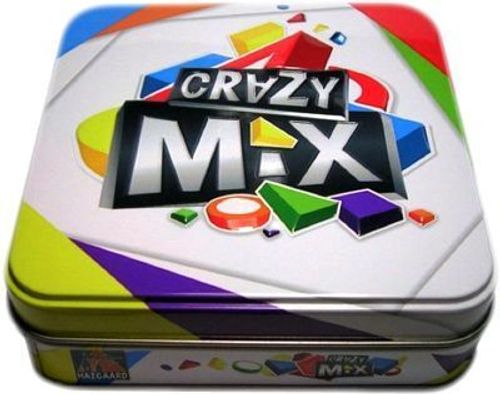
Crazy Mix
Crazy Mix Rulebook
Table of Contents
Table of Contents
Components
54 cards, including:
- 18 "target" cards with a green border, showing 2 symbols on the front and 4 on the back.
- 36 "decoder" cards with a purple border, showing a decoder on the front and a single symbol on the back.
- One set of rules.
Setup
Shuffle the 18 target cards (green border) and lay them out in a rectangle of 5 cards by 6, with the two-symbol side face up.
Note on the card count: the printed rules give 18 target cards, but a 5 by 6 rectangle holds 30 cards, and the BGG description gives 20 target cards. This transcription keeps the printed figures; the discrepancy is in the source.
Shuffle the 36 decoder cards (purple border) and place them as a face-down pile in the centre of the rectangle, with the decoder side face up.
[Diagram: Example starting layout, labelled "Target cards", "Decoder", "Symbol cards" and "Number of cards won by the round's winner".]
Principle and Goal
At the start of each round, four cards are placed around the central pile. "Decoding" these cards points to a symbol present on a target card (green border). The first player to find which symbol it is wins one to three cards. The player with the most cards at the end of the game is the winner.
The Symbols
Each symbol has four characteristics:
- Shape: square, triangle or circle
- Colour: red, yellow or blue
- Size: large or small
- Fill: empty or full
Gameplay
A player chosen at random turns over the first 4 cards of the pile and places them, symbol side face up, so that they are adjacent to the four sides of the pile.
The card now showing on top of the pile serves as the decoder for the current round.
Once the cards are placed, all players try simultaneously, as quickly as possible, to find the symbol defined by the decoder (see "How to Use the Decoder" below). As soon as a player thinks they have found the correct target symbol, they point to it. Pointing at the green-bordered card where the symbol is located is not enough; the player must clearly point to the symbol itself.
The first player who has found the correct symbol wins the number of cards shown in the centre of the decoder (one, two or three). These cards are taken from those placed around the decoder.
A player who points to a wrong symbol loses one card they won previously (if they have any). They place it under the central pile.
Note: if the target symbol is also present on one of the 4 purple-bordered cards adjacent to the decoder, it is possible to point to that card to win it (in addition to the target symbol present on a green-bordered card). The same player may do this using both hands, but it may just as well be two different players: one wins the number of cards shown in the centre of the decoder by pointing to the target symbol, and the other wins the card adjacent to the decoder that they pointed to.
How to Use the Decoder
Each side of the decoder corresponds to one of the four characteristics of the symbols. Each side therefore indicates which characteristic of the adjacent symbol must be used to find the target symbol. For example, if the symbol adjacent to the decoder's "colour" side is blue, the target symbol is also blue; if the symbol adjacent to the decoder's "shape" side is a triangle, the target symbol is also a triangle, and so on.
[Diagram examples:]
- The target symbol is a circle.
- The target symbol is full.
- The target symbol is blue.
- The target symbol is small.
- The target symbol is the small full blue circle.
New Round
The winner of the previous round begins the new round by taking from the top of the pile the number of cards needed to have four cards around it again.
For example, if the player has just won two cards, they turn over the top two cards of the pile and place them, symbol side face up, on the two free positions.
The card that is now visible on top of the pile serves as the decoder for the new round.
End of the Game
The game ends as soon as there are not enough cards left in the central pile to complete the decoder.
Each player then counts all the cards they have won during the game. The player with the most cards is the grand winner.
Advanced Rules
To make things a little more complicated, you may play with the back of the target cards, which shows four symbols instead of two.
The game then proceeds in the same way, but in addition to the four usual characteristics, you must also take into account a fifth: the background colour, white or light blue, of the central square of the decoder cards.
[Diagram examples:]
- The target symbol is empty.
- The target symbol is a triangle.
- The target symbol is on a blue background.
- The target symbol is small.
- The target symbol is yellow.
- The target symbol is the small yellow empty triangle on a blue background.