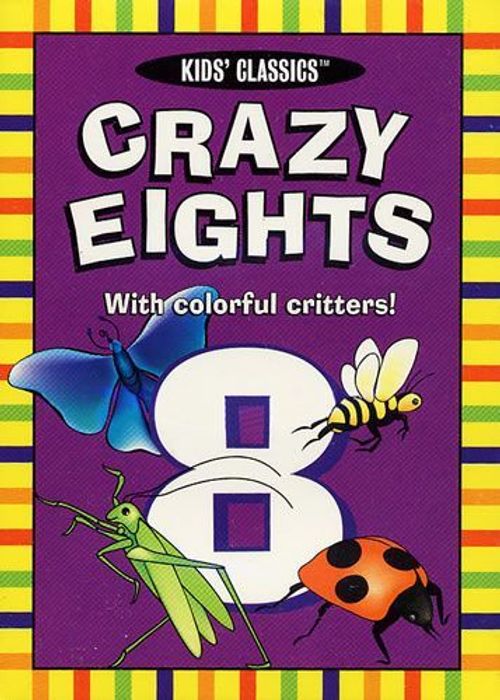
Crazy Eights
Crazy Eights Rulebook
Table of Contents
Table of Contents
Players and Equipment
Players: 2 to 8. The basic game uses a standard 52-card pack, or two such packs shuffled together if there are a lot of players.
Basic Game
The dealer deals (singly) five cards to each player (seven each if there are only two players). The remainder of the pack is stacked face down on the table as a stock from which cards will be drawn. The top card of the stock is turned face up and placed beside the stock to start the discard pile.
Starting with the player to dealer's left, and continuing clockwise, each player in turn must either play a legal card face up on top of the discard pile, or draw a card from the undealt stock. The following plays are legal.
- If the top card of the discard pile is not an Eight, you may play any card which matches the rank or suit of the previous card (for example if the top card was the king of hearts you could play any king or any heart).
- An Eight may be played on any card, and the player of the Eight must nominate a suit.
- If an Eight is on top of the pile, you must play either another Eight or any card of the suit nominated by the person who played the Eight.
If an Eight is turned up by the dealer as the first card of the play pile, it is treated as though the dealer had played it. The dealer looks at his or her hand and nominates a suit, and the first player must play a card of that suit or another Eight.
A player who has only one card left in their hand must alert the other players by saying "last card". A player who fails to do this before the next player takes their turn must draw two cards from the top of the stock as a penalty.
The first player who gets rid of all their cards wins, and the other players score penalty points according to the cards they have left in their hands - 50 for an eight, 10 for a picture card, and spot cards at face value (one point for an ace, two for a two and so on).
If the stock pile is exhausted, the played cards, except for the last card, are shuffled and stacked face down to make a new stock and the game continues.
Special Cards
Apart from the Eights, usually there are other cards that have special effects when played. Typical rules are as follows.
Skip. When a Queen is played, the next player in rotation misses a turn, and the turn passes to the following player. In a two-player game the opponent is skipped and the same player plays again.
Reverse direction. When an Ace is played, the direction of play reverses, becoming anticlockwise if it had been clockwise, or vice versa. In a two-player game an Ace has no effect.
Draw cards. When a Two is played the next player must either draw two cards or play another Two (an Eight cannot be played in this case). If several Twos have been played by consecutive players, the next player must either play another Two or draw two cards for each two in the sequence. The penalty cards cannot be played in the same turn - after the penalty cards have been drawn, the turn passes to the following player, who can continue with any card of the same suit as the last Two, or another Two or an Eight to change suit.
If one of these special cards is turned up as the first card of the play pile, it is treated as though the dealer had played it. If the turned up card is an Ace, play begins anticlockwise and the player to dealer's right has the first turn. If the turned up card is a Two the first player must play another Two or draw two cards. If the first card is a Queen, the first player is the player two places to the left of the dealer.
If the last card played by the winner happens to be a special card, the special effect is ignored. For example the card on top of the play pile is the ten of spades and the next player's only remaining card is the two of spades. The player plays the two of spades and immediately wins. The hands are scored as they are - no one has to draw cards as a result of the two.
Variations
Crazy Eights is one of the easiest games to modify by adding variations. In particular the roles of the special cards are often changed, for example using a different card, such as Jack instead of Queen to cause the next player to skip a turn, or Four instead of Ace to reverse direction. Sometimes there will be additional special cards with other effects - for example it may be agreed that the Queen of Spades requires the next player to draw 5 cards. The result is that almost every group of players has their own house rules, and it would be rare to find two groups that play exactly the same way.
Deal
The number of cards dealt to each player initially may vary. For example some begin with eight cards each.
Drawing Cards
In the normal game, you may always use your turn to draw a card. However, some people play that you may only draw if you are unable to play - if you can play you must.
Some allow the drawn card to be played immediately if it is a legal play.
Some allow more than one card to be drawn - either up to a fixed number of cards, after which if you still cannot (or will not) play the turn passes to the next player. Others require you to continue drawing until either you can play or the deck is exhausted.
Changing Suit
The special card that changes suit is nearly always the Eight, at least in places where the game is called Crazy Eights. In many countries and regions the equivalent game goes by other names and a different card may be used to change suit - for example in the British game Switch it is often the Ace, and some other variants use the Jack or the Seven.
Some play that you can only play an Eight that matches the previous card's suit or rank.
Some play that you can play an Eight at any time but when playing an Eight you do not nominate a suit. The next player must simply match the suit of the Eight you played or play another eight.
One correspondent (Szu Kay Wong) gives the rule an Eight can be played on any card, but the player can only nominate a different suit if the Eight matches the rank or suit of the previous card. Some players use jacks or aces rather than eights as the cards which have the power to change suit.
Multiple Equal Cards
Some allow a player holding two or more equal ranked cards to play them all at once, provided that the first of them is a legal play. If they are special cards all the special effects take place. For example if the top card of the play pile is the five of diamonds, the next player could play the nine of clubs, nine of diamonds and nine of hearts in that order, and the next player would have to play a nine or a heart. If the equal cards are special cards all the special effects take place. For example if an Ace reverses direction, playing two Aces together will reverse it twice, leaving the direction of play unchanged. If a Queen skips the next player, a pair of Queens will skip two players (in a two-player game that would be your opponent's turn and your own next turn, leaving your opponent to play next). If a Two requires the next player to pick up two cards, a pair of Twos will require the next player to pick up 4 cards (or play another Two).
Last Card
Some groups have a special word that must be said by a player when they have just one card left. On the other hand, some groups do not require a player with one card to warn the other players.
End of Stock Pile
When the stock pile is exhausted, the rules given in most books do not envisage shuffling the play pile to make a new stock. Instead they specify that play continues without drawing. A player who cannot or does not wish to play just passes. If all pass, the game is blocked. Play stops and everyone scores for the cards remaining in their hands. In practice this version of the game is rarely played.
Crazy Eights Countdown
This variant has become popular in North America. Each player begins the game with a score of 8, and eight cards are dealt to each player. When a player gets rid of all their cards, this does not end the play. Instead, the player subtracts 1 from their score, and is immediately dealt a new hand of cards equal in size to their new score. The other players keep the cards that they have and the play continues. The winner of the game is the first player who reduces their score to zero.
Each player's current score determines the rank of the card that is wild for them. So at the start of the game everyone has Eight as their wild card, and the game is like normal Crazy Eights. But later in the game it is possible for each player to have their own, different rank of wild card, which can be played on any card and allows the player to nominate the suit to be played next. Each time a player runs out of cards, their wild card changes, first from Eight to Seven, then Six and so on down to Ace. When a player with a score of 1 and Ace as wild card runs out of cards, their score becomes 0 and they win the game.
The changing wild card introduces several new situations and players need to agree how to resolve these. The following rules are suggested.
- When a wild card is played, the player nominates a suit. The next card played must either be a card of that suit or the player's own wild card.
- Example. My score is 6. I play the six of spades and nominate hearts. If the next player's score is 7 that player must either play a heart, or play a wild seven to nominate a suit, or draw a card. The next player is not allowed to play (for example) the six of diamonds even though the rank is the same as my wild Six.
- When a player's wild card rank also has a special effect, the player nominates a suit and the card also acts as a special effect card as follows.
- Wild / Skip. The next player is skipped and the following player must play the nominated suit or a wild card. For example, suppose that our house rule is that 4 skips the next player, 4 is my wild card, and I play the four of clubs nominating diamonds. The next player is skipped and the player after that must play a diamond or one of their own wild cards.
- Wild / Reverse. The direction is reversed and the next player in the new direction must play the nominated suit or a wild card. For example, suppose that Aces reverse direction. We are playing clockwise and I play the ace of hearts nominating spades. The direction reverses to anticlockwise and the player to my right must play a spade or one of their own wild cards.
- Wild / Draw Two. The next player must either draw two cards or play a Two of the nominated suit. For example, the players in order and their scores are A(2), B(5), C(6). Player A plays the two of diamonds nominating clubs. Now B must either play the two of clubs or draw two cards. If B plays the two of clubs, C must either draw four cards or play any Two (since the two of clubs was not wild). If B draws 2 cards, C must play a club or a wild six or draw a card, since clubs was the suit nominated by A. Another example: player A plays the wild two of diamonds and nominates diamonds. Assuming that we are playing with a single deck, player B is forced to draw two cards, and C will then have to play a diamond or a wild card. Playing with a double deck, B's only legal play to avoid drawing two cards would be the other two of diamonds.
Here is a blog post and discussion about Crazy-8-Countdown describing a version in which Jacks skip the next player, Twos make the next player draw two cards or play another Two as usual, and the Queen of Spades makes the next player draw five cards. Multiple cards of equal rank can be played together. No 'reverse direction' card is mentioned. As in normal Crazy Eights, when multiple cards are played in one turn and some or all of them are special cards, the special effects apply even for cards that are covered, but it is the last card played that has to be followed by the next player.
Variant. Some groups allow a card of equal rank to be played on a wild card even if it is not in the called suit. For example a wild five of hearts is played calling "diamonds" but the next player plays the five of clubs instead of a diamond, even though 5 is not wild for them. This rule is the most frequent cause of arguments in this game so it is a good idea to agree in advance whether your house rules allow this play or not.