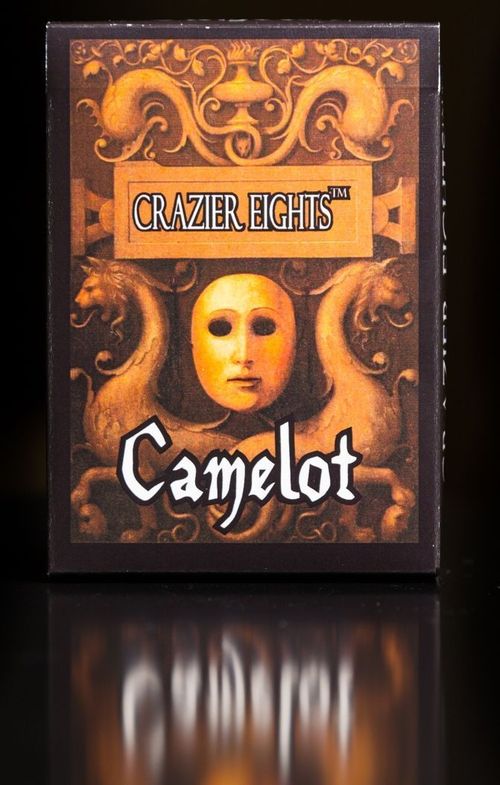
Crazier Eights: Camelot
Crazier Eights: Camelot Rulebook
Table of Contents
Table of Contents
Part I: Main Rules
Chapter 1: Setting up
Randomly determine who goes first, shuffle the deck, and all players draw seven cards.
Put the top card of the deck into the discard pile (face up). The remaining cards in the deck are the draw pile.
Chapter 2: Taking turns
Players take turns, going clockwise. Each turn has four phases:
- Beginning phase – Some assets have beginning of turn abilities.
- Draw phase – Draw a card. (To draw a card, take it from the top of the draw pile, and put it into your hand.)
- Main phase – You may play a card from your hand (as an asset or event), and you may discard a card from your hand. You may discard before playing the card.
- End phase – Some assets have end of turn abilities.
Chapter 3: Playing cards
Assets – Cards played as assets are controlled by the player who plays them, are put into play on the table in front of the player who controls them, and do whatever is stated on them while they are in play on the table. The controller makes any decisions needed for the asset.
Events – Cards played as events have the stated effect and go to the bottom of the discard pile. The person who plays the event makes decisions needed for it.
Chapter 4: Discarding cards
A card may only be discarded that has the same color or rank as the top card of the discard pile unless it is an eight.
Eights are wild, so they may always be discarded. If a player discards an eight, that player names a color and the next card discarded must be that color (or another eight) for as long as it's on top of the discard pile.
Discarded cards have no effect and are put on the top of the discard pile, face up.
Chapter 5: Win condition
The first player to have zero cards in hand wins. When a player wins, the game is over.
Chapter 6: Losing the game
If a player loses the game, that player no longer plays the game, and she puts cards from her hand and cards she controls on the bottom of the discard pile in a random order. The last player left wins.
Chapter 7: Destroyed cards
Destroyed assets are put on the bottom of the discard pile.
Chapter 8: Can't Draw?
If the draw pile runs out of cards and a player needs to draw a card (or reveal the top cards, etc.), first shuffle the cards from the discard pile together other than the top card. That's the new draw pile.
If there are still no cards to draw, the game is over and the player with the fewest cards in hand wins.
Chapter 9: Two player rule
The first player in a two player game has an advantage. To offset this advantage, you may choose to play with the optional two player rule – the player who goes second may choose to skip their first draw phase.
Chapter 10: Playing for points
If a group of players want to play multiple games and want to be able to determine how well each player did, they can use points. After a game, each player gets one point for each card she has in hand. The winner gets zero points. Players with the fewest points do the best.
Need more clarifications? If any more clarifications are needed than are included in the rule book, go here: CrazierEights.com/rules. Also, take a look at a play through video: http://tinyurl.com/crazier8video
Part II: More Clarifications
Chapter 11: Card Layout
Each card has information about the card name, rank, suit, text, card type, illustrator, and copyright. This information is always located in the same places as is indicated on this diagram.
The diagram labels the card's parts: Rank & suit, Title, Card type, Image, Text, Illustrator, and Copyright info.
Note that the eights have a different card frame to help you know when you have a wild card.
Chapter 12: Card front & Back
Each card has the same back, but the card fronts are unique and tell you what each card is and what it does. Cards that are face-down have only the back showing (such as cards in the draw pile), and cards that are face-up have the front showing (such as cards in the discard pile and cards that are in play on the table).
Looking & searching
If you look at or search cards from the draw pile, then you pick the cards up and look at the front of the cards to see what they are and what they do.
Revealing cards
If you reveal cards from the draw pile, then you turn them face-up. Looking at and revealing cards doesn't change where they are. For example, if you look at the top card of the draw pile, then you put it back on top of the draw pile afterward.
Cards that you draw go into your hand, and no other player can see the front side of cards that are in your hand.
Not enough cards in the draw pile?
If there's not enough cards in the draw pile and a player needs to reveal, look at, search, or play cards from it, first shuffle the cards from the discard pile other than the top card into the draw pile.
Cards have a rank and suit. The rank is the number or letter on the top left-hand side of the card: A (ace), 2, 3, 4, 5, 6, 7, 8, 9, 10, J (jack), Q (queen), or K (king). The suit is the symbol shown on the top left-hand side of the card and represents the card's color.
The suit symbols and their colors are:
- Eye: purple
- Ankh: green
- Moon: blue
- Sun: orange
Multicolor cards have two or more colors and suits. If a card is multicolored, you may discard it whenever the top card has one of its colors. Whenever the top card of the discard pile is multicolored, the next card that is discarded must have one of those colors (or be an eight).
Chapter 13: Table Layout & Zones
The draw pile, discard pile, and in play zone can be visualized using this representation. The diagram shows: Player one's in play zone (put assets that are in play on the table here); the draw pile and discard pile; and Player two's in play zone (put assets that are in play on the table here).
Assets you play are put into play on the table in front of you (which is the in play zone). Assets have an effect on the game for as long as they are in the in play zone.
Chapter 14: Conditional Abilities
Sometimes an asset that is in play on the table makes something happen because of a condition being met. These are conditional abilities. For example, Angel of Hope's ability states "At the beginning of your turn, a player of your choice draws a card." The condition that makes that effect occur is that you start a new turn.
Whenever a condition makes two or more conditional abilities occur, the first conditional abilities that take effect are ones from cards controlled by whoever is currently taking a turn, then conditional abilities take effect based on turn order.
If a single player controls two or more cards with conditional abilities that both occur from the same condition, then whoever is currently taking a turn decides what order they take effect in.
If a card does something at the beginning of your turn, it has to be in play on the table when you start a turn before it can do anything and it can't be used on the turn you play it. For example, Devious Dragon says, "At the beginning of your turn, destroy any one asset that is in play on the table." You can't destroy an asset with Devious Dragon the turn that it is put into play on the table. It only occurs when it is in play on the table at the start of your turn (before you draw a card).
When a conditional ability occurs, it will take effect no matter what else happens.
Chapter 15: Substitution abilities
Some assets change what effect other cards have. These cards have abilities that start with the word "if." For example, Castle says, "If an opponent would cause you to draw one or more cards, the opponent causes you to draw one fewer card." Every time an opponent's asset would cause you to draw a card and you control Castle, Castle prevents you from drawing the card. Also, cards with the same substitution effect are even more effective in multiples. For example, if you control two Castles, then opponents cause you to draw two fewer cards.
Chapter 16: Playing on teams
Before playing games, players can decide to use teams with two or three people on each team. When playing in teams, the allied players take their turns at the same time. Any player who wins on a team causes the whole team to win the game. Any player who loses the game on a team causes the whole team to lose.
Players on the same team are allies rather than opponents, and they may look at cards in an allied player's hand.
Taking turns at the same time means they have phases at the same time. They draw during the same phase, play and discard cards during the same main phase, etc.
If a player on a team gets an extra turn or loses a turn, only that one player gains or loses the turn.
Chapter 17: More than four players
One deck of Crazier Eights: Camelot cards is enough for four people to play, and one deck of Crazier Eights: Avalon cards is enough for three people to play. However, two decks can be shuffled together. (e.g. Camelot and Avalon can be mixed together for enough cards for a seven player game.)
Expect games with more players to take longer. A four player game takes 20-30 minutes, a six player game can take 30-50 minutes, and an eight player game can take 40-70 minutes.
Chapter 18: FAQ
1. How do you discard additional cards?
Additional cards are discarded one at a time. When discarding a card it must always have the same rank or color as the top card of the discard pile unless it's an eight.
2. What happens if an eight is on top of the discard pile, but wasn't the last card discarded?
It's just an eight with a color. For example, the first card put into the discard pile before the game begins could be an eight. The next card discarded has to have the eight's color, or be another eight.
3. What if two players draw cards from one ability?
If multiple players would draw cards from the same effect, then each player draws cards going clockwise.
4. Can you ask how many cards are in a player's hand?
Yes, and they have to be honest. You may also count the number of cards in a player's hand or in the draw pile at any time.
5. Can you name any color you want?
No. Named colors must be blue, green, red, or purple. e.g., you can't name pink.
6. If a card ability puts an asset into play, may I still play another asset?
You may only play one card from your hand during your turn as a main phase action. Restrictions regarding playing one card per turn may be ignored when you play an event or asset from an ability.
7. Do I have to use card abilities?
Yes. If a card or ability says to do something, then you have to try to do it unless it says you may do it. For example, Devious Dragon says, "At the beginning of your turn, destroy any one asset that is in play on the table." If your Devious Dragon is the only card in play on the table at the beginning of your turn, then it destroys itself.
8. What happens if a card ability does nothing?
You may play cards for an effect, even if the ability has no effect. For example, you may play Death, which destroys any one asset that's in play on the table, even if there are no assets in play on the table.
9. Does Sword in the Stone work with multicolored assets?
Yes. Sword in the Stone is an asset that says, "At the end of your turn, if all the assets you control are red, you may destroy any one asset that's in play on the table." If you control a red-blue asset, Sword in the Stone will still function. It will not function if an asset you control has no red color.