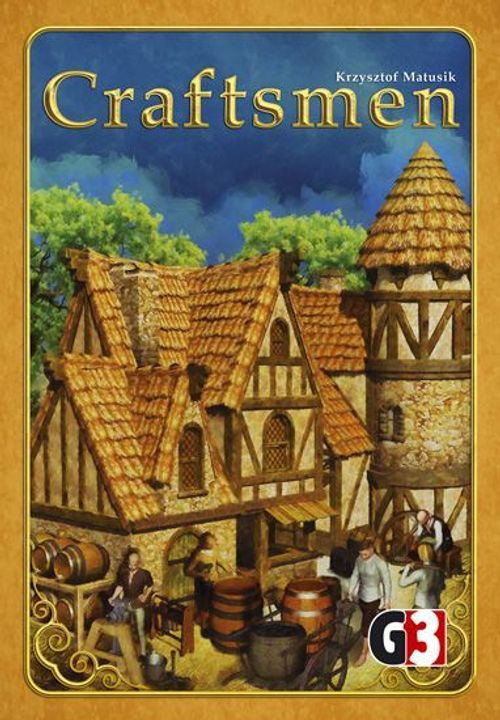
Craftsmen
Craftsmen Rulebook
Table of Contents
Table of Contents
The Aim of the Game
The aim of the game is to gain most appreciation points. One can gain appreciation points by building production buildings, creating connections between them, producing raw materials and consumption goods. Extra points can be bought or gained. You gain points by sending the produced goods to the furthest parts of the world. Each player will choose his/her own way of winning the game.
Contents
- game board
- rules
- 48 money cards
- 6 lumber mill cards
- 24 basic building cards
- 24 expanded building cards
- 16 advanced building cards
- 10 privilege tokens
- 10 work tokens
- 8 bonus items
- round marker
- turn marker
- 14 natural wooden markers
- 5 sets of wooden markers in different colours (8 wooden discs, 20 wooden cubes, each)
Preparing the Game
- Place the game board in the centre of the table so that everybody can reach it.
- Each player receives 8 wooden discs and 20 cubes in a chosen colour. 5 wooden discs represent 5 helpers. The sixth disc is used to mark players order in the round. The remaining 2 discs are used to count the appreciation points. The first of those discs is placed on the appropriate space of the track 0 – 50, the second – on the space '0' showing each subsequent 50 points. Wooden cubes are used to mark raw materials, half-products and final products.
- Place the turn marker (year marker) on the first year on the year track. Place the round marker on the first season (Spring), on the season track.
- Shuffle and give each player 5 money cards (players do not show their cards). Place the face down stack of those cards next to the board. Take 2 cards from that stack and place them face up on their designated places.
- Shuffle the basic building cards and give each player two of them. Place the stack of those cards face down next to the board. Take 2 more cards from the top of that stack and place them on their designated places.
- Take 8 cards with the house symbol (bottom left corner of the card) from the expanded building stack. Shuffle the remaining expanded building cards and place them face down next to the board. Shuffle the 8 cards and give one of them to each player. Place the remaining cards face down on the expanded buildings pile. Take 2 more cards from the top of this pile and place them on their designated places.
- Take 8 cards with the house symbol (bottom left corner of the card) from the advanced building pile. Shuffle the remaining advanced building cards and place them face down next to the game board. Shuffle and place the 8 advanced buildings cards with the house symbol on the advanced buildings pile. Take 2 more cards from the top of this pile and place them on their designated places.
- Shuffle the 6 lumber mill cards and give each player one of them. Put the remaining lumber mill cards into the box. Each player places his/her lumber mill card in front of him/her (face up).
- Before the game begins, each player can replace one of the building cards. The player can replace his/her lumber mill card with a lumber mill card of a different colour or other building card (basic, expanded). The card which the player does not want is placed on the bottom of the appropriate pile (into the box in case of a lumber mill card). The new card is taken from the same pile (basic, expanded, lumber mill – box).
The Course of the Game for 3-5 Players
The game lasts 12 rounds. It is divided into 3 turns (years). Each turn is divided into 4 rounds (seasons). The markers on the year and season tracks indicate which year and season is being played. After each season, the season marker is moved to the next space. If the winter is over, the season marker is moved to the first space of the season track. The year marker is moved right by one space (next year). If the year marker is on the last space and the winter ends, the game ends.
On each of the spaces on the season track there are icons indicating which guilds will be available during each guild phase.
Each round is divided into phases. In each turn, the first three rounds (Spring, Summer and Autumn) are divided into 3 phases. The last round (Winter) is divided into 2 phases.
Determining the Order of Play
The value of players' money cards determines the order of play in the first round. The value of cards is indicated by the numbers on those cards (each card counts only its printed value, no sets of colours possible – see 'Money cards'). The player with the cards of the lowest value places one of his/her round disc on the first space of the player order track. The next player with the cards of the lowest value places his/her disc on the second space of the player order track. The remaining players place their markers in the same way. If the players have cards of the same value, the first to put his/her marker is the younger player. After the order of play is determined, each player places one of his/her discs on the appreciation track. The player who begins the game places his/her disc on '0', the second and third players on '1', and the fourth and fifth on '2'.
Detailed Description of the Round (Spring, Summer, Autumn)
1. Helpers Phase
The actions in this phase are performed accordingly to the order on the player order track. When the last player performs his/her action, the turn returns to the first player. Then, the following players perform their actions. This phase lasts until all players pass (they cannot send any more helpers), or send all their helpers.
The players send their helpers to guilds. There are 6 guilds in the town. Each guild allows the players to perform different actions. The player can perform actions in the guild, provided that he/she has got at least one helper in that guild. The helpers are sent to the guilds at the beginning of each round and they stay in those guilds until the end of that round. During this phase, the players can perform one of the two available actions.
Sending a helper to a guild
To perform this action, a player has to have at least one helper disc in front of him/her. The player decides to which guild the helper will go. Then, the player places the disc on the first available space on the track in that guild. The track in each guild comprises of three spaces.
- The space with a golden border gives the player an extra privilege.
- The space with a silver border and green ribbon, releases the player who places the second disc from an obligation to pay for it.
- The space with a silver border does not give any extra profits.
If all the spaces of the track are occupied, the player can place his/her disc on other player's disc (or on his own). If the disc belongs to other player, he/she has to pay that player. The payment depends on the turn: in the first year – 1 money card or 1 appreciation point, in the second year – 1 money card or 2 appreciation points, in the third year – 1 money card or 3 appreciation points. The player chooses whether he/she wants to pay by money cards or by appreciation points. The player must have money card(s), or appreciation points.
NOTE: A player cannot send more than two helpers to each guild.
The number of all helpers that can be in each guild at the same time depends on the number of players. In a 3 player game there may be 4 helpers in each guild, in a 4 player game – 5 helpers, in a 5 player game – 6 helpers.
Resign from sending a helper
The player can resign from sending a helper to a guild. If, at the end of this phase, the player has got at least 1 helper in front of him/her. The player receives 1 appreciation point (regardless of how many discs he/she has not used).
2. Guilds Phase
This phase is divided into stages. Each stage corresponds to a different guild. During the first three rounds (Spring, Summer, Autumn), of each turn, this phase is divided into 6 stages. In each fourth round (Winter), the phase is divided into 2 stages.
In each stage, the players can perform one action per helper in a guild. The order in which the players will perform actions results from the sequence on the order track in the guild. The order tracks are viewed from the left to the right. If there are 2 discs on one space, the actions are performed according to the order in which those discs were placed. That is, first is the disc on the bottom, then, the disc on top. If the disc is on a space with a golden border, the players can use the privilege in that guild (apart from performing a standard action).
Stage I: Bankers' guild
Available action: Raising money.
The player takes 4 money cards. He/she decides to take 1 or 2 of the revealed cards. The remaining cards are drawn from the pile and taken on hand. Now, the player has to decide which two of all money cards on hand will be discarded. Then, if any of the slots for money cards is empty, it is supplemented with a money card.
Privilege: The player discards only 1 money card.
Money cards are the means of payment in the game. The number on each money card indicates its value (1, 2, 3). There are also 4 colours of the cards (purple, green, blue, red). The value of cards can be raised by setting them in a proper way. If a player has got 2 (or more), money cards of the same colour, the value of those cards increases. Two cards of the same colour are worth 5, 3 cards – 10, 4 cards – 15 etc. The player does not have to use this feature. If the player is paying more than needed, he/she does not receive any change.
NOTE: A player can never have more than 10 money cards on hand (8 at the end of the round). In a situation when a player has got more money cards than the limit, the extra cards are discarded.
Stage II: Builders' guild
Available action: Raising two buildings.
The player can raise up to two buildings. The cost of raising those buildings is merged. To raise a building, the player plays building cards from his/her hand (according to the building rule). Then, the money cards of the appropriate value are discarded. The price of raising basic building is 2, expanded building – 3, advanced building – 6.
NOTE: The colour of cards does not have to be compatible with the colour of the raised building.
Building rule: Each player begins the game with a lumber mill. Each building card (lumber mill card included) is divided into differently coloured parts: upper and lower. The players can raise new buildings by placing them on the left or right from the previously raised buildings. The colour (upper or lower) of the new building has to match the colour of the building next to it.
Privilege: You may raise one building skipping the building rule.
Types of buildings:
- Basic buildings – Those buildings produce raw materials necessary for further production. The raw materials can be exchanged on a market. There are 7 types of raw materials in the game: wood, iron ore, flax, wheat, cow, wax, grapes.
- Expanded buildings – Those buildings make half-products out of the raw materials. There are 8 types of half-products in the game: barrel, rope, leather, paper, iron, cloth, meat, flour.
NOTE: Meat is a special type of half-product. It is not further converted. Having produced it, the players may immediately place it on a ship.
- Advanced buildings – Those buildings make final products from raw materials and half-products. There are 8 types of final products in the game: weapons, tools, clothes, books, candles, wine, beer and bread.
During this stage, the players can get bonus tokens which can be exchanged for appreciation points at the end of the game. There are 8 bonus tokens in the game. Each of the bonus tokens represents different final product. A player receives this token if he/she is the first who builds a complete production line of a particular final product (see the Bonus Tokens section).
Stage III: Notary
Available actions (the player chooses one of them):
- The player chooses one of the revealed building cards on the board. He/she takes this card on hand and pays for it (the value is indicated on the board). Then, the spaces on the board are supplemented from the appropriate pile. The cost of a basic building is 3, expanded – 5, advanced – 10. When the player buys a building, he/she has to pay with the money cards in the colour of that building. For example, a player can pay for the green vineyard with only green money cards, for the red and blue mill, with red and/or blue money cards. The money cards which were used to buy a building are discarded.
- The player can bid for a building card which is on the board. He/she indicates it, offers the price (no less than 1). Each following player (starting from the player on the left from the bidding player) declares his/her price for that card or gives up bidding. When a player gives up bidding, he/she cannot take part in that bidding later (the bidding goes to the next player). The player who won the auction pays (discards the money cards), and takes the building card on hand. The player who has won the bidding does not have to pay with cards of the same colour as the building card. During bidding, the players cannot declare to pay more than the value of their money cards. If neither of the players raised the initial bid (the bid of the first player), the mayor bids. In such situation, draw 1 money card for a basic building, 2 money cards for expanded building, and 3 money cards for advanced building. The value of those cards indicates the mayor's bid. The player may offer a higher value, or give up bidding. In the first case, he/she takes the card and pays the declared sum. In the second case, the building is put on the bottom of the buildings pile. In both of these cases, the mayor's money cards are discarded.
Privilege: The player may look up 5 building cards before or after performing an action. He/she takes 3 cards from a chosen building pile and 2 revealed cards of the same type. From this set of cards, the player chooses 2 cards and places them face up on the board, the remaining 3 cards are placed on top of their designated discard pile (in any order).
Stage IV: Craftsmen's guild
At the beginning of that stage, all players who have sent their helpers to that guild may place one of their cube markers on the upper left corner on each their basic building cards (on the table).
Available action: Using the work points.
Each building card shows the raw materials or half-products necessary for starting production, the picture of the building, the product made in the building, and the appreciation points gained after the good is produced.
The player receives work points. Thanks to those points, raw materials, half-products, and final products can be produced. The number of work points depends on the turn. In the first turn, the players have 3, in the second – 4, and in the third 5 work points for each helper in this guild.
NOTE: You cannot store work points. Unused work points are lost.
Each received work point can be used in 4 ways:
- producing raw materials
- producing a half-product
- producing final products
- trading on the market
Producing raw materials
Move the cube marker from the top icon to the bottom, each such move costs one work point. The free space on the upper part of the card is immediately supplemented with the next marker. Production of raw materials is limited by the number of work points.
The produced raw materials have to be sent to one of the available places:
- The player can send those raw materials to the market. The marker is moved from the bottom icon of the card to the appropriate space on the market. The markers placed in the market can be used later in the game.
- The player can send raw materials to expanded or advanced buildings. The marker has to be moved from the bottom icon to the same icon on top of different building.
Trading on the market
The players can place the marker of the produced raw material in the market. The raw material can be bought for 1 work point and placed on any raw material icon on one of the buildings. A player cannot have more than 3 of his/her markers in the market.
Producing a half-product
Raw materials produced in basic buildings are necessary. There has to be a marker of raw material (produced in basic building or bought in a market), on the top icon of the expanded building card. To make a half-product the player has to use one work point by moving the marker from the upper part of the card to the bottom.
The player has to send the produced half-product to one of the two available places:
- To an advanced building – Move the marker from the bottom part of the expanded building card to the icon on top of the advanced building card.
- To the storehouse – Move the marker from the bottom icon to the appropriate space of the storehouse. The storehouse is always supplemented from top. There may be only two markers of one half-product in the storehouse at the same time. If both of the spaces are occupied, the player removes the bottom marker, and moves the upper marker on that space. Then, the player places his/her marker on the free space. The player receives one of the revealed money cards, or the first card from the money card stack. If the player takes a revealed card, the place is supplemented with a card from the top of the money cards stack.
Producing final products
All the icons on the top part of the advanced building card must have markers of half-products or/and raw materials produced in basic/expanded buildings or bought in the market/trader's guild. To produce (to spend a work point), a player has to move all the markers from the upper part of the card to the bottom. Only one marker remains on the bottom of the card.
The final product (or meat) has to be placed in one of the 4 ships. The ships' storages are filled from the right side. The product marker should be moved from the lower icon of the card to the storage of the chosen ship. At the same time, there may be only two markers of a particular product in a ship's storage. If both of the spaces in a storage are occupied, the player can bribe the ship's captain. The captain removes the products of other players (they return to those players) making space for a new product. To bribe a captain, a player has to discard 1 money card. Then, he/she has to remove the marker from the left (the marker on the right is moved left) and place his/her marker on the free space. A player can never remove his/her markers. A player has to have at least one money card to bribe a captain.
If the player cannot place a final product in a ship's storage, this marker is not used. The player does not receive any points for producing it.
Then, the players receive appreciation points for making half-products and/or final products. The number of appreciation points which the players receive for producing a final product is shown in the right bottom corner of the card.
Privilege: A player can produce two raw materials using one work point. One helper cannot use more than one privilege.
Stage V: Traders' guild
Available action: buying a half-product.
The player can buy any half-product from the storehouse. To buy a half-product a player pays by one money card and takes a marker from the storehouse. Then, he/she places it on one of his/her production buildings on the icon of the bought product. If the player took natural wood marker, the money card is discarded. If the player took other player's marker, he/she gives that player one money card. If both of the spaces are occupied, the player has to buy the marker which is at the bottom. Then, the remaining marker is moved to the bottom.
NOTE: The natural wood markers, when bought, are replaced with your markers and placed next to the board.
Privilege: Instead of paying by money card, the player can remove one of his/her markers from the market. When the player uses the privilege and buys other player's marker, instead of paying by money card, the other player can place one of his/her markers on the market.
Stage VI: Town hall
Available actions (the player chooses one of them):
- privilege
- work point
- changing the order
Privilege
The player may receive a privilege from the mayor. He/she takes one privilege token from the bank. If there are no such tokens, this action cannot be performed.
NOTE: The player can never have more than 3 privilege tokens at the same time.
The privilege tokens can be used during phases I through V. It allows the helper to use the privilege in a building. A player can use the privilege token, in a building with his/her helper. Each helper can use only one privilege during a round. The used privilege token is placed back to the bank.
Work point
The player can receive an extra work point. He/she takes one work point token and places it in front of himself/herself. If there are no such tokens on the board, the player cannot perform this action.
NOTE: A player can never have more than 3 work points at the same time.
The work point tokens can be used in the stages I through VI (in the guilds phase). To use a work point token, the player places it in bank next to the board. Then, the player receives one work point which has to be immediately used. This point can be used to: produce a raw material, trade, produce a half-product, produce a final product. Those actions are performed in the same way as the actions in Craftsmen's guild (see Stage IV).
NOTE: Using a work point counts as an extra action. An action in a guild is still performed.
Changing the order
The player can influence the order of players in the following round. He/she moves his/her helper marker from the player order track in the town hall to the first free space (from the left) of the changing order track (below).
After the VI stage, the players take their helpers from the board. The helpers which used the privilege are not taken from the board, instead, they are moved upwards (on the pictures of guilds).
3. The Final Phase
At the beginning of this phase, the players check how many helpers there are on the board. The player with the fewest helpers (if any), receives a privilege token from the bank. If more than one player has got the same (low) number of helpers, all of them receive privilege tokens. If there are no privilege tokens in the bank, the players do not receive them. If the number of tokens is smaller than the number of players, the players who are right on the player order track receive them first. After the privilege token(s) have been distributed, the helpers returned to the players.
Then, if there are any discs on the changing order track, the sequence in player order track is changed. In this way, the order of play in the next round is changed. The three discs on the changing order track show the order in the following round. The remaining discs are moved behind those discs.
Detailed Description of Round (Winter)
This round is shorter than other rounds. During this round, the helpers phase is skipped. The guilds phase consists of stage II (Builders' guild), and stage IV (Craftsmen' guild).
Stage II: Builders' guild
Each player, according to the sequence on player order track, can raise two buildings (like he/she had a helper in that guild).
Stage IV: Craftsmen's guild
Each player, according to the sequence on the player order track, can produce: raw materials, half-products, final products (like he/she had a helper in Craftsmen' guild). He/she can use work points.
NOTE: During those stages, the players may use privilege tokens.
Year Change
After winter, appreciation points are added. Appreciation points are added in 4 steps.
1. The ships leave from the harbour
The players who have their markers in the ships' storages receive appreciation points. The points are granted for each ship separately (starting from the left). The players count how many markers they have in each ship. The players with most markers receive extra appreciation points. If the players have equal number of their markers on a ship, the player whose marker is higher and on the left is the first. On the first ship, only one player receives extra points, on the second – two players receive extra points, on the third – three, on the fourth – four. Then, the players take their markers from the ships and add appreciation points. The number of appreciation points which the players receive for each product can be found next to the storage icon.
2. The mayor evaluates the city's growth
The players receive appreciation points for the raised buildings. Each building has 2 background colours (the top and the bottom). For each set of 4 different colours the player receives 3 appreciation points.
3. The mayor looks up the stock in the storehouse
The players receive extra appreciation points for their half-products in the storehouse. Each marker represents one appreciation point. After the points are added, the markers are removed from the storehouse.
4. The players invest in developing the city
The players can buy appreciation points using money cards. To do this, a player has to discard 4 cards – each in different colour. The player receives appreciation points equal to the total value of those cards.
After the points are added, the markers are removed from the ships. Then, if there are free spaces in the granary, the spaces are supplemented with natural markers.
At the end of the fourth round (winter), the round marker is placed on the first season (spring). The year marker is moved right by one space. If the third year ends, the game ends. The players add the points from the bonus tokens.
The winner is the player with the most appreciation points. If there is a draw, the winner is the player with most money cards in hand. If there is still a draw, the winner is the player with the lower position on player order track.
The Course of the Game for 2 Players
The 2 player game is similar to 3-5 players game with few changes.
1. Helpers phase
Sending a helper to the guild
The order track in each guild is shorter. Placing a helper on the third spaces on a player order track in each guild is forbidden. Each player can have at most 2 helpers in each guild.
If a player places his/her helper on other player's helper, he/she does not pay for that action. The player with the helper on the bottom takes the top card from the face down money pile.
2. Guilds phase
Stage IV: Town hall
You can perform two actions in the town hall:
- privilege,
- work point.
3. The final phase
If the players have an equal number of helpers in the guilds, neither of them receives privilege token. In other words: if both of the players used the same number of privileges in guilds, neither of them receives the extra token.
Moreover, the players change the order of their discs on the player order track. Thanks to this, each of them will be 6 times the first player.
Game Icons
The building cards use pictograms for raw materials, half-products, and final products: wood, iron ore, flax, cow, wheat, grapes, wax/honey, paper, leather, meat, barrel, rope, flour, iron, cloth, beer, candles, clothes, bread, wine, books, weapon, tools.
Production Chains
The rulebook's final page shows a diagram of the game's production chains: which raw materials feed which half-products in the expanded buildings, and which raw materials and half-products combine into the final products made in the advanced buildings.
Publisher
Publisher: © ST Games Spółka z o.o., 62-510 Konin, ul. Spółdzielców 3, Poland.
Distributor: G3 Spółka z ograniczoną odpowiedzialnością Sp. k., 62-510 Konin, ul. Spółdzielców 3, Poland, www.g3poland.com
Produced in Germany. 1st edition year 2013. Version 1.0