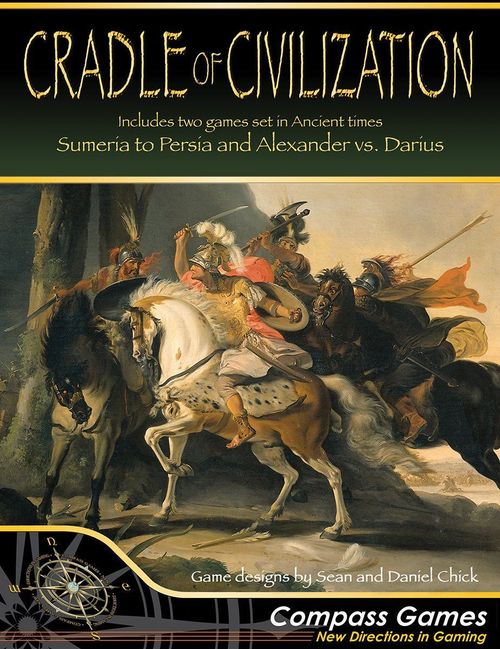
Cradle of Civilization
Cradle of Civilization Rulebook
Table of Contents
Table of Contents
- 1.0 Object
- 2.0 Setting up the Game
- 3.0 New Civilization Allocation Phase
- 4.0 Strategy Phase
- 5.0 The Civilization Round
- 6.0 Special Rules for Civilizations
- 7.0 Player Scoring
- 8.0 End of Epoch Events
- 9.0 Optional: Non-Player Civilizations
- Designer Notes
- Sequence of Play (Player Aid)
- Sumeria to Persia - Civilizations
1.0 Object
Sumeria to Persia is a game for 4 to 6 players, played in six Epochs (or Turns). In each Epoch (Early Bronze Age, Middle Bronze Age, Late Bronze Age, Dark Age, Iron Age, and Rise of the Achaemenid Empire), players control a civilization, which expands across the map but is usually overtaken by future civilizations. The object of the game is to conquer territory and gain Victory Points (VPs). The Player with the most VPs at the end of the game wins.
Box Contents
- 1 Game Board
- 2 Rule Books
- 9 Counter Sheets
- 4 Double-sided Player Aids
- 10 Dice
- 36 Civilization Cards
- 6 Epoch City Cards
- 6 Epoch Civilization Summary Cards
1.1 Game Board
The board shows the Ancient Near East, from Greece to Persia, and from the Caucasus to Arabia. Names for regions and areas are drawn from a variety of historical civilizations.
The map is divided into nine land Regions each having a uniquely colored border. Each Region is divided into a number of land Areas. There is an assortment of blue bordered sea Areas that do not belong to any Region.
1.2 Civilization Cards
There are six Epochs each comprised of six Civilization Cards. Each card represents a Civilization from ancient history. Players receive one Civilization Card every Epoch (turn).
Sample Civilization Card:
- The title band contains the Civilization name, its Epoch, and its turn order. For example, the '1' designates Epoch I the Early Bronze Age and the '3' designates that it is the third Civilization of the Epoch.
- The map section shows where on the game board the Starting Area is located.
- The Starting Area indicates the Area where the first Army belonging to this Civilization must be placed (in the sample, Zoan).
- The square contains the Army information for the Civilization (in the sample, 5 Epoch I Armies).
- Icons may appear on the card indicating special rules apply to the Civilization. One icon indicates that this Civilization has expertise in building a Wonder.
- Historical text about the Civilization appears on the card.
1.3 Armies
Each counter is an Army belonging to a Civilization. Every Epoch has a representative soldier icon which appears both on the Civilization Card and on the Army counters used by the Civilization. The left background stripe indicates the Army's Epoch. The color of the right background stripe on an Army counter denotes the player that controls that Army.
Each player has six Epoch Army counters (one set per Epoch).
Example: If the blue player is Middle Assyria in Epoch III the Late Bronze Age, the player uses 5 blue Army counters marked with a 'III' and having the Epoch III soldier icon to grow the Middle Assyrians on the game board. If the blue player has the Medes Civilization in Epoch VI the Achaemenid Empire and the Middle Assyrian Civilization is fortunate enough to still exist on the game board, the blue player first continues to use the blue 'III' counters to grow the Middle Assyrians followed by using 12 blue 'VI' counters with the Epoch VI soldier icon to grow the Medes.
1.4 Epoch City Cards
There is one Epoch City Card for each Epoch. The back of the card indicates the Epoch the card belongs to. The front of the card lists each City that enters the game during the Epoch.
The Region where a City appears is highlighted by the Region's border color. The City name appears under its Region and the Area the City is located in appears in parenthesis next to the City name.
1.5 Epoch Civilization Summary Cards
There is one Epoch Civilization Summary Card for each Epoch. The back of the card indicates the Epoch the card belongs to. The front of the card lists the Epoch's Civilizations in arrival order along with important information for each Civilization.
Players can use the information on the card to help form their strategy when choosing a Civilization Card or when expanding their Civilization.
2.0 Setting up the Game
Each player chooses a color and takes all Army counters with that color placing them off-board near the player. Players will build their Army Pools from this supply.
Place the Victory Point markers on the zero spaces on the game board's Game Track.
Place the Turn marker on the Epoch I space of the game board's Sumeria to Persia Game Turn Track. The Alexander vs. Darius Turn Track is not used in this game.
Separate the Civilization Cards into six decks by Epochs: Early Bronze Age, Middle Bronze Age, Late Bronze Age, Dark Age, Iron Age, and Achaemenid Empire.
Shuffle each deck and place face-down next to the game board.
Organize the Epoch City Cards in ascending order by Epoch and place face-down next to the Civilization Cards.
Organize the Epoch Civilization Summary Cards in ascending order by Epoch and place them face-down next to the Epoch City Cards.
Take the Epoch I City Card from the deck and use it to place City markers onto the game board in the appropriate Areas. Remove the card from the game. Place City markers arriving in future Epochs aside until needed.
Each player draws one Civilization Card from the Epoch I deck. This is the Civilization the player will use in Epoch I. If there are less than six players, remove the remainder of the cards in the Epoch I deck from the game.
The player with the earliest arriving Civilization takes the Epoch I Civilization Summary Card from the deck and uses it to assist with forming their strategy if desired.
2.1 Outline of the Game
The game is played in six Epochs (or Turns). Each Epoch is divided into three phases:
- New Civilization Allocation Phase
- Strategy Phase
- Player Civilization Rounds
- Player Scoring
- End of Epoch Phase
3.0 New Civilization Allocation Phase
Skip this segment on turn 1.
Take the current turn Epoch City Card from the deck and use it to place City markers onto the game board in the appropriate areas. Remove the card from the game.
Each player receives one Civilization Card from the current Epoch. The player will control the Civilization throughout the game as long as the Civilization maintains at least one of its Armies on the game board.
Civilization Cards are drawn by players in reverse order of VPs, starting with the player with fewest VPs. If there is a tie, resolve it in favor of the player who had the fewest Armies last turn. If there is still a tie then both players roll a die with the highest total winning.
A player drawing a Civilization Card looks at it and keeps it concealed from other players. The drawing player decides whether to retain the card, and control the Civilization, or pass it to another player who has not received a card this turn. If the drawing player already received a Civilization card this turn, the player must pass the drawn card to another player.
A player receiving a passed card must keep the card and control that Civilization. A passed Civilization Card may not be examined by its owner until all the cards have been distributed for the turn.
The draw continues until every player has drawn a card. After all cards have been allocated, place them face up for all to see.
The Epoch's Civilization Summary Card can be passed between players to assist in their decision making. A player aid is provided with information for all the Civilizations in the game listed in arrival order to likewise assist players.
4.0 Strategy Phase
Player order in the Strategy Phase is determined by the Civilizations that enter the game during the current turn (Epoch). Any Civilization Cards controlled by a player that are from previous turns (Previous Epoch Civilizations) have no bearing on the order in which players take their turns in the Strategy Phase.
Example: In Epoch 2, the player with the 2-1 Minoans will go first even if they also control the 1-6 Amorites which moved last in Epoch 1.
Once player order is established, each player in turn conducts Civilization Rounds for each of their Civilization Cards. This is done in ascending order by Civilization. After turn 1 (where players only have one Civilization Card) each player will first conduct a Civilization Round for every Previous Epoch Civilization they control followed by the current Epoch Civilization they control.
Example: In Epoch 4 of a six player game, the player going fifth controls the cards shown below. A Civilization Round is conducted for each card in the following order:
- 1-3 Old Kingdom of Egypt
- 2-6 Kassites
- 3-3 Mitani
- 4-5 Arameans (this card is why the player was fifth this Epoch)
5.0 The Civilization Round
In each Civilization Round, a Civilization attempts to expand (or grow) its control by placing Armies into Areas on the game board. After a player completes all their Civilization Rounds the player receives Victory Points based on the Areas and Regions the player controls.
5.1 Create Army Pool
Armies belonging to the Civilization are used to form a Pool. As the Civilization expands, Armies are taken from the pool and placed on the game board. You may place your armies on their Civilization Card when forming the Army Pool if desired.
For Previous Epoch Civilizations: Flip inactive Armies belonging to the Previous Epoch Civilization on the game board to their Active side.
Count the number of Areas occupied by the Previous Epoch Civilization.
- If they have no Armies on the game board remove the Civilization card from the game. The Civilization has vanished into the mists of time.
- If the Civilization has 1-2 areas they experience no growth and cannot expand further.
- For every 3 Areas they occupy rounded down, add 1 Army to the Army Pool. You are limited to the counter mix provided for the Civilization's Epoch.
Example: Blue player has Armies in 7 Areas; round down to 6; 6/3=2; add 2 Armies to the pool.
For Current Epoch Civilizations: Form the Army Pool by taking the number of Armies shown on the Civilization Card.
5.2 Civilization Bonus
Before a Player places a Civilization on the board for the first time, they roll to determine a Bonus for the Civilization. Roll 2 dice and consult the Civilization Bonus Chart. The Bonus remains in effect only for the duration of the Civilization Round.
Only Civilizations belonging to the current Epoch receive a Civilization Bonus. Civilizations from prior Epochs do not.
Concerning Areas
Areas may contain multiple friendly Armies up to their stacking limit (see Terrain Chart).
An Area occupied by a Civilization is said to be friendly to that Civilization.
Empty areas are neutral.
Armies of different Civilizations cannot occupy the same Area at the end of any Civilization round.
Areas occupied by other Civilizations are hostile.
Important: Previous Epoch Civilizations controlled by the player are hostile to each other and also hostile to the player's current Epoch Civilization.
Illustration: Thrace is considered adjacent to Wilusha and Chalybes.
5.3 Starting a New Civilization
When the first Army of a current Epoch Civilization enters the game board it is placed in the Start Area shown on its Civilization Card. If there is an Army of another Civilization already there it must move to an adjacent Area that is vacant or friendly (subject to stacking limits). If it cannot do so, the Army is removed from the game board.
Example: Kush places its first Army at Nubia. If it is already occupied by an enemy Army, the enemy Army must move to a vacant or friendly area else be eliminated.
5.4 Placing Armies - Growth
You take Armies from your Army Pool, placing them one at a time. You can place an Army in an Area already occupied by the same Civilization (subject to stacking) or in an Area adjacent to one occupied by the Civilization (including a hostile Area). This continues until the Army Pool is empty.
Example: In Epoch 1, the Sumerians could place an Army in Uruk, Ur, Sumer, and so on until there are no Armies left in their Pool.
If you place an Army into a hostile Area (one occupied by another Civilization), you immediately conduct combat. This happens even if you control both Civilizations.
5.5 Combat
Combat occurs when an Army is placed in a hostile Area. The Attacker rolls two dice and keeps the higher number. The Defender rolls one die regardless of how many Armies they have in the Area. The player with the lower result removes an Army. When tied, both players lose an Army. Combat continues until the Area becomes friendly or the Attacker loses their Army.
If the Attacker loses and still wishes to continue the battle, another Army must be placed into the Area from the Army Pool.
Terrain may affect combat. See Combat Modifiers on the Terrain Chart.
5.6 Non-Combat Expansion
A Civilization belonging to the current Epoch may remove an Army from the Army Pool and elect to not place it into an Area but instead use it to possibly gain victory points by using the Army for Colonization, Creating a Wonder, or for Cultural Achievement. An Army used in this way is placed back with the player's off-board Army counters.
Colonization: If the Civilization has both Seafaring and has control of an area on the Aegean Sea, Ionian Sea, Egyptian Sea, or Phoenician Sea, the Civilization may remove an Army from the Army Pool in an attempt to Colonize land which is off-board in the Western Mediterranean. Colonization is successful on a roll of 4-6 and the player immediately gains 3 VP.
Building a Wonder: Once per Epoch, a Civilization may remove an Army from the Army Pool in an attempt to build a Wonder. There are only 7 Wonders in the game. There are never any more than that and any that are destroyed cannot be rebuilt. Designate a friendly Area with a City. On a roll of 4-6 a Wonder marker is placed in that Area and the player immediately gains 2 VP. A player may not attempt this if all the Wonders have been built.
Cultural Achievement: Once per Epoch, a Civilization may remove an Army from the pool and roll a die in an attempt to make a major contribution to art, science, or government. On a 5-6 they are successful and immediately gain 4 VP.
Terrain Chart
Certain Areas have terrain that affects stacking and combat. The number of Armies a Civilization may have in an Area and any combat modifiers the Area has is determined by the Area's terrain.
| Terrain | Stacking | Combat Modifiers |
|---|---|---|
| Plains | 3 Armies | None |
| Rough | 2 Armies | Defender wins ties. |
| Mountain | 1 Army | Defender rolls 2 dice. |
| Desert | 1 Army | * Special |
* Attacker eliminated if they roll 1-3. They can still win the combat. If desert is unoccupied, the army entering the space is removed on a roll of 1-2.
Wonders of the Ancient World
The seven Wonder markers: Statue of Zeus, Great Pyramid, Tomb of Mausolis, Temple of Artemis, Hanging Gardens, Colossus of Rhodes, Lighthouse of Alexandria.
These are the markers for the Seven Wonders of the World. When attempting to build a Wonder, any unused marker may be chosen. If a Wonder is destroyed it may not be rebuilt. A Wonder is destroyed if a Disaster occurs during a Civilization's End of Epoch event. A Civilization immediately receives 2 VP when it builds a Wonder. During end of round scoring, the player controlling the Area where a Wonder is receives 2 VP.
5.7 End of Civilization Round
The Civilization Round ends when there are no Armies remaining in the Army Pool. Flip the Civilization's Armies to their Inactive side. The player starts a new Civilization Round with the next chronological Civilization Card the player controls. If the player controls no more Civilization Cards, the player scores his Area and Regional Victory Points (see 7.0 Player Scoring). The next player then conducts Civilization Rounds and Player Scoring, and so on.
6.0 Special Rules for Civilizations
6.1 Civilization Traits
Some Civilizations have special rules that reflect some of its various traits which are indicated by icons that appear on the Civilization Card. Previous Epoch Civilizations lose all Traits except Seafaring.
- No City Bonus: This Civilization never scores for having a city location. On a roll of 4-6 any city they occupy is destroyed.
- Does Not Expand in Epoch VI: This Civilization never expands beyond its initial borders.
- Wonder: The Civilization may attempt to build a Wonder any number of times until it is successful.
- Commerce: Player receives 1 victory point for every 2 cities they control in addition to scoring 1 victory point per city.
- Military: A Civilization which defends against a Civilization with the Military trait receives no combat modifiers when attacked.
- Seafaring: If a Civilization with this special ability occupies an Area adjacent to a sea, it can place an Army in any other land Area adjacent to that sea.
6.2 Bonus Areas
Some Civilizations have Bonus Areas. This is indicated if there is red text at the bottom of a Civilization Card. The Area listed scores bonus Victory Points if occupied by that Civilization (see 7.0 Counting Victory Points).
Example: the 1-2 Elam card shows "Bonus Area: Ur".
6.3 Exceptions
3-4 Troy / Arzawa
These are considered to be separate Civilizations in all respects. Keep their Army Pools separate. Remember when expanding that Armies from Troy and Arzawa are hostile to each other.
The player controlling Troy and Arzawa place an 'A' marker on or next to an Arzawa Army and a 'T' marker on or next to a Troy Army to differentiate between the two Civilizations.
6-2 Sargonid Assyria
The player controlling 6-2 Sargonid Assyria may not expand into any Area that has Epoch V Armies belonging to the player that controlled 5-4 Neo Assyria.
6-6 Persia
The Persian player, if they ever roll doubles during battles in 4 separate Areas, must then end their expansion. At that point Cyrus is considered to have died or turned north to fight the Scythians off map.
Note that the doubles are only counted once per attacked Area; for instance if Persia attacks Judea and doubles are rolled twice during the Judean attacks, it only counts once toward the four double total needed to end the Persian expansion.
7.0 Player Scoring
Victory Points (VPs) advance the player's VP marker on the Game Track. When scoring Area and Regional VPs, use all armies belonging to the player color on the game board to score regardless of the Epoch they belong to.
7.1 Non-Combat Expansion VPs
Victory Points (VPs) for non-combat expansion are scored immediately and only once.
- 2 VP when your Civilization builds a Wonder
- 3 VP when your Civilization is successful at colonization.
- 4 VP when your Civilization advances culture.
7.2 VPs for Area Control
This is scored after the player's last Civilization Round of the Strategy Phase.
Victory Points (VP) gained by the player is based on control of Areas. An Area and its contents is considered controlled if it is occupied by an Army belonging to the player.
- 1 VP for every 2 areas controlled rounded down
- 1 VP for Every City controlled
- 1 VP for Every Civilization Bonus Area controlled
- 2 VP for Every Wonder controlled
7.3 End of Round VPs Based on Region Status
This is scored after the player's last Civilization Round of the Strategy Phase.
Each Region grants victory points for presence, control, or domination. Presence is simply having an Army in 1 area in the Region. Control is having Armies in at least 2 Areas of the Region and having Armies in more areas of the Region than anyone else. Domination is having an Army in every Area of the Region.
Region Status Victory Points awarded for (P)resence, (C)ontrol and (D)omination:
| Region | P | C | D |
|---|---|---|---|
| Aegean Islands | 1 | 2 | 3 |
| Anatolia | 1 | 5 | 9 |
| Arabian Desert | - | - | 1 |
| Caucasus | 1 | 3 | 5 |
| Egypt | 1 | 2 | 4 |
| Greece | 1 | 4 | 7 |
| Iran | 1 |
Army counters have an Active side and an Inactive side.
8.0 End of Epoch Events
An Epoch ends when the player going last completes Player Scoring thus ending the Strategy Phase. At the end of every Epoch, except for the Rise of the Achaemenid Empire, each Civilization on the map rolls 1 die. On a result of 6 roll again and consult the End of Epoch Event Chart on the player aid. Start the next Epoch if any remain.
When placing Armies for Barbarian Raids and Civil War, use any Army belonging to the last place player (if tied, roll die to determine which player). Armies placed should be placed with the In-Active side showing. The Army should be oriented so that the counter is turned upside-down. Never flip or change the orientation of these counters.
Bronze Age Collapse
At the End of the Late Bronze Age (Epoch 3), after rolling for events for each Civilization, Plague occurs in every Area on the game board. Each Area on the board rolls 1 die. On a 4-6 Plague strikes. If there is a city where the plague roll is successful, 1 city is destroyed. If there is an Army or Armies where the plague roll is successful, remove 1 Army.
9.0 Optional: Non-Player Civilizations
If playing with 4-5 people, players can decide to have a non-player Civilization enter the game. In this case a color is chosen for a "dummy" player who will expand when their Civilization arrives, but it gains no Victory Points nor does it roll for a Civilization Bonus. Players take turns deciding where this "dummy player" will grow, with the player with the lowest VP going first placing the first Army in its starting location followed by the second Army. The player with the second fewest VP places the third Army, etc. With any ties, roll between players to decide who places an Army. Dummy players do not engage in Non-Combat Expansion and they do not stack, nor enter Desert Areas unless they have to. Non-Player Civilizations also do not grow after their Epoch.
Designer Notes
Cradle of Civilization was born out of a fascination with the Persian Empire and a design challenge. Can one make a History of the World style game on the Ancient Near East that includes Persia? Can one make a game where Alexander the Great's invasion of Persia could fail? Designers have generally avoided the former and made some unbalanced games in the case of the latter.
Sumeria to Persia is an update of sorts to the mechanics of History of the World, adding rules for wonders, colonization, and old civilizations still enjoying steady growth. The system, without modification, breaks down a bit with the Neo-Assyrian and Persian Empires. Both were massive. Indeed, Neo-Assyria enjoyed two periods of particularly robust growth, while Persia all but covered the map by the time the Persians were defeated at Marathon. The answer was to have both periods of Assyrian growth simulated, while Persia would cover only Cyrus the Great's conquests. The Persian army is large, but its growth is erratic, making the choice of Persia a calculated risk. Any player who is behind will want them, but that is no guarantee of victory.
Sequence of Play (Player Aid)
- The player with the lowest victory points draws a Civilization Card and may keep it or hand it to another player (on turn 1 Civilization Cards are drawn randomly by players). The player with the second lowest victory point total draws a card and repeats the above process until all players have a card.
- New Cities in Epoch II-VI are placed on the map.
- Strategy Phase
- a. Player order is based on the arrival of the Civilizations belonging to the CURRENT Epoch.
- b. Players perform Civilization Rounds for each Civilization they control starting with their oldest and proceeding to their newest.
- c. A Civilization belonging to the current Epoch receives a Civilization Bonus.
- d. The Army Pool is formed based on its Civ card or its controlled areas. A current Epoch Civilization automatically occupies their starting location.
- e. The player expands into adjacent areas. If they are occupied by an opposing Civilization (including one they control) then they fight a battle. They may also colonize if they meet the requirements, build a wonder, or advance art, science, or government.
- f. Victory points for control of Areas and Regions are scored after a player's last Civilization Round of the Strategy Phase.
- End of Epoch events are rolled for each Civilization. At the end of Epoch III also roll for Bronze Age Collapse.
Sumeria to Persia - Civilizations
Columns: Civilization, Starting Area, Armies, Bonus Area (if any). Spellings as printed.
| No. | Civilization | Starting Area | Armies | Bonus Area |
|---|---|---|---|---|
| 1-1 | Sumer | Sumer | 9 | |
| 1-2 | Elam | Elam | 5 | Ur |
| 1-3 | Old Kingdom of Egypt | Zoan | 5 | |
| 1-4 | Akkadian Empire | Malgium | 12 | |
| 1-5 | Guti | South Zagros | 7 | Ur |
* Expands from borders of 5th Epoch Neo Assyria and cannot attack Neo Assyria.