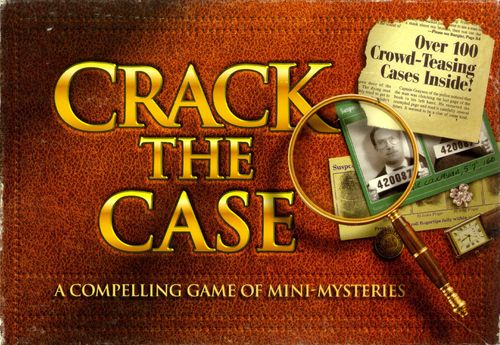
Crack the Case
Crack the Case Rulebook
Table of Contents
Table of Contents
Overview
For 2 or more Players.
Contents: 100 Case Cards, Card Box, Clipboard & Clip, Score Pad.
Object: Solve Mystery cases by asking "yes" or "no" questions.
The Seven Responses
To each question, you (the Moderator) will respond with any ONE of the seven answers listed below. Each answer is explained below, with examples from the Candy, Dish and Shell Game sample card. In cases where more than one response is appropriate, just use your best judgement.
The seven responses are: Yes, No, Yes and No, Irrelevant, I Don't Know, Define What You Mean By..., and Rephrase Your Question.
Yes Answer this way if the answer is clearly "yes."
No Answer this way if the answer is clearly "no."
Rephrase Your Question You may answer this way if an Investigator asks a double question or makes a false assumption. For example, it's the best response if an Investigator assumes the plate is a dinner plate and asks: "Did the dinner plate have food on it?"
Define What You Mean By... You may answer this way to clarify a question or to help the Investigators zero in on an important detail. For example, if the question is: "Was the plate bigger than a breadbox?" you could answer, "Define what you mean by breadbox." This is an old expression — not everyone knows the size of a breadbox!
(Yes and No, Irrelevant, and I Don't Know are also valid responses on this list — see The Seven Responses above — but their explanatory text was not legible in the available source photos.)
Playing Against the Clock
If you'd like, keep track of the time it takes to solve each mystery. Use a clock, a stopwatch, or a watch with a second hand. Here are the rules for playing against the clock:
When the Moderator opens the case for questioning, he or she "starts the clock" and keeps track of the time. (Investigators may ask for one additional reading of The Case and The Mystery before the clock starts.)
Playing for Points
Divide the players (evenly, if possible) into two teams. The teams take turns solving cases for points. After each team has played three cases, the game ends. The team who scores the most points wins.
Choose a team to go first. One player from the opposing team acts as the Moderator and the timekeeper. Play by the rules, keeping time as in Playing Against the Clock, above.
Scoring
As soon as a mystery is solved, the Moderator stops the clock. Write the solution time on the score sheet. Add penalty minutes for any clues that were given, then record the total time and the Point Value (4, 5 or 6 points) from the Solution Timetable. See Figure 2 for an example. Now it's the other team's turn!
Figure 2
| Case 1 | |
|---|---|
| Solution Time | 4:16 |
| Clue (Add Penalty Minutes) | 1:00 |
| Total Time | 5:16 |
| Point Value | 6 |
Team 1 solved Candy, Dish and Shell Game in 4:16 minutes. They asked for one clue, which added a 1-minute penalty. Their total time was 5:16 minutes, so they earned 6 points.
Who Wins?
Teams alternate turns until they have both played three cases. Add up the three Point Values for each team and record it in the Total Score box. The team with the highest total wins!
Although some real places may be featured in our game, the cases and characters are entirely fictional and do not represent any known individuals or circumstances.
The Case Cards
Each Case Card is lettered and titled (for example, "A Crime of Fashion"), and is printed in one of three colors that mark its difficulty: blue border for Easy, purple border for Medium, and green border for Difficult.
The front of the card shows:
- The Case — the scene the Investigators are presented with.
- The Mystery — the question the Investigators must answer.
The back of the card (kept by the Moderator only) shows:
- The Clues — one or more hints, to be revealed only if the Investigators are stumped. Each clue revealed adds penalty minutes to the team's solving time (noted next to the clue).
- The Solution Timetable — the point values (Master Detective, Private Eye, or Flatfoot) awarded depending on how long the case took to solve, including any clue penalties.
- The Story — the full, true account of what happened, for the Moderator's own reference.
- The Solution — a short summary of what the Investigators need to figure out to solve the case.
Sample Case: A Crime of Fashion
The Case Petite Missy Clark, a wedding consultant at a chic department store, is found dead and hanging from a hook.
The Mystery Who killed Missy, how, and why?
The Clues (Reveal only if Investigators are stumped)
- Blood is thicker than water. (Add 1 minute.)
- Every Thursday, after dinner, he signed his checks. (Add 2 minutes.)
Solution Timetable
| Rank | Time | Points |
|---|---|---|
| Master Detective | 1–14 Minutes | 6 Points |
| Private Eye | 15–21 Minutes | 5 Points |
| Flatfoot | 22–28 Minutes | 4 Points |
The Story Maggie Dunham, Astorbilt's private secretary, had a brother who was a real loser, both at gambling and at life. Maggie loved her brother dearly and willingly supported his habits, until he got in over his head and was being blackmailed for $50,000 in casino gambling debts. Maggie asked Astorbilt for a loan to cover her brother's losses, but he flatly turned her down. So Maggie devised a plan to get the money.
During their weekly after-dinner check-signing session at his penthouse, Maggie waited for Astorbilt to sign his last check — a weekly expense check made out to cash for $1,000. Just as he was finishing his signature, Maggie plunged her ballpoint pen into his carotid artery (a trick she learned in a women's self-defense class). She then altered the check to read $51,000.
At the bank the next morning, Maggie was arrested. Unbeknownst to her, Astorbilt had standing instructions to the bank to question any check on which he did not place his trademark star as the dot on the "i" in his last name. Fittingly, Maggie ended up spending time in the pen.
The Solution Investigators must discover that when Astorbilt refused to lend his private secretary money for her brother, she killed him. As he finished signing a check, she stabbed him in the neck with a pen, then changed the amount on the check. She was caught when the bank noticed the star was missing from his signature.
(This card is marked "Difficult" in the printed corner label.)