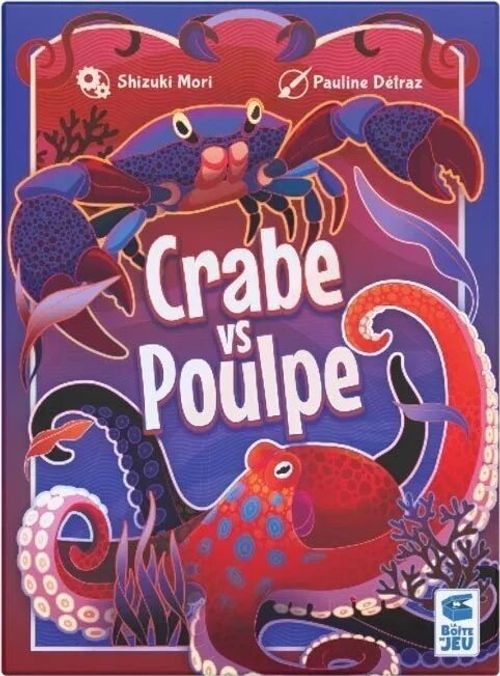
Crabe vs Poulpe
Crabe vs Poulpe Rulebook
Table of Contents
Table of Contents
Components
- 1 rules sheet
- 30 Crab cards (blue)
- 30 Octopus cards (red)
- 2 player aids
Setup
- Each player takes the deck for the animal of their choice, Octopus (red cards) or Crab (blue cards), and a player aid.
- Choose the game mode:
- Symmetrical (recommended for a first game): The players' decks are strictly identical. Return to the box the cards bearing the crab symbol and the octopus symbol. They will not be used.
- Asymmetrical: Crabs and Octopuses each have 3 effects specific to their species! Return to the box the cards bearing the crab symbol and the octopus symbol. They will not be used.
Translator's note: the printed Asymmetrical step names the same two symbols as the Symmetrical step, and the sheet does not say which species-specific cards each player keeps. It is transcribed as printed.
- Each player has 24 cards bearing their animal's image: 20 numbered cards from 1 to 10 (2 copies of each), and 4 unnumbered cards: α (the "Alpha" symbol) and Ω (the "Omega" symbol) (2 copies of each).
- Each player shuffles their cards to form a draw pile, then draws 5 cards to form their hand.
- The space in the centre of the table holds the pile of played cards. Reserve a space to the side for the common discard pile.
- The first player is the last one to have observed a reef, or the player who lost the previous game.
The game can begin!
Object of the Game
Be the first player to have no cards left, neither in hand nor in your draw pile.
Game Progress
A game is played over several rounds.
Round Progress
1. Playing cards in turn
Starting with the first player, the players take turns playing a card from their hand and applying its effect, if any. To play a card, its value must be strictly higher than the value of the last card played (visible in the centre of the table).
The value order is as follows:
α < 1 < 2 < 3 < 4 < 5 < 6 < 7 < 8 < 9 < 10 < Ω
Example: On a 6 you may play a 7, 8, 9, 10 or Ω, but you may not play an α, 1, 2, 3, 4, 5 or 6.
During the first turn of the round, you may play the card of your choice.
Played cards are placed face up on top of one another in the pile in the centre of the play area.
Tip: Before applying the effect of a card, ask your opponent whether they want to cancel it with a Resist (1) card.
2. End of the round
On their turn, if a player does not WANT to or cannot play any longer (because they have no cards left in hand, or because their cards do not meet the conditions for playing), the round ends.
The player who played the last card wins the round. All the cards played during the round are placed face down in the common discard pile. The discard pile may not be examined.
3. Refilling the hand
Each player refills their hand to 5 cards. If a player already has 5 or more cards in hand, they do not draw any new cards.
When you need to refill your hand, the colour of the cards does not matter.
Example: If you have three Octopus cards and one Crab card, you have four cards in hand. You draw only one card!
4. Start a new round
The first player is the player who won the last round!
End of the Game
The game ends as soon as a player plays, has a card taken from them, or discards the last card from their hand AND their draw pile is empty. That player wins the game.
Card Effects
The rule may be contradicted by card effects. A card's effect ALWAYS takes precedence over the basic rule.
Most cards have an effect:
- If the text says "you may", the effect is optional. The player may choose whether or not to apply it.
- If the text is in the imperative ("discard", "draw", etc.), the player must apply the effect, even if it is not to their advantage.
An effect must be applied in full whenever possible. If the player cannot apply the effect in full, they may still play the card.
Example: The Red player wants to play the card 7 Draw and Discard but has no cards left in their draw pile. They may play their card, but only carry out the effects that are possible: they do not draw (since their draw pile is empty), but they discard a card from their hand (since they can, and MUST, do so).
Card List
Each card is listed with its value and its printed text. The French card name is given in italics.
- Pincer (Pincer), value 2: The opponent reveals their hand. Choose a card, which they shuffle back into the draw pile of that card's colour.
- Heal (Guérir), value 5: Discard a card, then refill your hand to 5 cards.
- Search (Fouiller), value 10: Take the card of your choice from your draw pile, add it to your hand, then shuffle your draw pile.
- Blind (Aveugler), value 2: You may play this card on any card (except Ω). Draw a card. Cannot be cancelled.
- Capture (Capturer), value 5: You may pick up the card covered by this card.
- Mimic (Imiter), value 10: The opponent reveals their hand. You may carry out the effect of one of the cards in it.
- Draw and Discard (Piocher et Défausser), value 7: Draw a card, then discard a card.
- Resist (Résister), value 1: You may play this card to cancel the effect of an opposing card. Cannot be cancelled.
- Offer (Offrir), value 4: Give a card from your hand to your opponent.
- Reverse (Inverser), value 8: The next card played must be lower.
- Start (Débuter), value α: This card cannot be played on any other card. Cannot be cancelled.
Clarifications
- Cards of your opponent's colour may be in your hand at times. Play them normally, as you would the cards of your own colour.
- If an effect makes you "reshuffle" (remélanger) a card, that card is shuffled back into its original draw pile. A Crab card is shuffled into the Crab draw pile, and an Octopus card into the Octopus draw pile. This can allow you to hand a card back to your opponent.
- If an effect tells you to "discard" (défausser) a card, do not reveal it to your opponent. It is discarded face down.
- The Start card (α) cannot be played on another card. This means you may only play it to open a round, or get rid of it through an effect. It cannot be played after an 8 Reverse.
- Resist (1) may be played on any card that has an effect (including a card of higher value), except cards marked "Cannot be cancelled". The covered card does not carry out its effect.
Example of a Round
- To start the round, Jeanne plays a 6.
- Benoit plays an 8 Reverse. Jeanne must play below 8.
- She decides to play a 4 Offer to give a card from her hand to her opponent.
- But Benoit plays a 1 Resist to cancel the effect of an opposing card. So he does not take the card Jeanne wanted to give him.
- Jeanne plays another 4 Offer. This time Benoit has nothing to cancel the effect with, and must accept the α Start card from Jeanne.
- Benoit plays a 6.
- Jeanne has an Ω Win card in hand but decides to pass, to keep it.
- Benoit wins the round. The cards played are discarded face down. Benoit still has 3 cards in hand (including the α Start card given by Jeanne), so he refills his hand to 5 (see illustration 9).
- Jeanne has only one card left in hand (her Ω Win), so she draws 4 cards to have 5 cards in hand.
- A new round begins, and Benoit starts.