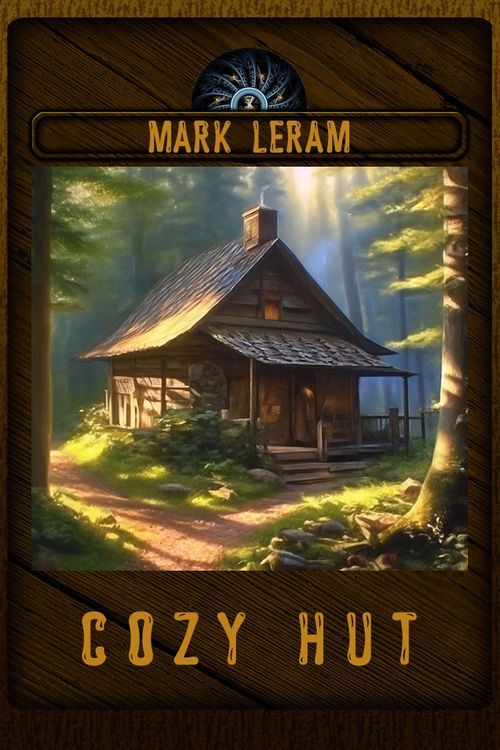
Cozy Hut
Cozy Hut Rulebook
Table of Contents
Table of Contents
Components
Components (per player):
- 12 double-sided Location cards for building your hut. One side shows a Nature location, the other a Home location.
- 1 Cozy Hut card
- 2 Resource boards for tracking dice
- 8 dice to track Nature and Home resources
- 1 die to track the game rounds
You can play The Cozy Hut with any number of players simultaneously, competing to see who earns the most cosiness. However, each player needs their own complete game set.
The Mint Edition of The Cozy Hut comes in two versions — Summer and Winter. They are identical in gameplay; only the artwork differs. Each standard Mint box contains everything needed for one player. If you plan to play with more people, you’ll need to acquire additional sets.
Setup
-
Each player places the Cozy Hut card in front of them along with two Resource boards. On the Nature Resources board, set all four D6 dice to “3.” This means you start with 3 Wood, 3 Clay, 3 Water, and 3 Supplies. Do not place dice on the Life in the Woods board yet. Remember that during the game, you will place eight Location cards around your hut — keep space for them when setting up your play area.
-
Take your deck of Location cards and place it to the left of your Hut — this is your Current Month deck. Leave some space to the right of your Hut for the Next Month deck.
-
Place the round tracker die nearby.
You are now ready to begin!
Gameplay
The game is divided into three phases:
- Planning — the main phase, lasting up to six rounds (game months);
- Life in the Woods — begins after the Planning phase is complete;
- Scoring — concludes the Life in the Woods phase and ends the game.
Victory points in the game are called Points of Cosiness (PC).
Before starting the game, set the round tracker die to “6” Then take your deck of twelve cards and make sure that all cards are turned to their Nature side, oriented the same way (with the location titles at the top).
Note:
Nature locations differ from Home locations not only in appearance but also in cost and function:
- Nature locations cost 4 resources to build.
- Home locations cost 5 resources and include a small consumption icon to the left of the title. These differences make it easy to distinguish the sides.
Each player shuffles their Location deck, then places it back to the left of the Cozy Hut — this is the Current Month deck.
Planning Phase
During the Planning phase, you draw the top card from the Current Month deck and place it in front of you (or hold it in your hand). You may look at the next card in the deck, but you cannot remove it, and you are not allowed to look at cards beneath it.
After examining the drawn card, you must decide:
- either to build this location into your hut,
- or to postpone it by placing it into the Next Month deck.
Building
To build, pay the required resources shown on the card by reducing the values on your resource dice accordingly. Then place the card in any open space around your Cozy Hut. You cannot build if you do not have enough resources to pay the cost.
Postponing a Card
If you cannot or do not wish to build a location, you may postpone it — placing the card into your Next Month deck.
When you choose to postpone, you have three options:
- Gain resources — take the resource(s) shown at the top of the card and adjust your Resource dice accordingly.
- Improve the card — rotate it 180°. This allows you to gain two resources instead of one when you postpone it in the future. Once improved, a card cannot be rotated back to its original position.
- Plan for Home construction — flip the card to its Home side, keeping the same orientation. (Example: If the Nature side was previously improved, flip it to the improved Home side as well.)
⚠️ Important!
- An improved Home card can no longer be flipped or rotated in any way. It can only be built or postponed, and postponing it always grants the depicted resources.
- An improved Nature card cannot be rotated back either; it may only be built, postponed (gaining its resource(s)), or flipped to its improved Home side.
After resolving the chosen option, draw the next card from your Current Month deck and repeat the process. In this way, you will gradually build your hut and form your Next Month deck during the Planning phase.
When the Current Month deck is exhausted:
- reduce the value of the round tracker die by 1, and
- move the completed Next Month deck to the Current Month position (to the left of the Cozy Hut), without shuffling.
This becomes your new Current Month deck.
One full pass through your deck is called a “Game Month” and represents a month of construction in the forest. During each month, you must build at least one location!
Tip: To remind yourself whether you have built something this round, you can use the round tracker die (the “month” die). When you build, place it on your Cozy Hut card. At the start of a new round, move it back next to your current month’s deck. Be careful not to accidentally change the die’s value while moving it — the number of remaining rounds will be used when calculating your final score.
You are not limited to one construction per round — you may build as many locations as you can afford, provided you have the necessary resources. However, you must always build at least one per month.
If you end a month without building any location, you immediately proceed to the Life in the Woods phase, followed by Scoring.
Construction Demand
At any time when any of your Nature Resource dice shows a value of “6,” a special rule called “Construction Demand” takes effect — you’ve gathered so many resources that you can’t resist starting to build something!
While Construction Demand is active, you are obliged to attempt to build every new location you draw until all your Nature Resource dice show values below 6.
If you cannot build the next location because you lack certain resources, only then may you postpone it according to the usual rules (gain a resource, improve, or flip the card).
When eight locations are placed around your Cozy Hut, the Planning phase immediately ends, and the Life in the Woods phase begins. This is the stage where you will earn most of your Points of Cosiness (PC).
Life in the Woods Phase
The Life in the Woods phase consists of visiting each location in strict clockwise order.
Tip: It helps to imagine this phase thematically — narrating your quiet Life in the Woods hut. For example: “Today I worked hard in the garden beds, then cooked a fine pumpkin soup in the pot. After a warm bath, I sat by the stove reading a good book while sipping tea.”
You may begin your Life in the Woods cycle from any location. For convenience, slightly move your starting location away from the hut to mark it, or use any other method that helps you remember where you began.
As a rule, the Life in the Woods phase continues until one of your Home Resource dice reaches “6.” When that happens, the game immediately ends, and you proceed to scoring Points of Cosiness (PC).
When visiting a location, you must perform its associated action. On Nature locations, this means gaining a natural resource (look at the icon to the left of the card title). On Home locations, this means spending one resource to convert it into a Home resource — Warmth, Food, Tea, or Coziness (look at the icon to the right of the card title).
If you complete a full cycle through all your locations (visiting each once), it means you have successfully lived a full game month in your hut. You may then start a new Life in the Woods cycle, beginning from any location (not necessarily the same one as before).
End of Life in the Woods and Game End Triggers
The Life in the Woods phase ends if any of the following occurs:
- You cannot perform a consumption action required by a location;
- The next location in the cycle is missing (your hut was not fully built during Planning);
- One of your Home Resource dice reaches a value of “6.”
These are all end-of-game triggers. When one occurs, the game immediately ends, and you calculate your Points of Cosiness (PC):
Scoring
- +1 PC for each remaining round in the Planning phase (the number shown on your round tracker).
- +2 PC for each unit of Coziness.
- +1 PC for each unit of Warmth, Food, or Tea.
- +0.5 PC for each remaining Nature Resource (Wood, Clay, Water, Supplies).
If you played solo, record your result and try to improve it next time! Also, don’t forget to try the solo variant “Blueprint Challenge” (see Variants of Play).
If you played with others, the winner is the player whose hut earned the most Points of Cosiness. In case of a tie, the winner is the player with the higher total amount of Home Resources. If still tied — play again!
Variants of Play
In its basic form, the game is deliberately deterministic — it contains only minimal randomness (the starting order of locations after shuffling differs for each player). This design creates a highly precise and deliberate planning experience: after several plays, construction becomes almost chess-like, where every half-point can decide the outcome.
If you prefer a more casual, random, strategic, or family-friendly experience instead of this “chess-style” planning and optimization, you can use one of the following variants.
Family Madness
Shuffle all players’ decks together, then deal each player 12 random cards. Each player now has a unique set of locations — some may repeat, others may be missing. You’ll have to build your hut using whatever cards you were dealt! This mode is recommended for family games or playing with children.
Draft Mode
This variant suits experienced players of The Cozy Hut.
Shuffle all players’ decks together to form one large shared deck, and place it in the center of the table. Before the game begins, a new step is added — the Draft Phase.
Each player draws 4 cards from the shared deck, keeps 2 (placing them face up in the chosen order in front of them), and passes 2 cards to the player on their left. The cards received from your neighbor are added to your hand. Then, each player draws 2 more cards from the shared deck, again keeps 2 (placing them on top of the cards already set aside, without changing their previous order), and passes 2 to the left.
Continue this process until every player has a personal deck of 12 cards. This becomes your play deck, and the game proceeds as usual with the standard rules.
Solitaire Variant — “Blueprint Challenge”
This exciting variant transforms The Cozy Hut into a more tense and challenging game — highly recommended to try at least once!
Before the game, create a fixed sample layout of a hut that every player must reproduce exactly. All players must build their huts according to this model.
If at any point you are forced to build an incorrect location (due to Construction Demand or other conditions), your game immediately ends. You stop building and wait for the others to finish.
Only players who successfully complete the model hut may proceed to scoring. If no one manages to finish the hut correctly, all players score their incomplete huts, and the player with the most Points of Cosiness wins.
In solo play, an unfinished hut — for any reason — counts as a loss.
How to create a Blueprint or “Model Hut”
You can create the model in any convenient way. If you have more than one deck, take one deck and shuffle it so that both Nature and Home sides are mixed — not just a standard shuffle, but occasionally flip sections of the deck before continuing to shuffle.
Then randomly lay out 8 location cards around the Cozy Hut card. You’ll get a random mix of Nature and Home sides — this layout is the model hut that all players must reproduce.
If you have only one deck, take a photo of the result or simply write down the names of the locations on paper.
The base rules remain the same. The only addition is one extra trigger for ending the Planning phase: if a player is forced to build a wrong location (because of Construction Demand), their Planning phase immediately ends at that point.
The difficulty in this variant depends on the number of Home locations in Model. You can increase their number to raise the challenge level of the solitaire. (The author himself couldn’t win when there were more than six Home locations.)
Quick Reference
1. Planning Phase — Actions
a. Build a location (spend the required resources) b. Gain the resource shown on the card (mandatory) c. Improve — rotate the card 180° (cannot rotate back) d. Plan Home Construction — flip the card to its Home side, keeping its current orientation
2. Imperatives
a. An improved Home card cannot be flipped or rotated again. An improved Nature card cannot be rotated back to its basic Nature side. b. You must build at least one location during each deck cycle (month). c. Construction Demand: if any Nature Resource die shows “6,” you must attempt to build each new location until that value drops below 6.
3. Life in the Woods Phase
a. Choose any location as your starting point. b. Visit each location clockwise, performing its action. c. After visiting all eight locations, you may begin a new cycle, starting from any location.
4. End-of-Game Triggers
a. You cannot consume a required resource. b. A location space is missing (incomplete hut). c. Any Home Resource die reaches “6.”
5. Scoring
a. +1 point for each remaining round (including unfinished) b. +2 points for each Cosiness c. +1 point for each remaining Warmth, Food, and Tea d. +0.5 points for each remaining Nature Resource (Wood, Clay, Water, Supplies)