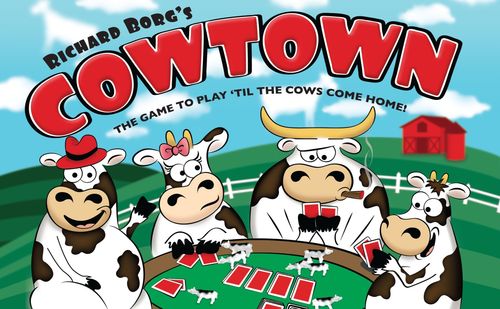
Cowtown
Cowtown Rulebook
Table of Contents
Table of Contents
Components
88 cards, 40 scorecows (not to be confused with scarecrows) and these rules. The cards come in four different herds (colors). Each herd color consists of 22 cards (two sets of cards numbered 1-10) plus two Cowtown cards.
Component illustrations in the source show the card back, card examples, and scorecows.
Object
Have the most scorecows when the game ends. In general, you gain the most scorecows by being the first player in each round to get rid of all of your cards.
Play
Select one player to deal the first round. The dealer shuffles and deals six (6) cards to each player and also deals four (4) more "table" cards, which are placed face up in the center of the table. Place the remaining cards off to the side. This is the draw deck. If one or more of the face up cards is a number 10, place those cards on the discard pile next to the draw deck. Then draw replacement cards from the draw deck, and place them face up with the other table cards—initially a total of four.
Hold your cards so the other players cannot see them.
If you have one or more Cowtown cards in your hand, place them face up along with the initial four table cards.
The dealer takes the first turn.
Player's Turn
On his turn, a player may play one card from his hand on top of any single or stack of face up table cards. The card played must be one number greater than the number of the card on the top of the stack.
A Cowtown card does not have a number but it will start a new stack. A number '1' cow card is played on top of a Cowtown card.
When the herd color of the card being played is the same color as the face up card, it is a safe play, and your turn ends.
When the card being played is not the same color, it is a "Bullish" play.
A bullish play means that after the card is played onto the stack, you must turn the top card on the draw deck face up onto the discard pile. The card you turn onto the discard pile will determine what happens on your Bullish play.
- When the card you turned onto the discard pile has a Bull's Eye (red circle with a picture of a bull), you must draw the top card from the draw deck and add it to the cards in your hand. Your turn ends.
- When the card you turned onto the discard pile does not have a "Bull's Eye," your bullish play is safe, you do not have to add a card to your hand. Your turn ends.
- When the card turned is a Cowtown card, place it with the other face up cards on the table, your bullish play is safe, you do not have to add a card to your hand. Your turn ends.
Play examples (from the source illustrations):
- A Green '9' cow is a bullish play on a Blue '8' cow.
- A Blue '9' cow is a safe play on a Blue '8' cow (cards are from the same herd).
- A Yellow '1' cow is a bullish play on a Blue Cowtown.
- A Yellow '1' cow is a safe play on a Yellow Cowtown.
When you cannot make a play or you choose not to make a play, you must add a card to your hand. You may take the top card from the draw deck or the top card from the discard pile. This ends your turn.
Note that when you draw a card you may not play it right away, unless it is a Cowtown card. When drawn, a Cowtown card must always be played at once to the middle of the table with the other face up table cards.
When a player's turn ends, play passes to the left.
Special Cow Card Plays
Horn-to-Tail Sequence
A player may play a Horn-to-Tail Sequence of two or more cards on his turn. The cards played must be in numerical sequence and of the same color.
EXAMPLE: A Horn-to-Tail Sequence might be a Blue '6' and a Blue '7' cow played from your hand onto a stack with a Blue '5' cow.
If the Horn-to-Tail Sequence is a Bullish play, you must turn the top card on the draw deck.
You need to turn only one card when making a Bullish Horn-to-Tail Sequence play. If you turn up a Bull's Eye, you must draw the top card from the draw deck and add it to your hand. If your bullish play is safe, you do not add a card to your hand.
When making a successful Horn-to-Tail Sequence play of three or more cards, you collect 1 scorecow.
Stampede
A player may play two or more of the same numbered cow cards (a Stampede) on his turn. To avoid this being a Bullish play, these cards must all be the same number and color as the cards they are being played on, and they must be played on two or more stacks with the same lower number.
EXAMPLE: In your hand, you have two number '7' blue and yellow cow cards. On the table, there are two stacks with a blue and yellow number '6' cow on top of these stacks. You may play both number '7' cow cards, one on each of the number '6' cow stacks. You can also make this a Bullish play if either of the colors do not match, but then you must turn the top card on the draw deck.
If you turn up a Bull's Eye, you must draw the top card from the draw deck and add it to your hand. If your bullish play is safe, you do not add a card to your hand.
When making a successful Stampede play of two or more cards, you collect 1 scorecow.
Note that it is possible to make a play that combines both of these special cow card plays on the same turn.
Close the Barn Door
When a player plays a number '10' cow card (Close the Barn Door), place the card stack face down off to the side, these cards are out of play for the rest of the round. The player may then choose to either take another turn, or pass one of his cards to another player.
Remember if the Close the Barn Door is a Bullish play, you must turn the top card on the draw deck. You only need to turn one card when making a Bullish Close the Barn Door play.
Ending the Round
When you only have one card remaining in your hand, you should alert the other players with a loud "Mooooo". If you forget to "Mooooo" before the next player takes a turn and you get caught, you must draw a card as a penalty.
The round ends when a player gets rid of his last card.
The player who gets rid of all his cards first in the round collects 4 scorecows. The player with the next fewest cards in his hand collects 2 scorecows (in case of a tie for next fewest cards; each player collects 2 cows). The "udder" players all collect 1 scorecow, except for the player who holds the most cards, he gets none. When there is a tie for most cards, all tied players receive no scorecows.
The deal passes to the left and a new round is started. Clear all cards off the table, reshuffle and start a new round.
The round may also end when the last card is drawn from the card deck. When the round ends in this manner, players collect scorecows as above – i.e. the player with the fewest cards collects 4 scorecows, etc.
Winning
The game ends after four rounds of play, or when all the scorecows are claimed.
The player who has collected the most scorecows wins! If there is a tie, the player who won the last round prevails.