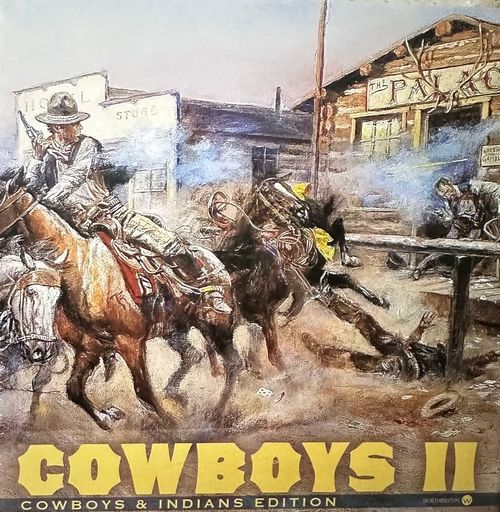
Cowboys II: Cowboys & Indians Edition
Cowboys II: Cowboys & Indians Edition Rulebook
Table of Contents
Table of Contents
Game Components
Characters: Stand up counters that represent the main characters in the game. The stand up counters need to be placed in the plastic bases when in play. Normal health is 4 and movement rate is 4. Each time he is shot the health value is reduced 1 and his movement rate is reduced 1. Cowboy modifiers improve shooting. Each character has a front face and a back face, with a direction arrow.
Town Folk: Normal health is 1 and movement rate is 4. Once shot, they are eliminated from the game by flipping them in the space they are shot. Town folk normally start with rifles and do not have to track ammunition.
Indians: Start hidden (with the question mark shown), once shot they are revealed. If revealed and hit they are removed from the board. They start with rifles and do not have to track ammunition.
Horses: Normal health is 2 and movement rate is 4. Horses are either mounted or dismounted.
Health: Health is tracked on the character tracking chart.
Other Game Counters: Weapons (pistol, rifle, shotgun), stagecoach, cattle, turn marker, modifier counters.
Character Tracking Chart: Each tracking chart has a corresponding stand up character for the board. Health, weapons, ammunition, and modifiers are tracked on this chart. The chart has a health track, a shot modifier, rifle, pistol ammo and shotgun ammo tracks, and a character activation chit.
Game Cards: The cards affect game actions; each card will describe how it affects play, when it can be played, and can override game rules.
Game Boards: Lettered A to L. The boards have squares that regulate movement and range for weapons. Each board has a row of small letters and numbers that are used for cross reference setup locations in the episodes. The boards show layouts of various western settings. Board features: board letter and alignment arrow, doors, walls (noted by black line), cross reference, windows, obstacles (noted by red line).
Game Chart: Has SHOT CHART and TURN RECORD CHART for determining the results of shoot actions and keeping track of game turns during play.
Game Set Up
Pick an episode to play. Players should choose sides. More than one player may play on a side by dividing the characters among them. Players on each side share the dealt hand of cards. Card limits are determined by side, not the number of players on each side.
Take an activation marker for each character, or group of characters per the episode instructions and place in an opaque container.
The game boards should be laid out according the episode set up diagram. Each board has a large letter in the left corner with an arrow which is used for board alignment for each episode. Each board also has a row of small letters and numbers that are used for episode set up purposes to cross reference specific locations for the initial placement of counters. Place the counters on the board according to the episode instructions.
Each player uses a Character Tracking Chart with a corresponding on board character. Place a weapon marker on the Character Tracking Charts for the weapon types listed in the episode for that cowboy. Weapons start fully loaded and the weapon counter is placed on a space that matches the amount of ammunition.
Shuffle and deal out the listed number of cards to each side for the episode, then play begins.
Game Turn
For the first turn of every episode, follow the episode instructions for which side performs actions first in a turn. After the first turn, ignore all references to who performs actions first in a turn. Instead, players will draw one character chit from the opaque container.
To determine which character(s) performs actions next in a turn, players will alternate drawing a marker from the cup to determine which character(s) perform actions next. When a character marker is drawn, move that specific character. When the town folk or Indian marker is drawn, all town folk or Indians for that side perform their actions for the turn. Once all of the markers have been drawn, players start a new turn by returning all of the drawn markers back to the cup and continuing the game by drawing markers until the episode ends.
Actions
When a cowboy or town folk chit is drawn, that particular character (or group of characters for town folk) is activated. Once activated they receive 4 action points if at full health. If below full health they receive the number of action points equal to the number currently showing on their particular health base. The following chart list the different types of actions and their action point cost.
| Action | Point Cost |
|---|---|
| Move 1 square | 1 per square |
| Move across red line | 1 additional action point |
| Change facing on last move | 1 |
| Change facing during move | 0 |
| Stand up / pick up / put down | 2 |
| Move carrying character | 2 per square |
| Mount/dismount | 2 |
| Draw/Change weapon | 2 |
| Reload weapon | 2 |
| Shoot | 2 per shot |
| Spin and shoot one shot | 2 |
| Brawl adjacent character |
Move Actions
Cowboys and town folk may move, mount, dismount, or change weapons during the move action. They may only do one of these during a turn.
Movement with Cowboys and Town Folk
Move cowboys, town folk or Indians up to their full movement value which is 4 to start the game. This is reduced by 1 each time a cowboy is shot. Normal movement cost 1 movement point per square. Diagonal movement is allowed for 2 actions. Cowboys and town folk may move through each other but may not end a move in the same square. Cowboys and town folk may move through horses and cattle and the stagecoach and can end a move in the same square.
Walls are denoted by a black line. Movement across black lines is not allowed, except at doors. (Once adjacent and in front of a door it is open and movement across the door black line is allowed).
Windows and obstacles are denoted by a red line. Movement across a red line cost 1 additional movement point.
FACING is the direction the front or back of a cowboy or town folk points. Facing is changed during movement (or a spin and shoot action) and may be changed any number of times during the move action.
Movement with Horses
Cowboys or town folk must be in the same square as a horse to mount or dismount for 2 movement points. The same applies for the stagecoach. A character may move before or after they mount or dismount provided they have movement points remaining. Horses may not be moved unless mounted. Horses face the same direction as their rider.
When mounted, horses add 4 to the movement value of the cowboy or town folk. If shot once, place a 1 health marker under the horse. If a horse is shot a second time it is removed. If a cowboy or town folk is mounted when a horse is eliminated, they remain in the square and may not perform any action their next turn. Horses may only move with one rider in a turn. Horses may not enter buildings except for stables, corrals, and the livery.
Movement to Change Weapons
The only time weapons may be changed is during movement and it cost 2 movement points. When eliminated, cowboys and town folk leave their weapons in the square. These weapons may be picked up by cowboys or town folk but they must be in the same square as a weapon to pick it up and it cost 2 movement points.
Examples of Movement Actions
There are many movement options for the cowboys in the illustration but the illustrated examples are highlighted by the numbers and are described below:
Cowboy #1 is at full health and can move 4 movement points. His first movement option could be to move out the front door of the bank and through the cowboy or town folk in front of the door. He could not end his movement in the same square as the cowboy or town folk. Another option for Cowboy #1 is to move across the red line, which cost one extra movement point and towards the back of the bank by the window. He could not move out the window as it would cost an extra movement point to cross the red line to go through the window which would exceed his remaining movement value. Cowboy #1 could also move one square to his left but could not continue to his left as movement across a wall black line is not allowed.
Cowboy #2 is at full health and can move 4 movement points. Cowboy #2 exits the building through the door (1) and into the square with the horse (2) and mounts the horse (3, 4). Cowboy #2 has expended all of his movement points, but may use the horses 4 movement points to continue moving (5, 6, 7, and 8).
Cowboy #3 is at 3 health value and can therefore only move 3 movement points. His first movement option could be to move 3 squares straight up towards the back of the bank. His next option could be to move one square up (1) and then across the red line window into the bank (2, 3). Another possibility is to move down (1) towards the street, to the left (2) and then down into the street (3). He could not keep moving to his left after his second move as he would not have enough movement points left to exit the square with the cowboy or town folk and can not end his move in the same square as the cowboy or town folk.
Cowboy #4 starts with full health mounted on a horse. His first option could be to move 8 squares to the right behind the buildings, 4 for his movement value plus 4 for being mounted on the horse. Another option could be to move one square towards the building but could not enter the building because he is mounted on a horse and horses can not enter buildings other than stables, corrals, and the livery. A third option could be to move two squares to his left (1, 2) and then down two squares outside the window of the building. He has used 4 movement points of the horse to do this, he uses 2 of his cowboys movement points to dismount (1, 2) and then his last two movement points to cross the red line window into the building (3, 4).
Shoot Actions
Cowboys may start with a combination of the 3 weapons. This can be up to 2 pistols and either a rifle or shotgun. However, only one weapon may be used to shoot in a turn. The weapon used must be continuously used until a change weapon action is performed. Weapons may not be changed during shoot actions. Each time a loaded weapon is shot, the marker for that type of weapon will be reduced by one for each shot on the Character Tracking Charts for that cowboy (represents ammunition expended). A weapon with zero ammunition may not shoot until reloaded. Town folk carry rifles and never have to reload. Pick target and determine line of sight and range.
Line of Sight
LINE OF SIGHT is determined by the direction the cowboy or town folk are FRONT FACING, and any counters or buildings between them and their target. You must be able to see your target to shoot it. FRONT FACING is all squares in the front and sides of the cowboy or town folk shooting. All others are BACK FACING for which there is no line of sight and shooting is not allowed from the back facing.
LINE OF SIGHT is also determined by a straight line from the center of the shooting square to the center of the target square. Line of sight is blocked if this straight line crosses a black line, other than an open door. Doors are open if a cowboy or town folk is directly in front of it and adjacent (this opens the door). Cowboys and town folk block line of sight, body counters do not. Horses, cattle and the stage coach block line of sight except when the targeted cowboy or town folk is in the same square with them.
If the line of sight for the shot crosses a red line that the target is adjacent to there is a -1 shot modifier. Otherwise red lines have no effect on the shot.
Windows and open doors cover the entire square side when measuring line of sight, but line of sight is restricted when shooting from a window or door.
Examples of Line of Sight with Windows and Doors
A line of sight example showing restricted line of sight through windows and doors. The cowboy's front facing is represented by the blue sides of the square they occupy; the back facing is represented by the red side of the square they occupy.
Cowboy #1 has a line of sight out of the window to cowboys A and B. Cowboy #4 has a line of sight out of the door, which is open because he is adjacent to it, to cowboy D. Cowboy #5 has a line of sight out of the window as shown. Note how narrow his line of sight is because he is not adjacent to the window. He may not shoot out of the door to the left because the door is closed, and he nor a target is adjacent to the door.
In the second example, cowboy B has line of sight to all squares highlighted in blue. Note that line of sight works the same going into a building as out of a building. Cowboy E has line of sight to all squares highlighted in green, note he cannot shoot cowboy #6 but can shoot cowboy #5.
Range
RANGE is the number of squares a weapon may fire, and is determined by counting the number of squares from the cowboy or town folk shooting to the target. Take the shortest route possible, including diagonally, and each square adds one to the range. On the Shot Chart cross reference the weapon type with the RANGE to determine the die roll needed to score a hit on the target.
Roll Your Shot
ROLL YOUR SHOT - is each time a shoot action is performed; a player takes 1 SHOT from one weapon. Roll two six sided die once for each shot from the pistol or rifle. For the shotgun, roll 2 six sided dice twice for each shot. Add or subtract any shot modifiers to the die roll for a total. Modifiers are cumulative. Compare this total to the hit number on the Shot Chart; if the die total is within that range then the target is hit.
Flip a card to check damage done. The target's health is reduced by rotating the health base one number lower for each hit. Once the health falls to 0, place a fallen body counter and leave it in the square. Remove the eliminated cowboy and base from the board, leaving any weapon bases in the square with the fallen body counter.
Any time a shooting cowboy or town folk roll a natural 2 (two 1's) it is a miss, regardless of modifiers.
Shot Modifiers
- Cowboy Modifier +1 or +2: Number listed in top right corner of cowboy.
- Back Shot +2: Target is shot at through its back facing.
- Shot crosses a red line the target is adjacent to: -1
- Shot crosses open door target is adjacent to: -1
- Shooting while mounted on a horse: -2 for pistol and -3 for rifle or shotgun.
- Spin and Shoot: -1 for pistol, -3 for rifle or shotgun.
- Reaction shot: -1
- Modifiers are cumulative.
Spin and Shoot
Cost 2 action points. With a spin and shoot action, characters may change facing in the square they are in and shoot. If shooting a pistol, there is a -1 shot modifier. If shooting a rifle or shotgun, there is a -3 shot modifier. Cowboys and town folk may not spin and shoot when mounted on a horse.
Reaction Shot
Anytime a character is moving through an opponent's cowboy's line of sight, the opponent can call for a reaction shot by his cowboy. This can only occur if the reacting cowboy has not moved or shot this turn. Any time a cowboy takes a reaction shot, he takes one shot with a -1 shot modifier applied. A cowboy may only perform one reaction fire in a turn. This counts as the reacting cowboy's action for that turn. Remove the reacting cowboys chit from the cup. A moving character may have reaction fire performed at them by any number of cowboys.
Reload
Each weapon type has a limited amount of times it may be shot before a reload action must be performed. Reloading allows one weapon to become fully loaded. The maximum ammunition allowed for each type of weapon is:
- Pistol = 6
- Shotgun = 2
- Rifle = Unlimited
A Gunfight Example
Illustrating range and line of sight and using the shot chart.
Cowboy #1 has a fully loaded pistol (6 ammo rounds), a 0 cowboy modifier, and has line of sight through the window to cowboys A and B. His range to cowboy A is 2 and on the shot chart he hits on a die roll of 6 through 12 for each shot. His range to cowboy B is 3 and on the shot chart he hits on a die roll of 8 through 12 for each shot. He decides to perform a shoot action at cowboy A and declares two shots. For his first shot he rolls two dice and adds them together. There are no modifiers. The total of the dice is 5 (2+3) which is a miss. For the second shot he plays a DEAD EYE card which adds a +2 to the die total for the shot. He rolls two dice totaling a 4 (3+1) and adds the +2 for the DEAD EYE card for a total of 6 (3+1+2) which is a hit on the shot chart. Cowboy #1 reduces his ammo from 6 to 4 on his Character Tracking Charts.
Cowboy #2 has a fully loaded rifle (16 ammo rounds), a +2 cowboy modifier, and has line of sight to cowboys D and E (note line of sight to cowboy F is blocked by cowboy E). His range to cowboy D is 2 and his range to cowboy E is 3. He decides to perform a shoot action at cowboy E and declares two shots. There is a -1 modifier for the shot crossing a red line adjacent to the target. And a +2 cowboy modifier. On the shot chart with a rifle at a range of 3 he scores a hit for a modified total of 7-12. For his first shot he rolls two dice totaling, a 4 (2+2), and applies the modifiers which totals 5 (2+2+2-1). The shot chart shows a rifle hitting on 7-12 at a range of 3. Therefore he misses. His second die roll totals a 6 (3+3), and applies the modifiers which totals 7 (3+3+2-1). Therefore he hits. Cowboy #2 reduces his ammo from 16 to 14 on his Character Tracking Charts.
Cowboy #3 has a fully loaded shotgun (2 ammo rounds), a +1 cowboy modifier, and has line of sight to cowboy E. His range to cowboy E is 3. Cowboy #3 decides to shoot 2 shots. There is a -1 modifier for the shot crossing a red line adjacent to the target. And a +1 cowboy modifier. On the shot chart with a shotgun at a range of 3 he scores a hit for a modified total of 8-12. For his first shot he rolls two dice twice (for the shotgun). The first roll of two dice totals 11 (6+5+1-1). This is a hit. The next roll for the first shot totals 7 (4+3+1-1). This is a miss. The second shot his first roll of two dice totals 9 (4+5+1-1). This is a hit. The next roll for the second shot is 12 (6+6). This scores a double hit. Cowboy #3 reduces his ammo from 2 to 0 on his Character Tracking Charts.
Cowboy #4 has a rifle with only 1 round of ammo remaining, a 0 cowboy modifier, and has line of sight to cowboys D, E, and F. Cowboy #4 has a range of 3 to cowboy D, and a range of 5 to cowboys E and F. He chooses to shoot at cowboy D because he has a back shot on him. Cowboy #4 declares one shot as he only has 1 round of ammo remaining. There is a +2 modifier for the back shot. On the shot chart with a rifle at a range of 3 he scores a hit for a modified total of 7-12. For his shot he rolls two dice which total 5 (3+2), adds his +2 modifier for the back shot, bringing the total to 7 (3+2+2). The shot is a hit. Cowboy #4 reduces his ammo from 1 to 0 on his Character Tracking Charts.
Brawl
Unarmed cowboys or cowboys with unloaded weapons may perform a brawl action as a shoot action. The cowboy performing the brawl action must be in a square next to the target. Brawling is not allowed across a red line. Both players roll one dice and add the following modifiers:
- For each point of health below 4: -1
- Hitting Target through rear facing: +2
- Cowboy modifier: +1, +2
The cowboy with the higher modified roll does one point of health damage to his target.
Card Play
Cards override any game rule. Follow the instructions on the face of the card and apply them immediately when the card is played. If an episode's special rules state that a card may not be played, and it is dealt to a side, the card is treated as a blank and has no effect on game play. The player keeps the card and may not draw another.
Players may play one of their cards during their actions of a turn and one card during their opponent's actions of a turn.
During their turn, players may play a card at the start of the move or shoot action for a cowboy or town folk.
A player using a card during their opponent's turn would play the card following the announcement of a move or shoot action or a card play by their opponent. A player who plays a card during their opponents' portion of the turn may negate the affects of the active player's card or action.
Episodes
The episode book list the detailed set up for the game's gunfights of the old west. Each episode has specific instructions related to the episode and special rules that may, at times, override or modify and adjust some of the game rules.
Optional Rules
Role Playing
For gamers who would like to add a role-playing element to their wild west adventures we add the following rules section. All rules should be played unless otherwise advised.
Character Creation: Using the CHARACTER sheet (photocopy for additional characters) we have included you can create a cowboy to be used in multiple scenarios to see how long you would have survived in the old west. This plays really well using multiple gamers on different sides as you follow each other through scenarios. A pencil should be used on the Character sheet as over time and scenarios your skill and belongings will grow. All player characters start as wet behind the ears, meaning you have no skills. You have use any cowboy figure but they start at 0 modifier. You must choose your alignment, either good or bad which will determine which side you will cow punch with in a scenario.
Solitaire Rules
Pick which side you want to play in the scenario. You will control all movement and actions for your side. The solo card deck will control the actions of the opposing side.
How to Use the Solo Chart: There is no change in the sequence of play. The player will draw a chit from the cup to determine which side in the game performs actions. If the player draws his side, he performs his actions. If the player draws the AI side, he follows the instructions on the solo chart. The decisions for the AI is based on the range from the AI drawn character to the closest target. When the AI calls to determine hit number use all modifiers that apply. The card list the type of weapon the AI character is carrying to determine what to do with that character. The action taken by the AI is always at and towards the closest target. Follow all rules based on the closest target, this applies to targets behind the AI character, you would perform a spin a shoot if it calls for Shoot.
AI characters that have not performed actions this turn get 2 reaction shots if the target is at a range of 3 - 4 regardless of the weapon they are carrying. They get 1 reaction shot if they have performed actions this turn.
Changes to the Game: AI characters do not track ammo. Much like in the movies, their guns are always fully loaded. AI characters do not brawl, they are always looking for the kill.
Solo Chart (range from the AI character to the closest target)
| Weapon | 1-2 | 3-4 | 5-6 | 7-10 | 11+ |
|---|---|---|---|---|---|
| Pistol | Shoot | Shoot | Move 2 and shoot | Move 4 | Move 4 |
| Rifle | Shoot | Shoot | Move 2 and shoot | Move 2 and shoot | Move 4 |
| Shotgun | Shoot | Move 2 and shoot | Move 4 | Move 4 | Move 4 |
Use the above chart when the AI has a player character in LOS. Modify as below:
- If no LOS to closest target, move up to 4 squares to obtain LOS and stop in first square with los to closest target. If 2 or more action points remain, shoot.
- If AI is adjacent to red line (providing cover), -4 from the range on the chart above.
Horses and Wagons: An AI character will not use a horse or wagon / stagecoach on their own. Any time a player's character mounts a horse, wagon, or stagecoach, the closest AI character immediately becomes mounted on a horse (you didn't think we were just gonna let you ride away into the sunset did ya'?)
Game Notes: Add modifier for shooting when mounted or on a wagon or stagecoach.
Advanced Optional Rules
To add more detail, players can choose which of these rules to apply.
- The front facing of a cowboy or town folk is determined by the direction of the last square moved to for that movement action. If a cowboy or town folk use less than their full movement rate during a turn, they may then change facing to any direction desired.
- Fan fire is a shoot action a cowboy may perform. Fan fire may only be done with a single pistol. During the action the cowboy gets to shoot as many times as he has ammunition available in the pistol (up to 6 shots). There is a -3 modifier applied to each fan fire shot as well as all normal game modifiers.
- A player with 2 pistols may fire them both with a shoot action (4 shots--2 from each pistol) with a -2 modifier on all shots.
- Deadly shots: Conduct shoot actions as normal but any modified roll of 12 or higher scores two hits.
- When shooting two shots, a cowboy or town folk may choose to shoot at two different targets. Roll one shot on each target applying a -2 shot modifier to each shot.
- To determine the order of play to start a episode, use the cards to determine who goes first. Each side flips from the deck of cards. High card (using the card values) determines the play order. Cowboy modifiers increase the number of cards flipped for a cowboy and he gets to use the highest one flipped. A +1 flips 2 cards and a +2 flips 3 cards. When a side has multiple cowboys, modifiers are based on the highest cowboy modifier for a side to determine the number of cards flipped. Highest card determines the play order. This play order is used for the remainder of the episode. Cards used to determine the order of play are placed on the bottom of the deck before cards are allocated for a episode from the top of the deck.
- To determine the order of play to start episode, play a 5 card draw poker hand before cards are allocated in a episode. The side that wins the poker hand performs the first action. This play order is used for the remainder of the episode. The cards used for the poker hand are put on the bottom of the deck and then cards are allocated based on the episode from the top of the deck.
- Reduce horse movement from 4 to 2 the first time a horse is shot.
- Design your own guidelines - To create your own episode from history or your imagination, lay out the game boards based on your design. Next assign the cowboys and town folk. Assign cards per side; an average of one card per cowboy is a good way to start. Extra cards can be added based on the chart below. The chart can also be used to randomly assign the cowboys values based on a single die roll.
Variable Damage from Any Shoot Hit
For each hit scored on a target, the shooting player rolls two dice and applies results in the following way:
- 2-3 = Miss
- 4 = Grazed, no damage. Target is pinned, the next time his chit is drawn, he may not move, but may shoot. Placed an unused plastic base next to a pinned cowboy / town folk to show he is pinned. Remove it when his next chit is drawn.
- 4-8 = 1 hit
- 9-10 = 2 hits
- 11 = 3 hits
- 12 = Kill
Card affects are still applied.