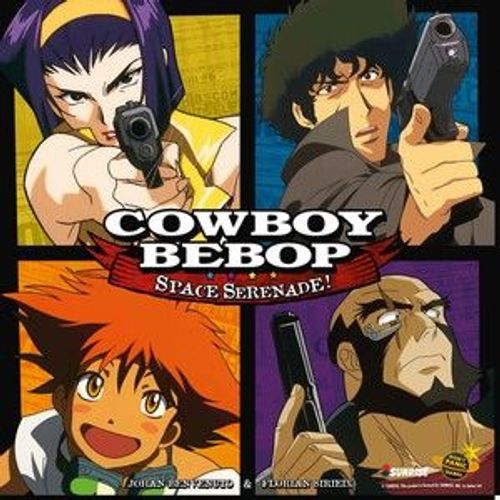
Cowboy Bebop: Space Serenade
Cowboy Bebop: Space Serenade Rulebook
Table of Contents
Table of Contents
Contents
- 1 rulebook
- 3 Planet boards1
- 1 Bebop board
- 4 Character boards
- 1 Damage board
- 1 Common Deck board
- 5 plastic miniatures (unpainted)
- 5 cardboard standees2
- 7 Fuel cubes
- 40 Renown tokens with values of 1, 2 or 3
- 50 Capture tokens (30 Location tokens + 20 Vicious tokens)
- 1 Big Shot stand (assembly required)
- 188 cards
- 92 Common Deck cards
- 21 Criminal cards
- 1 Vicious card
- 30 Damage cards
- 40 Basic Deck cards (10 per player)
Game Flow
Players start the game with a basic deck of 10 cards and play some of these cards on their turn. While accumulating resources, players will be for example able to buy new cards, activate abilities and capture criminals. A game is divided in two main phases: preparing the deck and capturing lesser criminals; and the final conflict against Vicious. Once Vicious is captured or runs away, the game ends and the player with the most renown wins.
Rules of Deckbuilding
Cowboy Bebop - Space Serenade is a Deckbuilding game. If you're not familiar with this game mechanic, this section should teach you the basics.
Each player starts the game with a basic deck of 10 cards, dedicated to their character and composed of 4 colored cards and 6 neutral cards. This deck must be shuffled and placed face down to the left of the Character board. Some space must be left next to the player's deck for their discard pile. Before the start of the game, each player draws 5 cards from their deck, except the first player, who only draws 4.
Then take the cards from the Common Deck, shuffle them, and place them face down on the Common Deck board. Reveal 5 cards from that deck and place them face up in a line within reach of all players, to form the Purchasing Area.
Players take turns to play. On their turn, the active player plays the cards of their choice from their hand by placing them face up in front of themselves and resolving the effects. At the end of the player's turn, all the cards played and those remaining in their hand are discarded, meaning they are placed face up in the discard pile next to their deck. The player then draws 5 new cards from their deck and their turn ends. It is then the next player's turn (clockwise).
When the player must draw new cards, but their deck is empty, they shuffle the cards from the discard pile and create a new deck, face down. They can then draw the remaining cards as required.
During their turn, a player can decide to purchase new cards from the Purchasing Area, provided they have the necessary resources. Each card purchased must be placed on top of the discard pile. Purchased cards are immediately replaced by new cards from the Common Deck. When the player shuffles their discard pile to refresh their deck, the cards they just purchased become available to be drawn and played in subsequent turns.
It is also possible to permanently remove cards from the player's own deck through the effect of some of the cards, thus increasing the chance of drawing better cards by removing less powerful ones from the deck (such as the basic starter cards). Drawing cards during the turn also increases the odds of getting good cards.
If a player must discard some cards during the turn of other players, they don't get to draw new cards to replace them and will have to start their turn with only the cards remaining in their hand.
The goal of each player is therefore to purchase new cards in order to gain more powerful effects and create interesting card combos to maximize the effects. The more you buy cards and draw them or the more you remove ineffective cards from your deck, the more you'll optimize your deck and increase the odds of drawing useful cards on your turn. Choose your options carefully to win!
Component Description
Action Cards
The cards in the Common Deck and the players' Basic cards (identified by a basic-card icon in the top right corner) are called Action cards and form the players' decks. Players play these cards during their turn to gain resources and trigger effects. These cards can be purchased from the Purchasing Area by paying their purchasing cost, indicated in the top right corner of each card. Basic cards form the starting deck of each player and cannot be purchased (they're actually not even included in the Common deck).
Example card, "It's Gonna Cost You" (card F07-2): its purchasing cost is 4 Woolongs, shown top right, next to its associated character shown top left. Resources gained when the card is played are shown on the left of the card body: 1 Woolong. Its effect, triggered when the card is played: "You may put a card you purchased this turn on top of your deck." At the bottom of the card, a Team Effects area shows 1 Woolong.
Most Action cards have a dominant color, associated to one of the characters in the top left corner. There are 4 different colors, one for each playable character. Some of the players' Basic cards are grey and with no associated character, and therefore neutral.
On some cards, an area at the bottom of the card matches the color of a different character, and triggers Team Effects, which are explained in more detail below.
Criminal Cards and Capture Tokens
Criminal cards are the source of Renown points that are used to win the game. To gain these points, players will need to participate in the capture of these criminals, by acquiring the Capture tokens featured on the card. There are two piles of Capture tokens on each card: the Resistance pile and the Investigation pile. Capture tokens placed on the Criminal cards must match the Planet represented on the card.
Some Criminal cards also feature an Appearance effect, that is triggered when the card is placed on the corresponding planet. This effect causes the Purchasing Area to be refreshed, by removing all the cards in that area and replacing them with new cards from the Common Deck.
Example card, "Asimov Solensan" (card W10-1): the number of Resistance tokens to be placed on the card is 4; the Strength required to gain 1 Resistance token is 1. The number of Investigation tokens to be placed on the card is 4; the number of Clues required to gain 1 Investigation token is 2. The Renown points gained at the end of the game for each token is 1. This card's Appearance effect refreshes the Purchasing Area.
Damage Cards
Damage cards represent the injuries and material damage inflicted on the players when they engage in physical combat with the criminals. For each Resistance token taken from a Criminal card, the player engaged in combat draws 1 Damage card and applies the effect indicated in the red text area. This card might be removed immediately, added to the player's discard pile, or placed on top of the player's deck. In the latter two cases, this card is now considered an Action card, and the effect in the grey text area can be resolved when that card is played.
Example card, "Solid Hit" (card D06-4): the effect triggered when the card is drawn from the Damage deck (red text area): "Put this card in your discard pile." The effect triggered when the card is played from the hand (grey text area): "You may pay to remove this card."
Most Damage cards have a permanent effect allowing the card to be removed by paying the indicated cost. This effect is not mandatory. If the player doesn't wish to pay the cost, they can keep the card and put it in the discard pile at the end of their turn, along with the other cards played that turn.
Damage cards can be discarded or removed just like any other Action card. When a Damage card is removed, place it in the Damage discard pile. When the Damage deck is empty, shuffle the discard pile to create a new Damage deck.
Resources
Woolongs — Woolongs are the currency of the game and are mostly used to purchase cards from the Purchasing Area. When a card with this icon is played, the active player adds the indicated amount to their virtual pool of Woolongs for that turn. At any time during their turn, a player can use this pool to purchase new cards or activate an effect on a card they played. When their turn is over, the pool of Woolongs goes back to zero. Any unused Woolongs are lost.
Fuel — The Fuel supply of each player is indicated on their Character board. Each player begins with 1 Fuel and moves the Fuel marker each time they gain Fuel or use some to move, apply effects or use abilities. This resource can be stored by players and is saved from one turn to the next, as opposed to Woolongs. It is not possible however to store more than 10 Fuel and any Fuel gained beyond that maximum is lost.
Strength — Strength is used to engage in physical combat with Criminals in order to weaken and capture them by taking their Resistance tokens (See Capture, below). Just as for Woolongs, Strength is a virtual pool that must be used by the end of the turn or be completely lost.
The number of Strength points required to gain 1 Resistance token is indicated on the Criminal card. This ratio is different from criminal to criminal. During a fight, however, everybody gets pushed around a bit, and player must draw a Damage card every time they gain a Resistance token.
Clues — Just like Woolongs and Strength, Clues unused at the end of the turn they were gained are lost completely. Clues are used to investigate criminals and capture them by ruse or by surprise, without needing to fight and take damage in the process!
The number of Clues required to gain 1 Investigation token is indicated on the Criminal card. This ratio varies from criminal to criminal.
Setup
A — Location Boards: Set up the 3 Planet boards and the Bebop board in the center of the play area. Place a Fuel cube on the space labelled "1" on each of the 3 planet boards.
B — Miniatures: Independent of the number of players, place the 4 miniatures of Spike, Jet, Faye and Ed on the Bebop board.
C — Purchasing Area: Place the Common Deck board within reach of all the players and put the shuffled Common Deck on it, face down. Reveal the first 5 cards and place them face up one next to the other near the Common Deck, to create the Purchasing Area.
D — Criminals (Planet Boards): Randomly pick 1 Criminal from each planet among the 6 starter Criminals (that have a point value of 0 in the sheriff star) and place them on the corresponding Planet boards. On the 2 spaces on each Criminal card (Resistance and Investigation), place the indicated number of Capture tokens (See "Criminals", below).
E — Criminals (Deck): Sort the remaining Criminal cards by planet (including the leftover starter Criminals) and shuffle each deck separately. Then, based on the number of players, randomly take the indicated number of Criminal cards of each Location and shuffle them together to create the Criminals deck. Then take the Vicious card and shuffle it in as one of the last 3 cards of the Criminals deck. Place the deck on the Big Shot stand.
| Number of players | Number of criminals per location | Shuffled in the last 3 cards | Total number of cards in the Criminals deck |
|---|---|---|---|
| 2 | 3 | Vicious | 10 |
| 3 | 4 | Vicious | 13 |
| 4 | 5 | Vicious | 16 |
F — Player Boards and Decks: Each player chooses one of the characters and places the corresponding board in front of themselves, as well as the 10 cards of their Basic deck, made of 6 neutral cards and 4 cards of their character's color. The player also takes a Fuel cube and places it on the "1" space of their fuel gauge.
The Basic deck cards are, for example: "For a Few Woolongs" (card B01-24, resources gained: 1 Woolong; effect: "You may pay 1 Fuel to remove this card."), "A Little Fuel" (card B02-1, resources gained: 2 Fuel), "This Might Work" (card B03-1, resources gained: 1 Strength), "Just a Hunch" (card B04-1, resources gained: 1 Clue), and "Let's Jam!" (card B05-1, effect: "You may move one Non-Player Character for free."). The Basic deck is composed of 6 neutral Woolong cards, 1 Fuel card, 1 Attack card, 1 Investigation card, and 1 Transport card.
G — Damage Deck: Shuffle the Damage cards and place them face down on the Damage board within reach of all players. Save some space for the discard pile.
H — First Player: The jazziest player starts the game. Players then take their turns clockwise.
I — First Hand: Each player shuffles their basic deck of 10 cards and places it face down next to their Character board. The first player draws 4 cards, other players each draw 5 cards.
Let's jam!
Playing a Turn
- Players take their turns in sequence. The active player generally begins their turn with the 5 cards they drew at the end of their previous turn. However, if card effects have forced them to discard or draw cards before the beginning of their turn, they might start with more or fewer than 5 cards in their hand.
- The active player can then take any of the following actions, as many times as they wish and in any order:
- Play a card (and resolve its effects immediately)
- Purchase a card
- Move
- Use a character's abilities
- Confront and capture criminals
- When the player decides they are done with their actions, they declare the end of their turn and place all the cards they have played in their discard pile as well as the cards remaining in their hand.
- The player draws 5 new cards from their deck. If they no longer have enough cards in their deck, they shuffle the discard to make a new deck and draw the cards required to complete their hand.
- Players move Vicious if required.
- The next player begins their turn.
Playing Cards
The active player can play cards from their hand by placing them in front of themselves. There is no cost attached to playing a card.
When a card is played, the active player immediately gains the resources indicated, then resolves the specified effects. If an effect indicates "You may…", the player may ignore the effect but cannot resolve it later. Each effect can only be resolved once, unless indicated otherwise.
The effects are resolved as soon as the card is played, unless specified otherwise. When an effect is applied, it must be resolved completely before taking another action.
Example: Florian plays a card indicating "You may move up to 2 characters for free". He is not allowed to move 1 character, then use an ability, then move another character. The effect on the card must be resolved completely in a single action. (Card J09-2, "I'll Take Care of This": resources gained, 5 Woolongs; effect, "You may move up to two characters for free.")
Team Effect
Some cards have a Team effect, visible at the bottom of the card in an area of the color matching the character affected.
The effect indicated in the colored area is resolved whenever a card associated with the affected character is present in the player's play area. The order in which the two cards composing the Team effect are played doesn't matter. If the affected character's card has already been played, the bonus is resolved as soon as the card indicating the Team effect is played. If that card is played before a card of the affected character is in play, then the Team effect will be resolved automatically as soon as a card of the affected character is played (after resolving the effect of the first card).
A character card can activate the Team effects of multiple cards. A Team effect, however, can only be resolved once, even if multiple cards of the affected character have been played.
Example: by playing these 3 cards in that order, the active player resolves each of the Team effects once. The three example cards are "Dance!" (card S04-2), "Synchronization" (card E04-2, effect: "You may discard a card to draw a card."), and "Souvenirs for Edward" (card J04-2, effect: "You may remove a card from your hand or your discard pile.").
Removing Cards
Some of the card effects allow you to remove cards from your discard and/or from your hand. The cards you pick in this manner will be permanently removed from your deck. Place the removed cards in a separate pile or put them back into the box. Removing cards is useful to clean up your deck, so you can increase the odds of drawing useful cards faster and more often.
Purchasing Cards
Each Action card in the Common Deck has a purchasing cost in its top right corner. When a player wishes to purchase a card from the Purchasing Area during their turn, they must spend the required Woolongs they have accumulated on this turn and immediately place the purchased card face up in their discard pile. Immediately replace the purchased card in the Purchasing Area by another card, that becomes available for purchase. Players can buy as many cards as they wish during their turn and can do so over multiple actions.
As indicated on the Common Deck board, it is possible to refresh the Purchasing Area by spending 2 Fuel during your turn. In that case, remove all 5 cards from the Purchasing Area and immediately replace them with new cards from the Common Deck.
Some criminals also refresh the Purchasing Area when they make their first Appearance on a planet (but not when they are discarded).
Moving
A player can move their character multiple times during a single turn if they have enough Fuel to do so. There are 4 locations to which they can move: Mars, Earth, Ganymede and the Bebop.
To move, players must spend the amount of Fuel indicated on the Movement gauge of the Location where they would like to move. This gauge represents the difficulty of locating a criminal in that location.
The movement cost of returning to the Bebop is always 1 and varies from 1 to 3 for the other locations. At the beginning of the game, movement cost is 1 for every location.
Updating Movement Gauges
Movement gauges can be modified in various manners:
- When a Criminal card is revealed after a previous one has been captured, and the corresponding Planet board is already occupied by a Criminal card: +1 (if the gauge is already on 3, the current criminal escapes, see below).
- When a criminal escapes or is captured: the gauge on the corresponding Planet board goes back to 1.
- When a player plays a card modifying a gauge by +1 or -1.
- When a Criminal card is revealed in order to move Vicious and he is already on the indicated Planet board: +1 on the corresponding Movement gauge.
- When Vicious moves, gauges on Planet boards do not change.
Confronting a Criminal
Weakening a Criminal
When a character is on the same planet as a criminal, they can decide to spend Strength or Clues to weaken them and eventually capture them. Each Criminal card shows the Strength or Clues scores necessary to gain 1 Capture token from the corresponding space (see Criminal card description, above).
The active player draws 1 Damage card per Resistance token gained from a criminal. If a Resistance token is taken from Vicious, the player draws 2 Damage cards instead of one. No Damage cards are drawn when gaining an Investigation token.
Example: "Baker Panchorero" (card W03-1). This criminal originally has 3 Resistance tokens and 2 Investigation tokens. To gain one of his Resistance tokens, the player must spend 1 Strength, and draw 1 Damage card. To gain an Investigation token, the player must spend 2 Clues, but doesn't draw a Damage card.
Players decide the order in which they take the tokens and are not obligated to spend all their resources when confronting a criminal. It is possible to weaken or capture multiple criminals in a single turn or on multiple planets, if the players have enough resources to move, fight and/or investigate.
Capturing a Criminal
As soon as one of a criminal's token piles (Resistance or Investigation) is depleted, the active player immediately captures the criminal. Then proceed as follows:
1 — Distribute Renown Points: The active player takes the Criminal card and places it face down to the right of their Character board. Each player who has gained Capture tokens corresponding to the planet on which the criminal was captured converts them into as many Renown points, to be placed face down on their Character board. Players keep their tokens from other planets (corresponding to criminals not yet captured).
2 — Planet Cleanup: Characters located on the planet where the capture took place go back to the Bebop (without spending any Fuel). Vicious is not considered a character, and so remains on the Planet board if he is there. The Movement gauge of the Planet board is reset to 1.
3 — Reveal New Criminals: When Vicious is in play, no new Criminal card is revealed. Ignore this section. If Vicious is revealed during this step, do not reveal any further criminals, and skip to the section titled "Vicious Appears".
Reveal 2 new cards from the Criminals deck, one after the other. For each card revealed this way, check the availability of the planet indicated on the card:
- If the planet is already occupied by a criminal, increase the Movement gauge by 1 and discard the Criminal card that was just revealed to the pile placed next to the Big Shot stand. If the gauge was already on 3, the current criminal manages to escape (see below), and the revealed criminal takes their place. The movement gauge goes back to 1.
- If the planet is free, place the new Criminal card there. If a new Criminal card is placed on one of the Planet boards, resolve the Purchasing area refresh effect if the Criminal card has one. Likewise, place the indicated number of Capture tokens of the corresponding planet on the Resistance and Investigation spaces on the newly arrived Criminal card.
Escaped Criminal
When the Movement gauge on a Planet board is on 3 and a newly revealed Criminal card triggers another rise in the gauge, the criminal present on the planet manages to escape.
- Discard the current Criminal card and replace it with the new Criminal card.
- Reset the planet's Movement gauge to 1.
- Return all characters present on the planet to the Bebop.
- Each player discards all their Capture tokens of the corresponding planet (without receiving any Renown points).
Some cards cause changes in the level of a planet's Movement gauge. This will not allow a criminal to escape, even if the gauge is already on 3.
If a criminal escapes while Vicious is on the same planet, Vicious stays where he is.
Vicious
The appearance of Vicious triggers the second part of the game. Criminals already in play remain so and can still be captured, but no additional criminals are revealed from that moment onwards.
Remember that Vicious is not considered to be a character and so cannot be moved because of a card effect.
Vicious Appears
When the Vicious card is revealed, his miniature is put in play. In order to determine on which planet he appears, you must create his Movement deck:
- Take all the discarded Criminal cards and those remaining in the Criminals deck and shuffle them together. Players who have captured criminals keep them in their own play area. Place this new deck on the Big Shot stand. This is now the Movement deck for Vicious.
- Reveal the first card of the deck to determine on which planet Vicious appears. Place his miniature there and discard the revealed Criminal card.
- Place the Vicious card between the Planet boards.
- Place the Vicious tokens on his card corresponding to the number of players (see below).
The Vicious card (W22-1): Vicious deals 2 Damage for every Resistance token taken. Vicious moves at the end of each turn he has taken a token. Vicious tokens by player count: 2 players — 9 Resistance / 5 Investigation; 3 players — 11 Resistance / 6 Investigation; 4 players — 13 Resistance / 7 Investigation.
Confronting Vicious
To confront Vicious, a character must be on the same planet as he is. If there is a Criminal card on the planet as well, the player can choose to confront either of them.
Gaining Capture tokens from Vicious works the same way as when capturing other criminals. Taking one of his Resistance tokens, however, forces the player to draw 2 Damage cards instead of one. Likewise, 3 Clues are required in order to gain 1 Investigation token (but still without drawing any Damage cards when dealing with Investigation tokens).
Moving Vicious
At the end of every player's turn, if Vicious has lost at least 1 Resistance token during that turn, Vicious moves (if he hasn't lost any token, or only Investigation tokens, Vicious doesn't move). Reveal the top card of his Movement deck and resolve the following effects:
- If the revealed Location is different from his current whereabouts, simply move Vicious to that Location without changing the Movement gauges on the Planet boards.
- If the Location indicated matches his current Location, raise the Movement gauge of that Planet board by 1. If the gauge is already on 3 and a Criminal card is present on that planet, that criminal escapes following the normal rules explained above. If not, leave the gauge on 3. Vicious cannot escape in that manner.
Criminals revealed from the Movement deck do NOT go to a Planet board, even if that planet is available. Likewise, Purchasing Area refresh effects indicated on Criminal cards revealed during that phase do not apply.
Capturing Vicious
As for any other criminal, Vicious is captured when either of his Capture token piles is depleted. The game then ends immediately.
Vicious Escapes
If the last card in the Movement deck is revealed, every player gets one last turn, then the game ends. If Vicious remains uncaptured by the end of the last player's turn, he manages to escape, and all players lose their Vicious tokens.
Character Abilities
Each character has two unique abilities that they can use on their turn by spending the indicated amount of Fuel. It is also possible for a player to use another character's first ability if their miniatures are in the same Location, whether on a planet or on the Bebop. The abilities available to a player are indicated on their Character board.
It is therefore important to play with ALL miniatures in a 2-3 player game. Non-player characters can be moved with certain Action cards, including one in every player's starter deck.
A character's ability can be used as many times as desired during a turn, provided its cost can be paid before using that ability.
- Ed A: Spend 3 Fuel to gain 1 Clue, to be used immediately on the planet where Ed is currently located.
- Ed B: Spend 6 Fuel to choose a card from your discard pile and place it back in your hand.
- Jet A: Spend 2 Fuel to remove 2 Damage cards from your hand and/or your discard pile.
- Jet B: Spend 5 Fuel to gain 1 Strength, to be used immediately on the planet where Jet is currently located. Do not draw any Damage cards for Resistance tokens gained while using this ability.
- Spike A: Spend 3 Fuel to draw a card. You can discard it to draw another one.
- Spike B: Spend 5 Fuel to buy a card with a 2 Woolong discount and place it on top of your deck. (for example if a card is worth 5 Woolongs, you can purchase it for 3 Woolong).
- Faye A: Spend 2 Fuel to gain 1 Woolong.
- Faye B: Spend X Fuel to buy a card worth X Woolong. You cannot use Woolongs to complete a purchase made in that manner.
Ending the Game
The game ends when:
- All players have played one last turn after revealing the last card in Vicious' Movement deck and he has not yet been captured. In that case Vicious manages to escape and players must discard all their Capture tokens.
- One of Vicious' token piles is depleted. Vicious is immediately captured by the active player, and the game ends. Players convert their Vicious tokens into as many Renown points and discard their other Capture tokens.
Whether Vicious is captured or manages to escape, the game still has a winner. However, in the latter case, it is only a minor victory… and you'll have to try again!
Any remaining criminal manages to escape, and Capture tokens remaining in play are ALL discarded without bringing any Renown points at the end of the game.
Players add up the Renown points they have collected during the game, without forgetting the points gathered through the criminals they have captured personally.
The player with the most Renown points wins the game! In case of a tie, the player having captured the most criminals wins. If there is still a tie, you will have to share your victory!
Solo Variant
The solo variant of Cowboy Bebop - Space Serenade lets you try to take on Vicious all by yourself! Not to mention the other criminals, of course!
The basic rules of the game don't change, with a handful of exceptions:
- To create the Criminals deck, first place the starter criminals like in a normal game, then create the same Common Deck as for a 3-player game (see table above, in Setup).
- Every time you shuffle your discard pile to refresh your deck, reveal a criminal from the Criminals deck and apply the same rules as for a normal reveal.
- You still reveal 2 Criminal cards every time you capture a criminal.
- When Vicious enters play, take the Criminal cards in the discard pile and those remaining on the Big Shot stand to create his Movement deck (just like in a normal game).
- Place on his card as many Capture tokens as for a 4-player game.
- When Vicious is in play, he moves at the end of EVERY turn (not just when he loses a Resistance token). Reveal the top card of the Movement deck and apply the rules as normal.
- When Vicious is in play, no longer reveal new Criminal cards when you recreate your deck.
- When the last card of the Movement deck is revealed, you only have one turn left to capture Vicious! Otherwise he escapes and you lose the game!
Your goal is to capture Vicious while gaining as many renown points as possible. Write down your score and compare it to other solo players!
The rulebook includes a scoresheet with columns for Player Name, Character Played, and Score, for tracking solo results across plays.
Player Aid
Possible Actions
- Play a card and resolve its effects
- Activate a character's abilities
- Confront and capture criminals
- Move
- Purchase cards
End of Turn
- Discard the cards you played and still have in hand and draw 5 new cards
- Move Vicious if required
Capture
- If a Resistance or Investigation space is empty, immediately capture the criminal
- All players convert their corresponding Capture tokens into Renown points
- Cleanup the planet:
- characters present all return to the Bebop for free
- gauge reset to 1
- Reveal 2 new Criminal cards
Criminal Reveal
- Free planet: revealed criminal arrives
- Planet occupied:
- Gauge on 1 or 2: +1 to the gauge
- Gauge on 3: criminal present escapes; planet cleanup; revealed criminal arrives
Vicious
- Movement deck: criminals discarded + unrevealed criminals
- Moving Vicious:
- At the end of every turn in which Vicious loses a Resistance token
- By revealing a card from the Movement deck:
- if same planet: +1 to the gauge (Vicious can't escape)
- if different planet: movement (gauges don't change)
Footnotes
-
For simplicity's sake, we use the term "Planet" to describe Earth, Mars and Ganymede, even though the latter is in fact a moon. Thank you for your understanding! ↩
-
The cardboard standees are there as an alternative to the plastic miniatures, in case you'd like to display the latter instead of using them to play! ↩