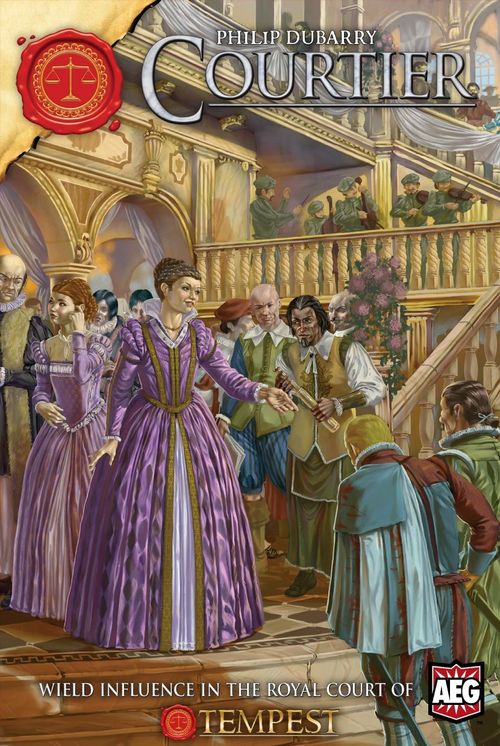
Courtier
Courtier Rulebook
Table of Contents
Table of Contents
Prologue
Arnaud IV paused at the landing of the elegant curving staircase, smiling as he surveyed the gathered people. The main salon of the palace buzzed with energy: people mingling, the clink of glassware, servants gliding smoothly among the guests, music from the best sextet in this part of the world, and there, across the room, his wife, the queen consort at the center of the social life of Tempest.
Even from this distance her smile lit the room. Her warmth and grace were almost as compelling as her laugh. He watched as she introduced two ladies to each other, and seeded the conversation with a comment or two. A few moments later, the two ladies were so enamored with their own conversation that the queen was able to gracefully excuse herself.
With a smile, the king descended the rest of the staircase, intending to speak with his wife, but—
"Your highness," said the Prime Minister, bowing smoothly, a tall glass of liqueur in one hand.
"Ah, Janis," said the king with a tepid smile. "'Tis good to see you, though we should not tarry. The queen decreed that tonight no one should speak to old friends, but only to those with whom we are not well acquainted."
"The queen? Er, a thousand pardons, my liege, but I thought you had decreed. She did… check with you first, did she not?"
"Erm, well… I thought to… uh, indulge her. Her fancy. Tonight."
"Ah, 'tis of no importance," said Janis, waving a hand. "Your Highness, Rex Tempestas and High Protector of the Temple is, of course, exempt from her whimsy."
King Arnaud cleared his throat and stood a little taller. He looked over Janis' shoulder toward the queen, and his expression softened again.
The prime minister turned, following his gaze. "Ah, I see that Lord Chantril, Master Elmen and… Sirus have captured the queen's ear. She truly has a way with men, does she not?" Together they watched as the foursome talked animatedly, with Lord Chantril gesturing to a parchment covered with diagrams. At last the queen smiled and nodded, and the three gentlemen bowed and removed themselves.
"Ah. I had heard that some inventor lass was seeking a patron to finance her newest project," said Janis with apparent approval. "I am so glad to see that you agreed, my king." He raised his liqueur glass in toast.
"You know of this?"
"I was approached earlier this evening," said Janis nonchalantly. "I said I would have to speak with you first. But apparently they bent your ear before I could." He glanced sidelong at the king. "They… she… did get your approval first, did she not?"
The king flapped his mouth for a moment. "She is my wife," he said at last, as if resolving the matter in his heart, "and the queen. I trust her. And she grants these boons because… because it's good for Tempest. And because she trusts her advisors. Just as she trusts you," he added.
"Of course she trusts me," he said, "just as you trust her." He eyed the king, masking it with a sip of liqueur. "However, I take pains to ensure that she trusts me… by telling her exactly those platitudes that she wishes to hear."
Arnaud furrowed his brow. "You lie to the queen?"
"Of course not, my king," he said, bowing once more. "But I do avoid telling that which would distress her, or cause her to mark me with concern. For my loyalties are not to her, my liege, but to you." He watched the king for a moment, smiled in satisfaction, and drained his glass. He placed it on the tray of a passing servant.
"Well," he said, clapping his hands, "with everyone mingling with strangers, no one will notice that the queen has granted a private audience to that dashing new ambassador. I'm sure that will be most helpful to foreign… relations." Pressing his hand to his heart, he bowed once more. "By your leave, my sovereign king, while you might be above the queen's edicts, I find that I am not. I must mingle with someone new. Perhaps I shall find out more about that new ambassador," he mused. "He seems such an… energetic young man."
So saying, Minister Velox withdrew from the king, turned, and wound his way through the assembled guests.
The king's eyes followed him until he disappeared into the dining room. Then he looked back to where the queen had been, but she was no longer there.
Object
In Courtier, 2–4 players compete for recognition in the royal court.
Your mission is to act as an influence broker, manipulating the levers of power and granting favors to important supplicants. You accomplish this by influencing key people to act at your behest. Points are awarded for each completed petition card; bonus points can be earned from cards and abilities. The winner is the player with the highest score at the end of the game.
Components
Your game of Courtier should include the following. If it does not, contact [email protected] for assistance.
- 48 influence cards (white marble back)
- 44 power cards (black marble back)
- 26 petition cards (sealed letter back)
- 17 fashion cards (the queen on the back)
- 8 coterie ability cards (double-sided)
- 140 wooden cubes
- 25 each in blue, green, red, and yellow (influence markers)
- 40 white (neutral influence markers)
- game board
- these rules
The board area also has a place for the influence deck and power deck, each with a discard pile and a face-up card available for purchase. In each coterie are various courtiers, who are the key people that the players can influence. Each courtier has one or more spaces that indicate how easily that person is swayed to a particular course of action; the more spaces a courtier has, the more difficult that courtier is to manipulate. See Controlling Courtiers below for more details.
There is also a place for the fashion deck, and a scoring track for recording victory points gained by means other than by completing petitions.
Setup
Place the neutral (white) influence markers near the game board. This pile of markers is called the reserve. Give each player a set of wooden cubes of one color. These are your influence markers. Each player places one cube on the zero space of the scoring track, keeps 15 markers to create a pool, and places the rest into the reserve with the neutral markers.
Shuffle the petition cards and deal one to each player; these are your secret petitions. Reveal four more petition cards and place them face up beside the board; these are public petitions and may be completed by any player. The remainder of the petition cards form the petition deck, which should be set near the board.
Remove the card named The Queen Is Arrested! from the fashion cards. Shuffle the fashion cards and make two stacks of six cards each. Place the rest back into the game box without looking at them. Shuffle The Queen Is Arrested! into one of these stacks, making a stack of seven cards. Place the other stack on top of the seven-card stack, thus placing The Queen Is Arrested! in the bottom half of the fashion deck. Place the assembled deck in the center of the game board.
Shuffle the influence deck and the power deck and set them beside the board within reach of all players. Flip the top card of each deck face up beside it; these cards will be available for purchase during the game (see Refilling Your Hand).
Key Concepts
These items are all important to understand when learning to play Courtier.
Game Board
The game board represents the royal court, and the various areas of influence that shape the world around the City-State of Tempest.
The board is divided into eight sections, called coteries. Each coterie has a special ability granted to the player with the most influence there, which is discussed under Coterie Control & Abilities below.
Influence Markers
Your wooden cubes are your influence markers. You have a limited quantity of them. You start the game with most of your influence markers available in your pool, although some start the game in the reserve and can be acquired during the game.
You place influence by taking influence markers from your pool and adding them to a courtier on the board. You cannot place influence if your pool is empty.
When you gain influence, take markers of your color from the reserve (assuming there are any left) and place them in your pool.
If you spend influence, take influence markers from your pool and place them into the reserve. If you have no markers in your pool, you must take one of your markers from the board instead.
How to Play
Play cards to place influence markers on courtiers on the board. Enough influence on a courtier gives you control of that courtier. Once you control the right courtiers, they can convince the queen to grant that request, and you complete that petition card and score points.
Certain cards seem to break the basic rules of the game. The text on a specific card always overrides the basic rules.
Opening Auction
At the start of the game, deal one hand per player face up onto the table. These hands are made up of five cards drawn from the influence and/or power decks. Beginning with the starting player, each player may decide how many cards to draw from each deck for one hand, announcing the mix before drawing any of them. Players may inspect these hands.
The starting player selects one hand and bids on it by placing one or more influence markers from his or her pool onto that hand.
The next player does likewise, and bidding proceeds around the table. Players must bid; they cannot pass.
If a player bids on a hand that already has influence markers on it, the bid must be at least one influence marker higher than the previous player's bid.
If a player gets outbid, that player immediately retrieves all of the influence he or she bid on that hand and takes the next bid action. Play then passes to the next player who has not been outbid.
Once influence has been bid, it cannot be retracted.
Once the last player has bid (this will always be the player to the right of the first player), all players take the hands they won and place all the influence markers they bid into the reserve.
First game? If this is your first game, you won't know very well how to bid on the various hands. Instead, have everyone draw a starting hand of three influence cards and two power cards so you can dive right in and start playing.
Example — Opening Bid: Albert bids 1 influence on hand #1, placing one of his influence markers on it. The bid option passes to Britt.
Britt bids 1 influence on hand #3. The bid option passes to Charles.
Charles bids 2 influence on hand #1. Since he was outbid, Albert retrieves his markers and has the next bid option.
Albert raises his bid to 3 influence on hand #1 (the same hand). Since he was outbid, Charles has the next bid option.
Charles retrieves his 2 influence and decides to bid it on hand #3, outbidding Britt. Since she was outbid, Britt takes her influence marker back and has the next bid option.
Britt doesn't think hand #3 is worth three influence, so she bids a single influence marker on hand #2. The bid option passes to Diane.
Diane bids 1 influence on hand #4.
All players have bid, and no one is being outbid. The auction ends. The players take the hands they won and place all the influence markers they bid into the reserve.
On Your Turn
On your turn, do one of the following three actions:
- Play one influence card or power card, doing everything the card says.
- Discard any or all of the cards in your hand.
- Gain one influence marker from the reserve.
Once you've done your action, you can complete one eligible petition (see Completing Petitions).
Finally, refill your hand to 5 cards, drawing the cards from any combination of the influence and power decks. If you end your turn with more than 5 cards, you do not discard down to 5, but you do not draw more cards, either.
After your turn, play proceeds to the player on your left.
Playing Cards & Placing Influence
The cards you play come in two varieties: influence cards and power cards.
Influence cards expand your sway over the royal court, while power cards alter the board position to your advantage. (Usually, this distinction makes no difference to play, but a few cards and abilities reference cards by their type.)
When you place an influence marker, place it in an empty slot on that courtier. If there are no empty slots, each influence marker you place can replace another marker, either a neutral marker or that of a different player. The replaced marker returns to its owner's pool (or the reserve for neutral markers).
Certain cards specify that you place influence markers on an empty slot. In such cases, you cannot replace any influence markers.
Example — Placing Influence: Chelle (red) plays the Influence the Senate card, which lets her place one influence on any Senate courtier.
She can place it on the Magistrate. Since he has empty spots, she cannot replace anyone else's influence.
She can also play it on the Palatine. The Palatine is full, so she gets to replace someone's influence. However, Todd (blue) controls the Royal Family coterie, so she cannot replace Todd's influence (per the text on the Influence the Senate card). She can replace the marker belonging to John (yellow).
Refilling Your Hand
At the end of your turn, refill your hand to five cards. To do so, draw cards one at a time from either the power or influence deck until your hand is full.
When you draw, you may take the top face-down card from the deck, or spend one influence marker into the reserve to take the face-up card beside the deck.
If you take a face-up card, immediately replace it with the next card from its deck before you draw another card. If you still need to draw another card, you can spend another influence to draw the new face-up card if you wish.
If either deck ever runs out, shuffle the discard pile to create a new deck the moment that someone needs to draw a card from it. The deck may even be shuffled after you discard a card but before you refill your hand. When you shuffle the discard in this manner, do not shuffle in the face-up card from that deck; it remains in place.
Completing Petitions
You may complete one petition per turn, and only after your action (playing your card, discarding cards, or gaining an influence) but before refilling your hand. You may complete either your secret petition or one of the four public petition cards at the side of the board that are available to all players. You cannot complete two petitions in a single turn.
A petition card can be completed when each courtier listed on the card is completely filled with influence markers (of any color) and you control each of those courtiers. See Controlling Courtiers below.
When you complete a petition:
- Remove all influence markers from each of the courtiers used to complete that petition card. If you use the Minister's coterie ability, you clear the Minister instead of the courtier he is substituting for. If you play a Resourceful power card, you do not clear the replaced courtier since that courtier was not used. Players' influence goes to their respective pools, while neutral influence goes into the reserve. Place the petition card face-down beside you to track your points. You do not move your marker on the scoring track; that is only used to track points acquired by means other than by scoring petitions. Be sure to keep completed petitions separate from your secret petition.
- Draw a new petition card to replace the completed petition (that is, replace a secret petition with a new secret petition, and a public petition with a new public petition).
- Flip over the top fashion card. This card represents the shifting fancies of the royal court. Follow the instructions on the fashion card, and then move it face down to the bottom of the fashion deck. Most cards call for filling a coterie with neutral influence markers, though some have other effects. Many fashion cards also call for players to gain influence from the reserve.
- Discard the face-up cards beside the power deck and influence deck, and turn new cards face up beside them.
Controlling Courtiers
A player controls a courtier when that player has more influence markers on that courtier than any other player does. Players do not control a courtier if they are tied in influence markers with another player. Neutral markers do not count against control.
When it's your turn, you also control any courtier completely filled with neutral markers. Such a courtier has the queen's approval, and no other player is blocking that courtier's actions through their influence.
Example board note: the red player controls the Minister and also controls the Cardinal. No one controls the Banker.
Coterie Control & Abilities
Each coterie of the board provides a special ability to the player who controls that coterie. You control a coterie if you have the most total influence markers in that coterie, regardless of how many courtiers you control within it.
Example: Chelle, playing red, has three influence in the Military coterie. The other players each have two, therefore Chelle controls the Military coterie.
When you have the most influence in a coterie, immediately take possession of the corresponding ability card. You may use it as applicable. When you no longer have the most total influence in that coterie, you must immediately surrender the ability card. Note that an ability card may change hands multiple times in a turn.
Winning
The game ends immediately when The Queen Is Arrested! is revealed from the fashion deck. Players total up the values from their completed petition cards, and add their victory points from the scoring track. Note that a player who controls the Senate coterie card receives 10 bonus victory points at this time.
The player with the highest score is the winner. If there is a tie, the player with the most completed petition cards is the winner. If there is still a tie, the player with the most influence markers on the board is the winner. If there is still a tie, tied players share the victory.
Appendices
Example of Play
It's Chelle's turn, and she sees a chance to score some points. She eyes the 12-point petition with the Princess, Guildmaster, Bishop, and Emeritus.
The Atheneum has been filled with neutral influence by a previous fashion card, so Chelle already controls the Emeritus. The Princess is controlled by John and the Guildmaster is empty. But the Bishop has only one of Chelle's influence markers; also present are two of Todd's influence and one of John's. Since the Cardinal is empty of influence, Todd controls the Church coterie ability.
Chelle starts by playing Resourceful (the one for the Royal Family), spending one influence marker from her pool to the reserve. Resourceful will stand in for the Princess, and it allows Chelle to play another card.
Next she plays Energetic, allowing her to play two influence cards this turn. She happens to have the influence card for the Bishop, so she plays it. Since the Bishop is full, she gets to replace an influence marker with her own. She replaces one of Todd's markers with hers, and immediately takes control of the Church coterie ability card, since she now has more influence in the church than anyone else.
For her second influence card, she plays the card Influence the Guild, which allows her to place an influence marker on any courtier in the Commerce coterie. Because she controls the Church coterie ability, she places two markers instead of one. She places two markers on the Guildmaster.
Since no one else has influence in the Commerce coterie, she takes control of the coterie ability card. She cannot use its ability since the ability takes place at the start of a turn.
She now controls the Guildmaster and Bishop (by virtue of having more influence on them than any other player), as well as the Emeritus (because he is filled with neutral influence). Each of these courtiers is also filled with influence. Finally, she has a substitute for the Princess.
She claims the petition and sets it face down beside her. She returns all influence on the Guildmaster and Bishop to the various players, and returns the neutral marker on the Emeritus to the reserve. She does not return the markers on the Princess, since the Princess was not used to complete the petition (the Resourceful card was used instead).
Since she no longer controls the Commerce coterie, she returns the coterie ability card to the table. Since no one has any influence left in the Church coterie, she returns that ability card as well.
Chelle then draws the top card of the fashion deck, applies its effects, and places it face down at the bottom of the fashion deck. She replaces the petition she claimed with a new one from the deck. Then she discards the face-up influence and power cards and replaces them with the top card of each deck.
Finally, she fills her hand, drawing two fewer cards than normal due to the text on Energetic. With one influence spent and fewer cards in hand, her next turn might be lean, but it was worth it to score a high-value petition.
Playing with Two Players
When playing with two players, the game flows much better with a third player: Adjunct Gianni Archiato.
How Gianni Plays
Gianni has some influence being in the senate, but he doesn't have a grand plan and is easily distracted. He plays with a third color, not neutral influence. Gianni starts with all of his influence tokens.
After each player's turn, that player discards the top card of the influence deck for Gianni's turn.
- If it is an influence card that names a specific courtier, play it. The player whose turn just ended makes all choices.
- If the card is a wild card (Influence the Church, Influence Any Courtier, etc.), ignore it.
Finally, if Gianni controls all courtiers for one or more petitions, he automatically completes the most valuable petition that he can. Draw a fashion card.
Gianni can acquire coterie powers, and uses the Church, Culture, and Royal Family abilities as applicable. He uses the Minister's ability to score petitions when necessary. He does not use the Minister if he can complete a petition without using this ability.
Play Tips
While it is always tempting to draw influence cards to get more of your markers on the board, when your pool starts to run dry, switch to drawing power cards.
Most of the victory points in the game come from completed petition cards, so finish as many as possible.
Getting free discards with the Atheneum coterie can filter unneeded cards from your hand. Don't let the other players use this power too often.
After the first six fashion cards get played, consider holding the Senate coterie. That extra 10 victory points can make a big difference.
Don't ignore the Culture coterie's ability. Those victory points can add up.
Pick your fights. If you go in trying to stop everyone, you end up stopping yourself.
Variants
Fast Start
Before the start of the game, place 1 neutral influence on each courtier except those in the Atheneum.
Longer or Shorter Games
Adjusting the number of fashion cards on the top and bottom of the decks changes the game length and the variability of game's end. Tweak these numbers to suit your play style.
No Cheese
To complete a petition, a player must have at least 1 influence marker on one courtier listed on that petition, or else use a Resourceful card. This prevents people from scoring a petition using nothing but courtiers that are filled only with neutral markers.
FAQ
Can I use a coterie power that I just gained to affect the card I just played? No. Since the card had already been played before you had the ability, it is too late for that ability to affect that card.
How can I get influence that I spend back from the pool? Influence can be gained by three means. The first is the power card Charismatic. The second is by drawing one marker for your turn. The third is by scoring a petition; you get your influence back, and many of the fashion cards also provide you with extra influence.
Do I have to complete a petition just because I can? No, you don't, if you deem holding onto coterie abilities is worth more than the points the petition will score. On the other hand, the less time you spend scoring petitions, the less chance you have of winning…
Can I play multiple Resourceful cards in a turn? Yes, because each card lets you play another card.
I have one influence on the King, so does another player, and there is one neutral influence on him. Who controls him? No one. You and the other player are tied, and neutral influence does not add to your influence for control.
Every courtier on a petition is filled with neutral cubes; can I complete that petition? Yes, you can. During your turn, you control all courtiers that are filled entirely with neutral influence markers. It may seem strange that you can complete a petition when you have no sway over these people, but they have the queen's confidence and want to act; they just need someone to prod them in the right direction.
Can I use Resourceful to substitute for the Minister on a petition, and then use the Minister coterie ability to substitute him for another courtier on the same petition? Absolutely.
Can you play the Subversive card even if you don't plan to attack the player who controls the Royal Family, just to get the card out of your hand? Absolutely.
If I control the Military coterie and play Flattering, do I have to make the same choice both times? No, you don't; you can make different decisions each time. Treat it as if you played the card twice in a row.
Reference
For your convenience, here is a listing of all the steps in game play:
Setup
Each player chooses a color and takes 15 influence markers. Place one marker on the zero space of the scoring track for each player.
Shuffle the petition cards and deal a secret petition to each player. Place four more petition cards face up beside the board.
Shuffle The Queen Is Arrested! into the bottom half of the fashion deck.
Shuffle the influence deck and the power deck. Flip the top card of each deck face up beside it.
The starting player is the person who most recently had a birthday.
Opening Auction
Deal one hand face up for each player. Beginning with the starting player, each player announces the mix of cards for one hand before drawing any of them.
The starting player selects one of these hands and bids on it. The next player does likewise, and bidding proceeds around the table.
If a player gets outbid, that player immediately takes the next bid action. Once influence has been bid, it cannot be retracted.
All players take the hands they won, and place all the influence markers they bid into the reserve.
Play
Take one of these three actions:
- Play a card.
- Discard cards from your hand.
- Gain one influence marker from the reserve.
Claim a petition, if you can and you wish to.
- You must control each courtier.
- Each courtier must be filled with influence.
- Take the petition and place it face down beside you.
- Return all influence on the courtiers used.
- Replace the petition with the top card from the petition deck.
- Draw and apply one fashion card.
- Discard the face-up influence card and power card, and replace them.
Refill your hand, one card at a time. You can:
- Draw the top face-down card from a deck.
- Spend one influence to take the face-up card beside a deck. Replace that card.
Epilogue
With the arrest of Queen Marianna, a dark cloud fell over every facet of the city. The jewel of Tempest seemed to shine less brightly than before. Rumors and worries flowed through the canals, until the senate began to seize power and consolidate its position. Using promises of a people's voice leading the way to a new future, citizens of the city quickly flocked to this bright new hope. Had the illustrious queen's fall not blighted Tempest, perhaps fewer would have been willing to ignore the question of just how certain senators managed to acquire the finances needed to take control so quickly, and who might benefit the most from this new order.
—A Contemporary History of Tempest Declan Jahani