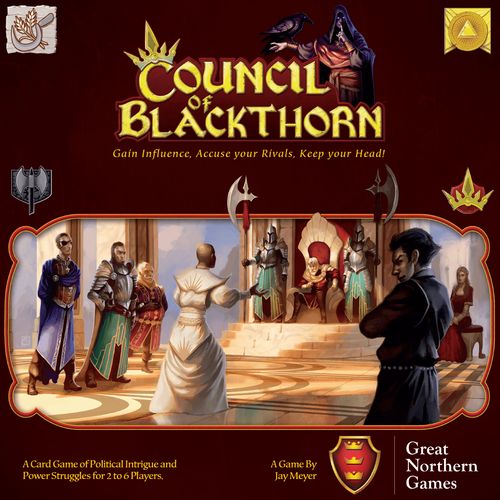
Council of Blackthorn
Council of Blackthorn Rulebook
Table of Contents
Table of Contents
- Game Overview and Objective
- Game Elements
- Faction Cards
- Whispers Cards
- Treason Cards
- Influence Tokens
- Faction Dice
- Game Set-up
- Round
- Turn Sequence
- End of A Round
- Winning the Game
- Two Player Game
- Strategy Hints
Game Overview and Objective
Council of Blackthorn™ is a board game for 2 to 6 players. Each player assumes the role of a member of the Council of Blackthorn. There are several different council member characters to play. Each player must build influence with the kingdom's political factions by playing ally and building cards. Custom dice change the game conditions for each round. As players gain influence and power, they also gain hidden Treason points. The players that appear to have the most power will typically gain more Treason points. The player with the most Treason points at the end of the game is beheaded for treason and is removed from the game. The remaining player with the most total influence points, wins the game.
Game Elements
Components
1 Game Board, 80 Faction Cards, 96 Treason cards, 8 Whispers Cards, 140 Influence Tokens, 4 Custom Dice, 6 Character Placards, 24 Character Tokens, 1 Right Hand of the King Token and 2 Turn Sequence Cards.
Characters
Each player assumes the role of a member of the Council of Blackthorn. Each character has a unique set of abilities and a set of unique character tokens. The abilities on the character placard supersede any game rules. The character tokens are used on the game board to measure each player's influence with the factions.
Character Tokens
The six council members are: Lord of the Tower, Lord of War, Master of Shadows, Minister of Coin, Queen, and Seventh Vigil.
Factions
There are four political factions in the kingdom of Blackthorn: Noble, Guild, Peasant and Legion. Each faction has a unique symbol, a set of faction cards, a matching colored faction die and a faction scoring track on the board (see below).
Game Board
Each faction has a separate track on the board with 9 levels and influence values ranging from 0 to 13 points. As a player gains influence with a faction, his or her character token will be moved to a higher level on the respective faction track. Influence with factions is important for two reasons:
- At the end of the game, each player adds his or her influence value in each faction to his or her total influence points.
- Influence level in a faction triggers faction card abilities throughout the game.
Faction Cards
There are 4 types of faction cards (one for each faction). See the Factions: Cards, Dice and Tracks diagram below.
Faction Card Diagram Key
- Faction symbol
- Card name
- Card class
- Trigger
- Text effect
- Building icon
- Building value
- Faction die
- Faction track
Card Class
There are two classes of faction cards: Ally and Building. In general, cards are discarded after they are resolved. However, Building cards that are triggered remain in-play. Building cards have two types of text effects: Permanent game effect or an Action effect. Action effects of in-play Building cards may be invoked at the beginning of a player's turn.
Trigger
Trigger is a very important game mechanic in Council of Blackthorn™. Trigger is the minimum influence value of a faction a player must have to enact the text effect of a card when it is played. A player may play any faction card regardless of whether or not the text effect is triggered.
EXAMPLE: Player A plays the Noble Faction card King which is triggered on a Guild faction value of 5 or higher. That player has a Guild faction value of 7. The text effect is enacted.
EXAMPLE: Player B plays the Guild Faction card Merchant which is triggered on a Peasant faction value of 4 or higher. That player has a Peasant faction value of 2. The text effect is ignored.
Building Icon and Building Value
The Building icon is a visual aid only that is placed on each Building card. The Building Value is the number of influence points that a player will score at the end of the game if he or she has the Building card in-play.
Whispers Cards
Whispers is an Event class card which means the text effect of the card occurs automatically (no trigger is required). The card text is resolved immediately and is then discarded. Whispers cards force opponents to draw Treason cards from the Treason card deck.
Whispers cards are shuffled into the faction card deck during game set-up.
When a Whispers card is played, resolve the text in order:
- The player that played the card (i.e. the active player) gains one faction level in any faction that he or she chooses.
- Identify the player that has the highest faction score on the Noble track. That player must draw a Treason card from the Treason deck (keep it hidden). If there is a tie for highest Noble faction score, the active player chooses which of the tied players will draw. NOTE: If the active player has the highest faction score, no player receives a Treason card for that faction. After completing the Noble track continue around the board in the clockwise direction i.e. Legion, then Peasant, then Guild. Any player that has 0 faction points does not receive a Treason card even if he or she is tied for highest faction score.
- The player with the highest number of in-play building cards (include Buildings "under construction") must draw a Treason card. If that player is the active player, no card is drawn. If there is a tie for most in-play Buildings, the active player chooses which of the tied players will draw a Treason card.
Treason Cards
All council members engage in treasonous acts to gain influence i.e. Bribes, Spies and Poison. The difference between a great council member and a poor council member is the ability of the council member to cover his or her tracks. When a player receives a Treason card, it means there is a trail of evidence that ties that player to a treasonous crime. Raising suspicion with the King!
Players secretly accumulate Treason cards throughout the game. They are kept hidden from opponents and are not placed in a player's hand i.e. they cannot be played like a faction card. There are 4 types of Treason cards (96 total cards): Rumor (48), Bribe (24), Spy (18) and Poison (6). Each is worth a different number of Treason points. Rumor cards are worth 0 Treason points and thus cause no harm to a player. A Poison card is worth 3 Treason points and is the worst Treason card to possess. At the end of the game, each player will reveal his or her Treason cards and add up the total Treason points. The player that accumulates the highest number of Treason points at the end of the game is beheaded by the King for treason and is removed from the game.
When Treason cards are discarded, they are discarded face-up into a Treason card discard stack. When the Treason card draw deck is depleted, re-shuffle and form a new Treason card draw deck.
Influence Tokens
Influence tokens are used to measure each player's hidden influence during the game. There are four denominations of influence tokens (140 total tokens): 1s (50), 2s (45), 3s (25) and 5s (20). All influence tokens have the same back (blue influence symbol) and are meant to be kept face-down so that players cannot directly determine another player's total influence score. Influence tokens are placed in a bank (face-up) in the center of the board (separated by denomination). At the end of the game, these token values are directly added to a player's total influence points.
The symbol for an influence token point is the influence symbol. Example: Gain 2 influence points means take 2 influence POINTS from the bank, not 2 influence tokens.
Faction Dice
There are 4 custom dice used in the game called "faction dice". Each die has 6 sides with the following values: 0, 1, 1, 2, 2 and 3. The "blank" face on each die is considered a "zero". Each die is associated with one faction: Noble (Red die), Guild (Yellow die), Legion (Black die) and Peasant (White die). These are rolled at the beginning of each round and determine how faction card effects are resolved when they are played.
Game Set-up
- Each player rolls the dice. The player that rolls the highest, receives the Right Hand of the King token (i.e. the Ring Token) and chooses a character to play. That player receives the respective character placard and four matching character tokens. One character token is placed on the zero point faction level of each faction scoring track. Each player in clockwise order chooses a character to play and places his or her character tokens in the same manner.
- Shuffle the faction card deck (which should include 8 Whispers cards) and create a Faction card draw deck.
- Deal each player 5 cards from the faction card deck.
- Create a bank of influence tokens in the center of the board (tokens are placed face-up and are separated by denomination). Each player starts the game with 3 influence token POINTS.
- Shuffle the Treason card deck and create a Treason card draw deck. Deal 3 Treason cards to each player (face-down).
Round
Council of Blackthorn™ is played in a series of rounds. In each round, each player takes one turn. The "Right Hand of the King" must take the first turn of each round. The "Right Hand of the King" has the ring token.
At the beginning of each round, the Right Hand of the King rolls all of the faction dice. Place each faction die near its respective faction track on the board (in the matching colored boxes). These dice values are used by all players for the rest of the round (note: some players may have the ability to change dice values).
Turn Sequence
Each player takes one turn each round starting with the Right Hand of the King and continuing in a clockwise player order. The term "active player" refers to the player that is currently taking his or her turn. There are five phases in each turn which are resolved in order:
- Complete Building Construction (if applicable)
- Action: Character or Building
- Play a Card
- Draw
- Score for Control
1. Complete Building Construction
All of the active player's in-play building cards that are "under construction" (played in a previous turn) are immediately rotated to the straight up position to indicate that construction has been completed and that the building card text is now in effect.
2. Action: Character or Building
The active player may invoke ONE "action" per turn from either one of his or her in-play completed Building cards (that has an Action) or from his or her Character placard. Note: Not all buildings or characters have "Actions" available to invoke.
3. Play a Card
The active player may play one card from his or her hand per turn.
If the card is an Event class card e.g. a Whispers card, the card is immediately and automatically resolved and then discarded.
If the card is a faction card, it has two effects that must be resolved (in order): Dice Effect and the Text Effect.
- The Dice Effect is ALWAYS resolved and is resolved before the Text effect of a card. The Dice effect is resolved even if the Text effect is not resolved.
- The Text Effect of a card is only resolved if the active player has enough influence with the faction that triggers the card.
Resolve Dice Effect (resolve first)
When a faction card is played, the Dice Effect must be resolved first. How the Dice effect is resolved is determined by the value of the faction die that matches the faction of the played card e.g. if you play a Noble card, the value of the Noble die (red die) determines the Dice Effect.
- If the matching faction die is a zero (blank): The active player gains no level on the faction track that matches the faction of the played card. Instead, the active player targets an opponent. That opponent must take a randomly drawn Treason card from the active player (and keep it). The passed card is kept hidden.
- If the matching faction die is a 1: The active player gains one level on the faction track that matches the faction of the played card.
- If the matching faction die is a 2: The active player gains two levels on the faction track that matches the faction of the played card.
- If the matching faction die is a 3: The active player gains 3 levels on the faction track that matches the faction of the played card. Then, the player must also draw 2 Treason cards from the Treason draw deck.
A player must gain the exact number of faction levels as indicated by the respective faction die. However, if the faction die would cause the player to move beyond the 13 point faction level (i.e. the highest faction point level), the player must stop on the 13 point faction level (the gain in levels does not have to be exact in this case).
After the 5 point faction level, players start to score more than 1 faction point each time they gain one faction level. For example, if a player is located on the 9 point faction level and gains one faction level, he or she moves his or her character token into the 13 point faction level. Even though the player gained only one faction level, he or she gained 4 faction points.
Blocking a Faction – 13 Point Faction Level
Players can share any faction level with multiple opponents except for the 13 point faction level (a.k.a. the highest faction level).
When a player moves his or her character token into the 13 point faction level of a faction, he or she "blocks" that faction. After that, no opponent can move into the 13 point faction level of that faction (a.k.a. it is "blocked"). Once a faction is blocked, each player must now stop at the 9 point faction level (the gain in levels does not have to be exact in this case). A player can only be moved downward (a.k.a. bumped) from a 13 point faction level by a text effect or character ability that reduces a target player's faction level.
IMPORTANT!
IF A PLAYER'S TURN ENDS AND THERE ARE AT LEAST 3 "BLOCKED" FACTION TRACKS, the game ends at the end of the current ROUND i.e. declare that the game over condition has been met and then allow each player that has not yet taken a turn in the current round to complete his or her turn.
Resolve Text Effect (resolve AFTER the Dice effect)
VERY IMPORTANT! Unlike the Dice effect, the Text effect of a card is only resolved if the active player meets the Trigger requirements of the card.
Resolving Text Effect of Buildings vs. Ally Cards
The Text effect of Building cards and Ally cards are resolved differently. With both card classes, if the text effect was NOT triggered, the Text effect of the faction card is not resolved and the card is discarded into the community discard stack. If the text effect is triggered, resolve the Text effect based on the card class:
Ally: Resolve the Text effect and then discard the Ally card (face-up) into the community discard stack.
Building: DO NOT immediately resolve the text. Place the card in-play face-up in front of you. Rotate the Building card 90 degrees in a clockwise direction to indicate that the Building is "under construction". The Text effect of the Building is not available for the player to use until the beginning of his or her next turn. Building cards remain in-play for the rest of the game if their Text effect was triggered when the card was played (Note: If the player's faction score is lowered below the required trigger level later in the game, the Building card remains in-play).
Dice Modifiers to Text Effects
- If you play a faction card with a matching faction die that is a zero: The Text is resolved even if the player does not have the proper faction score to trigger the Text effect i.e. the text effect is "auto-triggered". In the case of a Building, the Building card is automatically placed in-play "under construction".
- If you play a faction card with a matching faction die that is a 3: The text is NOT resolved even if the player has the required faction score to trigger the card effect. In the case of a Building card, the card is NOT placed in-play and is discarded even if the player has the proper faction score to trigger the Text effect.
4. Draw
The active player draws cards from the faction draw deck until he or she has a hand of 5 cards. The active player may discard one card of his or her choice from his or her hand before drawing any cards. The card is discarded face-up into the community faction card discard stack. If the faction deck becomes depleted, re-shuffle the discard stack and create a new faction draw deck.
5. Score for Control
The active player scores influence token points for the following (take influence tokens from the bank):
- The active player scores 2 influence token points for each faction that he or she has the highest faction level score. If the player is tied for highest faction level score (and is above 0), he or she receives 1 influence token point.
- The active player scores 2 influence token points if he or she has the most in-play Building cards (include Buildings "under construction"). If the active player is tied for most in-play Building cards (and has at least 1 in-play Building), he or she scores 1 influence token point.
End of A Round
After each player has played one turn, the round ends. The game may end or another round may be played based on the following:
- If any player's turn (during that round) ended with at least 3 "blocked" faction scoring tracks, another round is not played and the game ends (proceed to Winning the Game) i.e. once a player's turn ends with at least 3 blocked factions, the game ends at the end of that round (all players get the same number of turns in each game).
- If the above did not happen during the round, another round is played. The "Right Hand of the King" token is passed one player to the left. The dice are re-rolled and a new round begins. Note: The Right Hand of the King plays the first turn of the current round and will play the last turn of the following round.
Winning the Game
At the end of the game, resolve the following steps in order:
-
Each player adds up his or her total influence points. DO NOT REVEAL TREASON CARDS AT THIS POINT. Influence points are scored from 3 sources:
- Faction Tracks: Each player receives influence points equal to the sum of all faction levels that he or she achieved.
- Influence Tokens: Each player receives the total of his or her acquired influence tokens.
- In-play Building Cards: Each player receives influence points for each in-play building card that he or she controls. The player receives the full Building value of influence points for each "completed" in-play building card (See – Factions: Cards, Dice and Tracks Diagram). Each player only receives 2 influence points for each in-play building card that is "under construction".
EXAMPLE: The Master of Shadows reached the 7 point faction level on the Noble track, the 3 point faction level on the Legion track, the 13 point faction level on the Peasant track and the 0 point faction level on the Guild track, he scores 7 + 3 + 13 + 0 or 23 influence points. He also has a total of 38 points of influence tokens. Finally he has 1 in-play building under construction for an additional 2 points. His total influence score is 23+38+2 or 63 points.
-
Each player (one at a time), beginning with the player with the lowest total influence points, reveals his or her Treason cards and adds his or her total Treason points. The last player to reveal his or her Treason cards should be the player with the highest total influence points.
-
The player that scored the most TREASON points is beheaded by the King for treason and is out of the game. If there is a tie for most Treason points, all tied players are beheaded. If a player scores 0 total Treason points, he or she is not beheaded (even in the case of a tie). It is possible for all players to be beheaded!
Two Player Game
In a 2 player game, you must add a "ghost" player. The ghost player must use four matching character tokens that are not being used by the "live" players. Place one of the ghost player's character tokens on the 0 point level of each faction.
- The ghost player does not use a character placard or have any character abilities.
- The ghost player does not have influence tokens, Treason cards or a hand of cards.
- The ghost player cannot target or be targeted by a player with the following exception: the ghost player can be targeted by a card or character effect that changes one or more of the ghost player's faction level(s).
- The ghost player does not have a score and cannot be beheaded i.e. it cannot win or lose the game.
- The ghost player takes its turn at the end of the round.
During the ghost player's turn, one faction card is drawn. The card text is never resolved. The ghost player gains the number of levels that matches the faction die of the drawn card e.g. if a Guild card is drawn and the Guild die is a 2, the ghost player gains two faction levels on the Guild faction track and then the drawn card is discarded. It is possible for the ghost player to "block" a faction (i.e. move into the 13 point faction level) and the block can create a game over condition.
There are two special situations for the ghost player when playing a card:
- If the ghost player draws a faction card that matches a "zero" faction die, each "live" player must draw one Treason card.
- If a Whispers card is drawn, the ghost player gains one level in each faction and the "live" players must draw Treason cards per normal rules. If the "live" players are tied for highest faction level or most in-play Building cards, they must both draw a Treason card.
In a two player game, a player is only beheaded if he or she has at least two times his or her opponent's total Treason points. If player A has 0 Treason points, any non-zero score for player B results in being beheaded.
Strategy Hints
- Typically a player that jumps out to an obvious lead too early in the game will get beheaded. Keep a low profile as long as you can!
- Early in the game, players do not have enough faction influence to trigger cards. Don't try to save the perfect card. The early part of the game is about building influence. You will have to waste perfectly good cards early in the game! Don't worry about it, you will get more cards later.
- Focus on building influence in one or two faction tracks until you gain enough influence to trigger your played card's text effects. Trying to build influence in all four faction tracks at the beginning of the game is a very difficult strategy to implement successfully.
- If you have a great building card, you may want to play it on a "zero die" early in the game so you can maximize the benefit of the card. Playing a card on a "zero" die automatically triggers the text effect of the card.
- Don't wait until it is too late to start getting rid of Treason cards. The game may end sooner than you expect.
- An occasional reminder to everyone about who you think is in the lead is a great way to deflect attention. Do it too often and it will focus everyone's attention on you.