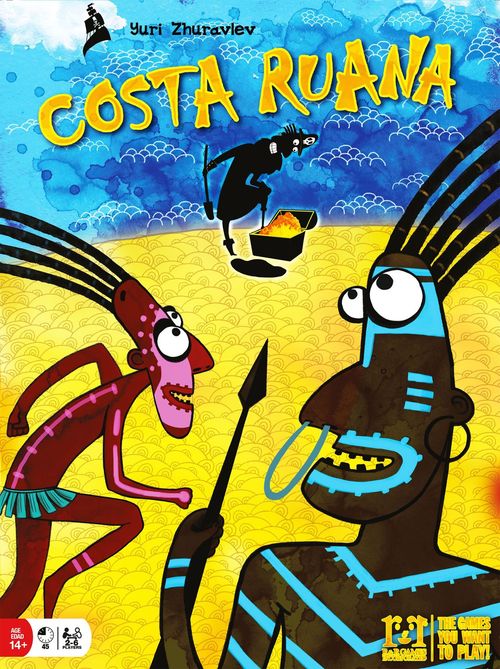
Costa Ruana
Costa Ruana Rulebook
Table of Contents
Table of Contents
Game components
- 72 playing cards: Move treasures, Place natives, Return natives, Move natives
- 2 Condition cards: High tide/Low tide and Day/Night
- 10 Island cards (each card can accommodate up to 7 natives)
- 60 natives (10 meeples in each of 6 colors)
- 50 gems (treasures)
- 6 huts (screens for players' treasures)
- 1 Shaman figurine
Aim of the game
The goal is to collect the most Respect points for the treasures in your hut and the natives in your supply at the end of the 5th round.
Game setup
- Prepare the game by sorting the cards: keep only the cards on which the number of white side-notches is less than or equal to the number of players. Shuffle the cards carefully and deal 5 to each player. Put the rest of the cards on the table face down to form a draw pile.
- Place the 2 Condition cards any side up in the center of the table.
- Place Island cards around the 2 Condition cards. The number of Island cards depends on the number of players:
- 2 players: 4 islands
- 3 players: 6 islands
- 4 players: 7 islands
- 5 players: 9 islands
- 6 players: 10 islands
- Place 4 treasures on any two Islands and 5 treasures on each of the remaining Islands.
- Choose the Shaman (the first player) randomly. He takes the Shaman figurine.
- Each player takes 10 natives and a hut of the same color, placing them in their supply.
- Starting with the Shaman and proceeding clockwise, players place natives on the Islands, one at a time, until each player has placed three natives. You can place natives on any Islands you choose but note that space on each Island is limited: there can never be more than 7 natives in total on the same Island.
You can start playing now!
Game play
The game consists of 5 rounds. Each round is structured as described below.
1. Play 2 cards and place a native
- Face-up card. Starting with the Shaman and proceeding clockwise, each player in turn places one card face up in front of themselves or in front of another player.
- Face-down card. Starting with the Shaman and proceeding clockwise, each player in turn places one card face down in front of themselves or in front of another player.
- Native. Starting with the Shaman and proceeding clockwise, each player in turn may optionally place one of their natives on any card played on the table (regardless whether the card is face up or face down, in front of themselves or in front of another player).
Cards affect the player in front of whom they are placed. Natives copy the effect of the cards for their owners.
Picture 2 example. Each player places one card face up: Antony places "Place 2 natives" card in front of himself (1), Mary places "Return 1 native" card in front of Serge (2), Serge places "Place 3 natives" card in front of himself (3). Each player places one card face down: Antony places a card in front of himself (4), Mary places a card in front of herself (5), Serge places a card in front of Antony (6). Each player places one native on any played card (optionally): Antony places his native on the card that he has played in front of himself (7), Mary places her native on Antony's card (8), Serge places his native on his own card in front of him (9).
2. The Shaman turns over a Condition card
The Shaman determines which cards will be activated during the current round by turning over one of the Condition cards on the table. Only cards with backgrounds that match the backgrounds now visible on the two Condition cards will be active in this round.
Picture 3 example. Shaman turned over one of the condition cards: in the current round only cards with backgrounds "Night" and "High tide" will be activated.
3. Reveal the cards
Turn over all the cards currently face down on the table so that they are face up.
Discard all cards whose background color does not match the backgrounds shown on the Condition cards. Immediately return any natives present on discarded cards to their respective owners' supplies.
All cards whose background colors match the backgrounds shown on the Condition cards will be resolved (see below). If there were any natives on them, they stay on these cards.
Picture 4 example. Mary has in front of her a "Place 3 natives" card whose background color does not match the backgrounds shown on the Condition cards. She discards it. Serge discards the "Return 1 native" card.
4. Resolve the cards
Beginning with the Shaman and proceeding clockwise, each player resolves all cards in front of them (for more information see the "Card Descriptions" section). If a player has several cards in front of them, they must be resolved in exactly the following order:
- Move treasures from one Island to another
- Return natives from the Islands
- Place natives on the Islands
- Move native from one Island to another
If a player has several cards of the same type in front of them, they may choose the order in which they are resolved.
The effect of a card in front of a player is initially applied to that player. Then, if there are natives (belonging to one or more players) on the card, the effect is applied to their respective owners, starting with the player who has the card in front of them (if they have a native on it) and continuing clockwise.
When the card has been fully resolved, discard it and return all natives placed on it to their respective owners' supplies.
Note. Card effects are mandatory and must be applied to the player in full. For example, if there is a "Place 2 natives" card in front of a player - he MUST place 2 natives. Players cannot choose to place just 1 native or ignore the effect of the card.
Exception. Sometimes a player is unable to apply a card effect due to restrictions imposed by the game rules. In such case they must apply the card effect to the fullest extent possible. For example, if a player is required to place a total of 3 natives on Islands but has only 2 natives in their supply, they place only those two natives.
Example (Picture 4). Antony is the first to resolve his cards. He takes 1 native back, places 2 natives on the Islands, moves 1 native and moves 1 native again (he copies the effect of this card). Mary moves 1 native (she copies the effect of Antony's card).
She doesn't have any cards in front of her, so it's Serge's turn to resolve his cards. He places 3 natives on the Islands and then he places 3 more natives (he copies the effect of his card).
Card Descriptions
Move a treasure. The player moves 1 treasure from one Island to another Island. There are no restrictions concerning the number of treasures on the same Island. For example, you may remove the last treasure from an Island or place 10 treasures on it.
Return 1, 2 or 3 natives. The player takes back from the Islands the number of natives shown on the card and adds them to their supply. Natives may be retrieved from any Island. There are no restrictions concerning the number of natives taken from a particular Island. If a player is required to return more than the total number of natives that they have on the Islands they simply return all their natives.
Place 1, 2 or 3 natives. The player takes the number of natives indicated on the card from their supply and places them on the Island. These natives may be placed on the same Island or on different Islands. If a player does not have enough natives in their supply they simply place as many as they do have.
Important: Natives present on played cards are not part of the supply!
Restriction: there must never be more than 7 natives in total on the same Island (whether from one player or multiple players).
Move a native. The player moves 1 native of their choice from one Island to another.
Unlike with the "Return natives" and "Place natives" cards, the player may either move one of their own natives or an opponent's native.
Restriction: there must never be more than 7 natives in total on the same Island (whether from one player or multiple players).
5. Collect treasures from the Islands
The Shaman, with the help of the other players, determines who deserves the treasure from each Island and awards it to the appropriate player (if any) as described below. In each round a maximum of 1 treasure is awarded from each Island. The procedure for each Islands is as follows:
- If one player has more natives on the Island than all the other players, he takes one treasure from this Island. He must also return their native from that Island to their supply.
- If several players have the same number of natives on the Island, these natives start arguing with each other and none of them receives any treasure from the Island. There can be several arguments on the same Island (for example, if two players each have 2 natives on an Island and two other players each have 1 native on that Island). In this case no one returns a native from that Island.
- If, on a particular Island, there are arguing natives AND a native belonging to a player not involved in the argument, that player collects the treasure and returns 1 of their natives from the Island to their supply. This situation occurs when on a particular Island there are either two players each with 3 or 2 natives or three players each with 2 natives AND there is also 1 native belonging to another player - this sole native gets the treasure and must be returned to its owner's supply. Note: Remember that there can never be more than 7 natives in total on the same Island.
- If there are no treasures left on an Island, no one collects treasure and no one returns a native from that Island.
Picture 5. The players collect treasures from the Islands. On the first Island there are only arguing natives, that's why nobody receives any treasure from the Island and no one returns a native from it. (Illustration caption: "No one collects any treasures".)
6. Preparation for the next round
- The player who collected the fewest treasures (including 0 treasures) during the current round becomes the Shaman (i.e. first player) for the next round. If several players are tied, the tied player sitting closest to the Shaman from the previous round (in a clockwise direction) becomes the new Shaman.
- Players put their treasures in their huts (behind their screens) so that nobody can see how many treasures they have collected.
- Each player draws 2 cards from the draw pile (bringing the number of cards in their hand up to 5) except in the last round when players draw only 1 card each (so that each player has 4 cards in their hand).
- After looking at the cards in their hand, the new Shaman may - if they wish - resign and choose any other player to be the Shaman for the coming round. The newly chosen Shaman cannot resign. The next round can now begin.
Picture 6. In the previous round Antony collected 1 treasure, Mary collected 1 treasure and Serge collected 3 treasures. Antony and Mary collected the fewest treasures and Mary will be the new Shaman (she is sitting closest to the Shaman from the previous round in a clockwise direction).
End of the game
The player with the most Respect points at the end of the fifth round wins the game. Each player receives 2 Respect points for each treasure collected during the game, plus 1 Respect point for each native in their supply (but not for natives on Islands). If several players are tied, the one with the most treasures wins.