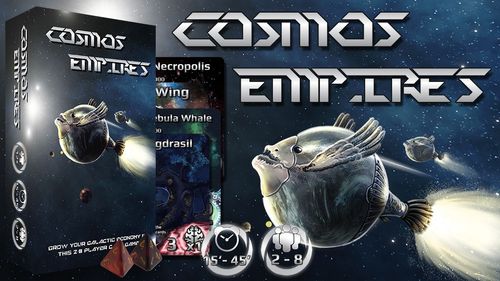
Cosmos: Empires
Cosmos: Empires Rulebook
Table of Contents
Table of Contents
How To Play
Setup
- Shuffle the deck then draw and place 10 cards face up in the centre for all players to see. This is called the "build pool".
- Give each player 8 Cosmic Credits. Use the silver tokens to represent 1 Credit and the yellow tokens to represent 5 Credits.
- Decide who plays first. Turns continue clockwise. The player who plays last is called the final player; give them the "final player" card to represent this.
Winning the Game
When any player reaches 30 total production (among all their cards), this becomes the final round. Turns continue until the final player completes their turn, and then the player with the greatest total production wins. (If the final player is the first to reach 30 production, they win immediately.)
If multiple players are tied, the player with the most Credits wins. If players are still tied, the player who played last wins.
Gameplay
Each player has 2 actions per turn.
On your turn:
-
Roll the production dice (two D4) and add them together. You may expend an action to shift the total up or down by one. (You can do this multiple times by expending multiple actions). Skip step 1 on each player's first turn.
-
Every player checks to see if they own any cards whose roll value total from the production dice. Those cards earn Credits equal to their combined production. (Note: Your cards produce Credits every time their roll value is confirmed, regardless of whose turn it is.)
-
Use your remaining actions to either:
- Build a card from the build pool, or
- Cycle a card and take 2 Credits
You can do either of these multiple times. Card abilities can be used immediately after you build the card (on the same turn), and can be used each turn without consuming your usual actions.
-
When you are done, pass the dice to the next player.
To summarise, you may use your actions in three ways:
- Shift your roll up or down by 1
- Build a card
- Cycle a card and take 2 Credits
7-8 Players
For 7+ players, make the following changes:
- The final round is triggered at 20 production instead of 30.
- Each player has 3 actions per turn instead of 2.
Building
Choose a card from the build pool, decrease your Credits total by its cost, and place the card in front of you. That card belongs to you for the rest of the game, and will earn you production. Add a new card from the deck to the build pool to replace it.
Cycling
Choose a card in the build pool, place it at the bottom of the deck and draw a new card to replace it. Do not take 2 Credits unless you're doing it as a normal action (e.g. Deepspace Scouts' special ability does not earn 2 Credits).
Card Anatomy
Each card shows:
- Cost — Cost of this card when you build it.
- Ability — This card's special ability.
- Type — Relevant for special abilities. There are three types: Mech, Bio and Spirit.
- Roll value — What total value needs to be rolled on the production dice for this card to produce Credits.
- Production — How many Credits you get when the roll value is rolled.
Important Tips
Your cards: The cards that you build will sit in front of you for the rest of the game. We recommend organising them by roll value, lowest to highest, and stacking those with the same roll value, so when a number is rolled you can quickly figure out how much you earn from it in total.
Cheat Sheet: Some cards complement each other (e.g. Yggdrasil and Nautilus), so a good strategy might involve building complementary cards. The Cheat Sheet (overleaf) shows you all the cards in the deck, so it can help you make your plan, and it also gives you more details to fully explain how each card's special ability works.
Cheat Sheet
Nautilus
Cost: 1 Credit. Type: Bio. Roll Value: 2. Production: 2.
Roll Chance: 6.25%. Deck Quantity: 7.
Tips: This is the second-best value-for-money card in the game. As a Bio it synergizes with Yggdrasil. It is also the only card with a roll value of 2, so you will need it (or a Darkspace Hub) to maximise your Transit Hub.
M.E.R.V.
Cost: 5 Credits. Type: Mech. Roll Value: 4. Production: 3.
Roll Chance: 18.75%. Deck Quantity: 7.
Tips: With seven copies in the deck, it is easy to get a second copy for The Collective and more for Ancient Gate.
Nebula Whale
Cost: 2 Credits. Type: Spirit. Roll Value: 6. Production: 2.
Roll Chance: 18.75%. Deck Quantity: 5.
Tips: This is the best value-for-money card in the game, but, as a Spirit, it does not synergize with many cards.
Ancient Gate
Cost: 3 Credits. Type: Mech. Roll Value: 7. Production: x1.
Roll Chance: 12.50%. Deck Quantity: 5.
Ability: Ancient Gate's production is equal to the largest set of the same card you have. For example; with 1 Nautilus and 3 T-Wings, Ancient Gate's production is 3.
Tips: This card can get big fast, great if you can get two or three early.
World Ship
Cost: 6 Credits. Type: Mech. Roll Value: 3. Production: 4.
Roll Chance: 12.50%. Deck Quantity: 5.
Tips: This card has one of the highest flat production values, great to scale your income and total production.
The Librarian
Cost: 5 Credits. Type: Spirit. Roll Value: 5. Production: 3.
Roll Chance: 25.00%. Deck Quantity: 7.
Tips: 5 is the most likely roll value; this card is best if everyone has plenty of credits and will not be shifting their roll often.
The Collective
Cost: 8 Credits. Type: Spirit. Roll Value: 6. Production: x2.
Roll Chance: 18.75%. Deck Quantity: 3.
Ability: Production is equal to twice the number of card names you have with more than one copy. Example: If you have a T-Wing, 2 M.E.R.V.s, 4 Nautilus, and a Collective, its production would be 4 since you have two "pairs".
Tips: This card has great potential, but you need to plan for it!
Beacon Hub
Cost: 4 Credits. Type: Mech. Roll Value: 8. Production: x1.
Roll Chance: 6.25%. Deck Quantity: 5.
Ability: This cannot reduce costs to below 0 credits, but you can buy cards for free with this ability, and multiple Beacon Hubs provide a cumulative discount. Mechs cost 1 Credit less for you.
Tips: Synergize this card with Fabricator Belt and churn out smaller mechs.
Yggdrasil
Cost: 7 Credits. Type: Bio. Roll Value: 3. Production: x1.
Roll Chance: 12.50%. Deck Quantity: 5.
Ability: Yggdrasil counts itself as a Bio, so with 2 Nautilus and 1 Yggdrasil, your Yggdrasil's production is 3. Production is equal to the number of Bio cards you have.
Tips: Grab all the Bios! You will probably be racing other Bio players for this card.
Fabricator Belt
Cost: 7 Credits. Type: Mech. Roll Value: 5. Production: 1.
Roll Chance: 25.00%. Deck Quantity: 5.
Ability: This does not count as an action; you may do this once per turn for each Fabricator Belt you own in addition to your normal actions. You must still pay the card's cost. Each turn, you may build an extra Mech.
Tips: Great in combination with Beacon Hub.
T-Wing
Cost: 1 Credit. Type: Mech. Roll Value: 7. Production: 1.
Roll Chance: 12.50%. Deck Quantity: 5.
Tips: Great card to get with Fabricator Belt and Beacon Hub.
Transit Hub
Cost: 7 Credits. Type: Mech. Roll Value: 8. Production: x1.
Roll Chance: 6.25%. Deck Quantity: 5.
Ability: Transit Hub counts itself when checking its set. For example; with 1 Nautilus, 3 T-Wings and a Transit Hub, its production is 3. Production is equal to the number of different roll values you have.
Tips: This card gets large fast, but has a hard limit at 7 production.
Seraph Gate
Cost: 5 Credits. Type: Bio. Roll Value: 4. Production: 1.
Roll Chance: 18.75%. Deck Quantity: 5.
Ability: This does not count as an action; you may do this once per turn for each Seraph Gate you own in addition to your normal actions. You may shift your production roll by 1.
Tips: Great if you have cards concentrated on a few roll values.
Discovery
Cost: 2 Credits. Type: Mech. Roll Value: 6. Production: 1.
Roll Chance: 18.75%. Deck Quantity: 5.
Tips: Great card to get with Fabricator Belt and Beacon Hub.
Deepspace Scouts
Cost: 3 Credits. Type: Mech. Roll Value: 7. Production: 1.
Roll Chance: 12.50%. Deck Quantity: 5.
Ability: This does not count as an action; you may do this once per turn (after your roll) for each Deepspace Scouts you own, in addition to your normal actions. Once per turn, you may cycle once. You do not take credits for this ability, unlike when cycling as an action.
Darkspace Hub
Cost: 6 Credits. Deck Quantity: 5.
Ability: You set this card's roll value to any number (2-8) when you build it and, once set, it cannot be changed. Use a die to mark the chosen number. As the ability states, you cannot set it to match the roll value of any cards you already own. Note: this locks you out of ever buying other cards with that roll value.
NOTE:
Culture cards are an optional expansion to the main game of Cosmos: Empires. We recommend adding them in after you have already played and are experienced with the main game of Cosmos: Empires, to spice it up a little. If you want to play with them immediately, read the basic rules first.
Culture Cards
Culture cards are cards each player starts the game with and benefits from all through the game. They are hidden when the game starts, but their abilities won't activate until revealed, so choose wisely when to show them. The game is otherwise played as normal.
Using Culture Cards
There are two different ways to play using culture cards: Single Culture or Hybrid Culture. Decide with your group which version you would like to play ahead of time.
Single Culture
First, set up the play area and the build pool as normal. Then, divide all culture cards equally between players (set aside the remaining cards face-down if you cannot divide evenly).
Each player secretly chooses a card from among them to keep and discards the rest face down.
Hybrid Culture
Rather than setting aside all but one of the culture cards they were dealt, each player keeps all their cards, starting the game with more than one culture.
Begin the game as normal, bearing in mind your special advantage.
As you play, you may reveal your culture cards at any time in order to benefit from their abilities. Culture cards have no effect while hidden.
Some culture cards require that you reveal them to activate a special ability. Once revealed, these cards cannot be hidden again unless they say otherwise; if they can be, revealing them again has the same effect as the first time.
That's it! Each culture card will give you different strengths and opportunities, so make sure to adjust your strategy to optimise the effectiveness of your cards, and enjoy!
Culture cards are a Kickstarter backed stretch goal, sponsored by you! To learn about any of our future crowdfunding projects and get in on exclusive material like this, visit www.biggerworldsgames.com
Culture Card List
Awakened
Ability: This is a passive effect that you benefit from for the rest of the game after revealing the card. Spirits cost 1 Credit less for you.
Tips: Usually great at the very beginning of the game, but you might want to keep it hidden before your turn starts so people don't take your spirits!
Industrious
Ability: Once per turn, if you would purchase a card which costs 3 Credits or less, and there is a second copy of it in the build pool, you may build the second copy immediately for free. This only applies if both copies were already in the build pool, not if the second was drawn to replace the first. It can also only trigger once per card you build, so you cannot use this ability to build two cards for free from a single build.
Tips: Usually great at the very beginning of the game, but you might want to keep it hidden before a pair appears so people don't take them from you!
Innovative
Ability: Reveal this card: This turn, each time you build a card you get 1 Credit. On your next turn, hide this card; you cannot reveal it until the turn after. This effectively means you can use the ability every second turn (at most). You get credits even if you buy something for free (due to Beacon Hub, for instance) and even if it doesn't use one of your actions.
Tips: Use the down-turns to cycle, and buy a lot on the turns you activate this card.
Militaristic
Ability: Reveal this card at the end of the game: If you have the largest number of cards among all players, you get +7 total production. You cannot reveal this card early to end the game early. It does not count towards the production required to trigger the final round.
Tips: How many more cards you have doesn't matter, so be careful you don't over-invest in just getting a large card-count.
Orthodox
Ability: Reveal this card at the end of the game: Your total production increases by the quantity of the two cards which you have the most copies of. Example: If you have a T-Wing, 2 M.E.R.V.s and 4 Nautilus, Orthodox would provide 6 more production. You cannot reveal this card early to end the game early. It does not count towards the production required to trigger the final round.
Tips: This has great synergy with Ancient Gate.
Resourceful
Ability: When you cycle as an action, you get an additional 3 Credits. This means you would get 5 credits instead of 2 when cycling with the standard rules. Note, this does not count cycles using other card abilities such as Deepspace Scouts.
Tips: Actions are still valuable, so don't forget to still buy cards when you can!
Scientistic
Ability: Reveal this card: You may build cards from the deck this turn. You may look at the whole deck and select cards to build from it. Don't change the deck order until you complete your turn, taking cards from the top like normal if building from the build pool. Shuffle the deck when you finish your turn.
Tips: Great to ensure critical cards for a combo or have a perfect start. Note, this is also the only way to shuffle the deck in the game.
Transcendent
Ability: Spirits are also Bios for you. This mainly counts for Yggdrasil and other such card-type synergies.
Tips: Spirits are very efficient, so this lets you get them first and then synergise off Yggdrasil later.