Cosmic Supreme
Cosmic Supreme Rulebook
Table of Contents
Table of Contents
- More Cosmic Encounter
- 7.0 Other Destiny Cards
- Optional Rules
- 9.0 Inverted Planetary System Hexes
- 10.0 Inverted Warp Hex
- 11.0 Lucre
- 13.0 Moons
- 14.0 Changes Required by the Expansion
- 15.0 Special Alien Powers
- Simply Cosmic
- Setup
- Description of Alien Power Cards
- How To Win
- Overview of Play
- Description of Icons
- Description of the Warp
- A Player's Cards
- Description of Flares and Edicts
- Description of the Pre-Challenge Phase
- Description of a Challenge
- Timing Conflicts
More Cosmic Encounter
The More Cosmic Encounter expansion adds colourless cones and Comet cards to the Destiny deck, inverted planetary system hexes and an inverted Warp hex, Lucre, Moons, changes to some base-game Alien Powers, and special Alien Powers with artefacts.
This rulebook is an English translation of the More Cosmic Encounter sections of a community Italian translation, "Cosmic Encounter & More - Regolamento" (Regolamento Base e Regole Opzionali di Cosmic Encounter e dell'espansione), translated by Guido "The Goblin" Ceccarelli, Rome, 1997. It is not an official Mayfair Games document, and no English-language rulebook for this material was located. Only the expansion's own rules are reproduced here (sections 7.0-7.2, 9.0-11.0, 13.0-15.0); the base-game rules printed in the same document are not transcribed. Obvious typographical errors in the Italian source were corrected in translation, and the Moon category icons are described in words. "GO" is the offense player (the active player) and "GD" is the defense player.
7.0 Other Destiny Cards
By default, as described in game setup (1.2), the Destiny deck contains only the base Destiny cards: coloured cones on a white background, or inverted black cones on a coloured background. The composition of the Destiny deck can be varied by including the special Destiny cards of the expansion: colourless cone cards and Comet cards.
During setup, shuffle the Comet and colourless cone cards together, then include one of these cards at random for each player in the normal Destiny deck. Each time the Destiny deck must be reshuffled, remove the last of these additional cards that was played and replace it with another, at random, from those that were left out of play. Players may also choose to replace all of these cards instead of only the last one, to add variety to the game.
7.1 Colourless Cones (Optional)
Colourless cone cards are special Destiny cards that are not linked to a colour directly, but only through the instructions printed on them. The text on the card allows the GO to identify the system against which it must make its Challenge. For those Alien Powers whose effects depend on colour (Assassin or Will, for example), treat these cards as if they were of the colour of the player indicated by the instructions above.
The Dictator Alien Power may still direct the cone as it chooses, unless the description can be applied to more than one player; in that case the Destiny card turned over is treated as a wild card, and the Dictator has no effect.
If the instructions indicate the GO itself, treat it as if a Destiny card of the GO's own colour had been turned over: the GO may choose to ignore it and draw the next card. If the instruction could refer to more than one player, the GO chooses among them which one it will attack. The Assassin Alien Power may in that case choose a different target from those matching the description, as if it were a wild card.
Cards that refer to a Regular Challenge indicate that the GO may make a Challenge in that player's system, attacking them on a planet or attacking the occupant of a Moon in the system (or occupying a free Moon). Cards that refer to a Warp Challenge indicate that the target will not be an opposing base, but the ships of a player that are in the Warp, with the results detailed on the card itself.
If the inverted planetary system hexes (9.0) are used, the Worldships player may use any such cards it holds as if they were a normal Destiny card, and may use a normal card to replace one of these special cards when it is drawn. If the inverted Warp hex (10.0) is used, the section of colour corresponding to the system in which the Challenge took place is the one emptied into the Warp (or the Defense's section in the case of a Warp Challenge).
7.2 Comet Cards (Optional)
Comet cards are Challenge modifiers: they establish additional or special rules for the duration of the next Challenge only. Note the effect in force and draw a new card from the Destiny deck, ignoring any other Comets drawn, until a Destiny card identifying the Defense of the Challenge is drawn. Even if several cards must be drawn after a Comet before the target of the Challenge is identified, the first Comet drawn will still affect how the contest unfolds.
If the inverted planetary system hexes (9.0) are used, the Worldships player may play a Comet card it holds even after the Destiny card that establishes the Defense of the Challenge has been turned over, provided this happens before the hyperspace cone is pointed at the target.
Optional Rules
The following rules are all optional and may therefore be adopted in whole or in part by the players, by mutual agreement before the start of the game.
9.0 Inverted Planetary System Hexes
Each of the systems has an uncoloured back, different for each hex, which represents a peculiarity of that player. The effects produced by the inverted hexes are very powerful, so players should agree to use either all or none of this version of the game, in order to keep it balanced.
It is nonetheless possible to give an inexperienced player more chances by allowing them to play with the inverted hexes while the more skilled players use the normal side of the planets.
When using this version, during setup the system hexes are chosen before the Alien Powers, optionally drawn at random based on the colours of the normal side. The peculiarities of each system are described below.
BINARY. During setup this player distributes its ships among the six planets as it wishes. When the Alien Powers are assigned, the Binary player draws two Flare cards and assigns the two Alien Powers to its two stars. From then on it may use both powers, but not together in the same Challenge. If the Binary player loses two bases in one of the two systems, it also loses the use of the corresponding Alien Power, while the other remains unchanged. To lose both Alien Powers, the Binary player must be reduced to one or fewer bases in each of the two systems.
GAS GIANT. During setup this player places its 20 ships on the surface of the planet as it wishes. These ships may later move off the planet normally, but the Gas Giant player must always have at least three ships on the planet to keep its Alien Power. When the Gas Giant is the target of a Challenge, the phase proceeds normally until the allies have declared themselves. At this point, before the Challenge cards are selected, the Gas Giant player may withdraw as many ships as it wishes from the Challenge (provided at least one remains), setting them aside so that it is clear which are involved in the cone and which are not. Other players may have more than one base on the Gas Giant, shown by separate stacks of ships left after different Challenges; each such base may be targeted as if it were a normal planet in the base version. The Filth Alien Power has no effect on the Gas Giant. If the Sniveler Alien Power is in play, treat the Gas Giant as if it constituted three bases for its owner, unless the owner has fewer than three ships there, in which case the number of ships is also the number of its bases.
RINGS. The central planet and each of the rings count as separate planets. During setup the Rings player distributes its ships among them as it wishes. The rings and the central planet have special defensive characteristics: each adds the number shown on its hex to the number of ships present there when defending. For example, the central planet adds 10, while the outermost ring adds only 2. If the Rings player prefers, it may subtract these bonuses instead of adding them.
ROSETTE. During setup this player places its 20 ships on the six planets in any combination it wishes. When it is the target of a Challenge, the Rosette player may also use the ships present on the two planets adjacent to the one targeted by the hyperspace cone to compute the result. Ships on the adjacent planets are not at risk in case of defeat, and are added to the total only after the Challenge cards have been revealed and after any other effects. The player is never forced to add the adjacent ships (as when facing the Anti-Matter Alien Power), and it may evacuate its ships from the targeted planet to an adjacent planet, provided it has a base there. When trying to reconquer a base in its own system, the Rosette player may always add the ships of its bases on the planets adjacent to the one it is attacking; again, these ships are not at risk in case of defeat.
SPACE DUST. During setup this player removes three of the Destiny cards of its colour from the deck, including the one with the inverted cone, and sets them aside, reshuffling the rest of the Destiny deck. The Space Dust player places its 20 ships on the system in any way it likes; each of these ships counts as an independent base. When a ship is taken, its base disappears, and more than one ship cannot be stacked on the same base when ships are drawn from the Warp. As Defense, the Space Dust player, after the Challenge cards have been selected but before they are revealed, may play one of the Destiny cards set aside earlier to add 5 to its total in the Challenge. In case of defeat, that card is discarded on the discard pile of the Destiny deck. When a player wins a Challenge against Space Dust, its ships are stacked somewhere and form a single separate base, apart from the others.
WORLDSHIPS. During setup, after the Destiny deck has been shuffled, deal three of its cards to this player as a separate hand, immune from consolations, discards and other incursions. The player may later use these cards to replace a card turned over from the Destiny deck, either to avoid an attack or to deflect one of its own Challenges. If the replacement is a wild card, the player may make any decision about the target system. Both Destiny cards are then discarded. When the Destiny deck runs out, the Worldships player loses any unused cards and draws three new ones from the new deck. The Worldships player has no effect on the Will Alien Power.
10.0 Inverted Warp Hex
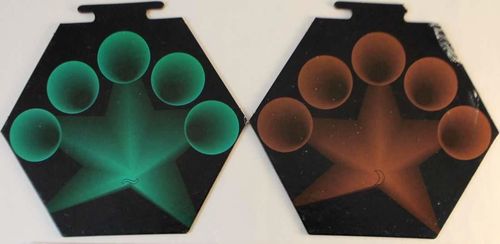
The reverse side of the Warp hex (which contains a coloured fan) may be used both with the normal system hexes and with the inverted ones (9.0).
The coloured fan printed on the reverse side of the Warp hex represents a kind of limbo, to which ships temporarily go before entering the Warp proper. Ships in this Limbo are inaccessible to the players and to Flare and Edict cards (including Mobius Tubes and Warp Break). All ships lost in a given Challenge go into the same coloured section of the Limbo, regardless of that section's colour and of the colour of the ships.
At the start, place a marker of any kind on the Limbo section of the colour corresponding to the first player. At the end of each Challenge, place all the ships lost in it into the Limbo section indicated by the marker, then move the marker to the next section clockwise. In each following Challenge, repeat this procedure.
Each time a card is turned over from the Destiny deck, some ships may slip from the Limbo into the Warp, where they become available to be drawn again. When an inverted cone is drawn, no ships pass into the Warp; otherwise, all the ships in the section of the colour drawn by the cone go into the Warp. If a wild card is drawn, the colour of the section emptied into the Warp is the one the GO has set for its Challenge.
11.0 Lucre
Yellow pieces bearing the money symbol represent Lucre, the currency in use in the universe. At the start of the game each player receives a number of Lucre equal to its starting position plus three (the first player will have 4, the second 5, and the fifth 8).
At the start of its turn, before drawing a ship from the Warp, each player receives three Lucre plus one for each base it owns in its own system, Moons included.
If the inverted system hexes (9.0) are used, the Gas Giant and Space Dust players nonetheless receive seven Lucre plus one for each Moon owned in their system, unless they have fewer than four ships in their system; in that case they receive that number plus three, as normal.
Lucre may be spent only by a main player (the GO or the GD), following the usual timing of events during the turn (so the GO acts before the GD in every phase).
There is no limit to the amount of Lucre a player may spend, and it may be spent several times for the same purpose, as listed below:
| Lucre spent | Turn phase | Use |
|---|---|---|
| 3 | 1 | Draw an extra ship from the Warp |
| 3 | 7 | Add 1 to the total in a Challenge |
| 6 | 8 | Add 1 to the total in a Challenge |
| 4 | 1-6 | Buy a card from the Challenge deck |
| 10 | 1-6 | Discard a card from hand |
| 7 | 1-3 | Buy a random Flare card from those not in play |
Naturally, money may also be used to influence an agreement, to persuade an uncertain ally, or to bribe a player into using, or not using, its Alien Power. It is worth bearing in mind, however, that this option may considerably lengthen the duration of the game.
13.0 Moons
Moons are the satellites that may be present in the planetary systems of the various players. Once occupied, they introduce further changes to the rules and to various aspects of the game in progress, making it even more varied and unpredictable.
The effects that each Moon has on the game may be mild or very heavy, so the Moon pieces are classified into four categories of complexity, represented by the following icons:
- Quarter Moons: cause effects that can be kept under control with a minimum of skill.
- Half Moons: cause effects that also require a little luck to be dealt with successfully.
- Full Moons: generate complex effects that can overturn the course of the game in a few moments.
- "Cheese" Moons: are often senseless or silly, or have little connection with the actual game in progress.
In this way, players can easily establish at the start of the game how much importance they wish to give the Moon factor, using only certain categories rather than all of them. It is advisable to begin with the simplest Moons, adding the other categories one at a time, depending on how random the effects on the game should be. With some experience it is possible to reach an ideal mix of Moons of the various types. All types of Moon use the same game rules described below.
13.1 Setting Up a Game with Moons
Once the players have agreed on the types of Moons they will use, make a stack with the corresponding pieces. Then, after the Alien Powers are assigned (1.3), each player draws two Moons at random and places them face down in its own system. Each player may look at its own Moons to learn their effects, then return them face down to its system. During the course of the game, each player may look at the face-down Moons in its own system as many times as it wishes.
13.2 Moon Effects
Moon effects may be recurring or sporadic, and may occur in a given phase of the turn rather than at any moment. Each Moon piece bears the usual timing icons and one of three wordings:
- Continuing: the effect comes into operation as soon as the Moon is revealed and remains in effect for as long as it is occupied. If another player occupies that Moon, the effect remains active but may transfer to the new occupant (unless it is of a global nature or specifies otherwise).
- Intermittent: the effect takes place as soon as the Moon is revealed, then ends, and does not repeat until the Moon is occupied again by another player. If a player abandons the Moon and then reoccupies it, the effect takes place again, unless this happens in the same Challenge in which it was abandoned.
- One-shot: the effect described for that Moon takes place once, and only once, in the game, when the Moon is revealed. The Moon is then discarded without being replaced by another Moon.
13.3 Challenges Against a Moon
When the GO draws a Destiny card, it may choose to make a Challenge against a Moon in the system of that colour, rather than against a planet, even if the Moon is not occupied by the player who owns the system. The GO may not make a Challenge against a Moon on which it already has a base. If it draws the colour of its own system, the player may choose to occupy, or make a Challenge against, a Moon in its own system, taking advantage of the fact that it already knows the Moon's effects.
If the Moon targeted by the Challenge is not occupied, the GO occupies it directly, without carrying out the full normal Challenge procedure. If the Moon is occupied by another player, that player is the GD for that Challenge, and not the owner of the system in which the Moon is located (as is normal for Challenges against planets; see 3.2).
The resolution of a Challenge against a Moon takes place as usual (3.3-3.9), with the exception that neither main player may invite allies, nor may alliances be created in any other way (with the abilities of the Magnet or Parasite Alien Powers, for example). A Challenge against a Moon is always "one against one", and only one player at a time may take a base on a Moon. That player is always the GD if the Moon becomes the target of someone else's Challenge, regardless of the system in which the Moon is located.
13.4 Occupying a Moon
When a player places a base on a Moon for the first time, it must immediately take the corresponding Moon piece and read its instructions. If the Moon bears the words "Play Now", the player must reveal the piece by turning it over, and the effects described take effect immediately. If the Moon bears the word "Secret", the player may decide whether to reveal it immediately or at any later moment, for as long as it is the occupant. If a player loses a Challenge on a "Secret" Moon it occupies (and so is the GD) before the Moon has been revealed, it may not reveal it until it reconquers that Moon later in the game.
A player may occupy, or make a Challenge against, a Moon that has already been revealed, but each effect of the Moon comes into operation as soon as it does so, whether the Moon is "Secret" or "Play Now". The icon shown on the Moon piece serves to time its effects with respect to the turn; it does not determine the phase in which the Moon must be revealed.
If a player removes all its ships from a Moon, it has deserted the base, which ends every effect of the Moon (even if Continuing). The Moon piece remains face up.
13.5 Value of Bases on Moons
Once occupied, a Moon is treated as a base in all respects, with the following exceptions: it does not count as one of the five bases needed for victory; it cannot be granted or acquired as the result of an agreement; and its occupation does not allow the Plant Alien Power to activate its ability. A Moon occupied in one's own system counts as an internal base for keeping one's own Alien Power and for calculating any Lucre gains (11.0).
14.0 Changes Required by the Expansion
Integration of the rules and clarifications. The following is intended to make it easier to integrate the base version of the game with its expansion, and to clarify how base and optional rules may be mixed, so that each group arrives at its own customised version of Cosmic Encounter.
14.0 Changes Required by the Expansion. Some cards and Alien Powers of the base game cannot take into account the components introduced with the More Cosmic Encounter expansion and its optional rules. It is nonetheless evident that interactions between them will occur, and these are listed below.
14.1 Cavalry Alien Power and its Flare card. The Cavalry player cannot use a Kicker card when using its power, but its Challenge card is affected by any Kicker played by the main player. When the Flare card of this Alien Power is played, in either the Wild or the Super version, any Kicker affects every Attack card played by the allies of the player who used the Kicker.
14.2 Chosen Alien Power and its Flare card. When this player draws for the effect of divine intervention, if it draws a Kicker before a Challenge card, the first of any Kicker cards applies to the Challenge card it will take. When the Flare card of this Power is played in the Super version, the player may keep any Reinforcement card it draws.
14.3 Chronos Alien Power and its Flare card. When Chronos declares a time journey, if its opponent has played a Kicker card, it must set that card aside together with the Challenge card played. The Flare card in the Wild version does not force a player to make a Challenge against a planet; it may make a Challenge against a Moon, if it wishes.
14.4 Clone Alien Power. This player may not keep the Kicker cards it plays.
14.5 Deuce Alien Power. Kicker cards affect only the main Challenge card of this player, not its additional card. The player must always declare which card is the main one.
14.6 Filch Alien Power. May not redraw Kicker cards played by the opponent.
14.7 Gambler Alien Power and its Flare card. This player may keep its Kicker card, if any, secret together with the Challenge card it plays, and may lie about both. The difference in score referred to in the Flare card in the Wild version is calculated after the effect of the Kicker cards.
14.8 Laser Alien Power and its Flare card. The opponent may play a Kicker card before the Laser player draws the Challenge card to be played for it. The Flare card in the Wild version, consequently, forces the victim to select its Kicker card, if any, before asking for allies.
14.9 Loser Alien Power. Players may use Kicker cards after the Loser declares the revolt, but before the Challenge cards are selected.
14.10 Mirror Alien Power. The reversal of the digits takes place after the multiplication caused by Kicker cards.
14.11 Oracle Alien Power. May not see the opponent's Kicker card, if any, before choosing its Challenge card.
14.12 Pentaform Alien Power. With the exception of the Moon "Moon Base Omega", bases conquered on Moons do not count toward the change of life stage.
14.13 Phantom Alien Power. As soon as a player receives this Alien Power (possibly during the game), it must turn over five of its ships that are in any combination of bases and place them on the star of its system. Losing the Alien Power prevents the player from using or creating further phantom ships, but it may always convert existing ones into normal ships by moving them from the star to the hyperspace cone.
14.14 Seeker Alien Power. This player may ask questions about the additional hand of the Miser Alien Power and the victory conditions of the Schizoid Alien Power.
14.15 Sorcerer Alien Power. When this player swaps Challenge cards, the Kicker cards stay where they are.
14.16 Visionary Alien Power. Has no power over Kicker cards, and specifies the Challenge card the opponent must play after each player has chosen whether or not to play a Kicker card.
14.17 Worm Alien Power. This player may not reposition the hyperspace cone so that it points at a Moon.
14.18 Edict card Keeper. Allows the player to keep Kicker and Reinforcement cards as well as Edict and Flare cards.
14.19 Edict card Plague. Also causes the discard of one Kicker card and one Reinforcement card.
14.20 Edict card Sanity. Also nullifies all effects of the Moons, and limits each player to the use of only one of its Alien Powers (if it has more than one).
14.21 Flare card Vampire. In the Wild version, it does not oblige a player to consider only bases on planets: ships may also be exchanged with a player on a Moon base.
14.22 Flare card Void. Does not affect only planets, but also allows the removal from the game of a Moon.
14.23 Worldships inverted hex. If this player has Comet cards in its special hand, it may use them in any Challenge.
15.0 Special Alien Powers
The incredible variety of effects caused by the various Alien Powers almost guarantees that conflicts or misunderstandings will arise. Sometimes the descriptions of Alien Powers seem vague, because it was decided not to limit the player in its actions, and this can lead to situations of abuse of certain Alien Powers. Moreover, despite the efforts of the designers and developers of the game, some combinations of Alien Powers are decidedly ambiguous. The examples below, which are the most frequent, show the approach to follow in resolving any uncertainty that arises from particular combinations in play.
15.1 Artefacts
Some Alien Powers use certain game components in a special way. These special objects, which other Alien Powers do not possess, are called Artefacts. For example, the victory conditions of the Schizoid, the additional pieces of the Symbiote, the additional hand of the Miser, and so on.
Most of these Alien Powers have on their card the icon indicating initial game setup, since artefacts can be acquired only at that moment. The general rule is that none of these Alien Powers can be acquired during the course of the game. If one is drawn later (for example because of the Reincarnator), it must be discarded and replaced with another.
The only possible way to acquire a Power of this type during the game is through the abilities of the Pentaform or the Changeling. If a Power of this kind passes from one player to another during the game, the artefacts are transferred along with the Alien Power. For example, if the Changeling were to clash with the Terrorist, it would also receive the list of bombs placed with the Power.
The Alien Powers with Artefacts are: Hurtz, Industrialist, Miser, Pentaform, Queue, Schizoid, Symbiote, Terrorist, Warrior and Witch.
15.2 Assassin, Dictator and Will Ambiguity
These three Alien Powers all relate to the drawing of a card from the Destiny deck, and may seem complicated to understand. The Assassin kills a ship of the colour drawn with the Destiny card, regardless of which system or colour is then attacked. The Dictator points the hyperspace cone at the system of its choice, regardless of the colour drawn, the colour hit by the Assassin, and the Will. The Will may enter a Challenge with the colour of its choice, regardless of the colour hit by the Assassin, but it is subordinate to the Dictator's choice of system, although within that system it may still attack any colour.
15.3 Loser and Insect Ambiguity
Can the Insect copy the Loser and counter a revolt? No. This is a prime example of the timing rules of the turn. The GO would have the opportunity to declare a revolt first. If it did so, the revolt would take place and the GD could do nothing about it. If the GO decided not to declare the revolt, the GD could do so, and in that case the GO could do nothing about it.
15.4 Silencer Ambiguity
What exactly this Alien Power prevents is generally clear, but it often causes confusion. In practice, every attempt to reach an agreement automatically fails, while normal play of cards that require no explanation is allowed. Any card or other game component that involves some indeterminacy, such as the need to select a target or to choose something (like the Edict card Plague), is forbidden by the Silencer, because it requires some form of communication from the player affected by this Alien Power.
The Silencer blocks the following Alien Powers: Anomaly (partially), Aura, Berserker (Challenge), Calculator, Chronos, Crystal, Delegator, Demon, Dictator, Diplomat, Doppelganger, Extortionist, Force, Gnome, Grudge (if it chooses), Healer, Hurtz, Judge, Lloyd, Loser, Magnet, Mesmer, Mind, Mirror, Mutant (by other players), Negator, Obverse, Pavlov, Phantom, Philantropist, Pirate, Plant, Prolong, Prophet, Queue (timing), Seeker, Serpent, Silencer, Siren, Skeptic, Sniveler, Sting, Trader, Visionary, Will (if the base has more than one colour), Witch, Wrack.
The Silencer does not block the following Alien Powers: Amoeba, Anomaly (partially), Anti-Matter, Aristocrat, Assassin, Assessor, Berserker (card value), Boomerang, Bully, Busybody, Butler, Cavalry, Changeling, Chosen, Clone, Connoisseur, Deuce, Disease, Dragon, Empath, Entrepreneur, Ethic, Filch, Filth, Fungus, Gambler, Ghost, Gorgon, Grief, Grudge (if only one), Industrialist, Insect (depending on the Alien Power copied), Laser, Machine, Macron, Miser, Mutant (from the deck), Oracle, Pacifist, Parasite, Pentaform, Queue (order in the turn), Reincarnator, Reserve, Schizoid, Sorcerer, Spiff, Subversive, Symbiote, Terrorist, Vacuum, Vampire, Virus, Void, Vulch, Warpish, Warrior, Will (if the target base has only one colour), Worm, Wraith, Zombie.
15.5 Abuse of Alien Powers
Some Alien Powers of the original version of the game left players a great deal of freedom of interpretation, allowing them to range with individual creativity. Such powers risk being unlimited in their effects, and indeed they were often abused in the original version of the game.
In this new version, Mayfair Games Inc. has sought to limit these effects without distorting the essence of the Alien Powers themselves. This is the case with the Schizoid, which must now include at least three external bases in its victory conditions. For some Alien Powers, however, limiting their effects would have meant profoundly altering their nature, so they were kept in the original versions, knowingly at risk of abuse by players. For these Alien Powers, it is advisable for players to agree before starting the game on the limits to observe or, where this is not possible, to set them aside.
The Alien Powers still subject to abuse are: Force, Judge and Witch.
Simply Cosmic
Source note: the publisher's printed Simply Cosmic booklet (Mayfair Games, 1995) was not available. This is a community transcription of the Mayfair-format Cosmic Encounter basic rules ("Mayfair Cosmic Encounter Basic Rules", originally from The Warp, hosted at cosmicencounter.daveola.com), which Simply Cosmic uses; it has not been verified page-for-page against the printed booklet. Simply Cosmic has only 8 Alien Power Cards and 4 player colors (Tan, Pink, Lavender, Mint); it is fully compatible with Cosmic Encounter and the rules are otherwise the same.
Cosmic Encounter is a highly social, science fiction game for two or more players. Three factors set this game apart from others: intense interaction among the players, different strategies for each player, and frequent surprises.
In Cosmic Encounter, each player represents a different race of alien beings seeking to gain control of the universe. As a Cosmic Encounter Player, you must try to defend your native planetary system while sending your forces through hyperspace to encounter alien beings from other worlds. You may make alliances with other players, sharing the risks in hopes of greater gains, or you may choose to go it alone. Aiding you in your hopes for cosmic supremacy is a special power which is unique to your race that may give you an edge. But beware, your opponents have powers of their own, making them equally dangerous and unpredictable.
Setup
Place the warp hex in the center of the table. You should now attach the planetary system hexes to the warp. Next, take the 20 tokens of each color and place four of these tokens on each of the five planets of the corresponding planetary system hex. A planet is one of the five colored circles in a planetary system hex. Each player now chooses a color to play.
Separate the Destiny Cards from the rest of the deck. If you are playing with fewer than four players, remove all Destiny Cards with the name of the colors that are not being played written on them. Shuffle the remaining Destiny Cards and place them face down as the destiny pile.
Shuffle the Alien Power Cards and give one at random to each player. After reading your Alien Power Card, stand it up behind your planetary system hex, with the picture facing the warp and the description facing you. Before play begins, you should describe to the other players what your Alien Power does.
The rest of the cards make up the Challenge Deck. Shuffle these cards and deal 7 cards to each player.
Cut the Destiny pile. The color that comes up determines who plays first. If a wild card, comet or instructional destiny comes up, cut the destiny pile again. Play proceeds clockwise around the warp.
Description of Alien Power Cards
Each player takes the role of an alien race determined to gain control of the universe. The Alien Power Card describes the unique power that each race possesses. Players can use the unique power of their race to break certain rules in the game. Exactly how and when the alien powers can be used is described on each of the Alien Power Cards. These powers may contradict existing rules. That's OK; the text of the Alien Power Card takes precedence over the rulebook.
Some powers are automatic and are triggered by specific situations. Other powers are optional allowing their player to decide when they should be used. Optional powers say "may" or "can" to indicate that their use is at the player's discretion.
How To Win
The object of the game is to establish bases on other players' planets, called external bases. A base consists of one or more of your tokens on a planet. You win by being the first player to have five bases outside your own planetary system. If two or more players gain a fifth external base simultaneously, then a joint win is declared for those players that have five external bases.
Overview of Play
A player's turn consists of two phases. These phases are called the pre-challenge phase and the challenge phase. The challenge phase may consist of either one or two challenges. A challenge consists of several stages which include retrieving tokens from the warp, determining your opponent, asking for allies, and playing Challenge Cards.
Description of Icons
To make it clear when the many different actions and powers may be used during the game, each is assigned one or more icons. These icons correspond to specific game phases or stages. These icons appear on Flare, Edict, and Alien Power Cards indicating when those cards or abilities can be used. These icons also are pictured in the Challenge Description section.
There are two icons found on some Alien Power, Edict, and Flare Cards that are not linked to a specific phase or stage of a challenge. The first icon, an infinity symbol, indicates that the card or power can be used at any time. The second one, showing a miniature planetary system hex, indicates that your power is used during the setup at the beginning of the game.
Description of the Warp
The black space in the central hexagon is called the warp. Whenever tokens are lost, they are placed in the warp.
Tokens in the warp cannot be used in challenges. These tokens are out of the game until you retrieve them and return them to your bases.
A Player's Cards
You can have an unlimited number of cards in your hand. You may not discard cards unless specifically required to.
Description of Flares and Edicts
Flares and Edicts are cards found in the Challenge Deck. They can be used by any player (not just the players involved in the challenge) unless otherwise specified. Flares and Edicts can be played anytime during the phase or stage represented by the icons on the card. They are played face up and take effect immediately. Discard Flares and Edicts after they are played.
Flares are cards that correspond to the Alien Powers found in the game. If you have a Flare Card that is different from your Alien Power or you have lost the use of your Alien Power, you can use the effect described under "Wild". If you have the Flare Card that corresponds to your Alien Power, you can use the effect described under "Super".
Edict cards are played like Flares, but do not correspond to an Alien Power. Each Edict card indicates when and how it can be played.
Description of the Pre-Challenge Phase
On your turn, you are the offensive main player. During the pre-challenge phase, all players may play any pre-challenge phase cards that they want. Cards that say "at the start of a challenge" can be used during this phase. The icon for this phase is the same as the icon for Challenge Stage 10.
Then examine your hand. If you have one or more Challenge Cards (Attack or Compromise Cards), you begin the challenge phase. If you have no Challenge Cards in your hand, discard your hand, draw seven new cards and return to the beginning of the pre-challenge phase. You may not draw a new hand except during the pre-challenge phase, and if you run out of Challenge Cards prior to playing a Challenge Card in Challenge Stage 7, your turn ends immediately with all tokens on the hyperspace cone returning to their owners' bases, and play passing to the left.
Description of a Challenge
Stage 1. Retrieve a token from the warp.
As the offensive main player, if you have any tokens in the warp you may take one of your tokens from the warp and put it on any of your bases, either in your home system where you currently have tokens or on a planet in an opposing system where you have tokens. If you do not have any bases, you may place a token from the warp directly onto the hyperspace cone.
Stage 2. Determine who the offensive main player will be challenging.
The offensive main player is assigned an opponent to challenge based on which Destiny card is drawn from the destiny pile. Used cards form a discard pile beside the destiny pile.
There are five types of destiny cards which can be drawn: Regular Destiny Cards, Reverse Destiny Cards, Wild Destiny Cards, Instructional Destiny Cards, and Comets.
Regular Destiny Card
A Regular Destiny Card displays a single color. This color indicates both the player and the planetary system in which the offensive main player must make a challenge. For example, if you are pink, and you draw a tan Destiny Card, you must make a challenge against the tan player somewhere in the tan player's planetary system. You can either challenge a tan player's base directly, challenge an empty planet in the tan system, or challenge a planet that contains other players' tokens but none of tan's tokens. Tan would always be the defensive player, simply defending with zero tokens if there no tan tokens there. Other players' tokens on the planet are not at risk and are not involved in the challenge.
If you turn up your own color from the Destiny pile, you have a choice. You may turn over the next destiny card and ignore this one, you may attempt to regain a base in your own planetary system, or you may attempt to eliminate another player's base in your system where have a base. To regain once of your lost bases, you must challenge another player's base in your system where you do not have a base. If you chose to challenge a player in your system, announce who you are attacking, and that player becomes the defensive player.
If you draw your own color and one of your home planets has no tokens of any color on it, you can regain a base simply by placing one or more of your tokens on the planet. This counts as one of the two challenges for your turn and is considered a successful challenge. Go directly to Challenge Stage 10 at this point.
Reverse Destiny Card
The Reverse Destiny Card has a black picture of the hyperspace cone on it with the color of the player to be challenged on the outside. If this card is drawn, turn over the hyperspace cone so that the reverse side is up. This will reverse the rewards that allies receive for being involved in a challenge. Offensive allies will receive rewards as if they were defensive allies and defensive allies will receive rewards as if they were offensive allies. The main players will get the same benefits for winning as with the regular hyperspace cone.
Wild Destiny Card
Two of the Destiny Cards are Wild Destiny cards which contain all four colors and do not have the name of a color written on them. These cards allow the offensive main player to select any planetary system to attack, as if that color had appeared on the destiny card. There is a Regular and a Reverse Wild Destiny Card.
Instructional Destiny Card
An Instructional Destiny Card does not indicate a color to challenge but has instructions instead. The instructions tell you whom to challenge. If more than one player meets the conditions of the Instructional Destiny Card, then you may choose any player who meets the specified conditions to challenge in that player's planetary system.
Comet
Comets modify the rules of the coming challenge. Simply note the effect and draw another Destiny Card to determine who the offensive main player will challenge. If more than one Comet appears on the same challenge, use only the first Comet drawn, ignoring all others.
Defensive Main Player
If you have been chosen as the defensive main player, you must determine whether or not you have any Challenge Cards. If you have no Challenge Cards (either Attack or Compromise Cards), play any legal cards that you want, and then discard your hand and draw seven new cards. As the defensive main player, you continue to play, discard and draw a new hand until you have one or more Challenge Cards.
Stage 3. Place tokens on the hyperspace cone and select the planet to be challenged.
Take from one to four of your tokens from any of your bases and place them on the offensive (oval) end of the cone. You may take tokens from your home planets, from bases you have established elsewhere, or from any combination of both. Removing all tokens from a planet means that you no longer have a base on that planet and your tokens cannot be returned to that planet. After you have selected which tokens you will use in the challenge, point the cone at the planet you want to challenge. The defensive main player must defend the planet with all of the defensive main player's tokens on the planet (even if this number is zero). Tokens that are on the challenged planet that do not belong to the defensive main player do not count toward either side's total and are not affected by the outcome of the challenge.
Stage 4. Offensive main player asks for allies.
If you want help, you can now invite other players to become your allies in the challenge. Such an alliance lasts only for the duration of the current challenge.
While it may seem as though you would always want allies, you may want to exclude one or more players or may want no allies at all. This is because allies stand to gain for their support. A winning offensive ally gains a base along with the winning offensive main player. You can specify which players you are inviting to become your allies. The players respond to this invitation in Challenge Stage 6, below.
Stage 5. Defensive main player asks for allies.
When you are the defensive main player, you may also seek allies. Like the offensive main player, you can choose which players to invite, including those already invited by your adversary. These allies also stand to gain for their support. Each winning defensive ally receives rewards based on the number of tokens committed in support of the defensive main player. A winning defensive ally receives one card from the Challenge Deck or one token from the warp for each token committed to the challenge. The reward can be a combination of cards and tokens. For example, a winning defensive ally who committed two tokens in support could receive two cards from the Challenge Deck, two tokens from the warp or one card from the Challenge Deck and one token from the warp.
Stage 6. Players accept or decline alliance invitations.
Starting with the player to the left of the offensive main player and proceeding clockwise, each player decides whether or not to ally with one of the main players. A player may not ally with both of the main players in the same challenge and also may not ally unless invited. To accept an alliance invitation, place one to four of your tokens, taken from any of your bases, onto the cone. Offensive allies place their tokens on the oval end of the cone along with the offensive main player's tokens, while defensive allies place their tokens on the ring around the pointed end. Defensive allies do not place their tokens on the challenged planet itself. All tokens in the offensive end or on the defensive ring are considered to be on the cone.
Stage 7. Main players play Challenge Cards face down.
Once all tokens are in place, each of the main players chooses a single Challenge Card and places it face down on the table. There are two types of Challenge cards: Attack and Compromise cards. Attack cards have a number on them indicating the value of the card. Compromise cards have "Compromise" written on them and are used to attempt to make a favorable deal with another player. Once both Challenge Cards are played face down, neither of them may be changed.
Only Attack and Compromise Challenge cards are played face down in a challenge. Edict, Flares and Reinforcements are never played face down during a challenge.
If you are the defensive main player and do not have a Challenge Card at the beginning of this stage, play any legal cards that you want, discard your hand, and draw seven new cards. Repeat this procedure until you have a Challenge Card.
Stage 8. Reveal Challenge Cards simultaneously, resolve the challenge, and apply results.
After both cards are played, the main players reveal their Challenge Cards simultaneously. Determine the results of the challenge as described below:
Situation A. Both Main Players Played Attack Cards
If both main players played Attack Cards, you each add the number on your Attack card to the number of tokens on your side (your own plus your allies'). The player with the higher total wins (in case of a tie, the Defending player wins). At this time, players may play Flares, Edicts and Reinforcements which may affect the results. The challenge is resolved and the winner determined only after all players have finished playing Flares, Edicts, and Reinforcements.
If you win as the offensive main player, move all tokens from the oval end of the cone to the planet, establishing a base for yourself and for each of your allies. Defensive tokens on the planet and defensive allies' tokens on the cone's ring go to the warp.
If you win as the defensive main player, keep your tokens (if any) on the planet. All the tokens on the oval end of the cone go to the warp. Defensive allies return their tokens from the cone to any of their bases. The defensive allies receive one card from the Challenge Deck or one token from the warp for each token committed to the challenge. The reward can be a combination of cards and tokens. Any tokens retrieved from the warp must be placed on one of the player's bases.
Reinforcement Cards
Reinforcement Cards add to one side's total in a challenge after cards are revealed and all other effects are computed. If both players play Attack cards, any player involved in the challenge can play Reinforcements to raise their own side's total or to raise the opposing side's total. Players can play any number of Reinforcements in a challenge.
Situation B. One Player Plays a Compromise Card and the Other Player Plays an Attack Card
If one player plays an Attack Card and the other player plays a Compromise Card, the player who played the Attack Card wins, with all the same effects as if both players had played Attack Cards. All of the losing side's tokens still go to the warp. If you played the Compromise Card and were willing to compromise you get consolation because your opponent attacked you while you attempted to deal.
As Consolation, draw one card from your opponent's hand for each of your tokens lost in the challenge, not counting your allies' tokens. (Zombie receives consolation for each Zombie token involved in the challenge). The allies get nothing. If your opponent does not have enough cards for full consolation, you get your opponent's entire hand.
Situation C. Both Players Play Compromise Cards
If both players play Compromise Cards, they have one minute to make a deal. All tokens on the cone return to their owner's bases before the deal is made.
You can give your opponent cards or a base as part of a deal. To give your opponent a base, you allow your opponent to move tokens to a planet where you already have a base, thus forming a new base for that player. You can never gain more than one base as part of a deal. Deals can also involve any number or type of cards. The deal can be for a specific card, such as a Warp Break, or a specific type of card, such as an Attack Card greater than 12.
In addition, deals can include promises to perform any action that a player can normally perform. These promises are not binding; you can refuse to perform the action.
In all deals, at least one player must receive something beyond the promise to perform an action. The deal need not be equitable; one player could gain nothing.
If the players cannot reach an agreement within one minute, each of the main players loses three tokens of their choice to the warp. The reverse cone has no effect on a deal, and allies are not affected by any deal.
Reverse Cone
When the reverse cone is face up, determine the winner of the challenge in the normal way. The main players get the same benefits for winning, but their allies' rewards are reversed. If the defensive main player wins, defensive allies get a base on the defensive main player's planet. If the offensive main player wins, offensive allies return their tokens to their bases and receive rewards of card or tokens from the warp for each token committed to the challenge. All losing allies still go to the warp.
Loss of an Alien Power
If you have fewer than three bases in your own planetary system, you can no longer use your Alien Power. If you lose the use of your Alien Power, you must turn your Alien Power Card face down and continue to play in the normal manner but cannot use your power, even if its use is otherwise automatic. If you later re-establish a base and thus have at least three bases in your own planetary system, you regain the use of your Alien Power, and may stand the card up.
Stage 9. Discard the Challenge Cards and Reinforcements that were played.
Cards played by the main players and all Reinforcement cards that were played are discarded.
Stage 10. End of challenge.
The last stage in a challenge occurs after the winner has been determined and before the offensive main player's second challenge or the beginning of the next player's turn. This is the stage to use cards that say "at the start of the challenge"; such cards cannot be used after the offensive main player begins the challenge by removing a token from the warp (Challenge Stage 1). The icon for this stage is the same as the icon for the pre-challenge phase of a player's turn.
If you win an attack or successfully make a deal on the first challenge of your turn, you may choose to make a second challenge or you may pass. If you have no more Challenge Cards, you may not draw a new hand, you may not make a second challenge, and your turn ends. If you still have Challenge Cards and want to make a second challenge, you start the second challenge at Challenge Stage 1 and remove a token from the warp.
When you, as the offensive main player, lose your initial challenge, fail to make a deal, or complete your second challenge, your turn ends. The player to your left becomes the next offensive main player and that player's turn begins with the pre-challenge phase.
Timing Conflicts
In all cases of timing conflicts (when two players invoke contradictory special effects simultaneously) between Alien Powers, Flares, Edicts, or so on, resolution takes place as follows: Any players who are not main players go first, starting with the player to the left of the offensive main player and proceeding clockwise, then the offensive main player, and finally the defensive main player, if one exists at that time.