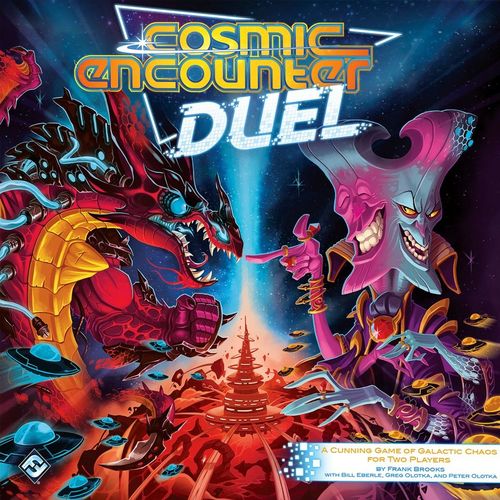
Cosmic Encounter Duel
Cosmic Encounter Duel Rulebook
Table of Contents
Table of Contents
Game Overview
Cosmic Encounter Duel is an original game in the Cosmic Encounter setting where two players play as alien species with special abilities, clashing and contending in crazy contests and climactic challenges!
The players compete to be the first to control five planets. Players try to win planets by using cards in their hands and the powers of their allies. The first player to seize control of five planets is the winner!
Components
- 27 Alien Cards
- 25 Event Cards
- 13 Discovery Cards
- 19 Refresh Cards
- 19 Reinforcement Cards
- 18 Envoy Cards
- 17 Blue Plan Cards
- 17 Orange Plan Cards
- 20 Blue Ships
- 20 Orange Ships
- 12 Planet Tiles
- 1 Warp Tile
- 2 Ship Dials
- 5 Blue Tactics Tokens
- 5 Orange Tactics Tokens
- 1 Straggler Token
Some components come as punch-out pieces that must be assembled before your first game: the Dial Assembly, the Straggler Assembly, and the Tactics Assembly.
Examples of cards found among the components include the Cudgel alien card ("Headstrong and foolhardy, the Cudgels seek out new beings to meet, greet, and smash!"), whose Duel ability, Bash, reads "When you reveal a tactic, increase its value by 1"; the Chosen card, whose Contest & Duel ability, Divine Intervention, reads "After revealing plans, you may force each player to look at the top 3 cards of their deck. Then, starting with the leader, each player must replace their plan with 1 of those cards and discard the remaining cards" (flavor text: "The Chosen's unverifiably unfalsifiable prophecies foretell of an imminent victor."); and the Mirror card, whose Contest & Duel ability, rOrrIm, reads "Transpose the digits of each revealed plan. (For example, a '13' is a '31' and an '08' is an '80.')" (flavor text: "Coming from a perfectly chrome world, each Mirror can't help but be a reflection of their environment.").
Basic Concepts
This section contains the basic concepts that players need to understand before playing the game.
Aliens
Each player assumes the role of an alien species, which is represented by the alien card they choose during setup. A player's alien provides them with one or more abilities that alter the game in some way. Those abilities are described on the alien cards.
The color of the frames on alien cards indicates how complex those aliens' abilities are. Green are the simplest, yellow are more complex, and red are the most complex. Complexity does not relate to how likely it is for a player to win with any particular alien, but simply gives the players an indication of how hard they will have to think about using their abilities.
For example, the Bouncer alien's Duel ability, Flex, reads: "After revealing tactics, if both players revealed matching tactics (value and icon), you may ignore your opponent's tactic. If the tactics match and both are Blast tactics, you may destroy 1 of the ships your opponent sent." (Flavor text: "Coming from a culture where being intimidating is the highest virtue and skipping arm day is the gravest sin, the Bouncers easily find work as security guards, professional wrestlers, and babysitters for Cudgels.")
Ships
Ships represent the diverse spacefaring craft that each species uses to traverse the cosmos. Since space is a dangerous place, these ships tend to be armed in case things turn aggressive.
Each player has 20 ships. During the game, a player's ships can be in their supply, which is a pool of available ships that a player uses during duels. To decrease clutter, the ships can be stacked.
Planets
Planets represent the new places that your fledgling species hopes to colonize, subjugate, or otherwise hold significant political influence over. The multiverse is full of infinite planets; what weird and wacky planets will you find?
Ships can be placed on these planets. When a player has ships on a planet (that is not currently being dueled over), that player controls that planet. This means that a situation can arise where both players control the same planet.
An effect can allow a player to send ships to a planet. Ships sent to a planet are placed on top of the planet. If an effect allows a player's ship to retreat from a planet, that player takes the ship from the planet and places it in their supply.
Warp
The Warp represents a place between worlds and beyond space. Ships that go to the Warp may return, but could also be lost forever.
Each player begins the game with five ships in the Warp. If an effect allows a player to recover a ship, they take one of their ships from the Warp and place it in their supply. Ships can also be destroyed which causes them to be placed on the Warp.
Setup
To set up a game of Cosmic Encounter Duel, follow these steps in order:
1. Prepare Your Destiny: Separate the discovery, event, refresh, and reinforcement decks and shuffle each one. Shuffle the stack of planets. Place these components facedown within reach of both players as shown.
2. Summon Envoys: Separate the envoys into three decks based on their icon. Place one random envoy card from each deck facedown in a row between both players. These decks may be needed again later in the game. If playing for the first time, use the Cudgel, the Chosen, and the Deuce instead of randomly selecting them (still place them facedown).
3. Choose Aliens and Gather Player Components: Each player chooses an alien and places it faceup in front of them. If playing for the first time, one player should use the Swarm alien and the other player should use the Prime alien.
One player gathers the 20 orange ships, 5 orange tactics tokens, the orange dial, and the orange plan deck. Then they shuffle their plan deck. The other player does the same with the blue components.
Each player places their tactics tokens standing up with the common back facing their opponent.
4. Prepare the Warp: Place the Warp so it is within reach of both players. Then each player places five of their ships on the Warp.
5. Determine the Straggler: Each player reveals the top card of their plan deck. The player that revealed the higher number becomes the leader. The other player becomes the straggler and gains the straggler token. If both players reveal the same card, the older player becomes the leader. Although one player starts as the straggler, these roles can switch during the game.
6. Draw Opening Hands: Each player takes their revealed card and draws the top five cards of their plan deck to form their starting hand of six cards. (While playing with an alien that has a different hand limit, draw up to that hand limit instead.)
7. Draw the First Discovery Card: Draw the top card of the discovery deck. Now the players are ready to begin!
Playing the Game
A game of Cosmic Encounter Duel consists of drawing and resolving destiny cards. Each destiny card progresses the game or otherwise shakes things up.
As stated during setup, the game begins by drawing the top card of the discovery deck.
When the players draw a destiny card, they place it faceup in a discard pile called the past. The past is a single discard pile that is shared by all three destiny decks. Although players can look through the past, players cannot change the order of its cards unless an effect specifically instructs them to do so.
After placing the destiny card faceup in the past, the players read aloud the text on the card and follow its instructions.
Destiny cards of the same type have similar effects, as follows:
- Discovery Cards: These cards instruct the players to discover a planet and have a duel there. To discover a planet, take the top planet from the planet stack and place it faceup along an imaginary line between both players. Duels, which are described in detail later, always conclude with one—or both—players gaining control of a planet.
- Event Cards: These cards present a wide assortment of challenges that test the players' mettle. They are varied and unpredictable—some even force the players to duel again on a previously conquered planet.
- Refresh Cards: These cards represent a mild respite amid all the chaos. They offer a way for players to recover ships, draw cards, befriend envoys, gain reinforcements, and ultimately, prepare for another duel.
After the players resolve a card, they look at the icon on the bottom of the card, which indicates the next deck to draw from. They draw the top card of that deck and resolve it, continuing in this way until a player wins the game.
Winning the Game
There are three ways that a game ends:
- Before drawing the next destiny card, if a player has control of five planets, that player wins the game; if both players gain control of their fifth planet, they both win. To control a planet, a player must have at least one ship on the planet.
- If a player ever needs to send ships to a planet but cannot because they have zero ships in their supply, they lose the game and their opponent wins. If this happens to both players simultaneously, any observers (including household pets) win the game!
- Some aliens and destiny cards provide alternative ways to win the game as described on those cards.
Duels
During the game, players duel each other for control of planets. While dueling, players send ships to the planet, play cards, and resolve tactics. A player wins a duel in one of the following ways:
- Destroying all of their opponent's ships on the current planet.
- Having the higher total clout.
Tactics
Players use tactics tokens to attack or defend ships during a duel. The faces of tactics are divided in half, with each half having an ability represented by one of the following icons:
- Blast: This can be used to destroy ships.
- Shield: This can be used to prevent ships from being destroyed.
- Recover: This can be used to regain spent tactics.
Each player's tactics begin the game readied, which means they are available for that player to use. A readied tactic is placed upright and faces the player who controls it. After a player plays a tactic, which is described later, it becomes spent. A spent tactic is laid facedown so both players can see it, and it cannot be used again until a game effect readies it.
Plans and Clout
During a duel, each player chooses a plan from their hand—usually a higher number is better. After this card is revealed, it becomes a player's initial clout. Players can play additional cards and use alien or envoy abilities to add more clout. At the end of the duel, the player with higher clout wins.
Each destiny card that instructs players to have a duel also provides them with a ship advantage. The player who has more ships present has the ship advantage and adds that number to their clout. If both players tie for ship advantage—by having the same number of ships on the planet—neither player has the ship advantage. The ship advantage may change between players throughout the duel.
Steps of a Duel
When players are instructed to have a duel, they are also instructed on which planet the duel occurs. To have a duel, the players proceed through the following steps in order.
1. Set Dials: Each player secretly selects a number between one and four using their ship dial. This is the number of ships they want to send to the planet.
2. Reveal Dials: Each player simultaneously reveals their dial and places that number of ships from their supply on the planet.
3. Reveal Facedown Envoys: Starting with the leader, each player with a facedown envoy may reveal it. This is described in detail later (see "Using Envoys").
4. Choose Plans & Tactics: Each player secretly chooses one card from their hand and places it facedown as their chosen plan. At the start of the game, each player's deck is filled with plan cards which range between -2 and 42. Also, each player chooses one of their readied tactics and places it next to their plan, keeping it hidden from their opponent with the half they wish to resolve at the bottom of the token.
5. Reveal & Resolve Tactics: Each player reveals their chosen tactic to their opponent by spinning it toward that opponent. Then the players resolve both revealed tactics. After tactics are resolved, they are spent (see "Tactics" above).
Players resolve the revealed tactics as follows:
- Each revealed Blast destroys a number of an opponent's ships on the planet equal to the value of the Blast. If the opponent revealed a Shield, the Blast value is reduced by the Shield value.
- If a Shield is revealed and the opponent did not reveal a Blast, the shield has no effect.
- If a player reveals a 1 Recover, they choose and ready one of their spent tactics. Additionally, the played 1 Recover tactic remains readied—it is not spent after it is used.
- If a player reveals a 2 Recover, they choose and ready two of their spent tactics. Then their opponent chooses and readies one of their own spent tactics—this does not include their current revealed tactic. Similar to the 1 Recover, the played 2 Recover tactic remains readied.
6. Check for Ships: Players check how many ships remain on the planet and proceed as follows:
- If there are no ships remaining on the planet, both players discard their chosen plans and begin the duel again at step 1: "Set Dials."
- If both players have ships remaining on the planet, they proceed to step 7: "Reveal Plans."
- If only one player has a ship remaining, that player has won the duel, and players proceed to step 10: "Resolve Prize."
7. Reveal Plans: Each player reveals their chosen plan.
8. Play Reinforcements: Players can play reinforcements to modify either player's clout by the value shown on the reinforcement by placing the card next to the plan it is modifying (see "Reinforcements" for more information).
9. Determine Winner: The player with higher total clout is the winner of the duel. If there is a tie, the straggler wins the duel! To determine a player's total clout, start with their plan, add the ship advantage (if they have more ships present), and apply any modifiers from reinforcements, aliens, and envoy abilities.
10. Resolve Prize: The loser or winner of the duel resolves the prize as described on the card depending on which player is indicated in the text above the prize.
11. Cleanup: The loser of the duel retreats all of their ships from that planet (if any remain), placing them back in their supply. The winner of the duel leaves their ships on the planet, gaining control of the planet.
Each plan (and any reinforcements modifying that plan's clout) are discarded to the discard pile of the player that played the plan.
Then check whether the straggler token should switch between players (see "The Leader and the Straggler").
Example of Duel
The Preservationist is using the orange components and the Bouncer is using the blue components. They draw the Vacant Shipyard card from the discovery deck. The players draw the next planet from the planet stack and place it between both players and now duel for the planet. (Vacant Shipyard: Discover a new planet and have a duel there. Ship Advantage: +8. Loser: Unsupervised Prize — Recover up to 8 ships.)
- Using their dials, both players secretly choose a number of ships to send.
- Revealing their dials, the Preservationist sends three ships and the Bouncer sends two ships.
- The Preservationist currently has the ship advantage (+8, as indicated on the Vacant Shipyard card) since they have more ships on the planet. Each player simultaneously and secretly chooses a plan from their hand and one of their available tactics.
- Both players reveal their chosen tactics. The Preservationist reveals a 2 Shield, and the Bouncer reveals a 4 Blast.
- The Bouncer would destroy all three of the Preservationist's ships, but the 2 Shield tactic reduces the 4 Blast by two. So the Bouncer destroys only two of the Preservationist's ships, which are placed in the Warp. The Preservationist has only one ship remaining on the planet, so the Bouncer now has the ship advantage (+8).
- The players reveal their plans. The Preservationist reveals the Sinister "13" plan and the Bouncer reveals the Inadequate "06" plan.
- The Preservationist's clout is 13 and the Bouncer's clout is 14 (6 from the plan and 8 from the ship advantage). The Bouncer wins the duel. The Preservationist retreats from the planet and gains the Unsupervised Prize.
Reinforcements
Reinforcements represent unexpected help or hindrances that players gain through various game effects. If an effect instructs a player to gain a reinforcement, that player draws a card from the top of the reinforcement deck and adds it to their hand.
During a contest (which is described later) or a duel, players can play reinforcements to modify either player's clout. The leader has the opportunity to play a reinforcement first or pass. Then their opponent has an opportunity to play a reinforcement or pass. Players continue playing reinforcements in this manner until both players pass consecutively.
During the Cleanup step of a duel or contest, reinforcements are discarded to the discard pile of the player whose clout the reinforcement was modifying. Therefore, if a player plays a reinforcement to modify their opponent's clout, that card is discarded to the opponent's discard pile.
Example of Reinforcement
The Iron Matron is dueling the Pickled.
- The Iron Matron has played The Nearly Unbeatable "31" plan while the Pickled has played The Below Average "10" plan. They are tied for ship advantage.
- Since the Pickled is the leader, he has the opportunity to play a reinforcement first. He plays the Mega Support "+12" reinforcement on his side, bringing his clout up to 22.
- The Pickled still has lower clout, so the Iron Matron passes. The Pickled has another opportunity and plays the Swayed Backing "-10" reinforcement on the Iron Matron, bringing her clout down to 21.
- Now that the Iron Matron has lower clout, she plays the Traitors! "-07" reinforcement on the Pickled, bringing his clout down to 15.
- Although the Pickled has the opportunity to play another reinforcement, he has none remaining, so he must pass to the Iron Matron. She also passes and wins the duel. The "31" and "-10" are discarded to her discard pile and the "10," "+12," and "-07" are discarded to the Pickled's discard pile.
(Note: reinforcement cards can also be played as a plan card of the value shown on the card — for example, a "+08 Reinforcement" can be played as an "08" plan, and a "-07 Reinforcement" can be played as a "-07" plan.)
Envoys
Each game begins with three envoys, each of which represents an ambassador from a previously established alien species in the galaxy (who first appeared in the game Cosmic Encounter). The envoys are divided into three different decks, each with a unique icon. Like a player's alien, each envoy has an ability. However, before a player can use an envoy's ability, they must first become allied with that envoy.
Becoming Allied
At the start of the game, the three chosen envoys are placed between both players. These neutral envoys are not allied with either player. Game effects can cause a player to increase or decrease their friendship with an envoy.
If a game effect causes a player to increase their friendship with an envoy, that player chooses a neutral envoy and becomes allied with it, moving the envoy to their play area. Alternatively, a player can increase their friendship with an envoy that is allied with their opponent, causing the envoy to become neutral again.
If a game effect causes a player to decrease their friendship with an envoy, they do the opposite of increasing friendship. That player can either have an envoy that is allied with them become a neutral envoy or have a neutral envoy become allied with their opponent.
Players can have only one allied envoy at a time. If a player has more than one allied envoy, they choose and decrease friendship with all but one of them.
If a player increases their friendship with their allied envoy, it has no effect. Alternatively, if a player decreases friendship with their opponent's allied envoy, it has no effect.
Using Envoys
Each envoy starts the game facedown. After a player becomes allied with a facedown envoy, they can read its ability without revealing it to their opponent. The ability on each envoy describes when and how it is resolved. Envoys can only be revealed during a duel or contest.
While a player has a faceup allied envoy, that envoy's ability is active—therefore any "must" effects happen whether or not the player wants. Unless stated otherwise, when a player uses the ability of an envoy, it remains faceup and allied with them. After a faceup envoy becomes neutral, it remains faceup, but their ability is no longer active (until they become allied again).
As an example, the Masochist envoy's ability reads: "Earn It: You can reveal the Masochist only while you have 10 or more ships in your supply. Masochism: If you must send ships from your supply, but cannot, you win the game (instead of losing)!" (Flavor text: "The Masochists evangelize that to feel the highest levels of pleasure, one must endure the highest levels of pain.")
The Leader and the Straggler
The leader and straggler are chosen randomly during setup; however, as the game progresses, these roles can switch between players. If the straggler ever controls more planets than the leader, the players switch roles and the straggler token is passed to the new straggler.
There are a few rules that apply to the leader and straggler:
- During contests and duels, if each player has the same total clout, the straggler wins.
- During contests and duels, the leader has the opportunity to play reinforcements first.
- During contests and duels, when the players can choose to reveal facedown envoys, the leader chooses and reveals their envoy first.
- While using the planet bar (see "Planet Bar") on event cards, if there are multiple of the same revealed planet symbol, the straggler chooses from among those planets.
Hand Limit
The hand limit indicates the number of cards a player must discard down to or draw up to when specified. The default hand limit is six cards; however, this number may be altered by game effects, such as an alien's ability.
Enforcing the Hand Limit
Before revealing a new destiny card, if the number of cards in a player's hand exceeds their hand limit, they must choose and discard cards from their hand until they have a number of cards equal to their hand limit.
Having Zero Cards in Hand
Before revealing a new destiny card, if a player has zero cards in their hand, they draw a number of cards from their deck until they have a number of cards equal to their hand limit.
Additionally, while resolving a game effect, if a player must use a card (play, reveal, look at, etc.) from their hand but has no cards in their hand, they draw up to their hand limit and then resolve the effect.
Having Zero Cards in Deck
If a player needs to draw cards, but has zero cards in their deck, they shuffle their discard pile to form a new deck and draw from it.
Additional Rules
Contests
There are some destiny cards that instruct players to have a contest. A contest is effectively a simplified duel during which players only choose and reveal plans—there are no ships, planets, tactics, or prizes.
To resolve a contest, the players perform the following steps in order:
1. Reveal Facedown Envoys: Starting with the leader, each player with a facedown envoy may reveal it.
2. Choose Plans: Each player secretly chooses one card from their hand and places that card facedown in front of them.
3. Reveal Plans: Each player reveals their chosen plan.
4. Play Reinforcements: Players can play reinforcements.
5. Determine Winner: To determine the winner, the player with the higher clout is the winner of the contest. If there is a tie, the straggler wins!
6. Resolve Contest Effect: The winner resolves the effect of the contest as described on the destiny card.
7. Cleanup: Any played plans and reinforcements are discarded to their respective discard piles.
As an example, the Iron Matron alien's ability, Punish, is always active: "When your opponent has only 1 card in their hand, they reveal it. If the revealed card is a '20,' '31,' or '42,' you win the game." Her Contest & Duel ability, Impose Your Decree, is only active during contests and duels: "After plans are revealed, you may treat each revealed '20' as either a '42' or a '-42.'" (Flavor text: "The queens of domination, destruction, and the perfect setting, Iron Matrons rule their homeworld and their households with heavy iron fists.")
Resources
Some refresh cards instruct players to acquire resources from one or more planets. To acquire a planet's resources, starting with the leader, each player finds the symbol on the card that matches the planet's symbol and resolves the corresponding effect.
As an example, one refresh card lets the orange player increase their friendship with 1 envoy or draw 3 cards, while the blue player could gain 2 reinforcements or draw 3 cards. Starting with the leader, each player either draws 2 cards or acquires 1 of the following resources from any planet they control: increase your friendship with 1 envoy; gain 2 reinforcements; recover up to 3 ships; draw 3 cards.
Alien Abilities
Each alien card includes the name of the species as well as the names of each of its unique abilities. Abilities specify the timing of when they can be used. Some abilities or groups of abilities have headers indicating when they can be used, such as "Setup," "Contests," "Duels," or "Contests & Duels."
Planet Bar
Some event cards have a planet bar that is used to determine on which planet an effect occurs. To use the planet bar, players start with the leftmost planet symbol and check if there is a revealed planet that has that symbol. If there are no revealed planets with that symbol, players repeat this process using the next icon on the planet bar, continuing to do so until a planet is chosen. If there is a revealed planet with that symbol, that planet is chosen. If there are multiple planets with that symbol, the straggler chooses one of those planets.
For example, on the Regular Revenge event card ("Use the planet bar to select a planet and have a duel there. Each player who controls the planet cannot send ships. Ship Advantage: +7. Winner: Fulfilling Prize — Draw 5 cards."), if there are no planets with the blue symbol revealed, the straggler chooses one of the two planets with the pink symbol.
Clarifications
Abilities. This section describes the language nuances of text effects to help players interpret card abilities.
- Each ability describes when and how a player can resolve it.
- Abilities on cards are mandatory unless they use the word "may." The abilities on facedown envoys are not active so those effects are not mandatory. Additionally, if an ability uses "can," this is an expanded capacity and is not an optional effect.
- If an ability causes an effect that cannot be completed, resolve as much of the effect as possible. For example, if an ability instructs a player to recover 2 ships and that player only has 0 (or 1) ships in the Warp, they would recover 0 (or 1) ships. Similarly, if an ability has multiple effects, a player must resolve as many of the ability's effects as possible.
- If the timing of an ability uses either the word "before" or "after," the ability's effect occurs immediately before or after the described timing event, respectively.
- If the timing of an ability uses the word "when," the ability's effect occurs at the moment of the described timing event.
- Effects that occur "when" an event happens take priority over effects that occur "after" an event happens.
Warpplanet
Through the Voyager envoy's ability, a planet can be placed in the Warp; this is called the Warpplanet. This planet follows the normal rules for planets, with the exceptions described on the card. Below are some additional clarifications:
- Instead of being able to control the Warpplanet by having any number of ships present, only the player with more ships on it controls it.
- When a player recovers ships from the Warp, they can choose to recover ships from the Warpplanet and/or from the Warp itself.
- The Warpplanet can be selected from event or refresh cards like any other planet.
- If the Voyager becomes neutral or is removed from the game, all of the previous rules stay in effect.
- Only the player who is allied with the Voyager can place ships on the Warpplanet when their ships are destroyed. Their opponent cannot place destroyed ships on the Warpplanet.
Miscellaneous
- During a duel, if a player uses their dial to select a number that is higher than the number of ships they have in their supply, they send all of their ships. If a player has zero ships in their supply when they need to send ships, they lose the game instead.
- Through various effects, players can have plans that started in their opponent's plan deck.
- When a player plays a card it goes into their own discard pile faceup. The contents of any discard pile are public information.
- When a player that has an allied envoy gains a second allied envoy, if the second envoy is facedown, the player can read it before choosing which envoy to decrease friendship with.
- If there are no cards in the reinforcement deck, any ability that requires a player to gain a reinforcement has no effect.
- The value of a played "±10" Even Support/Odd Suppression or "∓10" Even Suppression/Odd Support reinforcement changes if the player's clout changes from even to odd or vice versa.
- If either player has the Grumpus as an allied envoy, and one of the players is playing as the Unseen, although the Unseen's ship dial is revealed at a different time, the Grumpus's "Advantaged" ability allows the player with the Grumpus as an allied envoy to feel entitled if that player had sent more ships.
Quick Reference
Steps of a Duel
- Set Dials: Each player secretly selects one to four ships using their dial.
- Reveal Dials: Each player reveals their dial and sends that many ships to the planet.
- Reveal Facedown Envoys: Starting with the leader, players may reveal their facedown allied envoys.
- Choose Plans & Tactics: Each player chooses one card from their hand and one of their readied tactics.
- Reveal & Resolve Tactics: Both players reveal their chosen tactics and resolve them.
- Check for Ships: If there are no ships left, go to step 1. If both players have ships, go to step 7. If only one player has ships, go to step 10.
- Reveal Plans: Each player reveals their chosen plan.
- Play Reinforcements: Players have the opportunity to play any reinforcements, starting with leader.
- Determine Winner: Alien and envoy abilities, plans, reinforcements, and ship advantage add together to form the total clout for each player. The player with higher clout wins the duel!
- Resolve Prize: The player listed on the destiny card resolves the prize.
- Cleanup: The loser retreats from the planet and cards are discarded to the corresponding players' discard piles.
Steps of a Contest
- Reveal Facedown Envoys: Starting with the leader, players may reveal their facedown allied envoys.
- Choose Plans: Each player secretly chooses 1 card from their hand.
- Reveal Plans: Each player reveals their chosen plan.
- Play Reinforcements: Players have the opportunity to play any reinforcements, starting with the leader.
- Determine Winner: Alien and envoy abilities, plans, and reinforcements add together to form the total clout for each player. The player with higher clout wins the contest!
- Resolve Contest Effect: The winner resolves the effect of the contest as described on the destiny card.
- Cleanup: Cards are discarded to the corresponding players' discard piles.
Tactics Symbol Key
- X Blast: Destroy X of the opponent's ships.
- X Shield: Reduce opponent's Blast by X.
- 1 Recover: Ready one spent tactic. The 1 Recover tactic itself is not spent.
- 2 Recover: Ready two of your spent tactics and opponent readies one of their spent tactics. The 2 Recover tactic itself is not spent.