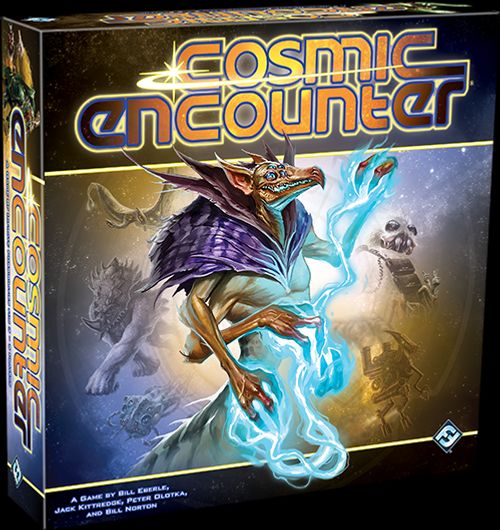
Cosmic Encounter: 42nd Anniversary Edition
Cosmic Encounter: 42nd Anniversary Edition Rulebook
Table of Contents
Table of Contents
Components
- 1 Quick-Start Guide
- 1 Genesis Planet
- 7 Grudge Tokens
- 1 Lunar Cannon Token
- 1 Warp
- 1 Hyperspace Gate
- 1 Prometheus Token
- 42 Cosmic Tokens
- 25 Player Planets (5 per Player)
- 5 Player Colony Markers
- 100 Plastic Ships (20 per Player)
- 51 Alien Sheets
- 51 Flare Cards (1 per Alien)
- 1 Alternate Filch Flare Card
- 34 Cosmic Combo Cards
- 55 Encounter Cards
- 6 Reinforcement Cards
- 11 Artifact Cards
- 20 Tech Cards
- 20 Destiny Cards
Basic Concepts
This section contains the basic concepts for Cosmic Encounter that players need to understand before learning how to play the game.
Aliens
During the game, each player controls an alien that can alter the rules of the game. To understand how alien powers work, the players must first understand the basic mechanics of the game. Then, they will be ready to learn about aliens in the "Additional Rules" section.
Planets and Systems
Each player begins the game with five planets that match his or her player color. These planets are his or her HOME PLANETS and compose his or her HOME SYSTEM. Any planets that do not match the color of a player's home planets are FOREIGN PLANETS to that player, and all foreign planets of one color are collectively a FOREIGN SYSTEM.
Ships and Colonies
Each player has 20 ships that match his or her player color. Ships of the same color are stacked on planets.
Each stack of one or more ships on a planet represents one COLONY. If a player has a colony on one of their home planets, it is a HOME COLONY. If a player has a colony on a foreign planet, it is a FOREIGN COLONY. Multiple players can have a colony on the same planet, but each player can only have one colony per planet.
Moving Ships
During the game, players move their ships to and from their colonies. When a player moves their ships, that player chooses which colonies they move from or return to, and these colonies can be home, foreign, or a mixture of the two.
A player cannot return a ship to a planet where they do not already have a colony of at least one ship.
The Warp
The warp holds lost ships and tracks each player's progress toward victory. When a ship is sent to the warp, it is placed on the warp where it remains until a player is able to retrieve it.
The outer edge of the warp contains a track that indicates the number of foreign colonies each player has. Establishing foreign colonies is how players win the game.
Winning the Game
Players win the game by establishing foreign colonies. The foreign colony track along the edge of the warp is used to indicate the number of foreign colonies each player has.
When a player establishes their fifth foreign colony, that player wins the game! If two or more players establish their fifth foreign colony at the same time, all of those players win!
Setup
To set up a game of Cosmic Encounter, players perform the following steps:
-
Choose Player Color: Each player chooses a player color and takes the colony marker, five planets, and 20 ships of that color.
-
Set Up Warp, Planets, Ships, and Colonies: Players place their planets in front of them, stacking four of their ships on each of their planets. Then, players place the warp in the center of the play area. Finally, players place their colony markers at "0" on the colony track.
-
Prepare Destiny Deck: Take the three destiny cards that correspond to the color that each player has chosen and shuffle them with the wild and special destiny cards to create the destiny deck. Any cards that correspond to a color that was not chosen are returned to the game box; they are not used during the game.
-
Choose Aliens: Shuffle the cosmic combo cards and reveal the top card of the deck. Then, gather the alien sheets indicated for the appropriate number of players and deal one randomly to each player.
Experienced players can use the alien selection rules described in "Advanced Game" on page 16.
-
Prepare Cosmic Deck and Deal Hands: Shuffle the encounter, reinforcement, and artifact cards to create the cosmic deck.
Experienced players can include flare cards as described in "Advanced Game" on page 16.
-
Deal Starting Hands: Deal a starting hand of eight cosmic cards to each player. Players may look at their cards but cannot show them to other players.
-
Choose First Player: If this is the players' first game, the youngest player is the first player and takes the first turn when the game begins. Otherwise, reveal cards from the destiny deck until a card matching the color of one of the players is revealed; that player is the first player. Then, shuffle the destiny deck.
Playing the Game
To play a game of Cosmic Encounter, players take turns in clockwise order starting with the first player, who is determined during setup. During a player's turn, they have an ENCOUNTER. An encounter is an interaction between two or more players who are trying to either establish or defend a colony.
During an encounter, the player taking their turn is the OFFENSE. The primary goal of the offense is to either establish a colony on a foreign planet or remove a foreign colony from one of their home planets. The player who opposes the offense during an encounter is the DEFENSE. The defense is determined by the destiny deck, which is described later. The offense and defense are each referred to as a MAIN PLAYER.
An encounter consists of the following eight phases that players resolve in order:
- Start Turn
- Regroup
- Destiny
- Launch
- Alliance
- Planning
- Reveal
- Resolution
Start Turn Phase
During the Start Turn Phase, if the offense does not have any encounter cards, they must discard their hand and draw eight new cards. They repeat this process until they have an encounter card in their hand. Attack cards, negotiate cards, and morph cards are all encounter cards.
Regroup Phase
During the Regroup Phase, the offense retrieves one of their ships from the warp and places it on any of their home or foreign colonies, stacking it on top of another one of their ships.
Destiny Phase
During the Destiny Phase, the offense draws the top card of the destiny deck and follows its instructions. The destiny card determines which player the offense will have an encounter with. There are three types of destiny cards: color, wild, and special.
Launch Phase
During the Launch Phase, the offense chooses the planet where the encounter occurs and commits their ships to the encounter.
To choose a planet, the offense takes the hyperspace gate and points it at any planet in the home system that was indicated on their destiny card—that planet is the target planet. Planets with fewer of that player's ships are easier to defeat.
If the offense drew their own color destiny card, they may choose to point the hyperspace gate at a foreign colony on one of their own home planets, or they can discard the card and draw a new one.
After choosing a planet, the offense must decide how many of their ships to commit to the encounter. The offense must place one to four of their ships on the hyperspace gate—these ships are participating in the encounter. Ships can be taken from home and foreign colonies and multiple ships can be taken from the same colony.
Alliance Phase
During the Alliance Phase, both the offense and the defense can form alliances with other players in an effort to sway the outcome of the encounter in their favor.
To resolve the Alliance Phase, players perform the following steps in order:
- Invite: The offense may invite other players to be ALLIES. Then, the defense may invite other players to be allies. To invite a player, the offense or defense states out loud which player they are inviting. The offense and defense can invite as many or as few allies as they like, and they can both invite the same player. However, main players cannot be allies themselves.
- Accept: Starting with the player to the left of the offense and proceeding in clockwise order, each player who was invited to be an ally chooses whether or not to accept the invitation and form an alliance. If a player accepts an invitation from the offense, that player becomes an OFFENSIVE ALLY; if a player accepts an invitation from the defense, that player becomes a DEFENSIVE ALLY.
When a player becomes an ally, they must commit one to four of their ships to the encounter. Similar to how the offense commits ships during the Launch Phase, an ally can take ships from any of their home or foreign colonies.
When an offensive ally commits ships, they place those ships in a stack on the hyperspace gate; when a defensive ally commits ships, they place those ships in a stack next to the planet that the hyperspace gate is pointing at.
There can be multiple offensive allies and multiple defensive allies, but players must remember to accept invitations to become allies in turn order, and each player must commit ships to the encounter before the next player either accepts or rejects any invitations they received. Players cannot accept invitations from both the offense and the defense during the same encounter, and they can refuse any invitations they receive.
Planning Phase
During the Planning Phase, each main player simultaneously selects one encounter card from their hand and places it facedown in their play area. The encounter cards that each player selects will be used to determine the outcome of the encounter. Encounter cards display the word "Encounter" at the top of the card.
If the defense has no encounter cards in hand, they must reveal all remaining cards in hand, discard them, and then draw a new eight-card hand before selecting a card during this phase.
If the offense has no encounter cards in hand, their turn ends immediately and they return any of their ships that are on the hyperspace gate to all of their home or foreign colonies. Allies must also return all of their committed ships to their colonies as well.
Reveal Phase
During the Reveal Phase, both the offense and the defense reveal the encounter card they selected during the Planning Phase. Then, they determine the outcome of the encounter according to the cards revealed, as follows:
Attack Versus Attack
If both players reveal an attack card, they calculate their totals. The offense's total is the value of their attack card plus the number of ships they and their offensive allies committed. The defense's total is the value of their attack card plus the number of ships they and their defensive allies committed.
The winner of the encounter is the player with the highest total. If the players tie, the defense wins the encounter.
Attack Versus Negotiate
If one player reveals an attack card and the other player reveals a negotiate card, the player who reveals the attack card wins the encounter.
However, the player who played the negotiate card collects COMPENSATION. Compensation is collected during the Resolution Phase, which is described below.
Negotiate Versus Negotiate
If both players reveal a negotiate card, all offensive and defensive allies return the ships they committed to their colonies. Then, the offense and defense must attempt diplomacy by making a DEAL.
The main players may make a deal to trade cards and/or establish one colony as follows:
Trade: A player can give any number of cards from their hand to the other player. Players can trade specific cards, specific types of cards, or cards at random. If players agree to a trade, they must trade the cards that were agreed upon (i.e., a player cannot agree to trade their highest-value attack card and then trade a different card). Players can discuss the cards they have, and a player can give cards without receiving any in return.
Establish Colony: A player can choose any planet where he or she has a colony (home or foreign) and allow the other player to establish a colony on that planet. When establishing a colony in this way, a player can take any of their ships from the hyperspace gate or from their colonies.
The offense and defense have one minute to make a successful deal. At minimum, a successful deal must result in either one card being traded or one colony being established. If after one minute, the players cannot negotiate a deal, that deal is unsuccessful, and both players must send three of their own ships to the warp.
Morph Versus Other Card
If either player reveals a morph card, that card becomes a duplicate of the other revealed encounter card. If the other card is an attack card, players resolve the encounter as if two attack cards were revealed; if the other card is a negotiate, players resolve the encounter as if two negotiate cards were revealed.
Resolution Phase
During the Resolution Phase, players resolve the encounter according to its outcome—an offense win, a defense win, a successful deal, or an unsuccessful deal. Then, all encounter cards played during the encounter are discarded.
Offense Wins
If the offense is the winner of the encounter, the offense and any offensive allies place all of their ships from the hyperspace gate on the target planet. If a player does not have a colony on that planet, they place their ships on the planet in a stack, forming a new colony. If a player already has a colony on the planet, they place their ships so they reinforce that colony, adding to the stack that is already there.
The defense sends to the warp all of their own participating ships and all participating ships belonging to defensive allies. Other ships on that planet that were not participating in the encounter are bystanders; they are not sent to the warp.
Each player that gains a new foreign colony advances their colony marker on the colony track so it matches the number of foreign colonies they have.
The defense collects compensation if they played a negotiate card against an attack card (see "Compensation" below).
Defense Wins
If the defense is the winner of the encounter, their colony survives and all ships on the hyperspace gate are sent to the warp. Then, each defensive ally gains DEFENDER REWARDS. For each ship a defensive ally committed to the encounter, that player can do one of the following:
- Draw one card from the cosmic deck.
- Take one of their ships from the warp and place it on one of their colonies of their choice.
After gaining defender rewards, the defensive allies return their ships to any of their colonies; they do not get to establish a colony on the planet they helped to defend. Only defensive allies receive defender rewards—the defense receives nothing.
The offense collects compensation if they played a negotiate card against an attack card (see "Compensation" below).
Successful Deal
The terms of the deal are carried out as agreed upon and the offense returns any of their ships on the hyperspace gate to their colonies.
Unsuccessful Deal
Each of the main players must place three of their ships in the warp. When placing ships in the warp, a player can take the ships from any of their colonies or from the hyperspace gate.
Compensation
If a player loses an encounter by playing a negotiate card against an attack card, that player collects compensation. To collect compensation, the player takes a number of cards at random from the winner's hand. The number of cards the player takes is equal to the number of ships that they sent to the warp as a result of losing the encounter. If the winner does not have enough cards to fully compensate the other player, that player takes as many cards from the winner as they can.
Second Encounter Rule
If the offense won or made a successful deal and if this was the first encounter of their turn, they can have a second encounter starting with the Regroup Phase. Otherwise, the next player in clockwise order takes their turn, becoming the offense.
Additional Rules
This section contains additional rules that players must understand to play Cosmic Encounter.
Alien Sheets
Each player has an alien sheet, which represents the alien species they are playing as. Each alien sheet includes the name of the alien and its unique POWER. The top of each alien sheet features upside-down text that provides a one-line summary of that alien's power for other players to read.
The bottom of each alien sheet indicates the prerequisites for using that alien's power. The upper blue bar indicates which role the player must have to use that alien's power (e.g., main player, defensive ally, etc.).
The orange bar indicates if the power is mandatory or optional. If an alien power is mandatory, the player must use that alien's power when they are able to. If an alien power is optional, the player can choose whether or not to use that alien's power when they are able to.
The phase bar (lower blue bar) reminds players when the alien's power can be used. One or more of the phases in this bar are highlighted in orange; the alien's power can be used during these phases.
Alert Lamps
Each alien sheet has a green-, yellow-, or red-colored alert lamp that indicates the complexity of each alien's power. Green represents less complex aliens, yellow represents aliens with medium complexity, and red represents more complex aliens. The complexity of an alien's power does not correlate to its strength; aliens with green alert lamps can be as powerful as aliens with red alert lamps.
Reinforcement Cards
Reinforcement cards offer a sneaky way for players to increase either side's total during an encounter.
After the main players reveal their encounter cards, each player participating in the encounter can play reinforcement cards, choosing to benefit either the offense or the defense. Each reinforcement card's value is added to the chosen player's total.
After an encounter is resolved, reinforcement cards are discarded along with the encounter cards that are revealed.
Artifact Cards
Artifact cards provide players with powerful, single-use effects. When played, they produce the effect described on the card. Like alien sheets, these cards contain bars to indicate the requirements for playing the card.
After an artifact is played, it is discarded.
Zapping Powers
Players can use the "Cosmic Zap" artifact card to cancel one use of an alien's power. That power cannot be used again for the rest of the encounter. Some alien powers (or some parts of aliens' powers) do not require the power to be used. Powers such as these that function without being used cannot be the target of the "Cosmic Zap."
For example, the Warrior's power can be zapped when used to add to the Warrior's total during an encounter, but it cannot be zapped when adding tokens to its alien sheet. Similarly, the Zombie's power can be zapped when used to save its own ships from going to the warp, but it cannot be zapped to stop the Zombie from freeing other players' ships as part of a deal.
Losing Home Planets and Alien Powers
When a player removes their last ship from one of their home planets, that planet is lost. Players cannot return ships to their lost planets. Players defend their lost planets as normal but will not have ships to add to their total. Players can re-establish colonies on their lost planets as described under "Home Colonies" in the Advanced Game section.
If a player ever has fewer than three home colonies, that player loses their alien power. When this happens, that player flips their alien sheet facedown to indicate that their alien's power is lost, and that player cannot use any part of the power on their alien sheet. If a player who lost their alien power ever has three or more home colonies again, they immediately regain their alien power, flipping their alien sheet faceup.
The Colony Track
The colony track always reflects the number of foreign colonies that each player has. If a player gains or loses a foreign colony, they increase or decrease their colony marker on the colony track accordingly so that the number their colony marker is aligned with equals the number of foreign colonies they currently have.
When a player establishes their fifth foreign colony, they immediately win the game. If multiple people establish their fifth foreign colony at the same time, all players who have five foreign colonies win the game together.
No Encounter Cards in Hand
When a player has no encounter cards remaining in their hand at certain times during the game, they must follow a special rule as follows:
- During the Start Turn Phase, if the offense has no encounter cards, they must discard their hand and create a new hand by drawing eight cards. They repeat this process until they have at least one encounter card.
- After a successful first encounter, if the offense has no encounter cards, they cannot have a second encounter that turn.
- During an encounter, at any time before cards are selected during the Planning Phase, if the offense has no encounter cards (due to an alien power or other game effect), their turn ends immediately. Any committed ships are returned to their players' colonies.
- When the defense must play an encounter card and has no encounter cards in hand, they may play any cards in hand that can be played during the current phase as the defense. Then, they must discard their hand and draw eight new cards. This process is repeated until the defense has at least one encounter card.
Bystanders
Foreign colonies on a planet where an encounter is occurring are BYSTANDERS. Ships that are part of a bystander colony do not contribute to encounters and are not affected by the outcome of an encounter. When committing ships, an ally can take any ships, including bystanders, from any of their home or foreign colonies.
Encounter Example
-
The Macron (green) is the offense and has drawn a destiny card instructing him to attack the Clone (purple). Both the Macron and the Clone are main players.
-
The Macron points the hyperspace gate at a Clone planet that contains two Clone ships. The Macron uses his alien power of Mass and commits one of his ships to the encounter, placing it on the hyperspace gate.
-
The Macron asks the Zombie to be his ally. The Clone asks both the Parasite and the Zombie to ally with her. The Zombie (yellow) decides to ally with the Clone, committing four ships.
-
The Parasite uses her alien power to Infest to become an offensive ally even though the Macron did not invite her to do so. The Parasite (blue) commits three ships.
-
The main players each choose an encounter card and place it facedown.
-
Each player reveals their chosen encounter card. The Macron reveals a 10, the Clone reveals a 12. Both players calculate their totals.
The Macron's alien power (Mass) makes his ship worth four. With the Parasite's three ships and the attack card of 10, the offense's total is 17.
The Clone's two ships, the Zombie's four ships, and the attack card of 12 is a total of 18.
-
The Parasite decides to play a +2 reinforcement card to increase the offense's total to 19. The Macron, Clone, and Parasite choose not to play any reinforcement cards. The offense wins.
-
The Clone loses the encounter so all of her ships on her planet as well as all of the Zombie's ships that were committed as defensive allies go to the warp.
-
The Zombie uses his alien power of Immortality, saving his ships from the warp and placing them back on his colonies instead.
-
The Macron and the Parasite each establish a foreign colony on the Clone's planet, moving their committed ships from the hyperspace gate to that planet.
-
The Macron and the Parasite each increase their foreign colony marker on the foreign colony track by one.
-
All players discard their played encounter cards. The Clone uses her power to Replicate to return her played encounter card (an attack card with a value of 12) to her hand instead of discarding it.
Advanced Game
Once players are comfortable with the core rules of the game, they should add flare cards to their future games.
Flare Cards
Flare cards provide players with powerful abilities that can be used repeatedly. Each flare has a blue bar indicating the prerequisites for it to be played. When a player plays a flare card, they use its wild ability. However, if that player has the matching alien sheet, they must use the super ability instead.
After a player plays a flare card, they return it to their hand. A player cannot play more than one flare card during an encounter, and the same flare card cannot be played more than once during an encounter, even by a different player.
If a player's alien sheet is facedown (due to losing their alien power), they cannot use the super ability on the matching flare card, but they can use the wild ability instead.
Advanced Setup
To play the advanced game, players replace steps 4 and 5 of setup as follows:
- Choose Aliens: Shuffle the flare cards and deal two facedown to each player. Each player takes the two alien sheets matching their flare cards, chooses one sheet to keep, and returns the other to the game box. Then, all players reveal their chosen sheet simultaneously.
- Prepare Cosmic Deck: Collect the flare cards that were dealt to each player; if playing with fewer than five players, add additional flares randomly to bring the total to 10. Then, shuffle those 10 flares with the encounter, reinforcement, and artifact cards to create the cosmic deck.
Variants
This section contains variant rules that players can incorporate into their games of Cosmic Encounter if they desire. The variants can be used individually, or they can be combined.
Four Planets
If players wish to play a shorter game of Cosmic Encounter, they play the game following all the normal rules with the following exceptions:
- Players each have four planets instead of five.
- Players start the game with 16 ships instead of 20, placing four ships on each planet.
- The winner is the first player to establish four foreign colonies instead of five.
- Players lose their alien power when having fewer than two home colonies instead of three.
To experience a variety of aliens quickly, it is recommended that players play multiple three-player games using the Four Planets variant.
Single-Encounter Turns
In this variant, the offense is limited to a single encounter during their turn, even if they win the encounter or make a successful deal. This ensures that players take roughly the same number of turns throughout the game.
Hidden Powers
In this variant, each player keeps their chosen alien secret until they are ready to use its power.
During setup, the players do not reveal their chosen alien sheets to the other players—the sheets remain facedown and their flare cards are shuffled into the cosmic deck without being revealed.
While an alien sheet is facedown, its power cannot be used. A player may flip their alien sheet faceup at any time in order to use it. Once an alien sheet is flipped faceup, it remains faceup for the rest of the game.
Cosmic Combos and Flares
If players want to add flares to their game while still using cosmic combo cards, they simply create the cosmic deck with the flare cards matching the aliens on the cosmic combo card plus enough random flares to bring the total in the deck to 10.
Technology
The technology variant allows players to use the effects of tech cards during the game. Tech cards represent revolutionary technologies that players can research. The text on each tech card describes the effect that each tech provides. Some techs provide players with single-use effects while other techs remain in play for the duration of the game.
Setup
If players are using the technology variant, after setup is completed, players shuffle the tech deck and deal two cards from the deck to each player. Then, each player selects one technology card to keep and discards the other faceup in the tech discard pile. The tech that each player selects is placed facedown in their play area.
Combining the Technology and Four-Planet Variants
If players are using both the technology and four-planet variants during the same game, players must remove all tech from the tech deck that have a research number equal to or greater than eight. The removed tech cards are placed in the game box; they will not be used during the game.
Tech Cards
Each player begins the game with one tech card, which is placed facedown in their play area. A player can look at their facedown tech card at any time, but before they can use a tech card, they must research it. Each tech card has a research number, which indicates how much time is required to research that tech.
During the start of any player's Regroup Phase, before that player retrieves one of their ships from the warp, each player can choose to RESEARCH, COMPLETE, or ABANDON a tech—a player can also choose to do none of these.
Researching Tech
To research a tech, a player takes one of their ships from among their colonies and places it on the facedown tech card. That ship must remain on that tech card until the tech is completed.
Completing Tech
If the number of ships on a tech card is greater than or equal to the card's research number, that player can complete the tech by flipping the card faceup and returning those ships to their colonies. The player can now use that tech card's abilities as described on the card.
Abandoning Tech
A player can ABANDON a tech by revealing the card and placing it in the tech discard pile. Then, they return any ships that were on the card to their colonies.
Using Tech
Like alien sheets and artifact cards, the bottom of each tech card has bars that indicate the role the player must have when using the effect on the card as well as the phase during which the card can be used.
After a player has completed a tech, they can use the tech by resolving the ability described on the card. The ability of some technology requires the use of specific tokens which are described on their corresponding tech cards.
Acquiring New Tech
If the first encounter is successful for the offense, and they still have an encounter card in their hand, instead of having a second encounter, that player may draw a number of tech cards equal to his or her current foreign colonies plus one. Then, he or she selects one tech card to keep and discards the others. The selected tech card is placed facedown and can be researched as normal. There is no limit to the number of tech cards a player can have; however, a player can only research or complete one tech card during each Regroup Phase.
If the tech deck is ever depleted, players shuffle the tech discard pile to create a new tech deck.
Note: The Machine may give up their second or later encounter to acquire a new tech card, but doing so ends their turn, regardless of their alien power.
Clarifications
This section contains a list of clarifications about components and some situations that can occur during the game.
Timing
Players must resolve alien powers and card abilities according to the specific phases indicated on the component for that power or ability. However, there are times when multiple people may wish to resolve powers or abilities during the same phase. When this occurs, players resolve their powers or abilities in the following order:
- Offense
- Defense
- Other players in clockwise order, starting with the player to the left of the offense
Alien Power Precedence
If an alien power contradicts a rule from this booklet, the alien power takes precedence.
No Colonies during Regroup Phase
When a player would take a ship from the warp during their Regroup Phase, if they have no home or foreign colonies, they place the ship directly on the hyperspace gate and continue their turn as normal.
Re-Establishing a Home Colony
If a player draws a destiny card of their own color and has a home planet that has zero ships on it, they may aim the hyperspace gate at it to automatically re-establish a colony with up to four ships from their other colonies. This counts as a successful encounter, allowing the player to have a second encounter if this was their first encounter this turn.
Defending without Ships
If the defense has no ships on a planet during an encounter, they still play encounter cards, can receive help from allies, and defend their planet as normal. When determining totals, the defense's own ship value is zero.
Color of Special Destiny Cards
For the purposes of game effects, a special destiny card is treated as a color card that matches the color of the player that the card indicates as the defense.
Depleting the Destiny Deck
If the destiny deck ever has only one card remaining, players cannot draw it. Instead, the remaining card is shuffled into the discard pile to form a new destiny deck.
Cosmic Tokens and Grudge Tokens
Many alien powers require the use of tokens. For example, the Warrior's alien power requires that tokens be placed on its alien sheet. Players use cosmic tokens when resolving powers such as these. Cosmic tokens have no inherent effects; they produce the effect described in the alien power. Alternatively, some powers instruct the players to use specific tokens instead, such as the Grudge tokens used by the Grudge's power.
Cosmic Quake
If a player needs to draw a card from the cosmic deck, and both the cosmic deck and discard pile are empty, then a cosmic quake occurs! All players discard their hands, the discard pile is shuffled to make a new deck, and eight cards are dealt to each player.
Hazard Warning
Some of the destiny cards are marked with a hazard warning, which is a glowing circle around the colored circle in the upper-left corner. This has no effect on gameplay and is used in expansions.
Alternate Filch Flare
An alternate flare card for the Filch alien is included in this game. This card contains the controversial version of the Filch flare card from the classic edition of Cosmic Encounter. Players can use the Filch flare of their choice, but only one version of the card should be used during a game.
Quick Reference
Phases of an Encounter
- Start Turn: If the offense has no encounter cards, they discard and draw a new hand of eight cards.
- Regroup: The offense retrieves one ship from the warp.
- Destiny: The offense draws a destiny card to determine the defense and target system.
- Launch: The offense aims the hyperspace gate at one of the defense's planets in the target system and places one to four ships in the gate.
- Alliance: The offense invites allies, then the defense invites allies. Starting to the left of the offense and continuing clockwise, allies join sides and send one to four ships each to help their side.
- Planning: The offense and the defense each select an encounter card and play them facedown.
- Reveal: The offense and the defense turn their encounter cards faceup and add up their totals.
- Resolution: Players determine the winner of the encounter and resolve any effects from the encounter.
Timing Conflicts
When timing conflicts occur, resolve effects in the following order:
- Offense
- Defense
- Other players (starting with the player to the left of the offense and proceeding clockwise)
Second Encounter Rule
If the offense won or made a successful deal and if this was the first encounter of their turn, they can have a second encounter starting with the Regroup Phase. Otherwise, the next player in clockwise order takes their turn, becoming the offense.
Defender Rewards
For each ship a defensive ally committed to an encounter that the defense wins, that player can do one of the following:
- Draw one card from the cosmic deck
- Take one of their ships from the warp and place it on one of their colonies of their choice
Deals
The main players in the encounter may trade any number of cards and allow up to one colonization, as follows:
Trade: A player can give any number of cards from their hand to the other player. A player can give cards without receiving any in return.
Establish Colony: A player can choose any planet where they have a colony (home or foreign) and allow the other player to establish a colony on that planet, using their ships from the hyperspace gate or from colonies.
No Deal: If the main players do not agree to a deal, they both lose three ships to the warp.
Compensation
If a player loses an encounter by playing a negotiate card against an attack card, that player collects compensation.
- The player takes a number of cards at random from the winner's hand. The number of cards is equal to the number of ships that they sent to the warp as a result of losing the encounter.
- If the winner does not have enough cards to fully compensate the other player, that player takes as many cards from the winner as they can.
Play Cosmic Encounter Online at www.cosmicencounter.com