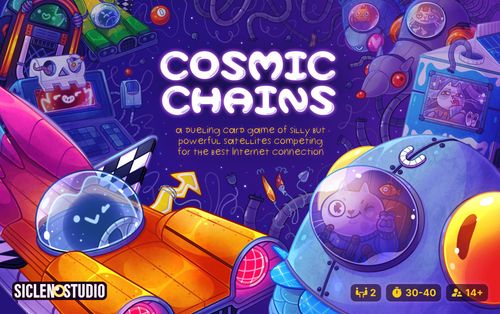
Cosmic Chains
Cosmic Chains Rulebook
Table of Contents
Table of Contents
Overview
Cosmic Chains is a dueling card game of silly but powerful satellites. You will launch your satellites to form a chain, move them around, and disrupt your enemy's plans by destroying their satellites.
Will your internet constellation be the one with the best service?
Objective
The goal is to gain the most Victory Points (VPs) by launching the longest uninterrupted chain of satellites into orbit. It is simple: the longer the chain is, the better internet coverage Earth gets.
The game is over when one of the players launches the last satellite from their deck and the other player performs their last action.
Game Setup
-
Choose the direction to build your chain. One player will launch satellites to outer space from left to right, and the other player from right to left. You cannot change direction during the game!
-
Choose a Satellite deck and place it face down next to you. Both players have identical Satellite decks regarding satellite types and effects. In the base game, only the characters are different.
We recommend you mark the first card's place with your Satellite deck—you will place your first card right above it. In that case, you will always see where the first satellite of your chain must be during the game.
The base game contains two Satellite decks, the "Cats" Satellite deck (15 cards) and the "AI" Satellite deck (15 cards). The setup diagrams show the "Cats" chain direction and the "AI" chain direction, with the first card placed right above each Satellite deck.
-
Draw three cards from the top of your Satellite deck. You will launch one of them on your first turn. Do not show your cards to the opponent!
If your initial hand does not fit your plans for the first turn, you may return any number of cards into your Satellite deck and shuffle it, then draw the same number of cards. You may only do this once.
Cosmic Chains has modes! For the best first experience with Cosmic Chains, we recommend playing the base game. Then, to add even more variety and challenges, try the Superpowers and Space Debris modes (separately or together). Read more about modes in the Modes section below.
Taking Turns
The player who most recently saw a satellite takes the first turn. After that, the order does not change.
On a turn, a player performs one of these three actions: launch, swap, or use a spendable effect.
At the end of the turn, a player draws cards from the top of their Satellite deck until they have a hand of three cards. Then the opponent takes their turn.
Types of Satellites
There are three types of satellites in the game:
- Yellow satellite (satellite dish icon): connects to the adjacent yellow or orange satellite.
- Orange satellite (Helper icon): connects the adjacent yellow, pink, or other orange satellite in the chain.
- Pink satellite (weapon icon): breaks your chain unless it is properly connected. Can be connected by a yellow satellite called "Buddy Buddy" or by orange satellites. Read more about pink satellites in the sections on connecting and destroying below.
The types of satellites indicate each one's ability to connect with the others. These capabilities can be copied by certain satellites.
Effects
In addition to types, most satellites have effects:
- Spendable effect (cursor icon): you can use it on your turn as an action or not use it at all. Spendable effects can be copied by certain satellites. There are two kinds of spendable effects:
- A spendable effect marked with the number 1 is limited to one-time use. You can use this effect as an action, but only once in the game.
- A spendable effect marked with the repeat symbol (a circular arrow) can be used repeatedly, but only once per turn.
- Instant effect (lightning icon): may be used right away when the satellite is launched, without spending an additional action. It is up to you whether to use this effect or not. Just remember that you are not allowed to use it later or repeat it, and this effect cannot be copied by any satellite.
- Background effect (purple chain-link icon): automatically activates when the satellite is launched and stays active until this satellite is destroyed. This effect can be copied by certain satellites.
Card Examples (Types and Effects)
The rulebook shows these satellite cards as examples. Card text is printed on the card; icons are rendered here as words.
- Pew-Pew: "Destroy any enemy satellite within a two-card range." Spendable effect, one-time use (marked 1).
- Toxic Helper: "Destroy one of your satellites by placing this card on it." Spendable effect, repeatable once per turn.
- 0000000000: "Place this satellite ahead of the first satellite in your chain." Instant effect.
- Copycat-101: "Copies the right adjacent satellite's type or spendable effect / background effect." Background effect.
- Wormhole: "Swap this satellite with any of your launched satellites." Spendable effect, repeatable once per turn.
- Pew: "Destroy the above adjacent enemy satellite." Spendable effect, one-time use (marked 1).
- Copycat-103: "Copies the above adjacent satellite's type or spendable effect / background effect." Background effect.
- Buddy Buddy: "Makes your adjacent pink satellite connectable to the chain if it has not destroyed anything yet." Background effect.
- Mad-Mad: "Destroy ANY enemy satellite."
- Helper-101, Helper-102, Helper-103: appear as examples with no effect text printed on the pages.
Actions
On a turn, a player performs one of these three actions: launch, swap, or use a spendable effect.
1. Launch a Satellite into Orbit
To launch a satellite into orbit, place a card from your hand on the table face up right next to your other card and according to the chosen direction. The satellite is launched!
If an empty slot in your chain appears due to another action, you must fill it with the next satellite you launch.
2. Swap
Swap the position of your satellite with an adjacent one.
Move a satellite one space forward, backward, upward, or downward, swapping its position with one of your adjacent satellites. By doing so, you can move your satellites around inside your chain.
If there is an empty slot inside your chain, you can use the swap action to move an adjacent satellite there.
The first and the last satellite in your chain (if they are not destroyed) are/can be connected. Imagine it is an orbit, so it is looped.
Diagram captions: "Swap your satellites' positions." "Opponents' satellites can't be swapped." "The orbit is a loop."
3. Use a Spendable Effect
Use a spendable effect of your satellite.
This action allows you to use a spendable effect of any satellite you have already launched. Spendable effects are written on satellite cards.
At the beginning of the game, the orbit is empty, so both players have only one available action—launch the first satellite.
Connecting Pink Satellites and Making Your Chain Longer
The competition is real. Disrupt your opponent's plans! Break their chain and make yours longer!
By default, pink satellites are not communication satellites—they are weapons meant for protection and battle. That is why they break your chain unless they are properly connected to it.
You can connect your pink satellite to your chain:
- by placing any orange satellite right below this pink satellite (↓);
- by the orange, pink, orange combination (2);
- or by placing a yellow satellite called "Buddy Buddy" next to this pink satellite.
Diagram captions: "#1", "#2", "#3", and "3 ways to connect your pink."
How to Destroy Enemy Satellites
Only pink satellites can destroy the opponent's satellites. To do so, place your pink satellite on your opponent's card, according to what the effect of your pink satellite says.
After that, the satellite you have destroyed is inactive and hidden under your card. Each pink satellite can destroy only one enemy satellite per game.
Game End
The game ends when one of the players launches the last satellite from their deck and the opponent performs their last action. After that, the scoring takes place.
Scoring
Count VPs in the longest uninterrupted segment of your chain.
You gain 1 VP for each connected yellow satellite, orange satellite, and pink satellite in your chain (and you still count VPs for your satellite bugged by the enemy's Spy in the Sky if it is in the largest chain segment, too).
Diagram captions: "count your VPs!", "it isn't looped :C", "it's looped! :C".
Tie-Breaker
In case of a tie, players count the number of satellites they destroyed. The one who destroyed more enemy satellites wins. If it is still a tie, players count the number of satellites in the second-largest segment of their chain—the one who has more wins.
Modes
Mode #1 — The Superpowers Mode
Try this mode if you have already played the base game and want a fresh experience with more room for strategizing.
In this mode, each Satellite deck has its own Superpower tokens that give players special abilities they can use to turn the tables on each other.
Superpowers setup: Do the base setup. Then take three Superpower tokens that match the color of your Satellite deck and place them next to it in the correct order (from 1 to 3).
Superpowers do not cost any actions, and you can perform them at any moment on your turn.
There are three Superpower tokens. You can use each Superpower only once per game and per turn and only in the correct order (from the 1st to the 3rd). After using a Superpower, flip over the corresponding token.
The rulebook prints the following Superpower token texts. The box contains six Superpower tokens in total, three for each Satellite deck.
- "Launch the top card of your Satellite deck without spending an action."
- "Perform +1 action this turn."
- "If you have a launched pink satellite that has not destroyed anything yet, you can use it right now without spending an action."
Transcriber's note: the numeral (1 to 3) printed on each token is faint in the scan and could not be read reliably for every token, so the order of the three tokens in each set is not transcribed here. Only the legible token texts are given.
Transcriber's note: the second set of Superpower tokens is partly overlapped in the scan. Its legible texts include "Discard one of your launched satellites and gain +2 actions this turn." The remaining token texts are not legible and are not transcribed.
Mode #2 — The Space Debris Mode
A teapot, an energy drink sample, and a frozen loaf of bread . . . Wow, it's pretty messy in orbit. But you can recycle all this Space Debris to your advantage (and for the greater good, of course)!
In the Space Debris mode, each player gets three Space Debris cards (one face up and two face down). All Space Debris will give players extra VPs at the end of the game if the conditions written on the cards are met.
Space Debris setup:
Do the base setup. Then take the eight Space Debris cards. One player instantly gets the Energy Drink Sample card with four Can tokens, and the other player gets the Chaotic Blender with four Milkshake tokens.
Shuffle the remaining six Space Debris cards. One player draws two Space Debris cards, chooses one of them, and shuffles the other one back into the Space Debris deck. The other player does the same. Each player does this twice.
At the end of the setup, each player must have one face-up Space Debris card (the Energy Drink Sample or the Chaotic Blender) with tokens and two more secret face-down Space Debris cards.
There will be two more Space Debris cards left in the deck. Do not look at them and return them to the box.
Space Debris card texts shown in the rulebook:
- Energy Drink Sample: "Feel the power of freebies! Spend an action to place a Can token on any of your cards. At the end of the game, gain +1 VP for each token remaining on cards. EXTRA: Discard X Can tokens from your cards for free to gain +X actions this turn."
- Chaotic Blender: "Whirr! You've just found your messy winning recipe! Spend an action to place a Milkshake token on any of your cards. At the end of the game, gain +1 VP for each token remaining on cards. EXTRA: Discard X Milkshake tokens from your cards for free to gain +X actions this turn."
The rulebook does not print the text of the other six Space Debris cards.
Copy-Combos (Examples)
By copying satellites with Copycats, you can start a chain reaction, as in the following examples:
- A Copycat combo with both your and your opponent's satellites.
- A Copycat satellite copying the orange type of a Helper satellite.
Remember that you cannot copy instant effects!
FAQ
A Couple of Terms to Clarify
A card under a Bug token "cannot move or function." This means that you cannot perform the swap action with this card or use its effect. Copycats cannot copy the effect of this card. The type can still be copied for scoring at the end of the game.
"Discard" in Cosmic Chains means that the card or the token is removed and cannot be used again during this game. Discarded cards count as destroyed.
Questions and Answers
Q: Can I launch a satellite that doesn't instantly connect to my chain and breaks it?
A: Yes, you can. You only count points at the end of the game, so you can break your chain if you need and connect all the satellites later.
Q: What does "or" on Copycat cards mean?
A: It means that during the game, Copycats copy background and spendable effects, but at the end of the game, while scoring, they copy the satellites' types instead.
Q: Can I swap positions with an empty slot at the end of the chain?
A: No, you cannot. The chain is looped—its beginning is connected to its end. So, the first or the 0000000000 satellite can be swapped with the last satellite in your chain. Even if your opponent's chain is longer, creating an illusion of empty slots in your chain, it does not mean these empty slots are really there for you.
Q: How do I perform the swap action with my pink that has already destroyed something (has other cards underneath)? Does the opponent get their destroyed satellite back?
A: No, the opponent does not get their destroyed satellite back. When you swap with your pink that has cards underneath, you move the entire stack with your card on top. This way, you will not forget that you have already used the effect of this pink, even if it ends up in your own chain after swapping.
Q: I launched a 0000000000 satellite, then moved it so that there is an empty slot in its place. Can I launch another satellite there or swap a satellite with this empty slot?
A: No, because this 0th slot disappears when empty. As a rule, you count the satellites in your chain starting from the first one, which is right above your satellite deck. A 0000000000 satellite serves to create an exception that you can use to your advantage, for example, to restore the loop of your chain when your first satellite is destroyed.
Q: If my Spy in the Sky satellite is destroyed, do I have to remove my Bug token from the opponent's satellite?
A: No, you do not remove your Bug token. Your Bug token stays in the game until the bugged card is destroyed.
Q: What happens to Can/Milkshake tokens if the cards where I placed them are destroyed?
A: You must remove and discard Can/Milkshake tokens from destroyed cards. You cannot place these tokens again.
You can find more questions and answers on the next page.
Components
The rulebook's contents page lists:
- 15 "Cats" Satellite cards
- 15 "AI" Satellite cards
- 2 Bug tokens
- 6 Superpower tokens
- 8 Space Debris cards
- 8 Can & Milkshake tokens
- 2 Player aid cards
- 2 Holofoil Teams promo cards