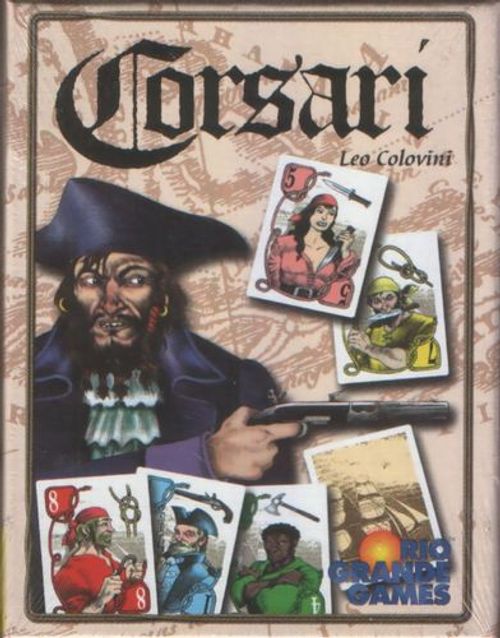
Corsari
Corsari Rulebook
Table of Contents
Table of Contents
Contents
- One pack of 110 cards numbered 1 to 11 in 10 different colours. Each colour corresponds to a band of corsairs and each number to the job of the crew (e.g. 1 is the captain, 2 is the first mate, and so forth...).
Set Up
Players choose the dealer; after which, each player takes turns to deal the cards clockwise.
The dealer proceeds as follows:
- He/she shuffles the cards and gives 12 (one at a time) face down to each player;
- Forms a row of cards face up at the centre of the table: 7 cards if two are playing, 8 cards if three are playing, 9 cards if four are playing. These cards represent the "pier", and the colour of the first card in the row (green in diagram 1) is called "the colour of the pier";
- Turns over the first card of the "discard pile";
- Forms the pack that players draw from ("stock") with the remaining cards and places it face down on the table.
Diagram 1 shows how to arrange the cards: each player's hand of 12 cards, the pier (a column of face-up cards, offset so every card is visible), the discard pile (a single face-up card), and the stock (a face-down pack).
Playing
The game consists of a series of rounds in which players "board their corsair galleons" and try to form the best sets of cards possible.
Taking Turns
Players take turns clockwise starting from the player at the left of the dealer. At turns the players proceed as follows:
- He/she always draws a card from either:
- the pack, or
- the discard pile (the last card discarded), or
- the pier (the first card in the row). "The colour of the pier" can change as cards are drawn from the pier;
- he/she always discards a card - face up - on the discard pile (you are also allowed to discard the card you have just drawn).
Setting Sail
After having drawn a card a player may choose to "set sail" i.e., to close the hand. In such case he/she discards one card as usual then puts the cards on the table and divides them into three parts, namely:
- The prisoners. The prisoners are corsairs with the same colour as the pier (green in the first diagram). The prisoners enable you to collect precious ransoms and no penalty is paid for transporting them.
- The crew. The cards that form the crew can be made up of no more than two different bands (two different colours) and all with a different job (a different number). For example, if the crew is composed of red and yellow you cannot use 7 yellow or 7 red. The ideal crew is therefore composed of 11 corsairs numbered 1 to 11, but this is difficult to achieve. The crew works in its own galleon and does not pay any penalty.
- The stowaways. The remaining cards are stowaways and the player has to calculate what they are worth, which represents his/her "limit". You must try to lower your limit as much as possible when drawing and discarding during the game.
The diagram 2 shows an example of how to close a hand. 6 yellow has been discarded, the three cards next to the pier are prisoners, 6 cards at the bottom (1, 2, 7, 8 orange + 3 and 10 violet) are the crew, the 3 remaining cards (10 violet, 2 grey and 1 green) on the right are stowaways. Take note that 10 violet is considered a stowaway even if one of the two colours of the crew is indeed violet. This is because the crew already includes a 10 violet and you are not allowed to have two corsairs with the same job (number). Therefore the "limit" is 10+2+1= 13.
When a player sets sail his/her opponents set sail with their ship too, but before putting down their cards and dividing them (just like the player who is closing) each can attach cards to the crew of the player who has closed. You can only attach cards according to the rules, that is, they must have one of the two colours of the crew and with different numbers than the corsairs present. In the example an opponent could attach 9 orange but not 7 violet because the crew already includes a number 7 card. Different players can attach cards with the same number (for example an opponent that holds 9 violet can attach it even if another one has already attached 9 orange), but one player alone cannot attach two identical cards (if he/she has both 9 orange and 9 violet he/she can only attach one of the two cards).
Special Situations
When a player draws the last card of the pier the round ends and is annulled.
Should a player draw the last card of the pack he/she is obliged to set sail at once.
Scoring
At the end of each round players count their own "limit" and compare it with the limit of the player closing:
- A player whose limit is more than that of the player closing keeps his/her stowaway cards and piles them up face down in front of him/herself. The number of cards that a player has in front corresponds to the number of penalties, irrespective of how much the cards are really worth.
- If the limit of a player is less than or equal to that of the player closing he/she has to pass his/her stowaways to this player and makes him/her "go under".
- If the limit of the player who closes is less than that of all the other players, he/she not only avoids getting cards from the others but also does not even keep his/her own stowaways, which are put back into the pack (he/she does not pay any penalty points for this round). If instead the player closing was made to "go under" by one or more opponents, he/she is penalized and therefore besides keeping his/her stowaways he/she also gets those of the players who made him/her "go under". All the stowaway cards used as penalties cannot be used in the next rounds, thus the pack of cards gets smaller and smaller as the game progresses.
Ending the Game and Winning
At the end of each hand all the players count their penalty cards and call out the resulting number. Before starting the next round all the penalty cards are summed up. If the number of cards is equal to or more than 35, just one more round can be played, after which the game ends. Exception: in the rare case of an overall total of 45 or more, the game ends at once. The winner is the player who has the least penalty cards at the end of the game.
Sweeping
If the player who closes is able to set sail with no stowaways, he/she makes a sweep and wins the game notwithstanding the opponents' cards. If an opponent is able to set sail with no stowaways he/she makes a sweep and wins the game (in the very rare case that two players make a sweep simultaneously, the winner is the player with the least penalty points).