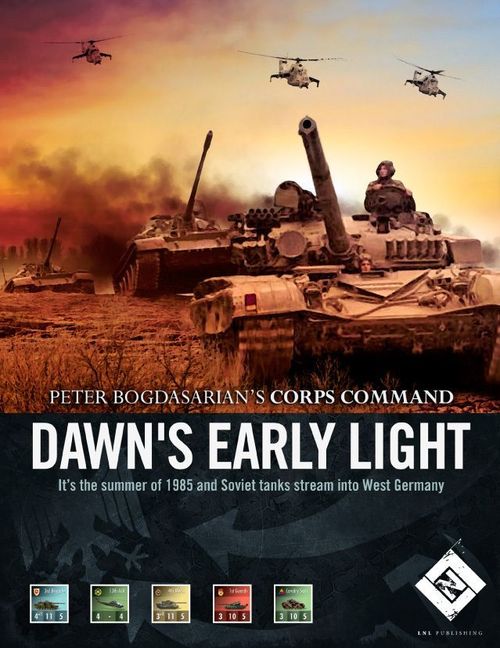
Corps Command: Dawn's Early Light
Corps Command: Dawn's Early Light Rulebook
Table of Contents
Table of Contents
Glossary
- 1d6: roll one six-sided die
- 2d6: roll two six-sided dice and sum them
- ACR: Armored Cavalry Regiment
- AFB: Air Force Base
- AN: Activation Number (2.1)
- Closed terrain: town, rough, forest or rough forest hexes
- MP: Movement Point (6.0)
- NATO: North Atlantic Treaty Organization
- Open terrain: clear or airfield hexes
- ZOC: Zone of Control (5.0)
1.0 Components
1.1 Anatomy of a Combat Unit
All combat units fall into one of five classifications: armored, infantry, reconnaissance, airborne or supply (see the player-aid card). Armored units are better in open terrain, infantry units in closed terrain. Reconnaissance units are terrain-neutral and can support attacks by other units. Supply convoys do little but move, but are worth Victory Points and are still considered combat units.
Players should not take the classification as implying units are 100% armor or infantry in composition. At the level below what this game is looking at, there are numerous cross-attached armor and infantry assets. Even the supply convoys have fighting troops assigned to them.
Four nationalities comprise the units in the game: West Germans, Canadians, Soviets, and Americans. West Germans are blue, Americans green, Canadians are tan, and Soviets are red.
The colored band at the top of a unit indicates the parent division as indicated below:
- Green: American 5th Armored, 13th ACR, and 101st Airborne.
- Beige: American 11th Armored.
- Blue: West German 1st Panzer.
- Black: West German Territorials.
- Gray: West German 27th Pzg Brigade.
- Tan: Canadian 4th Mechanized.
- Red: Soviet 1st Guards Tank.
- Gold: Soviet 47th Guards Tank.
- Silver: Soviet 171st Motor Rifle.
- Bronze: Soviet 33rd Motor Rifle.
- Blue: Soviet 2nd Guards Airborne.
- Pink: Soviet 87th Motor Rifle.
- Purple: Soviet 232nd Motor Rifle.
- Brown: Soviet 23rd Guards Tank.
Units are rated for Strength Points, Protection Factor and Initiative. A unit's Strength Rating reflects its cohesion and firepower. A unit's Protection Factor reflects the difficulty of damaging it. A unit's Initiative reflects both the raw ability of the unit to cover ground and its responsiveness to orders.
A unit counter shows, from left to right along the bottom, Strength, Protection Factor and Initiative. The top of the counter shows the division color band and the regiment/brigade identification. The reverse side of the counter shows the unit at reduced strength.
A unit loses one Strength Point for each hit taken. Flip the counter over to show the first hit and then place a Hit marker underneath the unit for additional hits. When hits reduce a unit's strength to zero, it is destroyed.
Some units will lose a point of initiative when flipped over. This is intentional. They do not lose any additional initiative for having a Hit marker placed on them.
Unless otherwise noted, units will always begin a scenario at full strength.
1.2 Organization of Brigades and Regiments
Underneath their parent division, NATO forces are organized into mechanized brigades (consisting of two mechanized-infantry battalions and one armored battalion) and armored brigades (two armored battalions and one mechanized-infantry battalion). The brigade identification is on the divisional color band.
Warsaw Pact forces are organized into tank regiments (three tank battalions and one motor-rifle battalion) and motor-rifle regiments (three motor-rifle battalions and one tank battalion). When the Pact player is given the choice of a regiment, he may select either kind of regiment (provided one is available from the listed formation). The regiment identification is on the divisional color band.
2.0 Impulse System
The game does not use a rigid sequence of play. Instead, each turn consists of a number of "couplets," during which each player will receive one impulse. An impulse allows each unit of the acting player to take one action. Once four couplets are complete, a night couplet occurs (8.0).
Resolve the night couplet and then begin the next turn. If there are no more turns left in the game, check the victory conditions to see who won.
2.1 Activation Roll
Each time a new couplet is begun, each player should roll 1d6 to generate his Activation Number (AN) and track it with the markers provided for this purpose.
The player with the higher AN receives the first impulse of the couplet. On a tie, the NATO player acts first. On an AN of five, a player may secretly decide whether or not to switch his AN to a 2. This decision should be made before his opponent reveals his selected AN (if he was able to choose) or before any botched orders are resolved.
On an AN of six, roll 1d6 and consult the Botched Orders table.
- Rather than roll, a player can select his next AN if his previous AN was a one. He does this secretly before his opponent rolls for an AN and reveals his AN after the AN roll (and any botched-orders effects) are complete.
The lower the AN, the more units a player can activate. (3.1) Consequently, there is a trade-off between going first and going with the most.
An AN of 1 from the Botched Orders table still qualifies for a choice of activation on the next impulse.
3.0 Actions & Activations
When a player receives an impulse, some or all of his units are activated and can perform one action each. Units are always activated individually.
3.1 Activation
For a unit to activate, it must have an Initiative Rating equal to or greater than the player's AN.
Just to be absolutely clear: if your Activation Number exceeds a unit's Initiative Rating, that unit is going to have to pass. No moving or shooting for it!
3.2 Actions
A unit can move or assault when it is activated; it cannot do both. A unit can choose to pass and do nothing.
- All units in the game, except the 2nd Guards and 101st Airborne and supply convoys, can make overrun attacks (7.4) when they move.
- Recon units can support assaults (7.6).
- Supply convoys cannot assault (or overrun) as indicated by their bracketed Strength Rating.
- Units that did not activate must pass.
4.0 Stacking
The NATO player can have up to three units in a hex. The Soviet player can stack three units from the same division or two units from different divisions.
Stacking is checked at the end of every impulse. If, when checked, a hex exceeds the stacking limit then any excess units are destroyed (owning player's choice). A player can rearrange his stacks at any point in a friendly impulse.
The order of stacks is important as combat is fought against the top unit in the stack.
5.0 Zones of Control
All combat units project a zone of control (ZOC) into the six hexes surrounding them. This reflects their ability to interdict enemy movement in their vicinity.
- A unit must stop moving on entering a hex containing an enemy ZOC. Exception: it can spend MPs to make an overrun attack.
- A unit can move directly from a hex containing an enemy ZOC to an adjacent hex containing an enemy ZOC but must stop and cannot make an overrun attack. Units can otherwise leave ZOCs with no penalty.
- Terrain has no effect on projecting a ZOC.
6.0 Movement
An activated unit receives Movement Points (MPs) equal to the player's activation number plus one.
- A unit moves by expending one MP for each hex entered. It can continue to move until its MPs are exhausted. As with every other war game ever made, MPs cannot be saved from one impulse to the next.
- Forest or rough hexes cost an extra MP to enter if a unit is not moving by road. Rough forest hexes cost two extra MPs.
- Mountain and lake hexes cannot be entered by any unit.
- Rivers: a unit cannot cross a river hexside except at a bridge. Bridge hexsides cost an extra MP to cross.
- Road March: a unit can expend an extra MP if all of its movement occurs along road hexes/hexsides. You can road march through town hexes provided you either (a) start your movement in the hex or (b) move along road hexsides passing through the town hex.
- Leg Troops: regardless of the number of MPs they have, Pact airborne units can only move one hex (two by a road march).
- Minimum-Movement Rule: regardless of its MPs, an activated unit can always move one hex.
- Units can never enter hexes occupied by enemy units or prohibited terrain. The minimum-movement rule does not override this prohibition.
6.1 Entry of Reinforcements
Throughout the game, the players will receive reinforcements. Reinforcements must be activated to enter the map. They pay all normal movement costs to enter their entry hex and then can continue moving if (a) they have MPs remaining and (b) they have not entered an enemy ZOC.
If all possible entry hexes (arrows pointing toward map: NATO, green or gray; Soviet, red or yellow) are occupied by enemy units or ZOCs, then reinforcements can enter at the closest hex along the same map edge not occupied by an enemy unit or ZOC. A player can delay entering his reinforcements for as long as he wants.
6.2 Exiting the Map
The Pact player can exit units from the map. To exit, a unit must move to a Pact exit hex (red arrow pointing off map) and then expend 2 MPs (this can qualify as a road march). Once exited, it cannot return to play.
7.0 Combat
An activated unit can attack enemy units. There are two types of attacks: assaults, initiated by a non-moving unit; and overruns, initiated by moving a unit (exception: airborne and supply-convoy units).
- In an assault, an activated unit must begin its activation adjacent to the defender to attack.
- In an overrun, a moving unit can move adjacent to an enemy unit and then pay MPs to attack.
- Note that units can assault hexes they cannot enter, but cannot overrun them.
- Units always attack individually. A hex can be attacked any number of times in an impulse.
7.1 Calculating Firepower
In an assault or overrun, an activated unit can fire at the top unit in any adjacent stack of enemy units.
For all attacks, generate the firepower for the firing unit. A unit's firepower is normally equal to its current Strength-Point total (its initial Strength Factor reduced by hits (1.1)).
- A NATO armored unit (M1 or Leopard) adds 1.
- If the attack possesses superior arms (7.5), add 1.
- Defender's terrain's combat modifier (if infantry or recon).
- If the attack crosses a river or bridge hexside, subtract 1.
- If attacking a recon unit by overrun, subtract 1.
- If a recon unit is supporting the attack (7.6), add 1.
- Attacks at night subtract 1.
7.2 Determining Defensive Fire
Defenders receive one or more defensive-fire numbers. If the unmodified attack roll is one of these numbers, then the attacking unit immediately suffers a hit (1.1) and its firepower is recalculated before resolving the attack.
- NATO units inflict defensive fire on a Pact attack roll of 7.
- Pact units inflict defensive fire on a NATO attack roll of 4.
- Infantry units defending in closed terrain also inflict defensive fire on an attack roll of 2-3 or 11.
- Armored units defending in open terrain also inflict defensive fire on an attack roll of 2-3 or 11.
- Recon units and supply convoys never inflict extra defensive fire for terrain.
EXAMPLE: A NATO infantry unit in town terrain inflicts defensive fire on a Pact attack roll of 2, 3, 7 or 11.
Resolving Fire
Once the firepower total is generated, the attacker rolls 2d6 and checks for defensive fire. If the die roll triggers defensive fire then he immediately suffers a hit and his firepower is recalculated (1.1). If he survives, or there is no defensive fire, then add his firepower to the die roll.
If the final attack roll is equal to or greater than the target's Protection Factor, then the target suffers a hit (1.1). If the final attack roll exceeds the target's Protection Factor by four or more points, the target suffers two hits (1.1). If the attack roll exceeds the target's Protection Factor by eight points, the target suffers three hits (1.1). A unit losing all of its Strength Points to hits is destroyed.
If a unit with one Strength Point suffers two hits from fire, the second hit is wasted. It is not applied to other defenders in the hex.
7.3 Advances After Combat
If an assault or overrun results in all defending units being eliminated, then any unit that attacked or supported an attack on the defending hex this impulse may advance into it. ZOCs do not prevent the advance.
- Units cannot advance into hexes they could not legally enter in the movement phase.
7.4 Overruns
All units (exception: airborne and supply-convoy units) can attack enemy units as part of their movement. To carry out an overrun, the units must move adjacent to the defender's hex and then pay a number of MPs equal to the cost of the defender's hex. Resolve the attack normally. (7.1)
- Moving units can only attempt to overrun defenders occupying hexes (or across hexsides) the moving units could legally enter.
- Road-marching units can overrun.
- Exception: Airborne and supply-convoy units cannot make overrun attacks.
If the overrun eliminates all defending units, 7.3 applies. The attacking units cannot move, except to advance after combat, after the combat is over.
7.5 Determining Superior Arms
The superior-arms bonus is available when the attacking unit is better suited to the terrain in the defending hex than its target. Infantry gains the superior-arms bonus when attacking armor in closed terrain hexes. Armor gains the superior-arms bonus when attacking infantry in open-terrain hexes. Recon units neither give nor receive the superior-arms bonus.
7.6 Recon Units Supporting Assaults
Instead of making an assault, an activated recon unit may choose to support other units' assault actions. The recon unit forgoes its own attack for the impulse to add 1 to the firepower of each supported attack. The recon unit must be adjacent to the defending unit under attack.
A recon unit can support a number of attacks equal to its strength points. A Soviet recon unit can only support units of its formation. A NATO recon unit can only support units of its nationality.
Recon units supporting attacks never suffer losses to defensive fire.
8.0 Night
Night is played as a normal couplet with an impulse for each player. All attacks are made at a -1 penalty and all units receive one less Movement Point.
Units that pass during a night turn can attempt to recover Strength Points lost to hits. Inactive units are still eligible for recovery.
8.1 Recovery Rolls
Any unit that has lost at least one Strength Point to a hit and which passes during a night turn is eligible to make a recovery roll. Immediately roll 1d6 for each hit the unit has taken:
- NATO and Pact units recover on a die roll of 5-6.
- Subtract 1 from the die roll if the unit currently occupies an enemy ZOC.
A unit recovers one hit for each successful recovery roll.
Destroyed units can never be returned to play by recovery.
9.0 Assets
Both players receive additional assets as the game goes on, representing resources tasked to assist with the fight in the Eisenbach Gap. Details as to the asset chits' effects can be found on the player-aid card.
9.1 Asset Selection
Before setup, each player should place his asset chits in an opaque container. The scenario will instruct him on which assets to use and how many to draw. He can look at the assets he draws before assigning them.
Assets are normally assigned by day; they become available at the beginning of the first couplet of the day. Once available, assets can be played at any time. They are discarded (and removed from the game) after being played.
A player is never forced to play an available asset; he can hold onto it for as long as he desires.
A player can play as many assets as he would like in an impulse.
9.2 Gunships
Gunships become available via asset chits and are kept off map until called in. They are placed for the duration of the attack and are then removed.
During a player's impulse, he can attempt to call in a gunship counter to attack any enemy unit adjacent to one of his combat units. For the gunships to be successfully called in, he must roll 1d6 and score equal to or less than the gunship's initiative. Subtract 1 from the gunship's initiative if the friendly unit calling in the gunships moved before the die roll. Gunships can be called in before or after any friendly unit activates, but cannot attack in the middle of an activation.
Gunships can attack any unit in the target hex using the normal combat procedure (7.2). The only modifier for their attacks is if the target is infantry or recon in closed terrain. Defensive fire has no effect on gunships.