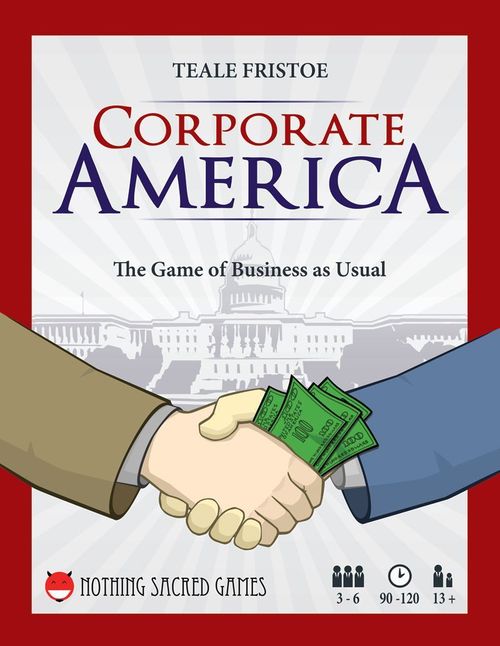
Corporate America
Corporate America Rulebook
Table of Contents
Table of Contents
Contents
- 60 Business Cards
- 54 Consumer Cards
- 40 Legislation Cards
- 8 Executive Privilege Cards
- 1 Board
- 1 Washington Monument Phase Token
- 1 Seal of the President (or Silly Hat)
- 140 bills (30 $1, 27 $2, 24 $3, 21 $5, 18 $10, 12 $20, 8 $50)
Game Overview
In a game of Corporate America, players will go through several election cycles. The game ends after a set number of turns (see Ending the Game). The player with the most money wins (just like in real life).
Who Goes First?
The president leads the country each turn. Whoever has the most money on his or her person is the first president. (Yes, real money.) Put the seal of the president in front of the president. Better yet, have the president wear a silly hat to symbolize his or her power. See what hats other players use and share your own at corporateamericahats.tumblr.com!
Setup
-
Sit around a good sized table with the board between everyone.
-
Each player gets money according to the Starting Money table (below). You can keep your money secret, and you should if you want to win.
Players $1 $2 $3 $5 $10 3-4 Players 3 3 3 3 1 5+ Players 3 3 2 2 1 -
Put the extra money in stacks on either side of the board (see board diagram). This is the Treasury's money. You're NEVER allowed to steal from the Treasury. If you suspect there might be some foul play with the Treasury's money, elect a player to be treasurer to guard it, but it's faster when players can take care of collecting, paying, and changing money for themselves. Changing money is allowed at any time. If the Treasury's money runs out, don't worry: it can always just print more (use coins or other tokens to represent $100).
Quick Setup
- Sit down.
- Deal each player money.
- Set up the Treasury.
- Deal each player 5 (3 or 4 players) or 4 (5+ players) business cards.
- Shuffle decks.
- Randomly select 4 (3-4 players) or 3 (5+ players) executive privilege cards to place on the board.
- Put the phase token on the Wall Street circle.
Phases of a Turn
During each turn, you will go on a whirlwind tour of the country, starting with Wall Street.
Wall Street Phase
The Wall Street Phase starts with the president and goes clockwise. Each player takes three steps (advanced players can play simultaneously):
- Draw two cards from the business deck. Note: If the business deck runs out, shuffle the discard pile to make a new deck.
- Discard one business card from your hand. (Place it face up in the discard spot on the board.)
- Start ONE* business from your hand by paying the start-up cost to the Treasury and putting the card face up in front of you. Note: On the first turn, start four businesses (3 or 4 players) or three businesses (5+ players) instead of one.
Your businesses will give you money when people buy their goods!
When all players have started businesses, move the phase token to the Main Street circle on the board.
Quick Wall Street
Each player:
- Draws two business cards.
- Discards one business card.
- Pays to start ONE business. (On the first turn, players start 4 (3 or 4 players) or 3 (5+ players) businesses instead.)
Main Street Phase
Note: "Monetary gifts" (bribes) are allowed any time during the Main Street Phase.
During this phase, players will play consumer cards on each blue spot in the center of the board (all of them). Since there are eight spots, some players (like the president) will play two or even three consumer cards during the Main Street Phase.
Starting with the president and going clockwise:
-
Reveal any number of consumer cards from the top of the deck, one at a time. The first card is free, but additional cards cost money based on the table below. Note: Costs are cumulative. For example, revealing three consumer cards costs a total of $10 ($0 for the first, $4 for the second, and $6 for the third).
Consumer Card 1st 2nd 3rd 4th 5th 6th Price Free $4 $6 $8 $10 $12 If you reveal a protest card, put it aside near the protest label on the board (see board diagram) and reveal another consumer card for free. Protests affect the Capitol Hill Phase.
Note: If the consumer deck runs out, shuffle the discard pile to make a new deck.
-
Play one consumer card you revealed by putting it in an open spot on the board. You have to play . It can be a difficult decision, but remember that your friends can help you (with bribes). Discard the consumer cards you don't choose.
When a consumer card is played, businesses in the consumed industry make money. Cheers! Each business with the industry gets money according to its income from the Treasury (see example businesses).
Additionally, players with more than one business in the indicated industry have corporate synergy and make even more money! You get extra money from synergy based on this table:
| # Businesses | 2 | 3 | 4 | 5 | 6 | 7 |
|---|---|---|---|---|---|---|
| Extra $ | $2 | $5 | $9 | $14 | $20 | $27 |
Note: Some businesses have PR problems written in red (see example businesses). Unlike industries, these do not get consumed. Instead, legislation in the Capitol Hill Phase can affect businesses with PR problems.
After eight consumer cards have been played, discard them. Don't discard protests. Then move the phase token to the Campaign Trail circle.
Note: At the end of the Main Street Phase, if there are no executive privilege cards left, the game ends!
Quick Main Street
Players take turns with the following steps:
- Reveal any number of consumer cards. The first is free, but additional cards cost money (see table).
- Play ONE revealed consumer card. Businesses in the indicated industry get money! Players with more than one business in the chosen industry get a synergy bonus.
Players with more than one business in the chosen industry get a synergy bonus. Remember: Bribes are allowed and encouraged!
When players have played eight consumer cards, the Main Street Phase ends.
Note: If there are no more executive privilege cards on the board, the game ends!
Campaign Trail Phase
During the Campaign Trail Phase, you determine the next president! Note: Sorry, no bribes in this phase.
-
Reveal the top six cards from the legislation deck, placing them in the red spots in the middle of the board (the top six).
These are election issues. Based on your businesses, you will like some and dislike others. After the election, the new president will reveal two more cards and enact three of them (appeasing protesters as necessary).
-
Any player that wants to be president can try to convince the other players why he or she would make a good leader by saying which legislation he or she would enact.
-
After everyone has had a lively, intellectual, friendly debate, the election begins. Move the phase token to the first bid circle on the board.
-
Starting with the president and going clockwise, secretly bid on who you want to be president. Put however much money you want face down in front of the player(s) you want to be president. Bidding on yourself is allowed (of course). You can pass, but you're out for the rest of the election if you do.
-
After three bid rounds, move the phase token to the Capitol Hill circle.
After three bid rounds, move the phase token to the Capitol Hill circle. The campaign is over and it's time to see who will be the next president!
Quick Campaign Trail
- Reveal six legislation cards.
- Anyone can run for president! Keep discussions brief. No filibustering here.
- Move the phase token to the first bid circle.
- Players take turns secretly bidding to determine the next president.
- After three bid rounds, move the phase token to the Capitol Hill circle.
Capitol Hill Phase
In the Capitol Hill Phase, the new president takes power and makes very important policy decisions.
-
Flip over the piles of campaign contributions and tally up the totals. The player with the most money pledged to him or her is the new president! In the case of a tie, consult the Supreme Court. Find someone not involved in the game (a roommate, a parent, call a random number, etc), and ask that person to make the decision arbitrarily. Note: Children make excellent Supreme Court justices.
-
All bids (from both the winner and losers) are given to the Treasury, and then the former president ceremoniously hands the new president whatever symbol of power (seal of the president, hat, etc) you're using.
-
The new president takes the top executive privilege card. He or she can use this card whenever the card says (even when no longer president). It's a little gift from the American people to their new leader. Any executive privilege cards not used by the end of the game are worth $5.
Note: The first (unelected) president doesn't get an executive privilege card. You have to earn them!
-
As a first act, the new president can clean up some of the messes left by previous administrations. If there are any laws (legislation with a law icon) from previous turns, the president may revoke one.
-
The president then flips the top two legislation cards and puts them in the open spots on the board (the bottom two spots).
Any protest forces the president to enact the legislation with the ideology it demands, following these rules:
- The president must satisfy as many protests as possible.
- The president must satisfy protests before enacting legislation that doesn't satisfy any. Otherwise, the president chooses the order of legislation to pass.
- If there is more than one piece of legislation that could satisfy a protest, the president chooses which legislation to enact.
- Each piece of legislation can only satisfy one protest. If one legislation card could satisfy two protests, the president chooses which protest to satisfy.
- If there are more protests than the president can satisfy, the president chooses which protests to satisfy.
- When a protest is satisfied, discard it.
- If a protest cannot be satisfied during a Capitol Hill Phase, it sticks around, limiting a future president.
To enact legislation without a law icon (see legislation examples), the president follows the effects and then discards the card. To enact legislation with a law icon, put it off the board near the bid circles (see board diagram). These are laws. Laws are in effect until revoked.
- After the president has enacted three pieces of legislation, discard the rejected legislation.
And that's the end of the turn. Time to head back to Wall Street!
Quick Capitol Hill
- Reveal the campaign contributions. Whoever has the most wins the presidency!
- All contributions are discarded.
- The new president takes an executive privilege card.
- The president may revoke an existing law.
- Reveal two more legislation cards.
- The president passes THREE pieces of legislation.
Remember: Protests must be satisfied.
- Discard legislation not passed.
Ending the Game
At the end of the Main Street Phase, if there are no executive privilege cards left on the board, the game ends.
Who Wins?
When the game ends, all players count their money. Remember that unused executive privilege cards are worth $5 each. Whoever has the most money wins! In the case of a tie, take it to the Supreme Court.
Business Special Rule Reference
Sponsored
Deranged Fantasy Games, Faux News, The Liberal Media, Lights, Camera, Megachurch!, Cabal News Network, Audibly Antiquated Vinyl, Clean Conscience Public Relations, Oggle Search
- Each business can be used only once per Main Street Phase, so if you get to play two or more consumer cards (for example, if you're president), a given business can only make revealing options for one of them cheaper. It can help to turn them sideways when you use them to remind yourself. Turn them right side up when you move to the Campaign Trail Phase.
- Multiple Sponsored businesses can contribute to revealing one consumer card. For example, if you use two Sponsored businesses, your second revealed card for the phase costs $0.
- You can give your deduction to another player.
Shared Customers
McDedcow, Phatty Televisions, Rugged Cowboy Smokes
- Give money from your personal fortune whenever the business is consumed.
- Give money to one player who has a business in the specified industry. This can be yourself.
- If no one has a business in the specified industry, you do not have to give anything.
Example: George has McDedcow and food is consumed. He takes $10 from the Treasury. John and Mitt each have a health business. George chooses to give $1 to John.
Job Creator
Smiling Sun Labor, Tower Erecters, Microhard, Start Up Labs
- Start an extra business at the end of the Wall Street phase you start a Job Creator business.
- You must pay to start the extra business as normal.
- Except for Start Up Labs, the extra business must come from your hand.
Think Tank
Back Alley Business Models, Patent Troll Law Firm
- Take the cards at the end of the Wall Street Phase in which you start a Think Tank business.
- These businesses do not allow you to start extra businesses.
- Take cards after players have started businesses with Job Creator businesses.
Lobbyist
Faux News, Greenwash Consulting, Lights, Camera, Megachurch!, The Liberal Media
- Take money when the president passes legislation of the specified ideology.
- Do NOT take money when a protest starts.
Immaculate Image
- No legislation that affect businesses with PR problems (polluting and labor) affect your businesses.
Oppressed Market
- Take $3 from the Treasury whenever a protest is revealed during the Main Street Phase.
Politics Fever
- Take $2 from the Treasury for EACH presidential candidate with $10 or more in campaign contributions when contributions are revealed at the beginning of the Capitol Hill Phase.
Legislation Effects Reference
Stimulus
Fannie Mae & Freddie Mac, Trickle Down Economics, Stop Online Piracy Act, Tax Loophole, Greenwash Government, Pell Grants
- Stimulus legislation has a light blue background.
- Take extra money from the Treasury for each business you own in the specified industry when they are consumed.
- Take extra money even when a business in the specified industry is consumed as another industry.
Example: George owns Trius (transportation, green, and luxury) and Greenwash Government is in play (which boosts green businesses). Whenever transportation, green, OR luxury is consumed, George takes $8 for Trius ($6 for its base income and $2 from Greenwash Government).
Giveaway
Farm Subsidies, Obamacare, Energy Subsidies, Subsidize Technology Sector, Bail Out, Subsidize Green Sector, Bridge to Nowhere
- Giveaway legislation has a dark blue background.
- The president takes $15 from the Treasury and gives it to players who own at least one business in the specified industry (or anyone for Bail Out).
- The president can give money to him or herself if he or she owns a business in the specified industry.
- The president can distribute the money however he or she wants.
- If no one has any businesses in the specified industry, these do nothing.
Tax
Emission Limits, Speculator Tax, Power Rationing, Wilderness Protection, Millionaire Tax, Sin Tax, Living Wages, Net Neutrality, Censorship, Safe Neighborhoods Act, Sidestep Roe v. Wade
- Tax legislation has a light pink background.
- These work the same as Stimulus legislation, but make the businesses get less money instead of more.
- A business can never make less than $0 from being consumed.
- If a business has more than one industry or PR problem affected by a single tax law, it is only affected by that law once.
Example: The business Soul of Coal is both home and polluting, and the legislation Wilderness Protection reduces the money home and polluting businesses make by $2. When home is consumed, Soul of Coal makes $2 less, not $4 less.
Fine
Disaster Fines, Indecent Behavior Fines, Workplace Violation Fines
- Fine legislation has a dark red background.
- When one of these passes, players must pay $8 to the Treasury for each business with the specified industry or PR problem they own.
Example: George owns Big Journey SUVs and Mobile Mansion RVs (both polluting) when Disaster Fines passes. He must pay $8 for Big Journey SUVs and $8 for Mobile Mansion RVs, for a total of $16.
If a player does not have enough money to pay the required fees, he or she pays all of his or her money, but is not in debt (he or she is too big to fail).
Offset
Cap and Trade, Public Health Fees
- Offset legislation has a background that transitions from light pink to light blue.
- These laws give businesses the Shared Customers special rule (see Business Special Rule Reference).
Distraction
Defense of Marriage Act, Filibuster
- These laws have no effect.
- Note that Defense of Marriage Act is a law, so stays in play after being passed (reminding all players of their rights or lack thereof each turn).
Abstinence Education
- When this law is in play, after eight consumer cards have been played in the Main Street Phase, reveal the next consumer card and play it.
- If a protest is revealed, put it in the protest area and reveal another card.
Crack Down
- The president can use this legislation to immediately end a protest, even one that could be satisfied with other legislation this turn.
- The president does not have to use this card, even if there is a protest that could only be satisfied with it.
- If there are no protests, this does nothing.
Term Limits
- When this law is in play, no one may contribute to the campaign of the current president in the Campaign Trail Phase, and he or she cannot be chosen by the Supreme Court in the case of a tied election.
- This law can only be revoked with Revoke legislation.
Revoke
Super Committee!, Small Government
- This legislation can revoke any law in play.
- The president can pass this legislation in addition to revoking a law for free when he or she first takes power.
- If there are no laws in play, these do nothing.
- These cannot be used to stop legislation without a law icon.
- These can revoke a law the president passed earlier in the same Capitol Hill Phase.
Bar the Revolving Door
- When this law is in play, the president cannot give him or herself money from Giveaway legislation.
- This law can only be revoked with Revoke legislation.
Break Monopoly
- The president chooses a player and an industry that player has synergy in.
- The chosen player chooses a business with the chosen industry (not in hand) to discard.
Corporate Transparency
- When this is passed, all players count up their personal fortunes and tell everyone how much money they have.
- Players must show their money if anyone wants to see (only immediately after the legislation passes).
Patriot Act
- When this law is in play, the president can satisfy one protest immediately after taking power, the same time he or she can revoke a law.
- The president cannot use this law the turn it is passed.