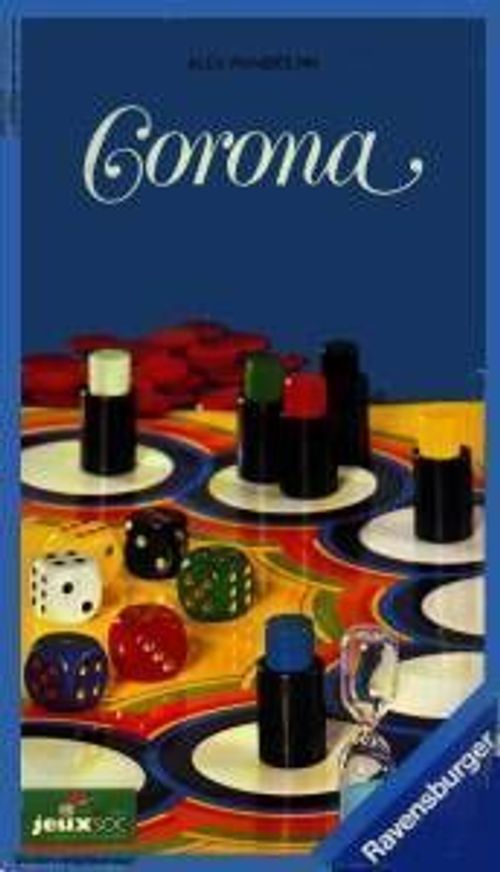
Corona
Corona Rulebook
Table of Contents
Table of Contents
Play Material
Play plan with 12 fields (rear side of Orbit).
6 carrier stones (heavenly body in 6 colors, except black/white).
6 black dice.
1 hourglass.
100 wooden chips.
Before the Game
Each player receives twice as many chips as the number of current players plus 2 chips more. With 5 players E.G. each player receives 12 chips (2 x 5 + 2). The remaining chips are put back into the box. With more than 6 players additional chips are needed.
A player is selected to be the "master of the stars". Their function is to structure the first starting situation. In the following rounds this role is passed on in each case to the player to the left.
The Flow of a Play Round
The master distributes the 6 carrier stones as desired on the 12 fields of the play plan. A field may have several carriers.
[Translator's note: In the original game the carriers were initially distributed in accordance with a roll of the dice.]
Then the master throws the 6 dice into the center of the game board and turns the hourglass. The players now have one minutes time, in order to evaluate the situation on the game board and make an estimate.
In order to be able to estimate the situation meaningfully, the players must understand the following clearly:
- that the object of the game is to move as many carrier stones as possible onto a common field.
- that each carrier stone will carry one die and that each carrier will move according to the number on that die in the clockwise direction.
- that points are received after each movement of a carrier stones.
- A carrier lands on an empty field - 1 point;
- A carrier lands on a field with one other carrier - 2 points;
- A carrier lands on a field with two other carriers - 3 points etc.
- [Translator's note: Some Corona versions say empty fields are worth 0 points]
- Each movement is analyzed individually and the points are added.
- E.G., three carrier stones land on the same field: the first receives 1 point, the second receives 2 points, and the third receives 3 points, hence 6 points in total.
- that it is important to foresee the order of movement. If your plan involves moving a carrier to an occupied field be sure that you have not moved the other pieces away from that field before your other piece arrives there.
During this minute the player should consider,
- which dice are to be assign to which carrier stones,
- in which order the carrier stones will be moved,
- how many points are they thereby able to obtain.
Note: On page 10 of the rule book there are examples to get further clarification of the process mentioned above. (Those examples are not included in this text.)
Once a player has decided on the number of points - while the hourglass is still running - he announces his estimate aloud. During the minute all other players can likewise, without observing any order, call their estimates - a player can also make several estimates. One condition: Each new estimate must be higher than the previous.
Whoever has announced the highest estimate when the hourglass stops flowing, may play it out his this estimate:
- the player first quickly distributes the 6 dice on the 6 carrier stones.
- then he moves the carriers in the clockwise direction, as many spaces as the dice determines, and naturally in the order in which he previously estimated.
- right after moving a carrier stone the player removes the dice from the carrier stone. This way it is easy to detect, which carrier stones were already moved and which have not.
- after each complete carrier movement the number of points earned is noted.
Once all carrier stones have been moved add the sum of their individual scores and compare the obtained score with the required score or estimate:
- if the player achieves his estimate or exceeded it, he receives a chip from each fellow player.
- if he did not achieve his estimate, he must pay a chip to each fellow player. Additionally he may not offer an estimate in the next round.
End Game
There are different possibilities. The game ends,
- if each player has been "masters of the stars" once, or
- if an agreed upon game duration has expired, e.g. 30 to minutes, or
- if a player has no more chips or
- if a player's start capital is doubled.
(The game play is excitingly however it is very arduous, anyhow it should not last longer than 30 to 40 minutes.)
The player, who possesses the most chips at the end, is the winner.