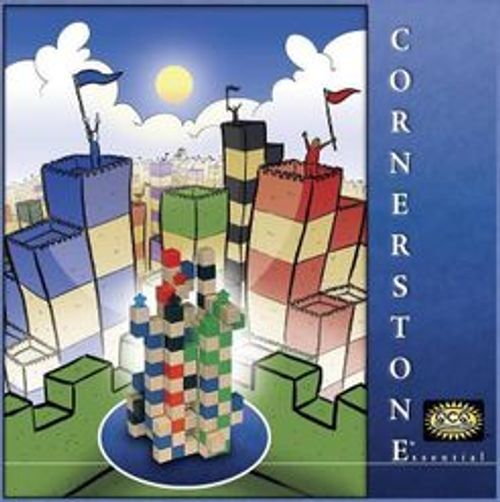
Cornerstone Essential
Cornerstone Essential Rulebook
Table of Contents
Table of Contents
Game Contents
- 48 Building Blocks (4 colors, each having 12 blocks)
- 1 Base Block
- 2 Dice
- 4 player pawns
- 8 Building Rings
- 5 Cloth bags
2-Player Rules
Read the following rules first. The special rules for the 2 player game are found at the end of these rules.
Game Preparation
- Each player receives a set of Building Blocks in one color (11 color blocks and 1 natural color block), a player's pawn (Climber) and 2 Rings.
- Place the Base Block in the middle of the table.
- Roll a die to see who rolls the highest number. That person will become a starting player. Then the game is played in a clockwise order.
Game Play
Round's Turn
- Active player rolls both dice.
- Now he must take one of his Building Blocks and add it to the tower. Which Building Block he may add is determined by the rolled numbers on the dice: Every Building Block is made up of 1 to 6 elements that conforms to the number of pips on a die: Example: a player rolls a "2" and a "3". He can now build with a block made up of 2 or 3 elements. He's not allowed to build with a block made up of 5 elements (sum of 2 and 3).
- After placing a Building Block on a tower, player can move his Climber.
Special Situations During Dice Rolls
- If a player rolls the same number on each die, he can choose any Building Block still in his supply to build.
- If both dice show a number of elements that a player doesn't have available to build, he must pass. In addition, he must pick a Building Block from the ones he still has available and put it back in the box (out of the game) unused. But he may still move his Climber. Tip: Player can prevent passing by giving up one of his Rings. (see "Building Rings")
- Should there be only one die showing the number of elements he doesn't have available, player must choose and build the Building Block with matching number of elements of the other die.
Building Rules
- At the beginning of the game only the Base Block is on the table. The Climbers are placed outside of it.
- In the first round each player must place their building block in such a way that it lays on the Base Block or is touching the Base Block.
- Important: Starting with the 2nd round, the pieces added by players may no longer touch the surface of the table, but rather must be built on top of the already created structure.
- The Building Block being built must be placed in such a way, that it touches at least one area of the already built structure.
- During the entire game, the Building Blocks must be placed such that they always form a checkered surface, like in chess. That means that the natural color element must be touching either a color element of a player's piece or the dark brown color of the Base Block.
- During building, empty spaces can be created underneath the blocks. Elements of a block being placed do not have to completely cover the elements of the block under it. Tip: If an empty space was created, another block can placed into that space to stabilize the tower later in a game.
- A block cannot be placed horizontally in such a way that more than 1 of its elements would be hanging in the air. Example: The 4-element block can't be built like this.
Movement Rules
- Players can move their Climbers only after they place their Building Blocks. But they are not forced to perform the movement.
- The square areas of each element of the Building Block are places where the Climbers can stand or move across.
- Player's Climber can be moved as far as desired, but only across neutral areas or areas of his own color. In order to do that, there must be a free path to do so. Even the dark brown areas of the Base Block can be moved across.
- Players cannot move their Climbers across other player's color areas.
- There can only be one Climber standing per space area.
- Players cannot move their Climbers over other player's Climbers either.
- Player's Climbers can move forward, back or to the side, but never on a diagonal.
- Climbers can move one step higher or one step lower, if possible to ascend or descend the tower. In one movement more than one of these ascending or descending steps can be taken. Tip: It is allowed to move the Climber any number of steps downward and move upward/downward from another spot according to movement rules.
- The Climber can even descend onto the table in one movement and enter the structure to climb from another point.
Examples
Black player can move to the 9 marked spaces, but can't move to the 8 marked spaces or beyond them.
Building Rings
After the dice roll, a player may use one of his Building Rings. After that, the rings are put back in the box. When played, a player has the following options:
a) Player can ignore the numbers rolled on the dice and build any Building Block of his choice from his supply.
b) On his turn, a player can move his Climber across any color spaces of other player's colors, even stop his movement on one of them. He may also move over other player's Climbers.
c) Player can jump-move his Climber to a space that's 2 steps higher or lower, rather than do the regular one step up or down movement. So in Example 2 above, green could follow the black arrow and jump 2 stories up.
Additional Rules
- You can build with two hands.
- If during the play a Building Block was placed in a wrong way such that it doesn't form the checkered pattern, the building block is not replaced and the game is further continued.
- A player may try out many locations when placing his Building Block. He can even decide to try out the other Building Block with different number of elements as shown on the other die. Only after he says he's done placing the block, the position of the block cannot be changed.
- It's allowed to temporarily remove one Building Block from the tower in order to get a better access to your own Climber. However a new path is not created because of this temporary move. Afterwards, the removed Building Block must be placed back on the same spot.
- Building Blocks can be built over player's Climbers, but Climbers can never be completely closed off. There must always be at least 1 free space for the Climber to move to.
- If during placement at least 3 Building Blocks fall, the game ends prematurely. If one or two blocks fall, they are simply put back in their position onto the tower.
End of Game
- The game ends when all players have built all their Building Blocks. The winner is the player whose Climber stands the highest on the tower.
- If multiple players have their Climbers standing at the highest level, then the winner is the one who has built more elements of the Building Blocks. To find out how many elements a player has left over, he counts the elements on the Building Blocks put out of the game (back in the box). Whoever has less elements as a total, wins the game. Example: Red had to put his 6-elements Building Block back in the box. Green had to put back his 2-elements and 3-elements (=5) Building Blocks. Thus green has won the game.
- If there still is a tie, the winner is the one with more unused Building Rings. If there's still a tie, players share victory.
- Important: if any player during the game makes the tower fall down, the winner, out of the players that didn't cause the falling, is the player who prior to the collapse had their Climber standing at the highest level. In case of a tie, players count the elements on their Building Blocks, as explained above, still in their supply. In case of another tie, Building Rings decide. Otherwise the game is undecided.
2-Player Rules (Detailed)
- In a 2 player game, each player plays with 2 colors.
- Each player gets all the Building Blocks, Climbers and Building Rings of each of the 2 colors and places them in front of themselves separating the colors from each other.
- Players will play the colors interchangeably. So if one player has red and green and the other blue and black pieces, the order of play for the whole game will be red, blue, green, black, red, blue, green, black, etc. Tip: In order not to confuse which color should be played next, a player who just finished his turn, should take a piece of the other color, that will be played next and place it in from of them.
- The other rules are the same as in the game for 3 or 4 players.
- At the end, the winner is not the player with the Climber standing at the highest level, but the player with the higher sum of levels that his Climbers are standing on. In order to do that the levels of the tower must be added up. Example: Player has one Climber standing on level 13 and another Climber on level 8. His sum is 21. In case of a tie, the previously explained rules are applied.
- If one of the players causes the tower to fall down, the other player is the winner.