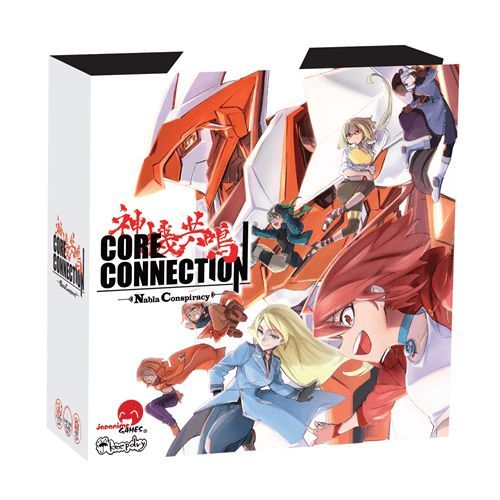
Core Connection: Nabla Conspiracy
Rulebook PDF: Japanime Games · PDF
Core Connection: Nabla Conspiracy Rulebook
Table of Contents
Table of Contents
Characters and Resonants
The seven playable characters, each shown with the Mecha and Pilot they fly. Their biographies are flavour text and are not transcribed.
- Akari Hino — Kannagara Mk-2
- Amelia Hawk — UNIVERSE
- Romana Ilis — Er-28+ Pndagruel
- Gao Fuan — Kirin
- Cleo and Patra Elharm — Shamaiet
- Rasha Dragnov — Lugievert
Goal of the Game
In Core Connection – The Nabla Conspiracy, you play a Mecha pilot competing against the other players in a battle against Nabla's Heart, an evil secret society.
Players fight as Pilots on the frontlines, utilizing Attachments and Tactics to power up their Mecha for battles against the Monsters that serve Nabla's nefarious ends. You'll need plenty of intel to discover the dark secret of Nabla's Heart! Defeat Monsters to gather their Energy: The stronger the Monsters, the closer you are to cornering Nabla and putting them away for good.
The first player to accumulate 20 Energy is the winner.
Card Types
Core Connection – The Nabla Conspiracy has 7 types of cards:
Mecha
Robots concealing unheard-of power. The players pilot these machines in battle against Nabla's Heart, doing everything they can to earn Energy faster than the other players can.
Mecha have 3 Battle Values: Melee, Ranged, and Durability. Melee represents a Mecha's close-range fighting prowess, Ranged represents its ability to fight at a distance, and Durability corresponds to how much damage it can sustain. All 3 values will be essential in your battle against Nabla and other Mecha.
Each Mecha has a unique fighting style based on these 3 values and its unique abilities. At a certain moment during the game, you can switch from a default Prototype Mecha to a unique Resonant. It's up to you to pick the Mecha that matches the way you fight.
Pilots
The person who pilots your Mecha.
Pilots can't be played on their own: Instead, you must connect them – that is to say, place them on top of your Mecha to power it up. Like Mecha, each Pilot has their own special abilities along with Melee, Ranged, and Durability values. These don't represent the Pilot's own fighting abilities, but rather are modifiers applied to any Mecha they pilot.
For example, if a Pilot with Battle Values of 2/2/2 pilots a Mecha with Battle Values of 3/4/5, the Pilot modifies the Mecha's Battle Values to 5/6/7.
Attachments
Equipment that you connect to your Mecha to power it up. Some provide battle modifiers to the Mecha like a Pilot does, while others have special support effects. A set number is distributed to each player at the start of the game, but it's possible to acquire new ones.
That said, you can't connect Attachments for free. Each has its own cost you have to meet first. Additionally, a Mecha can only connect a total of 6 Attachments at a time. (The source prints "Metcha" here; corrected to "Mecha".) If you want to connect a seventh, you'll need to Trash one of your existing Attachments first (see page 17).
Tactics
Strategies you may employ in your battle against Nabla's Heart. Unlike Pilots and Attachments, Tactics don't connect to Mecha. Instead, they have one-time support effects. Like Attachments, they also have costs you have to meet in order to play them.
Stories
These are events that may occur during the battle against Nabla's Heart which can affect all players. Stories occur randomly during the game, disrupting the battlefield with a variety of effects. They might change the course of the game entirely, or even provide a desperate player the chance they need to turn it all around.
When Stories are revealed, they're placed next to HQ: If a Story card is revealed when restocking HQ, draw another card from the HQ deck and continue restocking. When a player reveals a Story card, it remains in play until the start of their next turn, at which point they Trash it.
Until then, the effects printed on the card remain in effect. Stories add a strong element of randomness to the game. You never know what might happen next… which is what makes it fun!
Resonances
Resonances are a new type of card introduced in The Nabla Conspiracy which represent potent finishing moves that can only be used when a Pilot and her Mecha unleash their full power.
There are 6 different Resonances. Each has specific conditions you must meet in order to acquire it, offering support for a range of different strategies. You can only obtain and play 1 Resonance per game, so you'll need to choose wisely. Like Tactics, they provide a one-time effect. Resonances are also Trashed upon use, demanding careful consideration prior to activation.
Like Attachments and Tactics, Resonances are added to your deck when you obtain them, but they have no costs to play. Each player can only obtain 1 Resonance per game (including Discard Phases and other effects). After playing a Resonance, place it in the Junkyard.
Monsters
Armed with Battle Values and special abilities, these fearsome foes stand against the players, who must connect Attachments and Pilots to their Mecha and deploy Tactics cards in order to defeat them. When a player defeats a Monster, they acquire its Energy.
There are many different kinds of Monsters, including powerful ones that may require some ingenuity to defeat and some that even provide help to the players. Monsters are separated into 3 Levels based on their strength and Energy values, and as the game progresses, players will face increasingly stronger Monsters.
Monster Levels
The number of icons tells you the Monster's Level.
Monster Symbols
- Energy: The Energy value is shown in the top left corner of each Monster card. It is the amount of Energy that Monster is worth when placed in your Energy Pool.
- Resource Symbol: Represents Resources. More symbols means more Resources.
- Draw Symbol: Indicates that the player should draw a card from their deck.
- Unite and Divide: Some cards have 2 different effects, Unite and Divide, that you can choose from when you play them. Unite effects concern drawing and purchasing cards, while Divide effects are related to battle and obstructing the other players.
Note: See "▪Battle and Mecha States: ❸ Leveling Up the MD" for more details.
Before the Game
Ready to start playing? Let's get set up!
Mecha, Pilots, and Resonances
Start by giving a Prototype Mecha and a Hidden Figure Pilot to each player. Set the True Pilots and Resonants to the side in separate piles. These cards represent the Pilots and Mecha your Prototypes and Hidden Figures will eventually become. Finally, place the 6 Resonances face up in a row nearby.
Starter Decks
Core Connection – The Nabla Conspiracy is a "deck building" card game. Each player works to power up their deck by adding beneficial cards to it while removing unwanted ones. Each player starts with the following 10-card starter deck:
- Hi-Frequency Blade (2x)
- MGT Rail Cannon (2x)
- Ballistic Shield (2x)
- Operator (2x)
- Emergency Maintenance (2x)
Once your starter decks are in order, each player shuffles their deck and draws a starting hand of 5 cards.
HQ and the HQ Deck
Start by shuffling the following cards into a single deck:
Attachments (4 each, except where marked below)
- Spare Chargers
- Multi-Purpose Container
- Drain Gloves
- ATA Combat Stabilizer
- Reflector Wall
- Radar Goggles
- Vril Resonator
- Nuvlil Engine
- Totsuka No Tsurugi (1x)
- Support Unit Auxilia (1x)
- Hetepet's Staff (1x)
- TAIIN-GENBU (1x)
- Gunrogi (1x)
- COMET STAR (1x)
Tactics (3 each)
- Sniper Shot
- Scrambled Command
- Na.Vi.Co. Support
- Rummage
- Pinch Hitter
- Core Connect
- Romana's Cooking
- Snatch
- Secret Plan
- Carpet Bombing
- Development
- Air Transport
- A Girl's Day Off
- Burning Vitality
- Backroom Deal
- OverClock
Stories (1 each)
- The Gathering Stars
- The White Call
- Unbreakable Spirit
- Surge of Evil
This card pile is referred to as the HQ Deck. Once you finish shuffling, place the cards in the HQ Deck area. Then turn over cards from the top of the HQ Deck and place them next to the deck until you have revealed a total of 8 different Attachments and/or Tactics cards. Duplicate cards are stacked on top of each other.
If you reveal a Story card, set it aside and continue revealing cards from the HQ. When you're finished, shuffle the Story card(s) back into the HQ deck.
These 8 cards (piles) are called the "HQ." You can purchase new Attachments and Tactics from here.
The Monster Deck
Monsters are divided into 3 Levels. Create 3 piles, one for each Level.
Level 1
- Megadrone Alpha (3x)
- Megadrone Gamma (3x)
- Megadrone (3x)
- Bomb Megadrone (2x)
- Cannon Megadrone (1x)
- Heavy Megadrone (1x)
- Lucky Armadillo (1x)
- Megadrone Beta (3x)
- Transporter Megadrone (1x)
- Lucky Platypus (1x)
- Nest Megadrone (2x)
- The Monolis (3x)
- Atmos Megadrone (3x)
Level 2
- Patrol Droid (2x)
- Slimer Droid (1x)
- Guardian Droid (3x)
- Knight Droid (2x)
- Fortress Droid (2x)
- Jailer Droid (1x)
- Satellite Droid (1x)
- Telekinesis Droid (1x)
- Suicide Droid (2x)
- Gravity Droid (1x)
Level 3
- Delta Zero (2x)
- O-Ryu (1x)
- Kannagi (1x)
- Setnakhte (1x)
- DOMINATOR (1x)
- Chernoborg (1x)
- XX-300 Rostam (1x)
- Alba Nabla (1x)
The main pile of Monster cards is called the Monster Deck or MD. At the start of the game, only the Level 1 Monsters will be in the MD. The Level 2 and Level 3 Monsters will remain to the side. These higher Level Monsters will be added to the MD as the game progresses, leading to the arrival of ever-stronger Monsters (see page 23).
Shuffle the Level 1 Monsters and create the face-down MD. Set the other Levels to the side for now.
Preparations are now complete. Decide the playing order, and you're ready to start the game!
Setup Layout
The setup diagram labels the following areas:
- Player 1 Starter Deck: Your deck and hand.
- Discard Pile.
- Energy Pool.
- Field: Your Pilot and Mecha go here. Use Attachments and Tactics to do battle against the enemy!
- Pilots, Resonants, and Resonances: Place the piles of True Pilots, Resonants, and Resonances here.
- Monster Area: The Monster Deck is arranged by Level.
- HQ Area: Create the HQ Deck, HQ, and a Junkyard pile for Trashed cards here.
Gameplay
Let's take a look at how the game is played.
Turn Flow
In Core Connection – The Nabla Conspiracy, players take turns in the order you have chosen. Your turn consists of the following 4 phases, which you must play in order:
- Ready Phase (preparing for the turn)
- Main Phase (preparing for battle)
- Battle Phase (battling against Monsters)
- Discard Phase (end-of-turn cleanup)
Then the turn ends (End of Turn).
When your Discard Phase is complete, your turn ends and the next player begins their turn. You will continue taking turns until a player has collected 20 Energy (see page 24 "Winning the Game" for details). Let's go through each phase in detail.
Ready Phase
This phase is for the maintenance of your Mecha, and takes place immediately after the start of your turn. Follow the flowchart below as you carry out the required checks:
Prototype
- If your Prototype is Normal, proceed to the Main Phase.
- If your Prototype is Broken Down, perform Repairs: discard 1 card from your hand to return your Mecha to Normal. Then proceed to the Main Phase.
Resonant
- If your Resonant is Normal, proceed to the Main Phase.
- If your Resonant is Critical, you may perform Repairs (optional): discard 2 cards from your hand to return your Mecha to Normal. Then proceed to the Main Phase.
- If your Resonant is Broken Down:
- If Repairs are underway from the previous turn, return your Mecha to Normal. Then proceed to the Main Phase.
- If Repairs are not underway from the previous turn, perform Repairs: discard half (rounded up) of the Attachments connected to your Mecha and end your turn. At the beginning of your next Ready Phase, your Mecha returns to Normal.
Note: Mecha states are discussed in later sections. (See "▪Battle and Mecha States" and "❷Mecha States" for more details.)
Main Phase
Up next is the Main Phase. There are 3 actions available to you during this phase. You may perform these actions in any order you choose:
① Purchase 1 Card (max. once per turn)
You can purchase 1 card per turn from the HQ, adding it directly to your hand.
Note: If there are ever 7 or fewer different cards in the HQ, reveal cards from the HQ Deck until an 8th card type is revealed. Add any duplicate cards to the existing card piles in the HQ.
② Connect 1 Attachment (max. once per turn)
You can connect 1 Attachment in your hand to your Mecha per turn. Connected Attachments are not removed from your Mecha except under special circumstances (to repair damage or due to a card effect, for example).
A Mecha can only have 6 Attachments connected at a time. If you want to connect a 7th Attachment, you must first Trash 1 of the Attachments that's currently connected to your Mecha (put it in the Junkyard).
③ Play Tactics (no limit per turn)
You can play a Tactic card from your hand to use the effect of that card. Tactics are placed in front of you when played, and go to your discard pile during the Discard Phase. (See "❹ Discard Phase" for more details.)
Resources
The actions above all come with a cost. Purchasing cards, connecting Attachments, and playing Tactics all require that you have the required number of Resources.
- You may play any number of cards from your hand face down during your Main Phase. Each face-down card generates 1 Resource.
- Cards placed face down for Resources cannot also be played normally, and go to your discard pile during the Discard Phase.
- You cannot play a card as a Resource during the same turn that you acquire it.
Resources are not "spent" when you purchase or play cards. Instead, think of the Resources you have in play as an upper cost limit on the actions you can take.
For example, if you play 3 cards as Resources, you can purchase a card of cost 3 or less, connect an Attachment of cost 3 or less, and play a Tactic card of cost 3 or less, all in the same turn.
About Story Cards
In addition to Attachment and Tactic cards, the HQ deck also contains Story cards. Story cards are special: when a Story card is revealed when you are refilling HQ or one is added to a player's hand by an effect, set it in the Story Card area. If another Story Card is already present, Trash it.
Once placed, the Story card creates a variety of effects which persist until the player who revealed the card starts their next turn. Trash the Story card at the start of that player's next turn. Story cards often affect all players, pushing the game in unpredictable directions.
Battle Phase
The Battle Phase comes next. Here, players can choose to engage Monsters by following the steps below.
- Initiate Combat: Choose Melee or Ranged and announce your matching Attack Value.
- Identify Enemy: Reveal the top card of the MD. This is the Monster you'll be fighting.
- Battle!: Your Mecha and the Monster deal damage to each other based on their Battle Value for the chosen style of combat. (See below for details.)
- Combat Results: If the Monster was defeated, add it to your Energy Pool. If not, place it at the bottom of the MD.
Discard Phase
This final phase is something of a "cleanup" step leading into the next turn.
Cards you played as Resources, Tactics you played, and any cards remaining in your hand are all placed in your discard pile. Then, draw 5 cards from your deck. If you run out of cards to draw, draw as many as you can, then shuffle the cards in your discard pile together to create a new deck (this is called "Reshuffling"), then finish drawing up to 5 cards.
At any time during your Discard Phase, you may also perform the following actions if you meet the necessary requirements, even after you've finished refilling your hand:
① Reveal a True Pilot and/or Board a Resonant
If you have a Total Energy of 4 or more in your Energy Pool, you can reveal a True Pilot. If you have 8 or more Total Energy, you can acquire a Resonant.
Editorial note: the source sentence reads "…reveal a True Pilot. you have 8 or more Total Energy…"; the missing "If" is restored here.
② Obtain a Resonance
You can obtain a Resonance if you meet its requirements, adding it to your hand. You can only obtain a single Resonance per game, whether during your Discard Phase or due to some other effect. When played, Resonances are Trashed, so you must choose the best time to use it carefully.
Once you're finished taking actions during your Discard Phase, your turn ends and the next player can begin their turn.
How to Resonate
Some True Pilots and Resonants have special connections with each other. Boarding a Resonant with the specified True Pilot is referred to as "Resonating." These combinations allow you to use the [Resonate] effects on certain cards.
The following pairs of Mecha and Pilot are capable of Resonating:
- Kannagara Mk-2 & Akari Hino
- UNIVERSE & Amelia Hawk
- Er-28+ Pndagruel & Romana Ilis
- Kirin & Gao Fuan
- Shamaiet & Cleo and Patra Elharm
- Lugievert & Rasha Dragnov
Battle and Mecha States
Battle Structure
Throughout the game, players will engage Monsters and other players in battle. When the time arrives to fight, follow the steps below:
- First, decide which Attack Values you'll be using in the fight: Melee or Ranged. During your Battle Phase, you'll decide this before revealing the top card of the MD. For other battles, you'll make the decision at the time specified by the card that triggers the fighting.
- During the battle itself, each combatant inflicts damage to the other based on the chosen Attack Value, which is compared to their opponent's Durability. If the damage dealt meets or exceeds the Mecha or Monster's Durability, it's Disabled.
Example: Player A has a Prototype with a Hidden Figure and 2 Attachments connected: Custom Hi-Frequency Blade and Ballistic Shield. After finishing their Main Phase, they begin their Battle Phase. Player A announces they'll be using Melee combat (Initiate Combat). Then, they reveal the top card of the MD (Identify Enemy). It's a Megadrone Alpha!
The Prototype gets +1 Melee from the Hidden Figure and an additional +2 Melee from its Custom Hi-Frequency Blade, which means that it deals 4 damage in total to Megadrone Alpha (1 + 1 + 2 = 4). Megadrone Alpha, meanwhile, deals 3 unmodified Melee damage to the Prototype.
Megadrone Alpha has 1 Durability. The 4 damage from the Prototype exceeds Megadrone Alpha's Durability, destroying it. The Prototype, meanwhile, has a base Durability of 1, with +1 Durability from the Hidden Figure and an additional +2 Durability from Ballistic Shield, resulting in a total Durability of 4. As a result, it's able to shrug off the 3 damage from Megadrone Alpha (4 - 3 = 1 Remaining Durability).
The battle is over. Player A adds the destroyed Megadrone Alpha to their Energy Pool. (Combat Results) If you fail to destroy a Monster in a battle, return it to the bottom of the MD at the end of the battle.
Note: Damage does not carry over between battles. If the damage dealt isn't enough to Disable or destroy the Mecha or Monster, its Durability will be fully recovered for the next battle. Even if a card takes damage twice in the same turn due to card effects, each instance is handled separately with no carryover.
Mecha States
When a Mecha takes damage that meets or exceeds its Durability, it's Disabled. When a Mecha is Disabled, turn it sideways.
① Prototypes: When a Prototype is Disabled, it is Broken Down and cannot participate in any more battles until you repair it during your Ready Phase by discarding a card from your hand.
② Resonants: When a Resonant is Disabled, it is not immediately knocked out of the fight. Instead, it goes Critical. Flip the card over to its Critical side. Critical Mecha can unleash powerful effects, but if they are Disabled again, they become Broken Down. This carries a heavy penalty, requiring you to discard half (rounded up) of your connected Attachments and skip an entire turn (see page 16).
Remember: You can repair your Resonant when it is Critical by discarding 2 cards from your hand during your Ready Phase.
When your Resonant goes Critical, your Pilot also flips over to their Awakened side, powering up in the process. If your Mecha is Broken Down or returns to Normal, your Awakened Pilot returns to Normal, too.
Note: True Pilots and Resonants don't lose their Normal State effects when they Awaken or go Critical.
Leveling Up the MD
As players play cards and power up during the game, the Monsters get stronger to match. Initially, only the Level 1 Monsters are in the MD.
Here's where things get interesting…
- Once all players have revealed their True Pilots, shuffle the Level 2 Monsters into the MD.
- Once all players have boarded their Resonants, shuffle the Level 3 Monsters into the MD.
All Monsters in the MD have different effects and abilities, but the Monolis is truly unique. Though it has no special abilities on its own, if one is destroyed after 2 other copies of the Monolis have been destroyed previously, the following occurs:
- Find Alba Nabla from the MD or the Level 3 Monster pile. Then, each player must battle Alba Nabla one at a time, starting with the current player. After all players have engaged Alba Nabla in combat, if it hasn't been destroyed, place it at the bottom of the MD.
This is treated as the Monolis' effect, even though it differs from other cards. Note that it can be negated with other effects (i.e., Cleo & Patra Elharm).
Winning the Game
Goal of the Game
The first player to amass 20 or more Energy by defeating Monsters brings the game to an end… but that's not the only way to win!
When a player has 20 or more Total Energy, they must announce it to the other players. The game continues until that player's next Main Phase. At that time, if no other players have tied or exceeded that player's total Energy, they win the game.
If another player has matched or beaten their Total Energy, the game continues until a player has the most Total Energy at the beginning of their own Main Phase (in other words: in order to win you have to have the most Total Energy for an entire round of play).
However, if any player reaches 30 or more Total Energy, they win the game immediately, with no need to wait until their next Main Phase.
Resonate, unleash your power, and put an end to the dark conspiracy within Nabla's Heart!
Playing With Expansions
If you have other sets from the Core Connection series, you can mix them together for a custom playing experience. The following sets are needed to play with our recommended card sets:
- Core Connection – Rise of Atlantis (Base Set 1)
- Core Connection – Titans Unleashed (Expansion)
Note: The above sets are included in Core Connection – MastersEdition01 Atlantis Saga.
- Core Connection – The Nabla Conspiracy (Base Set 2)
If you have any of the sets above, you can swap out missing cards in each recommended set with other cards.
Suggested Rules for Combined Set Play
It's recommended that you use Base Set 2's rules for victory conditions, starter decks, Mecha, Pilots, Monsters, Resonance conditions, etc. When you use cards with the same names from different sets, always treat them as if they were the versions from Base Set 2.
Recommended Set ① Resonant Delusion
Included Cards:
- Attachments (1 each): Godforge -Oreikhalkos-, Futsu-No-Mitama, Hyakuren, Totsuka No Tsurugi, TAIIN-GENBU, Godforge -Tríaina-, PATRIOT, The Golden Mask, COMET STAR, Hetepet's Staff, Godforge -Aigis-, RI-06 Admantium, Zarnista, Support Unit Auxilia, Gunrogi
- Attachments (4 each): Frontline Base, Sensory Amplifier, Multi-Purpose Container, Nano-Repair System, EX Mag Belt, Vril Resonator, Reflector Wall, Drain Gloves, Radar Goggles, Spare Chargers, Emergency Booster
- Tactics (3 each): Emergency Budget, Maintenance, Sabotage, Romana's Holiday, Unbreakable Will, Na.Vi.Co Support, Advanced Development, M&A, Secret Plan, Core Connect, Backroom Deal, Overclock, Air Transport, Carpet Bombing
- Stories (1 each): Strange Awakening, Up All Night, Gao's Method, True Nature
Recommended Set ② Resonant Memories
Included Cards:
- Attachments (1 each): Godforge -Aigis-, The Golden Mask, TAIIN-GENBU, Hetepet's Staff
- Attachments (4 each): NAVI System, NS Bind Coil, Nuvlil Engine, Emergency Booster, Decoy Unit, Implosion Generator, Vril Resonator, Impact Striker, Nano-Repair System, Long-Range Sensor
- Tactics (3 each): Self Destruct, Concentrated Fire, Battle Senses, False Intel, Traitorous Deeds, Core Connect, Time to Say Goodbye, Unbreakable Will, Scrambled Command, Maintenance, Search Pattern, Emergency Budget, Secret Plan, Advanced Development, Na.Vi.Co. Support
- Stories (1 each): The Beginning of The End, Gao's Method, Strange Awakening, Unbreakable Spirit, Rampage, Traps, Traps, Traps!, The Gathering Stars, No Man Left Behind, The White Call, True Nature, Surge of Evil, Up All Night
- Events (1 each): Destructive Force, All Bow Before The King
When playing Recommend Set 2: Resonant Memories, please use the following rules in addition to those mentioned above:
Adding Event Cards and Ennosigaios to the MD
- Event cards are treated as Level 2 Monsters.
- Ennosigaios is treated as a Level 3 Monster.
- When the Event card "All Bow Before The King" is revealed, shuffle it into the MD and play Ennosigaios, even if it's currently only Level 2.
About Story Cards (Resonant Memories)
You can now have up to 2 Story cards active at a time. If a Story card is revealed when another is already in play, add it to the Story Card Area and apply its effects. Trash each Story card at the start of the drawing player's next turn, as normal. If a third Story card is revealed when there are already 2 in play, Trash the Story card that was revealed first and replace it with the newly revealed card.
Glossary
- Active Player: The player who is currently taking their turn.
- Attachment: A piece of equipment that can be connected to a Mecha to increase its power. In order to connect an Attachment, you must have Resources at least equal to its cost.
- Attack Value: The Melee or Ranged value of a Mecha or Monster.
- Awakened State: A Pilot in a Resonant that goes Critical enters an Awakened State. When a Pilot awakens, flip it over.
- Battle Values: The Melee, Ranged, and Durability values of a Mecha or Monster.
- Broken Down: A Mecha in this state cannot participate in battle. Turn Broken Down Mecha cards sideways as a reminder.
- Choice Card: A card that has multiple effects, usually a Unite effect and a Divide effect. You must choose only 1 of these effects when resolving the card.
- Combat Modifiers: Adjustments made to a Mecha's Battle Values by Pilot/Attachment Modifiers and effects.
- Connect: To power up a Mecha by placing a Pilot or Attachment on top of it.
- Cost: The number of Resources required to purchase Attachments and Tactics, play cards, and connect Attachments.
- Critical State: A Resonant in Normal State enters Critical State when it's Disabled. When a Mecha goes Critical, flip it over. Critical Mecha have more powerful abilities, but are in danger of Breaking Down.
- Defeat: To deal enough damage to a Monster or Mecha to Disable it.
- Destroy: To defeat a Monster or Mecha using damage or other effects.
- Disable: Occurs when a Monster or Mecha suffers damage equal to or greater than its Durability or through some other effects. When a Prototype or Critical State Resonant is Disabled, it becomes Broken Down. When a Normal State Resonant is Disabled, it goes Critical.
- Divide Effect: One of the options on a choice card that represents the pilots working for themselves. Typically concerns battle or obstructing the other players.
- Energy: The number shown in the top left corner of each Monster card. This represents the amount of Energy that Monster is worth when placed in your Energy Pool.
- Energy Pool: An area where you place the Monsters you have defeated (acquired) in battle.
- Field: The area of the table in front of you where you play cards during your turn and where you keep your Mecha, Pilot, and the Attachments you have connected.
- HQ: The selection of cards that a player can purchase during their Main Phase. There must always be exactly 8 different cards (and/or piles) in the HQ.
- HQ Deck: A deck of cards placed next to the HQ. Whenever there are less than 8 different cards in the HQ, new cards are added to the HQ from the top of the HQ Deck.
- Junkyard: An area where Trashed cards are kept. You cannot normally access any cards in the Junkyard.
- Level: A rating that reflects the power of a Monster as well as the general power of the Monsters in the Monster Deck.
- Level Up: Adding Monsters 1 Level above the current Level to the Monster Deck.
- MD: The Monster Deck.
- Mecha: An immensely powerful machine that can be controlled by a human who has the right Royal Wavelength.
- Modifiers: The 3 numerical values shown at the bottom of Pilots and Attachments. They modify the Battle Values of your Mecha.
- Monster: An enemy, drawn from the Monster Deck, that a player may face in battle.
- Monster Deck: The stack of Monster cards that the players will battle during the game.
- Normal State: When a Mecha or Pilot is face up.
- Obtain: To add a card to your hand, typically by purchasing it from the HQ.
- Pilot: A human gifted with the Royal Wavelength who is controlling a Mecha.
- Play: Placing Tactic cards in your field to activate their effects.
- Purchase: To obtain a card from the HQ or elsewhere by paying its cost.
- Reset: The act of shuffling all of the cards in the HQ back into the HQ Deck, then drawing cards from the HQ Deck to create a new HQ.
- Resources: The "currency" you must have in order to pay the cost of a card. You can gain Resources for a turn by playing cards from your hand face down in your field.
- Reshuffle: The act of shuffling your discard pile into a new deck when your deck runs out of cards.
- Resonance: One of the most powerful abilities of a Mecha and Pilot. Useable only once.
- Resonating: Unique abilities that can occur only when a Pilot is paired with their proper Mecha. You can only use a card effect with the [Resonate] keyword if you are playing the right combination of Pilot and Mecha.
- Story: A long-term event that represents forces outside of the control of the players. Story cards temporarily change the rules of the game.
- Tactic: A card representing a strategy you might use in battle or something useful that is not connected to your Mecha. You must have enough Resources to equal the cost of a Tactic to play it.
- Trash: To "permanently" remove a card from the game by placing it in the Junkyard. An effect can only target a Trashed card if it specifically says it can.
- Total Energy: The total amount of Energy in your Energy Pool. The goal of the game is to be the first to reach 20 Total Energy.
- Unite Effect: One of the options on a choice card that represents the pilots working together. Typically concerns drawing and purchasing cards.
FAQ
Q. What's the difference between card text that refers to card types with the word "card" attached (i.e., "Attachment Cards") and text that refers to card types by themselves? (i.e., "Attachments")
A. Cards of any type are referred to with "card" when they're in areas like the hand, deck, HQ, HQ Deck, Energy Pool, Junkyard, etc. Cards that are in play and affecting the game are referred to without the word "card."
Example: Cleo & Patra Elharm — "You can connect 2 Attachment cards per turn. When you connect an Attachment, draw 1 card."
Q. When I draw O-Ryu, does combat take place during the Battle Phase?
A. No – when you draw it, combat begins immediately without moving to a different phase. Since Mecha can't fight when they're Broken Down, this will result in the Monster not being defeated, so it is placed on the bottom of the deck.
Q. I remove a connected Multi-Purpose Container. What happens to any cards under it?
A. They're placed in the Junkyard.
Q. Can effects that allow you to purchase, connect, or perform multiple Battle Phases stack?
A. They only stack if the word "extra" or "additional" is used.
Q. Can I use this set with Core Connection – Rise of Atlantis and its expansions?
A. Yes, you can. Check page 25 for details.
Q. When I reach the required Total Energy, can I continue playing without assigning a True Pilot or boarding a Resonant?
A. No, you can't. Once you reach the required Total Energy, you must choose a Pilot or Resonant during your Discard Phase.
Q. What area does "Field" refer to?
A. The area where players place their cards. Mecha, Pilots, connected Attachments, cards placed face down as Resources during a turn, and played Tactic cards are all placed in a player's Field.
Q. Alba Nabla and IZR-66 don't have Levels. What Level Monster are they treated as?
A. Though neither has a level, they're both treated as Level 3 Monsters during the game.
Credits and publisher attribution are omitted.