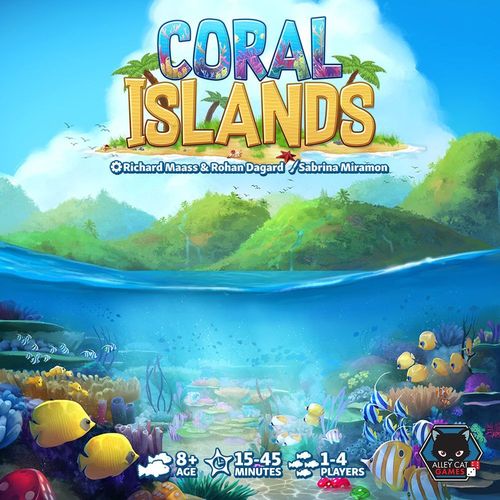
Coral Islands
Coral Islands Rulebook
Table of Contents
Table of Contents
Components
- 16 red dice, 16 yellow dice, 16 green dice, 12 purple dice, 8 blue dice, 8 black dice
- 2 side boards
- 1 double-sided main board
- 100 Shape cards (5 copies of each of 20 different shapes)
- 4 Nursery cards
- 4 Reference cards
- 41 Diverse Ecosystem cards (part of the deluxe edition only)
- 6 Specialist cards
- 108 Terrain cards (18 in each of 6 different terrain types)
- 24 Fish tokens
CORAL
Overview
In Coral, cultivate and grow coral to regenerate a coral reef under threat. You'll need to constantly adjust your perspective as you build three-dimensional coral, represented by stacks of dice, trying to create the shapes required to help the coral reef flourish. Match the right shapes to grow the healthiest coral and prove yourself as the leading conservationist.
Getting Ready
-
Find the following components:
- 60 dice: 16 red, 16 yellow, 16 green, 12 purple
- 1 main board
- 104 Coral cards: 100 Shape cards (5 copies of each of 20 shapes), 4 Nursery cards
- 24 Fish tokens
- 4 Reference cards
You won't need the following: 8 blue dice, 8 black dice, 2 side boards and all the Islands cards. The 41 Diverse Ecosystem cards are only used if you wish to play with one or more of the expansion modules.
The rules for Man vs Nature solo game and Diverse Ecosystem expansion modules appear after the rules for the main game.
-
Lay the main board on the table with the Coral side face up.
-
Put all the Fish tokens beside the board to form a supply.
-
Give each player 1 Nursery card.
-
Each player takes the following number of dice of one colour:
- 2 or 3 players: 16 dice (red, yellow or green)
- 4 players: 12 dice (red, yellow, green or purple)
-
Place your Nursery card in front of you, and keep all of your dice beside it in a reserve.
-
For your first game, find all the Shape cards with the marker symbol on them and sort them (the 7 cards shown) into stacks of matching cards. You will have 5 copies of each of 7 different shapes. Put these 7 stacks face-up beside the board.
Using Different Shape Cards
The game includes 20 different types of Shape cards. There are 4 different illustrated fish on the cards: Copperband Butterflyfish, Yellow Tang fish, Three-Stripe Damselfish and Saddle Butterflyfish.
In later games, find all the cards with either the Copperband Butterflyfish, the Yellow Tang fish, the Three-Stripe Damselfish or the Saddle Butterflyfish on them. In each case, you will have a different set of 7 shapes to play with. Once you are familiar with the different Shape cards, you may enjoy choosing your own set of 7 shapes. It is best to choose a mix of values and to not include shapes which are too similar.
Aim of the Game
Take turns to play dice onto the board and build a three-dimensional coral reef. Try to place your dice to create patterns of stacked dice that match the Shape cards. When you make a matching pattern, take the card and keep it. The player whose cards are worth the most points at the end of the game wins.
How to Play
To start the game, each player rolls two of their own dice and places them on their Nursery card. If you roll the same result on both dice, reroll one of them until you get a different result.
The player who rolled the highest total goes first. If there is a tie, the oldest tied player goes first. Players then take turns clockwise.
On your turn, do the following things in order:
- Add a die to the Reef
- Claim a Shape card (if possible)
- Refill your Nursery
About Fish
During the game you will be able to earn Fish tokens, which you can spend to take additional actions. Whenever you earn a Fish, take one from the supply and keep it in front of you. When you spend one or more Fish, return them to the supply. You may spend Fish on the turn in which you earn them, or keep them to spend in later turns. There is no limit to the number of Fish tokens you can earn.
Any Fish tokens you have left at the end of the game are not worth any additional points. The supply of Fish tokens is not intended to be limited, so if you run out, substitute with any suitable replacement.
1. Add a Die to the Reef
Choose one of the dice on your Nursery card and place it on the board, adding it to the Reef.
The first player must place their first die on the space in the middle of the board to begin the Reef. After this, each new die must be added to the Reef as follows:
- Directly onto the board in a space that is edge-to-edge adjacent to another die in the Reef. You cannot place a die so that it is only diagonally adjacent to another die.
- or -
- On top of another die in the Reef, making a stack. A stack can contain a maximum of 3 dice.
Earning Fish: If you placed a die directly onto the board in a space with a picture of a fish, take 1 Fish token.
You may only stack your die on top of another one if your die has a value that is higher than the die below it, or your die is a 1. When you place your die directly onto the board, it can have any value.
For example, you can stack a 6 on top of a 1, 2, 3, 4 or 5, but you can only stack a 3 on top of a 1 or 2. However, you can stack a 1 on top of any value, including another 1.
Adjusting the Value of a Die: Before you place a die, you may spend 1 Fish token to either add or subtract 1 from its value. Rotate your die to change its value. You may spend multiple Fish to do this more than once. For example, you could spend 3 Fish to turn a 4 into a 1. You cannot spend a single Fish to turn a 6 in to a 1, or a 1 into a 6.
Now check to see if you have created a pattern of dice that lets you claim a Shape. If not, skip ahead to the 'Refill your Nursery' step. In the unlikely event that you cannot place a die, simply skip ahead to the 'Refill your Nursery' step.
Adding a Second Die to the Reef: You may spend 3 Fish tokens to add the other die on your Nursery card to the Reef. You may spend Fish to adjust its value before you place it as normal.
2. Claim a Shape Card
Each time you add a die to the Reef, check to see if it created and completed a vertical pattern of dice in the Reef that exactly matches the pattern on a face-up Shape card beside the board. If it does, take the card and keep it face down in front of you. The number on the Shape card tells you how many points it is worth at the end of the game.
Earning Fish: If the Shape card you claimed has a Fish icon on it, take 1 Fish token.
Each pattern requires a combination of your own dice and dice belonging to your opponents. All the white dice shown in the pattern on a Shape card must correspond to your own dice, and all the grey dice in the pattern must correspond to dice that belong to any combination of your opponents.
Each pattern must be created vertically, but it may face in any direction.
To check if you have correctly completed a pattern that matches a Shape card, hold the card up vertically beside the Reef alongside any side of the board, with the bottom edge of the card touching the table. If the die you just placed, in combination with any of your own and your opponents' dice that were already in the Reef, creates a pattern that exactly matches the pattern on the Shape card you can claim that card.
You can only claim a Shape card immediately after placing a die that completes a matching pattern. You cannot claim a Shape card for a pattern you completed in an earlier turn. However, any die that was part of a completed pattern can be used as part of another pattern in a later turn.
If the die you placed completes multiple patterns that match more than one available Shape card, you may only claim one of them. Once all of the Shape cards of a particular pattern have been claimed, creating that pattern again is possible but is no longer worth any points.
3. Refill Your Nursery
Earning a Bonus Fish: If you did not claim a Shape card this turn, take 1 Fish token. Note, this can be in addition to earning a bonus fish by placing a die on a board space with a picture of a fish.
At the end of your turn, take a die from your reserve, roll it, and place in on your Nursery card. If you added both of the dice on your Nursery card to the Reef this turn, roll two dice and place them both on your nursery.
You cannot have two dice with the same result in your Nursery. If this happens, reroll one of them until you get a different result.
When you have used up the dice in your reserve, skip this step.
Play now continues clockwise.
End of the Game
The game ends when all of the players' dice have been added to the Reef. Keep taking turns clockwise until this happens. If play passes to you and you have run out of dice, simply skip your turn.
At the end of the game, everyone reveals all of their face-down Shape cards and adds up how many points they are worth. The player with the most points wins.
If two or more players are tied for the most points, the player with the most remaining Fish tokens wins. If players are still tied, all tied players share victory.
Man vs Nature: Solo Game
In the solo game, you play against Nature. You will take turns as usual, and must complete a specific set of unique shapes before you run out of dice. Will Nature be revealed as a powerful opponent, or will you be able to guide Nature into helping you?
Setup
Lay the main board on the table with the Coral side face up. Put all the Fish tokens beside the board to form a supply. Take a Nursery card and place 16 dice of one colour beside it as your own reserve. Roll two dice from your reserve and put them on your Nursery card as normal, rerolling one of them if you have rolled the same result on both dice.
Take 16 dice of another colour for Nature and place these beside the board as Nature's reserve.
Difficulty Level
Take one copy of each of the 20 different Shape cards, and sort them by their point value. Choose a difficulty level and then randomly choose a number of different Shape cards of each point value, according to the chart. Lay the 7 Shape cards selected face up beside the board and put all the other Shape cards away.
| Difficulty level | 1 point | 2 point | 3 point |
|---|---|---|---|
| Barnacle (introductory) | 3 | 4 | --- |
| Pufferfish (easy) | 2 | 3 | 2 |
| Narwhal (medium) | --- | 4 | 3 |
| Killer Whale (hard) | --- | 2 | 5 |
| Kraken (fiendish) | --- | --- | 7 |
Aim of the Game
You and Nature will take turns to add dice to the Reef. You will place your dice as normal, and will place Nature's dice for her automatically. You win the game if you successfully create and complete all of the 7 Shape cards before you run out of dice.
How to Play
Nature goes first. On Nature's turn, take one die from Nature's reserve, roll it and add it to the Reef. Depending on the value rolled, use the requirements below to decide where in the Reef to place the die depending on the value rolled.
In each case, if there are multiple legal positions that would satisfy a requirement, choose the one that is closest to the centre of the board. If there are still multiple equivalent positions, you choose in which of these positions to place the die.
A die placed directly on the board is at 'level 1'. A die stacked on top of a single die is at level 2. A die stacked on top of two other dice is at level 3. All of the usual rules about dice placement and stacking still apply. A dice stack can still only contain a maximum of 3 dice.
- If Nature's die is a 1: Place the die in a legal position on the highest level possible.
- If Nature's die is a 2, 3 or 4: Place the die in a legal position on level 2. If this is not possible, place it in a legal position on level 3. If the die cannot be stacked, place it on level 1.
- If Nature's die is a 5 or 6: Place it on level 1.
Adjusting the Value of Nature's Die: Before you place Nature's die, you may spend 2 Fish tokens to either add or subtract 1 from its value. Rotate the die to change its value.
Nature never collects any Fish, and you never collect Fish or complete Shape cards on Nature's turn. You cannot spend Fish on Nature's turn to place a second die.
After you have placed a die for Nature, take your own turn, and then continue to play taking alternating turns.
On your own turn, you may collect and spend Fish tokens as normal. You may spend 1 Fish token to add or subtract 1 from your own die's value, or 3 Fish to place your second die.
As normal, each time you add a die to the Reef, you can only claim at most one Shape card. On any one of your own turns in which you do not claim at least one of Shape cards, you still earn 1 Fish at the end of your turn.
Winning the Game
If you create and complete all of the Shape cards, you win!
Diverse Ecosystem: Expansion Modules
The Diverse Ecosystem expansion is made of 41 cards split into two modules: Evolve and Flourish.
Evolve (25 Cards)
The Evolve module includes 5 new three-dimensional shapes that require you to think in a new way when building the Reef. To play with this module, simply choose all the Shape cards with either the small blue dice (3 new Shapes and 4 regular Shapes) or the small red dice (5 new Shapes and 2 regular Shapes), or choose your own mix of Shape cards.
Flourish (16 Cards)
The Flourish module gives each player 4 new opportunities to earn points and Fish while building the Reef. During setup, give each player an identical set of the 4 different Flourish cards. Keep your cards face up in front of you, beside your Nursery.
Each time you add a die to the Reef, check to see if you can score a Flourish card. Each card shows a pair of dice, of value 2, 3, 4 or 5. If you create a pair of adjacent stacks, which can be the same or different heights, and which have a matching pair of your own dice on top, you can score the corresponding Flourish card.
You may claim a Shape card and score a Flourish card at the same time.
When you score a Flourish card, flip it over. If the card has 1 or 2 Fish on it, immediately take that number of Fish from the supply. You may only score each different Flourish card once.
At the end of your turn, you only earn a bonus Fish if you neither claimed a Shape card nor scored a Flourish card. If you did one or both, you do not earn a bonus Fish.
At the end of the game, add the points on your face-down Flourish cards to your score.
ISLANDS
Overview
In Islands, transform the islands of the archipelago to protect them from the rising sea level. Carefully choose where to intervene to increase the heights of the islands, represented by dice, by drafting cards and using them to move dice between islands. Use the powerful Specialists wisely, collect the right mix of Terrain cards, and think strategically to get the edge over opposing players.
Getting Ready
-
Find the following components:
- 48 dice: 8 red, 8 yellow, 8 green, 8 purple, 8 blue, 8 black
- 1 Main board
- 2 Side boards
- 114 Islands cards: 108 Terrain cards, 6 Specialist cards
- 4 Reference cards
You won't need the following: 8 red dice, 8 yellow dice, 8 green dice, 4 purple dice, all the Coral cards and 24 Fish tokens.
-
Lay the main board on the table, with the Islands side face up. With 3 or 4 players, use the side boards to extend the main board as shown.
- 2 players: Put the 2 side boards back in the box.
- 3 players: Lay one of the side boards beside the main board and put the other side board back in the box.
- 4 players: Lay both side boards beside the main board.
-
Place one die onto each island on the board. Place each dice so that it has a '1' on its top-most face, and match the dice colour to the island terrain as follows. Put any unused dice back in the box.
- Red dice on 'Volcano' islands.
- Yellow dice on 'Sandy Beach' islands.
- Blue dice on 'Waterfall' islands.
- Green dice on 'Archipelago' islands.
- Black dice on 'Rocky Stack' islands.
- Purple dice on 'Lavender Fields' islands.
-
If this is your first game, lay the following 3 Specialist cards face up beside the board: Conservationist, Ecologist and Oceanographer. Put the other 3 Specialist cards back in the box. In later games, you can choose any combination of 3 Specialist cards you like, or shuffle the cards and choose 3 at random.
Aim of the Game
Take turns during the Transformation phase to claim Terrain cards, use the powers of the Specialists and move dice from island to island, building stacks of coloured dice. Collect cards that will give you the best star value in specific colours, and so claim the most dice in the tallest stacks during the Evaluation phase. The player who claims the most dice wins.
How to Play
The game is played in two phases: Transformation and Evaluation.
During the Transformation phase, players take turns clockwise to collect Terrain cards and move and stack dice on the board. The Transformation phase ends when the Terrain deck is used up.
During the Evaluation phase, players take turns in order, based on the value of the Terrain cards they have collected of each colour, to claim stacks of dice from the board until all the dice have been taken.
At the end of the game, the player who claimed the most dice wins.
Transformation
The player who most recently visited an island goes first. Play then continues clockwise.
On your turn, do the following things in order:
- Deal
- Choose
- Movement
1. Deal
Deal three Terrain cards from the top of the deck, laying each one face up above a Specialist. Deal the cards in order, going from left to right along the line of Specialists. If there are already Terrain cards above a Specialist, lay the new card with them to create a column of cards. Spread out the cards above each Specialist so that they can all be seen.
2. Choose
Nominate one of the Specialist cards and take all of the Terrain cards above it. Do not take the Specialist card. Now choose one of the Terrain cards you took to keep face up in front of you. You will discard the other Terrain cards you took this turn at the end of your turn.
The Specialist you nominated, the number of Terrain cards you took, and the colour of the card you choose to keep in front of you are all important in the next step.
Important! The star value and seismic rating of all the cards you keep will be important in the Evaluation phase. Higher star values and, in the case of ties, lower seismic ratings are better.
3. Movement
Choose a Die
You must now choose a die to move. The die must have a value of 1-5 on its top-most face, and must match the colour of the card you just chose to keep. The die must be either the only die on an island space, or the die on top of a dice stack.
Before you move your die, you must add 1 to its value. Pick up the die and rotate it so that the value on top is one more than it was. You cannot choose a die with a 6 on its top-most face since you cannot increase its value.
Move Your Die
You must now move your die, taking steps orthogonally from island to island. You cannot move your die diagonally.
You must move your die at least one step, and may move it any number of steps up to a number equal to the number of cards you just picked up.
Each step must be made to an island which has at least one other die on it. To make a step onto an island, your die must have a higher value than the die on the top of the stack it lands on. You cannot move your die onto or through empty island spaces.
The Specialist you chose has an ability that lets you change the movement rules for this turn only. You do not have to use the ability if you prefer not to.
- Conservationist: You must still choose a die that matches the colour of the card you chose to keep and add 1 to its value.
- Ecologist: You may take steps onto dice that have the same value as the die you are moving, in addition to taking steps on to dice of a lower value as normal.
- Seismologist: If there is a die underneath the die you choose, you may choose to move both dice together. If you move both dice, you must keep them together for your whole movement. Only consider the value of the top die when moving, and don't change the value of the die beneath it.
- Oceanographer: You may move onto or through empty island spaces, and may end your movement on an empty island space.
- Geographer: Instead of choosing a die to move as normal, you may choose any die on top of a stack that is, at the start of your turn, directly on top of a die of a colour that matches the card you just chose to keep. You must still add 1 to this die's value and move it as normal.
- Agriculturalist: If you move a second die, you must add 1 to its value and must move it at least 1 space following the usual movement rules. You must have taken at least 2 Terrain cards this turn to be able to split the movement between the two dice.
End of Turn
After you have moved your die, discard all the Terrain cards you picked up this turn, except for the one card you chose to keep. Place that card face up in front of you and add it to the cards kept in earlier turns. Spread out all of the cards you have kept and organise them by colour face up so that everyone can see them.
Play now passes clockwise.
Evaluation
The Transformation phase ends when the Terrain deck is used up and you cannot deal new cards at the start of a player's turn.
Now evaluate each of the six colours in turn.
When you evaluate a colour, all players adds up the star value of all the Terrain cards they have collected of that colour. The player with the highest star value claims all of the dice in the the tallest stack topped with a die of that colour. The player with the second-highest star value claims the next tallest stack, and so on.
If there are stacks remaining after the player with the lowest star value has claimed one, take turns again starting with the player with the highest star value. Continue until all stacks topped by a die of that colour, including any stacks containing just one die, have been claimed.
If two or more players are tied with the same star value, the player who has the matching card with the lowest single seismic rating (Mw) wins the tie.
A player with no cards of a colour does not take part in the evaluation of that colour and never claims any matching stacks.
Example
In this example, the players are evaluating the colour green. Both John and Sarah have green Terrain cards worth 4 stars. Mike has green Terrain cards worth 2 stars. John and Sarah are tied, so they check their cards to see who has the single lowest seismic rating. John's best rating is 1 Mw and Sarah's is 2 Mw, so John wins the tie. Players will therefore now claim stacks topped by green dice in this order: John, Sarah, Mike.
John claims the tallest stack of dice topped with a green die (4 dice). Sarah claims the next tallest stack (3 dice). Mike claims next, but can only claim a 'stack' containing one green die. There is still a green stack remaining so John claims the final green stack of a single die.
End of the Game
The game ends when the Evaluation phase is complete and all of the dice on the board have been claimed. The player with the most dice wins.
If two or more players are tied, the tied player with the highest total star value across all of the Terrain cards collected wins the tie. If still tied, the tied player with the lowest total seismic rating wins the tie.