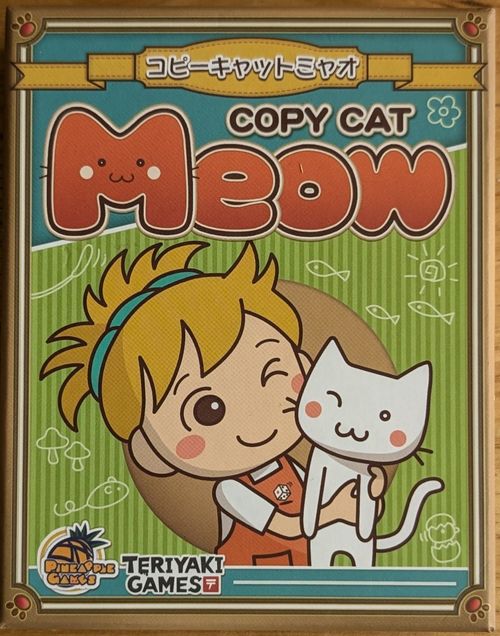
Copy Cat Meow
Copy Cat Meow Rulebook
Table of Contents
Table of Contents
Setup
- Each player hands out 25 tokens. Five 1-point tokens and four 5-point tokens.
- Deal five cards to each player.
- Determine the starting player in any way possible.
How to Play
- The start player plays a card. Multiple cards of the same number can be played at the same time. Special cards can be used as any number depicted.
There are 4 special cards in this game.
- The next player will take one of the following three actions.
- A. Declare a copy and play a card with the same number.
- B. Draw a card and become the new starting player.
- C. Draw a card and declare "Meow!"
A. Declare a copy and play a card with the same number
- The next player looks at the card played by the first player (hereafter referred to as the original player), and can declare "copy" and play a card of the same number. Special cards can also be used at this time.
- If copied, the original player pays 1 coin to the player who declared copy. If two cards are played, pay 2 coins, and if three cards are played, pay 3 coins.
- If possible, the next player can also continue copying.
Notes:
- It does not have to be the same amount of cards as the original player.
- When copied, it is always the original player who pays.
- If the original player has been copied by everyone else and it is his/her turn again, he/she will discard the cards that were played. After that, the original player will draw a new card from the deck and then play a
Printed-sheet note: the sentence above ends at "play a" on the sheet itself; the comic panel that follows covers the rest of the line, and the continuation is not printed. Transcribed as printed.
B. Draw a card and become the new starting player
- If there is no card with the same number and you can't copy, or you don't want to copy, discard the card that was played by the original player. After that, draw a card from the deck. You then become the new original player. Play any card from your hand onto the field.
Notes:
- Once you draw a card, the cards on the field are discarded, so you cannot declare a copy with the card you drew.
C. Draw a card and declare "Meow!"
- Discard the cards played on the table and draw one card from the deck. If you have four or fewer cards in your hand, you can declare "Meow".
When Meow is declared
All players reveal their cards and add up the numbers on the cards in their hand. If the original player has the least total number among all players, Meow is successful. Original player receive 3 coins from each of the other players.
On the other hand, if there is even one player whose total number is the same or less than the original player's hand, Meow is unsuccessful. In that case, original player must pay 6 coins to the other players who blocked Meow (there can be multiple players). Whether Meow is successful or not, the game ends and the next game begins.
Notes:
- Special cards are treated as the lowest number drawn.
How to Win
Pattern A
- If you copy and end up with 0 cards in your hand, you will receive 3 additional coins from the original player in addition to the coins you gained from copying.
Pattern B
- If the numbers you draw are the same as the cards in your hand, and you put them all on the table to reduce your hand to 0, you will receive 3 coins from all other players.
Pattern C
- Declare Meow and succeed. Original player receive 3 coins from each of the other players.
Notes:
- When one game is over, the next player in a clockwise direction becomes the next starting player. Play 2 games times the number of players, and the player with the most coins at the end wins.
FAQ
Q1. What do you do if the deck runs out of cards?
Even if the deck runs out, the game does not end at that moment. The player who drew the last card can play a card or declare "Meow". If you can't copy (or don't want to copy), you will have to draw a card from the deck, but if there is no more card in the deck, you cannot draw a card. At this moment, one game ends. In this case, all players reveal their hands and announce the total number in their hand. The player with the lowest total number will receive one coin from each of the other players.
Q2. What about when playing with two people?
The first cards dealt will be 6 instead of 5. The starting player will rotate, and a total of 8 games will be played. The player with the most coins at the end will win.
Q3. Additional Rules
① Change the play order
After all players have played the starting player once, the order in which cards are played is changed counterclockwise. This changes the player in front of you and allows you to change the tendency of the play.
② Play multiple matches and decide the winner by the cumulative score.
Usually, 2 games are played for each player, which counts as one set. Play 3 or 5 sets and decide the winner by the cumulative score. After each set, each player's coins are reset to their initial value.
Players receive a score bonus based on their ranking in each set.
3-player game:
- 1st place +6 points
- 2nd place ±0 points
- 3rd place -6 points
4-player game:
- 1st place +6 points
- 2nd place +3 points
- 3rd place -3 points
- 4th place -6 points
5-player game:
- 1st place +6 points
- 2nd place +3 points
- 3rd place ±0 points
- 4th place -3 points
- 5th place -6 points
House Rules
The following are the "Popular House Rules" printed on the same sheet. They are not part of the official rules above.
Here are some popular house rules to make Copy Cat Meow even more fun! Since this game encourages house rules, feel free to customize the way you play and make it your own. Now, let's take a look at the different rules you can try!
Excite the Game
In Copy Cat Meow, the game normally ends after each player has taken the starting player role twice. With this variant, once every player has completed their first turn as starting player:
- Change the Direction: The game order switches from clockwise to counterclockwise. The starting player rotation also follows this new direction.
- Increase the Stakes: Beginning in the second cycle, all rates are doubled or even tripled. This gives players who are behind a chance to catch up, increases the pressure of being copied, and makes the game exciting!
Deck Variants
At the start of the game, deal 5 cards to each player (or 6 cards each if there are only 2 players). After dealing, remove 2 cards from the deck without looking at them. No one is allowed to see these cards.
Since card counting can be a valid strategy in Copy Cat Meow, removing 2 cards at random lowers the accuracy of counting and adds more uncertainty to the game.
Another option is to prepare two full decks of Copy Cat Meow and shuffle them together. This makes card counting much more difficult and also allows the game to scale better for larger groups. For 5 or more players, we recommend using two decks.
Shared Meow Penalty
In the official rules, if multiple players block a Meow declaration, the declaring player must pay 6 points to each blocking player.
With this house rule, the declaring player pays only 6 points total, which are then divided among the blocking players:
- 2 Blockers: Each receives 3 points.
- 3 Blockers: Each receives 2 points.
- 4 Blockers: The declaring player pays 2 points to the nearest player in turn order, 2 points to the next, then 1 point each to the remaining two.
This variation reduces the penalty's overall impact while still keeping the pressure of a blocked Meow.
Special Card Value in Meow Declarations
In the official rules, when declaring Meow, a Special Card is counted only as its lowest printed value.
With this house rule, the declaring player must add all printed values together and use that sum in the Meow total.
For example: A Special Card showing 9, 10, 11 is counted as 9 + 10 + 11 = 30.
This rule makes Special Cards far riskier in Meow declarations and increases the tension of the game.
Meow Declaration Restriction
Players are not allowed to declare Meow during the first two turns of the game.
This rule prevents early Meow declarations and encourages players to build strategy before taking risks.
Knockout Rule
In the official rules, if a player runs out of points during the game, the player with the most points loans 10 points to them.
With this house rule, the game ends immediately when a player's points drop below 0.
- The player with the highest points at that moment wins.
- The player who caused the knockout should still add any points they would have earned on that turn to their total.
Optional Additional Rule:
Players with fewer than 6 points may be prohibited from declaring Meow. This prevents players from intentionally triggering a game-ending situation.