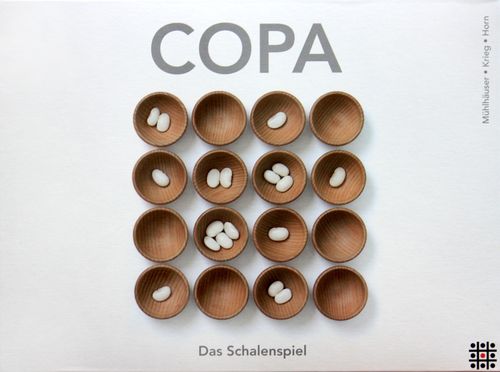
Copa
Copa Rulebook
Table of Contents
The Games
- KALA - Strategy game for 2 players aged 10 years and above. Duration 15-30 mins.
- RONDA - Memory game for 2-5 players aged 7 years and above. Duration 10-20 mins.
- HOPPER - Skill game for 2-5 players aged 7 years and above. Duration 10-20 mins.
- DA CAPO - Bluff game for 2-5 players aged 8 years and above. Duration 5-10 mins.
Extra game versions
Please visit www.steffen-spiele.de for an additional version of the KALA strategy game, plus an easier version of RONDA for children aged from 5 years and above.
The bean reserves
All four COPA games are playable with 80 beans. The beans are not counted individually to fill each box. Instead, they are filled from large sacks by weight using a measuring container. We chose a measure size so each game contains many more beans than required.
Dried beans are a natural product. Each game box will probably contain several smaller or split beans - but after sorting through them, plenty of beans will be left for playing the games.
KALA
Strategy game for 2 players aged 10 years and above.
Game materials
- 16 neutral cups ("field cups")
- 2 special cups ("playing cups")
- 56 beans
Object
The players sow beans in a game area made up of 16 cups that they slowly fill during the game. The aim is to make strategic moves, in order to harvest as many beans as possible from cups with a high bean count. At the same time, players try to prevent their opponents from harvesting the cups.
Preparation
The 16 field cups are laid out between the players, as shown in the illustration. One player selects the dark, while the other takes the light cups. The "playing cups" are placed on top of two diagonally opposing corner cups. Each player receives a store of 28 beans. The bean box is placed next to the game area as a bank. The first player is nominated.
How to Play
Sowing
The first player takes 4 beans from his or her store* and sows them one by one in a horizontal or vertical direction. The first bean is always put into the personal playing cup, while the other beans go into the field cups immediately alongside.
A player is allowed to make a 90°-angle move once during his or her turn.*
* Our aim is to make these instructions easy to read. From now on, references to 'he / his' of course imply 'he and she'.
A player is allowed to make a 90°-angle move once during his turn.
After sowing, the player moves his personal playing cup on top of the field cup that he sowed the fourth (last) bean in.
Now, the next player takes a turn. After sowing 4 beans, he also moves the personal cup, and so on.
The opponent's cup
Beans can also be put into the opponent's playing cups. Sowing can therefore also proceed above the opposing playing cups. (From now on the 4 beans, which the current player sows, are highlighted in green in all illustrations.)
However, a player's personal cup may not be moved on top of the opponent's cup. If a player puts the last bean from his turn into the opponent's cup, he must place his personal cup on top of any cup horizontally or vertically adjacent to it. (In the illustration, the four positions that the white cup can be moved to are highlighted in blue.)
At any time, the players are allowed to look under the two playing cups.
Bonus move
Every time the player takes a turn one bean is put into the personal playing cup, so its contents keep on growing.
If, after moving, the personal playing cup contains 4 or more beans, a player is entitled to another bonus move. He takes all the beans from his playing cup and instantly sows them again, starting with his personal cup. After the bonus turn, the player moves his cup a second time.
In a bonus move sometimes 5, and in rare cases even 6 beans can (and must!) be sown. Similarly, in this case during a turn a player may still only make a 90°-angle move once.
If the sixth bean can no longer be put into play due to this rule, the bean is awarded to the opponent. In this case, the fifth bean counts as the last one to be sown.
Bean harvest
If a player puts the last bean from his turn at sowing into a field cup already filled with 3 or more beans (after his turn there will be 4 or more), he is allowed to empty this cup. One bean is put back in the bank box. The player may add the remaining beans to his store as a reward. (In the illustration, the harvest cup is highlighted in yellow.)
PLEASE NOTE: Players are also allowed to harvest beans from the opponent's playing cup. After emptying the opponent's cup, as usual, the player moves his personal playing cup on top of any field cup, which must be in the direct neighbourhood.
Tip: It is better to empty the harvest cup first, and then move the playing cup on top of the harvested and empty cup.
End
The game ends as soon as one player can no longer finish a complete turn because he has fewer than 4 beans left.
The other player wins the match.
RONDA
Memory game for 2-5 players aged 7 years and above.
Game materials
- 10 neutral wooden cups, 1 black special cup
- 20 beans to fill the cups
- 9 beans per player
(Printed as above; the Preparation section below says each player receives 10 beans.)
Object
Each player attempts to be the first to get rid of all his beans.
Preparation
1 bean is hidden under two cups, 2 beans under another two cups, 3 beans are hidden under a further two cups and 4 beans under two more cups. Two cups therefore remain empty. Carefully shuffle and place the cups upside down in a circle in the middle of the game area. Place the black cup - with its opening facing upwards - in the centre of the circle.
Each player receives 10 beans and places them in front of him.
The first player is nominated.
Tip: When uncovering the cups, it is better not to flip them over, but just to lift them up and leave them upside down and slightly outside the circle.
How to Play
Play continues in a clockwise direction. The first player lifts up two cups so everyone can see their contents. If two different numbers of beans show up, the player must cover up the beans again with the cups. The next player has a turn.
If a player exposes the identical number of beans twice, he is allowed to add one of his beans to the contents of one of the lifted cups. Then, he may continue playing. He covers up one of the two bean groups, while lifting up a new cup from within the circle. If exactly the same number of beans shows up here as the player already left exposed, he is allowed to add another of his own beans and to continue playing, and so on.
The player's turn ends, if a different number of beans show up than the revealed number. Both groups of beans are covered up again, and the next player takes a turn.
Example
A player has revealed two groups of three beans. Now, this player is allowed to add one of his beans to either one of the three-bean groups, making a foursome.
Next, the player decides if he wants to continue playing with four or just three beans. If he still remembers the position of another foursome inside the circle, he will cover up the three-bean group, leaving the four beans exposed. Now, he can lift up the cup where he suspects the other foursome to be. If he has guessed correctly, he is allowed to add another of his beans to one of the exposed groups of beans. He covers up the contents of one cup, while continuing to play with the other cup and so on.
Missing a go
Any player can miss a go if he was able to add a bean, but then no longer wants to continue playing. He covers up both groups of beans again.
Off to the middle!
If a player finds two groups of five beans during his turn, he fills the black cup with one of the groups, plus the bean that he is allowed to add. So, 6 beans are here.
Now, in the circle there are: one group of five beans and one empty place. Both places are covered up and the player's turn ends. Any player, who reveals two groups of five beans, is not allowed to have another turn.
Penalty beans
As soon the black cup contains beans, the following applies: Any player making a mistake during his move (i.e. revealing two conflicting numbers of beans) must remove and keep one penalty bean from the black cup. Emptying the black cup again cancels out all the mistakes.
If another six-bean group forms, as long as the black cup still contains beans, the 6 beans are taken out of the game entirely. Only when the black cup is empty again can the next group of six forming in the circle move off to the middle once more.
End
The winner is the first player to get rid of all his beans.
RONDA - Simpler rules (extra version)
Simpler rules based on the original game version. Suitable for children aged 5 years and above.
The original game can be made easier thanks to three simple rule changes. The first rule (changing 'how to play') should be generally applied. Two additional rule changes can be applied to suit the players.
-
How to play. If a player has found the identical number of beans twice and added one bean, he covers both stacks of beans again. Next, he is allowed to lift up any two cups. If he finds the identical number of beans twice again, he continues playing as before etc.
-
Maximum bean number. In the original version up to 5 beans can be collected under one cup. If two groups of five beans are uncovered, the contents of one cup plus the player's bean are placed in the middle to leave an empty cup again. The game gets easier by limiting the maximum number of beans to 4. If two groups of four beans are uncovered, one group is placed in the middle along with the bean that the player is allowed to add.
-
Penalty beans. No penalty beans are gathered in the middle. If a five-bean group (or four-bean group) is dissolved, the beans are put back in the bean box, so removing them from the game entirely.
HOPPER
Skill game for 2-5 players aged 7 years and above.
Game materials
- 16 neutral wooden cups, 1 black special cup
- 1 box tray, about 80 beans
Object
The players try to catapult the beans from the edge of the table into the cups laid out in the tray, thus scoring as many hits as possible.
Preparation
The 16 cups are laid out in their tray in the centre of a table. The square tray with the cups should be placed about equidistantly from all players.
The beans are evenly distributed among the players. The first player is nominated.
How to Play
Play continues in a clockwise direction. The first player places a bean in the flat of the hand, using the fingers to hit the edge of the table from below. The impact catapults the bean in a high arch onto the square tray where it ideally falls into a cup. If a bean lands in-between or alongside the cups, for the meantime it stays in the tray or on the table. Now, the next player takes a turn.
Hits
Whoever gets a bean into a cup with 3 beans already, and so makes a foursome, is allowed to keep the cup. The beans are put back into play.
Shifting the other cups closer together fills any gaps emerging because of removing the cups.
Any player, who runs out of beans, can replenish his store by taking the beans from the game area where they landed outside the cups.
End 1
The winner is the first to claim 4 cups.
End 2 (longer version)
Play continues until the last cup is taken from the tray. When there are only 3 cups remaining, the black cup is put on the tray and arranged with the other cups in a square pattern in the middle. From now on, all players simultaneously catapult their beans into the tray! The game ends when the last cup is "shot down".
Each neutral cup counts for 1 point, the black cup counts for 2 points, the last cup on the tray, whichever colour, counts for 3 points.
The winner is the player with the most points.
DA CAPO
Bluff game for 2-5 players aged 8 years and above.
Game materials
- With 2-3 players: 4 cups per player
- With 4-5 players: 3 cups per player
- 16 beans per player
- 1 black target cup
Object
By cleverly revealing their hand and skilful bluffing, each player tries to fill as many of his cups as possible and to be the first to reach the target cup.
Preparation
Place the black target cup in the middle of the game area. Depending on how many players join in, 3 or 4 cups per player are arranged in a line starting from the target cup and moving towards each person in the game. (See game set-up diagrams). Each player receives 16 beans to keep in one hand and to hide underneath the table.
How to Play
All the players join in simultaneously. Each player secretly chooses a number between 1 and 5 beans. Under the table the players transfer their secret number of beans from their reserves into the free hand, though making sure none of their fellow players see. Next, the players present their closed fists concealing the beans on the tabletop. When all the fists are put down on the table, everyone simultaneously shows their hand to reveal the beans.
The player with the highest number of beans is allowed to fill the first cup nearest to him in his line. All other players forfeit the beans they revealed by putting them back in the bean box.
If several players have the same highest number of beans they cancel each other out. They must also put their beans back in the box. In this case, the player with the second highest number of beans benefits and moves one cup further.
If no single player has the highest number in a round, then nobody advances. Everyone puts all the beans that were revealed back into the box.
Any player with no more beans is out of the match. When only one player is left, he puts one of his beans into his nearest free cup, while putting his remaining beans back in the box.
End
If a player reaches the target cup with his beans, he has finished and wins the match.
If all the players have used up their bean reserves without reaching the target cup, the winner is the player who advanced the furthest.
If two or more players advanced equal distances, the winner is the player who used the least beans to move this distance.