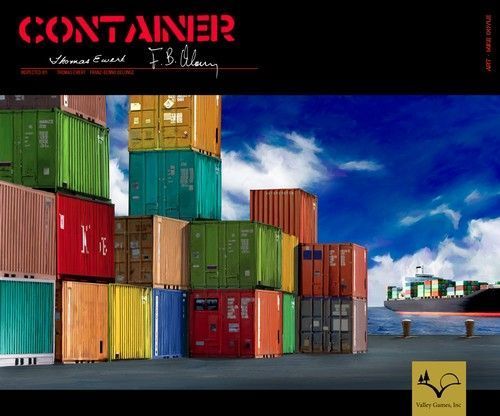
Container (2007)
Container (2007) Rulebook
Table of Contents
Table of Contents
- Contents
- Setup
- Start of the Game
- Credit
- End of the Game
- Basic Strategies for Beginning Businesspeople
Contents
- 5x Player boards
- 1x Island board
- 25x Factories (5 each of black, white, brown, tan, and orange)
- 25x Warehouses
- 5x Plastic ships (colors: blue, red, yellow, green, and purple)
- 100x Containers (20 each of black, white, brown, tan, and orange)
- 5x Scoring cards
- 10x Credit cards
- 115x Money cards (denominations: $1, $2, $5, $10, $20)
The area closer to the center of the table is called the Port Zone. Here you find the Warehouses, Port Storage, and the ports themselves. The Warehouses are five spaces marked "–", $4, $5, $6, and $7. Behind this zone are the Port Storage spaces, where players place goods bought from other players' factories; these spaces are marked $2, $3, $4, $5, and $6.
The port has room for 4 ships. Here, players who have docked their ship may buy goods from the port's owner.
Nearer to the player is the Factory Zone. This is where the factories and Factory Storage are located. There are four spaces marked for building factories: "–", $6, $9, and $12. In front of this space are the Factory Storage spaces — this is where a player can sell goods produced by their factories; there are 4 spaces marked $1, $2, $3, and $4.
Setup
3.1 Place the island board face up in the middle of the table.
3.2 Each player takes a player board and places it in front of themselves on the table. Ports should "face" the center of the table. If there are fewer than five players, unused player boards are returned to the box. A player board consists of two different zones: the Factory zone and the Port zone.
3.3 Determine a clear space along one side of the table where you can place the game components.
Place all the play money and credit cards in a place we will call the bank.
Depending on the number of players, determine the correct number of Containers to be used in the game, using the table below. Sort these Containers by color and pile them in one place.
| Number of Players | Number of Containers of each color |
|---|---|
| 3 | 12 |
| 4 | 16 |
| 5 | 20 |
Place all the Warehouses in the Warehouse supply.
Place all the Factories in the Factory supply.
3.4 Each player takes one warehouse from the supply and places it on their player board in the warehouse zone, on the space marked "–".
3.5 Place one factory of each color into the game box lid, so that each player can randomly draw one factory and place it on their player board in the factory zone, on the space marked "–".
If there are fewer than five players, place the factories of the unchosen color(s) back in the box.
Each player takes one Container from the supply of the same color as their factory and places it in the zone marked $2 of the Factory Storage.
3.6 The space on the table between the player boards and the island in the center will be called the Open Sea.
Each player places a ship of the same color as their player board somewhere in the Open Sea.
If there are fewer than five players, the unchosen ships are placed back in the box.
3.7 Each player receives $20 in play money from the Bank (5 × $1, 5 × $2, and 1 × $5). Players must remember to keep the amount of money in hand secret from their opponents.
3.8 The five scoring cards are shuffled and each player draws one at random. These cards indicate, at the end of the game, the value of a Container of each color for each player on the island. Keep this card secret from your opponents.
If there are fewer than five players, the leftover scoring cards are unused and put back in the box. The contents of those cards also remain unknown.
Start of the Game
Determine who goes first. Each player must completely finish their turn before passing the turn to the next player.
The turn passes around the table clockwise.
First, a player carries out two preliminary actions:
- Interest Payment
- Sell on the Domestic Market (variant rule "for beginners")
Then the player must carry out any two actions. An action may be carried out twice in a turn, except for Produce Goods.
- Buy a Warehouse OR Buy a Factory
- Buy a Good in your own port
- Produce Goods (once per turn)
- Move Ship
4.1 Interest Payment
Before the start of each turn, if a player has any credits (see Credit, section 5), they must pay interest for their use. They spend $1 to the bank for each credit card in their hand.
If a player cannot pay their interest, the bank confiscates one (or several) of the debtor's Containers for each overdue credit as follows, repeating this procedure for each overdue credit:
The bank confiscates 1 Container belonging to the debtor from that player's zone of the Foreign Island.
If the debtor has no Containers on the Foreign Island, the bank confiscates 2 Containers from the player's Port Storage.
If the debtor does not have enough Containers in their Port Storage, the bank confiscates 1 Container from the Factory Storage for each Container that could not be successfully seized from the Port Storage. It is possible that a player will have no Containers at all in their Port Storage to confiscate, in which case the bank confiscates both Containers from the Factory Storage instead. In the case where a player has only a single Container in the game, whether in the Factory Storage or the Port Storage (only one total, not one in each zone), the bank confiscates only that one Container for the overdue credit, for that turn only.
For example, if a player has one unpaid credit, 1 Container in their Port Storage, and 4 Containers in their Factory Storage, the bank confiscates 1 Container from the Port Storage and additionally confiscates 1 Container from the Factory Storage, leaving the player with only 3 Containers in their Factory Storage and none in their Port Storage. Additional unpaid credits can reduce this total even further.
If the debtor has no Containers at all in the game, the bank confiscates either a Warehouse or a Factory. If a Warehouse or Factory is confiscated, the player may return one credit document to the bank, since it has been paid off by the asset itself. The debtor must exhaust all other measures (see above) before a Warehouse or Factory may be confiscated, and cannot voluntarily lose a Warehouse or Factory unless it is the player's last option. The "–" and $6 Factory and the "–" and $4 Warehouse are always safe and can never be confiscated by the bank.
If a player has nothing that can legally be confiscated by the bank, the player may avoid paying the remaining interest, but only for the current turn.
In all cases, the choice of which Containers, Factory, or Warehouse the bank confiscates is made by the player sitting to the right of the debtor. The choice is NOT made by the debtor themself, except that if the player must lose an asset (a Warehouse or a Factory), they may choose which of the two types of asset they lose. In the case of a Factory, the player to the right still chooses which color is confiscated.
Any Containers confiscated by the bank are placed back in the box and leave the game. Any Factory or Warehouse confiscated by the bank is simply returned to the supply.
4.2 Sell on the Domestic Market (variant rule "for beginners")
The active player may take one Container from their Factory Storage and return it to the Bank.
If the player has no Containers in their Factory Storage, they may return a Container from their Port Storage instead.
The player receives $2 from the bank for each Container returned.
This action cannot be used by players at the start of the game.
4.3 Buy a Warehouse OR Buy a Factory
At the start, each player has only one Factory and one Warehouse. This action allows a player to acquire an additional warehouse or factory.
When buying a Factory or Warehouse, a player must pay the bank the amount indicated on the corresponding free space of their player board. The cost of acquiring each subsequent Factory or Warehouse is shown in the table below.
| Factory | Warehouse | |
|---|---|---|
| 1st | Free | Free |
| 2nd | $6 | $4 |
| 3rd | $9 | $5 |
| 4th | $12 | $6 |
| 5th | — | $7 |
A Factory increases a player's Production Capacity (4.5) and Factory Storage Capacity (4.5). A Warehouse increases Port Storage Capacity (4.4). The effect of these improvements applies immediately.
A player cannot have two factories of the same color.
4.4 Buy a Container for Port Storage
This action allows a player to acquire a Container from another player's Factory Storage and place it in their own Port Storage. The number of Containers can be any amount, but must not exceed the player's Port Storage Capacity.
Port Storage Capacity equals 1 Container for each Warehouse owned by the player. For example, if a player has 4 warehouses, they may have a maximum of 4 Containers in their Port Storage.
The buyer pays the seller the full price for the Containers chosen. For example, the red player has two black Containers in their Factory Storage priced at $2, and also an orange and a white Container there, priced at $4. The buyer chooses the black and orange Containers. They pay $6 to the seller and move the orange and black Containers to their own Port Storage.
The seller can never refuse to sell a Container from their Factory Storage.
Once a Container is sold, the buyer may place it in any space of their Port Storage; this indicates the fact that the Container was bought from another player. If several Containers are bought, the player may place them together in one Port Storage space or spread across any number of their Port Storage spaces.
There is no limit on the number of Containers stored in a single Port Storage space, nor on the colors of these Containers. Containers may be stored there for as long as needed, as long as the total satisfies the Port Storage Capacity. Piling up Containers in a single storage space is mainly for realism.
In addition to buying and setting prices for Containers, a player may reorganize their Port Storage. This may be necessary, for example, if a player feels the price on their Containers is too high or too low and needs re-pricing. A player does not need to buy Containers on this turn to declare a re-pricing of their Port Storage — they simply declare the action and carry out the intended change.
This action is spent by the active player when trading with one seller. For example, if a player wants to acquire Containers from both the red and blue player, they use both of their actions this turn. However, they may always buy as many Containers as they want from each seller.
A player can never acquire Containers from their own Factory Storage.
4.5 Produce Goods (once per turn)
This action allows a player to produce a number of Containers equal to their Production Capacity and place them in their Factory Storage. The number of Containers that may be produced also cannot exceed the Factory Storage Capacity.
A player's Production Capacity equals one Container for each factory located in the Factory zone of their player board. A produced Container MUST be the same color as the factory that produced it.
Factory Storage Capacity equals 2 Containers for each Factory on a player's board. For example, if a player has 3 factories, they may have a maximum of 6 Containers in their Factory Storage.
When a Container of goods is produced, the player may place it in any space of their Factory Storage, thereby indicating its price to other players. If several Containers are produced, the player may place them together in one space of their Factory Storage or distribute them across several spaces.
If there are no more Containers of a color available in the supply, as many as are available are produced instead. However, if Containers are available in the supply, they MUST be produced — a player may not DECIDE to produce less goods than their Production Capacity allows. If this would violate the Factory Storage Capacity, the player chooses which types of Containers to produce this turn.
In addition to production and setting prices for Containers, a player may reorganize their Factory Storage. This may be necessary, for example, if a player feels the price on their Containers is too high or too low and needs re-pricing.
Regardless of how many Containers are produced, the cost of production is always $1. This payment goes to the Union Boss — the player who always sits to the right.
The Produce Goods action may be chosen once per turn.
4.6 Move Ship
This action allows a player to move their ship from one zone to another. One move costs one action. There are two types of zones in the game: the open sea and ports. Ports exist on every player's board and on the island. All remaining space on the table is open sea.
One action is spent moving from the Open Sea into a port, or the reverse — moving from a port into the sea. A player can never move their ship from one port directly to another port in a single action; there must always be an intermediate move into the open sea. There are three possible movement scenarios:
- End the turn in the open sea
- End the turn in another player's port
- End the turn in a port on the island
4.6.1 End the turn in the open sea
If the action ends in the open sea, nothing further happens.
If the action begins in the open sea, one action is required to move into any port.
4.6.2 End the turn in another player's port
If the action ends in another player's port, the ship's owner gets the opportunity to buy Containers in that port. This does not cost an additional action if it happens at the END of the ship's movement. An additional action is required if the player instead decides to buy a Container onto their ship at the start of the action — in that case they may NOT move the ship in the same action; moving will require spending another action.
The buyer pays the seller the full price of all the Containers they chose. For example, the red player has two black Containers in their port priced at $3 each, and a brown and a tan Container there priced at $4. The buyer chooses the black and tan Containers. They pay $7 to the seller and move the chosen Containers onto their ship.
A player can never refuse to sell Containers from their Port Storage.
A ship can carry only 5 Containers at a time, and there are no restrictions on the colors that may be carried together.
A player can NEVER sail their ship into their own port, and can therefore NEVER buy from their own Factory Storage. A player also can never, under any circumstances, buy Containers from a Port Storage until their ship has actually entered that port.
4.6.3 End the turn in a port on the island
If the ship's movement ends in a port on the island, the player has the right to hold one auction, putting up for sale all the Containers on the ship. This does not require spending an additional action.
From this point, the other players are considered buyers. Secretly from one another, they take into hand the amount of money they are willing to offer for ALL the Containers on the seller's ship. All players reveal their bids simultaneously. The seller now has two possible choices:
- Accept the highest bid, or
- Reject all bids.
In a situation where the highest bids are tied, the players who offered them must lay their bids on the table and make ADDITIONAL bids in an attempt to break the tie. The sum of the initial bid and the additional bid forms the final bid. In the case where the tie is still not broken, the seller chooses whose offer to accept.
In any case, the auction always ends the player's turn, even if it took place at the end of their first action.
4.6.3.1 Accept the highest bid
If the seller decides to accept the highest bid offered for all the Containers on their ship, the player who offered it pays them the full amount. The seller hands over all the Containers from the ship to the winner of the auction. The winner, in turn, places them in their own zone of the island.
In addition to the highest bid, the auction's organizer also receives an amount equal to that bid from the bank. For example, if the blue ship docks in a port on the island and the highest bid for all the Containers on board is $12, the blue player receives $24 — $12 from the winner of the auction and $12 from the bank.
4.6.3.2 Reject all bids
If the seller decides not to accept the highest bid because they consider it too low, they may reject all the bids and pay for the Containers themself. They pay the bank the highest bid that was offered to them for the Containers, and place them in their own zone of the island.
When the auction's organizer buys the Containers from themself, they do NOT receive additional funds from the bank. For example, the active player sails their ship into a port on the island, and the highest bid at the auction for their Containers is $8. They decide that these Containers are worth more to them at the final scoring, so they pay the bank $8, even though they could have earned $16 by selling them.
For the active player, it is very important to make the right choice, since this amount is 3 times smaller at the end of the turn. However, there may be situations where a player believes this is necessary, when all the bids offered are low.
Credit
In the middle of any action, players may take credit from the bank. This does not cost an action.
When a player wants to take credit, they take $10 from the bank along with a credit card. The credit amount cannot be any different from this.
Before the start of their next turn, a player MUST pay interest for using the credit, to the bank (4.1). It is always $1 per turn for each credit card in hand.
A player may, at any point during their turn, after paying interest on their credits, return the money for a loan taken to the bank, to avoid paying interest at the start of the next turn. This does not cost an action, but it also does not exempt the player from paying interest on the credit for the current turn. Regardless, if the credit is not paid off by the player, due to lack of the necessary funds, at the start of the next turn they will have to pay interest to the bank.
A player may hold no more than two loans from the bank at the same time.
End of the Game
The game ends when the Container supply runs out of Containers of two colors. The player on whose turn this happens must finish playing their turn to the end, after which final scoring begins.
6.1 Final Scoring
All players sort the Containers in their part of the island by color.
To begin, a player determines whether they have Containers of all five colors. In our example, this is the case, and they will receive $10 for each tan Container.
Now the player must count which Containers they have the most of. In our example, these are the orange and brown Containers, but the latter are worth less, so the player decides to get rid of those instead (if they had the same number of tan Containers, they would have had to discard those instead).
Now they must check against their Scoring Card. Each Container color on it has its own price — that is, how much money the player will receive for each Container of that color delivered to their zone of the island. If the player managed to collect at least one Container of each color here, they need to look carefully at the row with the double price, $5 and $10. For each Container of that color they collected, they receive $10 from the bank. If a Container of at least one color is missing from their part of the island, the lower price is used for that color of Container in the calculation.
All players must discard ALL Containers of the color they have accumulated the most of in their part of the island. This represents a surplus of that type of good on the island market, and it becomes worthless. It is quite possible that this color turns out to be the Containers with the double price, which would make them useless for earning income from their sale. If a player has the maximum number of Containers of several colors, they must decide themself which color to get rid of. If any of those colors include the double-price Containers, the player MUST discard those.
The player receives money from the bank for all their remaining Containers, checking against their Scoring Card, and adds it to the money they had on hand.
Additionally, all players receive $2 from the bank for each Container remaining in their Port Storage, and $3 for each Container belonging to them on their ship.
Finally, everyone must subtract $11 for each unpaid credit in their hand.
For example, a player has 4 orange, 4 brown, 3 tan, 2 white, and 2 black Containers in their part of the island. They also have 3 Containers remaining in their Port Storage and 2 on their ship. They also have one unreturned bank credit remaining. The value of the Containers is determined by the following Scoring Card: orange $10, tan $5/$10 (double), white $6, black $4, brown $2.
Since the player has all five colors, the double price applies to tan. Of the two colors tied for "most" (orange and brown, 4 each), brown is the cheaper of the two, so all 4 brown Containers are discarded as the surplus color.
Containers on the island:
- 4 × $10 (orange) = $40
- 3 × $10 (tan, double price) = $30
- 2 × $6 (white) = $12
- 2 × $4 (black) = $8
- Subtotal: $90
In Port Storage: 3 × $2 = $6
On the ship: 2 × $3 = $6
Total: $102
Less unpaid credit: −$11 = $91
The player adds this money from the bank to the cash they have left on hand at the end of the game.
The player with the most money is declared the winner. In the case of a tie, the player with the most Containers on the Island wins. If there is still a tie, all tied players are declared joint winners.
Basic Strategies for Beginning Businesspeople
7.1 Variant Rule for Newcomers
Container is a demanding game for experienced players, and it can be unforgiving of mistakes. For that reason, people who have not played it before are recommended to use the rule changes described above as the variant for beginners. Players may well want to continue using these rules afterward too, if they find the game's economic system too complex to take in.
7.2 Tricks
Let's look at a few features of the game that matter for newcomers. While there is no foolproof strategy, there are several ways to significantly improve your chances.
A player should be able to judge the value of the Containers in play and compare that information against the amount of cash available. This will help you decide whether to sell your Containers right now or hold onto them.
Money can be scarce, especially early in the game. Remember, every time you decide to build something, or pay interest on credit, you are removing cash from the game. If every player is focused on building, the right decision may be to stay in cash. This means that while your opponents can't afford to take part in the auction for Containers delivered to the island, you can easily make that purchase, likely at quite a bargain price!
When making your bid at an auction, you should be confident that the lot is genuinely valuable to you. If you name too low a price for the Containers, hoping for a favorable deal, you run the risk that the auction's organizer will simply buy back their own lot. This can be very advantageous for the seller, since they won't have to spend much on the purchase, and they will profit from it at the final scoring.
Remember that if you reject all the offers at an auction on the island and decide to keep the Containers for yourself, you not only fail to get additional funds from the bank, but you also lose out on the benefit of having free cash on hand. $10 for a Container on the island is great, but it won't be worth more whether you get it on turn 1 or turn 15. It's often much better to take the $6 and put it back into circulation, which will pay off by the end of the game.
When you're setting the price on your Containers, remember that Container is a game about distributing profit. If you always sell the Containers in your Port Storage for $2 apiece, you'll have no shortage of customers. The problem is that they will deliver your Containers to the island and earn far more from them! Try setting a lower price on unpopular Containers to attract customers, and then set a higher price on the "set" of Containers that remain. You might sell one for $2, one for $3, and then the rest for $4 and $5. You may attract fewer buyers this way, but you will also stem the loss of profit you'd otherwise be giving away on your opponents' ships. These same techniques can also be applied to the Factory Storage.