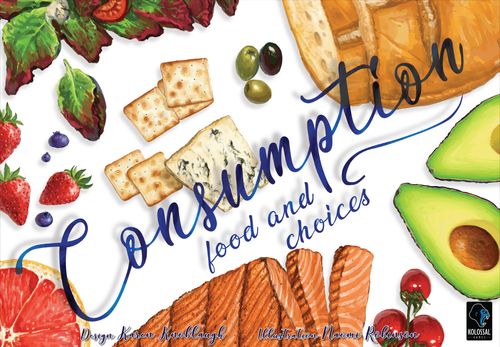
Consumption: Food and Choices
Consumption: Food and Choices Rulebook
Table of Contents
Table of Contents
Components
- 415 food tokens
- 48 activity cards
- 41 recipe cards
- 36 shopping tokens
- 16 action markers
- 12 Farmers Market cards
- 12 out of stock cards
- 6 assistant cards
- 4 double-sided diet boards
- 4 end of game scoring cards
- 4 reference cards
- 4 score markers
- 2 cravings dice
- 1 first player marker
- 1 food token bag
- 1 round marker
- 1 game board
- 1 rule book
Component Notes
- Diet board — each player's personal board, tracking the body's food groups, kitchen, recipes & cook action, activities & work out action, snack space, and completed recipes/activities.
- Round marker — tracks the current round on the round track.
- Scoring and action markers — used to track a player's score and to claim action spaces.
- First player marker — a plate and cutlery token, given to the player whose last meal was determined to be the healthiest (or least healthy, as agreed by the group) at setup.
- Food tokens — represent the different food groups: dairy & eggs, seafood, poultry, meat, fats & oils, sugar, alcohol, grains, fruit & veg, nuts & seeds, and water.
- Shopping token — placed on the Shopping List to mark a purchased food token.
- Cravings dice — two dice rolled during grocery shopping to discount certain food tokens.
- Assistant card — offers 2 alternative ability options; a player can only benefit from 1 option 1 time each turn.
- Recipe card — placed facedown on the Recipe Book until taken by a player, then placed faceup on a player's diet board while incomplete.
- Activity card — placed facedown on the Daily Planner until taken by a player, then placed faceup on a player's diet board while incomplete.
- Out of stock card — used in the 2-player and solo variants to mark food tokens unavailable for the round.
Setup
-
Place the board in the center of the table.
-
Shuffle the recipe deck. Place 2 recipe cards faceup on the spaces to the right of the indicated recipe deck spaces on the Recipe Book. Divide the deck into 2 roughly equal piles and place each of them on the indicated recipe deck spaces facedown. Flip the top card of each recipe deck faceup so that there are 4 recipes available at the start of the game.
-
Shuffle the activity deck and place it facedown on the indicated spot on the Daily Planner. Place 3 activity cards faceup on the indicated spaces so that there are 3 activity cards available at the start of the game.
-
Place the 2 cravings dice and shopping tokens next to the Shopping List.
-
Place all of the food tokens near the board to create the supply.
From the supply, add 10 of each type of food token to the food token bag, then:
-
Take 1 fats and oils food token from the general supply and place it on the corresponding Pizza To Go space.
Randomly fill the remaining Pizza To Go spaces with food tokens from the food token bag. If any alcohol food tokens are drawn from the food token bag, set them aside and draw until a non-alcohol token is drawn. Then return any drawn alcohol food tokens to the food token bag.
-
Randomly fill all of the Chinese Buffet spaces with food tokens from the food token bag.
-
-
Place the 6 assistant cards faceup next to the board within reach of all players.
-
Place the round marker on the 1 space on the round track at the top of the board.
-
Sort the Farmers Market cards into separate decks according to their card backs.
The living rules with 2-player and solo variant setup and instructions can be found at Kolossalgames.com.
Game Play
A game of Consumption is played over 6 rounds. Each round will follow this sequence:
- Select assistants.
- Take actions.
- Prepare for the next round.
1. Select Assistants
There are 6 different assistants available during the game. At the start of each round, players select 1 assistant in reverse turn order. Beginning with the last player and proceeding counterclockwise, each player selects any faceup assistant card from in front of another player or next to the board. Chosen assistants are placed facedown in front of the selecting player and their assistant from the previous round is returned faceup next to the board. After all players have chosen a new assistant for the upcoming round, flip all of the chosen assistant cards faceup.
NOTE: A player will never have the same assistant 2 rounds in a row. Additionally, each assistant card offers 2 options and players can only benefit from 1 option 1 time each turn.
Executive Chef — When a player cooks, that player can place 1 food token on a recipe, ignoring type requirements. OR: When a player cooks, that player can swap 1 of their incomplete recipes with any available recipe from the Recipe Book. Any food tokens on the recipe are placed in that player's trash.
Fitness Coach — When a player works out, that player can place 1 additional food token on any of their activities. OR: When a player completes any number of activities, that player can add 1 water food token to their body from the supply.
Kitchen Assistant — When a player cooks, that player can place 1 additional food token on any of their recipes. OR: When a player cooks, that player can move 1 food token from 1 of their incomplete recipes to another of their incomplete recipes.
Life Coach — If a player's completed recipes are greater than or equal to their completed activities, that player may complete 1 activity with 1 fewer food token of their choice. OR: If a player's completed activities are greater than their completed recipes, that player may complete 1 recipe with 1 fewer food token of their choice.
Personal Shopper — When a player shops, that player can place 1 additional shopping marker and take the corresponding food token from the supply at no cost. OR: Before a player shops, that player can modify the value on 1 of their cravings die by 1. A 1 may be changed to a 6 and a 6 may be changed to a 1.
Restaurateur — When a player dines out, that player can substitute 1 food token they would take with any food token from the supply. OR: Before or after a player dines out, they may return all food tokens on the selected action space to the bag and then refill each space with new food tokens.
2. Take Actions
Each round, players alternate taking actions 1 at a time until everyone has taken 4 actions. To take an action, place an action marker on any open action space on the board or a player's diet board and immediately perform the action as instructed. The round ends after all action markers have been placed and all actions are completed.
2A. Dining Out
Dining out consists of 2 different action spaces: the Chinese Buffet and Pizza To Go. Collectively, they are considered dining out, and can be affected by cards that specify "dining out." However, some game effects will refer to specific action spaces, which can only affect that specific action. For example, a card effect that refers to the Chinese Buffet could not be used on the Pizza To Go space.
To dine out, a player places their action marker on an available dining out action space on the board, then performs the action in that space.
Chinese Buffet — When a player dines out at the Chinese Buffet space, that player takes all available food tokens from 1 of the rows of their choice and places them into their body.
The 3+ space is only available in a game with 3 or more players.
Pizza To Go — When a player dines out at the Pizza To Go space, that player takes all available food tokens from the spaces above and places them into their body.
At the end of the round, the player with their action marker on the Pizza To Go space can place their action marker on any available action space and immediately take that action.
2B. Snack
To snack, a player places their action marker on the Snack action space on their diet board. Then, that player places any 1 food token from their kitchen into their body.
2C. Grocery Shopping
Each grocery shopping action allows players to purchase up to $6 worth of food. To shop, a player places their action marker on an available Grocery Shopping action space.
NOTE: The action spaces with a number are only available in a game of the same player count.
Then, that player rolls the cravings dice and places them on the matching spaces on the Shopping List.
Each time a player purchases a food token, first they place a shopping marker on the Shopping List in the space that matches the food token that they wish to purchase. Then, that player takes the food token from the supply and places it into the Shopping Basket space that matches the cost of the food token. After a player has decided that they are finished with their grocery shopping action they move all of the food tokens from the Shopping Basket into their kitchen.
The 3 sections below the Grocery Shopping action spaces represent a player's Shopping Basket. The cost of a food token depends on its position on the Shopping List. Any food token that is in the same column or row as a cravings die can be purchased for $1. A food token that is outside of a column or row with a cravings die can be purchased for $3. A player may also choose to purchase any unavailable food token directly from the supply for $5.
The player wants to purchase a dairy food token. First, they place a shopping marker on the space from which they are purchasing the food tile. Then, that player takes a dairy food token from the supply and places it in the $1 space of the Shopping Basket.
NOTE: Shopping tokens are not removed from the Shopping List until the end of the round.
2D. Farmers Market
Each round, the Farmers Market will have different food tokens available for players to add to their kitchen or body. The cards that are available are fixed from round to round as indicated by the number on the card.
To visit the Farmers Market, a player places their action marker on the Farmers Market action space on the board and selects 1 available market stand. They then add food tokens from the general supply that match the indicated food tokens on the chosen stand to their body or kitchen as directed. Some stands have a wild food icon. A player that selects a stand with a wild food icon can add any food token to their body or kitchen as directed.
The Farmers Market action spaces feature an open circle, which means that these spaces are always available to all players. However, each player can only use the Farmers Market twice per round.
A player that selects the Banana Nut Smoothie from Stan's Stand would add all of the indicated food tokens to their body from the supply.
2E. Recipes & Cook
On the left side of each diet board is the recipes & cook action. This action allows a player to take new recipes from the board, cook with the food in their kitchen, or both.
This action can be taken any number of times in a round as indicated by the infinity icon below the action space.
Take Recipes — A player may select up to 3 faceup recipes from the Recipe Book and add them to the left of their diet board. These are incomplete recipes that will need to be cooked in order to score them. At the end of a player's turn, refill any empty Recipe Book spaces and flip the top card(s) of the recipe deck(s) faceup so that there are 4 available recipes.
NOTE: There is no limit to the number of recipes, complete or incomplete, that a player can have. However, any recipes that are incomplete at the end of the game score negative VP.
Cook — To cook, a player moves up to 3 food tokens from their kitchen onto any of their incomplete recipes with open, corresponding food spaces. A player may cook multiple recipes simultaneously.
When a player cooks and fills all of the food spaces on any of their recipes, those recipes are completed. That player immediately scores the VP in the bottom right corner of the recipe and places the food tokens into their body. Move the completed recipe into the completed recipes area next to that player's diet board. The ability of the completed recipe is now available for the player to use.
NOTE: Some recipes have a split icon indicating that a food token of either type can be used to fulfill that requirement.
Completed recipe abilities may be used at any time during a player's turn, including the turn in which the recipe is completed. If multiple players want to use any end of round recipe abilities, resolve them in turn order. After a player uses a recipe's ability, they flip it facedown in their completed recipes area.
2F. Activities & Work Out
On the right side of each diet board is the activities & work out action. This action allows a player to take new activities from the board, work out to remove energy from their body, or both. This action can be taken any number of times in a round as indicated by the infinity icon below the action space.
Take Activities — The player may select up to 2 faceup activities from the Daily Planner and add them to the right of their diet board. These are incomplete activities that will need to be completed by working out in order to score them. At the end of a player's turn, refill any empty activity card spaces on the Daily Planner so there are 3 available activities.
NOTE: There is no limit to the number of activities, complete or incomplete, a player can have. However, any activities that are incomplete at the end of the game score negative VP.
Work Out — To work out, a player moves up to 3 food tokens from their body onto any of their incomplete activities with open, corresponding food token spaces. A player may have multiple activities in progress simultaneously.
When a player works out and fills all of the food spaces on any of their activities, that activity is completed. Return the food tokens from the completed activity to the supply. Move the completed activity into the completed activities area next to that player's diet board. Flip that activity facedown and immediately score the VP in the bottom right corner of the activity.
This player takes an activites & work out action. They place 2 food tokens from their body, matching the icons on their incomplete badminton activity card to the corresponding spaces. With all of the spaces filled, the activity is now complete. They move the activity to their completed activities area and score the 2VP on the back of the activity.
Wild Food Icons: Activities — Activity cards feature a few variations of wild food icon spaces. These can be fulfilled with any food token from a player's body that does not match either a food icon or food token present on the activity card.
Single wild food icon spaces are treated as if they were any other food token space. They can be fulfilled with any food token from a player's body that does not match either a food icon or food token present on the activity card.
Double wild icons in a box with the text "1 or 2" below the icons can be fulfilled with either 1 or 2 food tokens. These food tokens must be of the same type, placed at the same time, and cannot match a food icon or food token present on the activity card. If a player uses 1 food token to fill this space, they cannot place any more tokens in that space at a later time. The space is considered filled for the purposes of completing an activity.
Double wild food icons in a box must be fulfilled with 2 food tokens of the same type placed at the same time and cannot match a food icon or food token present on the activity card. A player cannot split up fulfilling this space across multiple work out actions.
Collecting Activity Sets — Each activity card features an icon in the top right corner that is used for bonus scoring based on the size of the set. At the end of the game, players will score based on the number of unique icons they have among all of their completed activities. It is possible to score multiple sets. However, an activity card can only belong to a single set for the purposes of scoring.
The 8 possible activity icons: cycling, racquet sport, weightlifting, running, winter sport, ice hockey, swimming, and ball sport.
| Set Size | Bonus |
|---|---|
| 3 icons | 5VP |
| 4 icons | 7VP |
| 5 icons | 10VP |
| 6 icons | 14VP |
| 7 icons | 19VP |
| 8 icons | 25VP |
At the end of the game, this player would score 12VP for their two sets of activities; 5VP for the set of 3 and 7VP for the set of 4.
2G. Place & Pass
A player may choose to place their action marker on any action space and do nothing, thus passing their turn. If a player passes, that player sets aside all of their remaining action markers and cannot take any more actions this round.
3. Prepare for the Next Round
At the end of a round:
- The player that has an action marker on the Pizza To Go action space can place their action marker on any available action space and immediately take that action.
- Beginning with the first player and proceeding clockwise, each player may use any number of end of round abilities.
- Starting with the rightmost kitchen space, players move all food tokens in their kitchen 1 space to the right. All food tokens beginning in the rightmost kitchen space are moved into that player's trash. All food tokens remain in a player's trash until the end of the game.
- If this was the 6th round, proceed to end of game scoring. Otherwise, advance the round marker to the next space on the round track.
- Return all action markers to players.
- Remove all shopping tokens from the Shopping List.
- Return any food tokens on the Chinese Buffet and Pizza To Go to the supply. Place 1 fats and oils food token from the supply on the indicated Pizza To Go space. Then, refill the each space with new food tokens from the food token bag. When refilling Pizza To Go, if any alcohol food tokens are drawn from the food token bag, set them aside and draw until a non-alcohol food token is drawn. Then, return any drawn alcohol tokens to the food token bag.
- Remove all faceup Farmers Market cards from the game and flip each Farmers Market cards that matches the current round faceup.
- Place all faceup recipe cards on the bottom of the recipe decks. Then, refill all empty spaces in the Recipe Book and flip the top card of each recipe deck so that 4 recipe cards are available.
- Place all faceup activity cards on the bottom of the activity deck. Then, refill all empty spaces in the Daily Planner from the top of the activity deck so that 3 activity cards are available.
- Pass the first player marker clockwise to the next player.
End of Game
The game ends after the 6th round. Players score their end of game VP using the following steps:
-
Each food group with 0 food tokens scores VP equal to the indicated value located in the top right corner of the food group.
Alcohol will score 5VP
-
For each food group with the furthest food token on a red space, subtract VP equal to the VP indicated by the value of the space. A player only subtracts the VP for that food token and does not score any other space in that food group.
Seafood will score -3VP
-
Subtract 2VP for each food token in a player's trash.
-
Subtract the VP indicated on the bottom right corner of each incomplete recipe and activity card.
-
For each food group with the furthest food token on a yellow or green space, add VP equal to the VP indicated by the value of the space. A player only adds the VP for that food token and does not score any other space in that food group.
Grains will score 5VP
-
Add the indicated VP on any completed recipe cards with a pink ability background that offer end of game VP.
-
Add VP for each set of completed activity cards using the table below. Multiple sets can be scored, but the same activity card cannot be used to complete multiple sets.
The 8 possible activity icons: cycling, racquet sport, weightlifting, running, winter sport, ice hockey, swimming, and ball sport.
| Set Size | Bonus |
|---|---|
| 3 icons | 5VP |
| 4 icons | 7VP |
| 5 icons | 10VP |
| 6 icons | 14VP |
| 7 icons | 19VP |
| 8 icons | 25VP |
The player with the most VP is the winner!
Key Concepts
In Consumption, you'll play with a particular dietary preference to guide your strategy. Through a variety of worker placement actions and careful resource management, each player must balance their food intake and activities to meet their body's needs. At the end of six rounds, the winner is the player with the most VP.
Recipe Cards
When a player takes recipes from the Recipe Book space on the board with a recipes & cook action, they will always place recipes to the left of their diet board faceup. After a recipe has been completed, the player moves it down to their completed recipes section. This gives the player access to the ability of the card.
facedown recipe / faceup recipe
Activity Cards
When a player takes activity cards from the Daily Planner space on the board with an activities & workout action, they will always place recipes to the right of their diet board faceup.
Activity cards have an icon in the top right corner that indicates the type of activity. At the end of the game, players will score bonus VP for each unique set of icons they have on their completed activities.
facedown activity / faceup activity
Kitchen & Trash
At the top of each diet board is the kitchen. In order to cook recipes, a player needs to have the food available in their kitchen.
The food icons at the top of the kitchen spaces indicate the expiration date of each type of food. Meats for example, spoil sooner than water. When a player places food in their kitchen from anywhere, they place the food token(s) in the space matching the icon at the top of each kitchen space. At the end of each round, all food tokens in kitchen spaces are moved one space to the right. If a player does not cook their food before it spoils, it will have to be thrown away! All food tokens in the last kitchen space are moved into the trash at the end of each round. Each food token in the trash at the end of the game scores -2VP, as indicated on each player's diet board.
Wild Food Icons
Wild food icons represent any food token. This icon can appear on Farmers Market cards and activity cards. Specific rules covering these icons are covered in their relevant sections.
The Body
The body area on each diet board holds all of the food tokens consumed during the course of the game. The desired number of food tokens for each food group is indicated in parentheses after its name and by the green colored spaces in that food group's area. The goal at the end of the game is to be within the range indicated for each food group.
Food tokens are always placed in the first available food group space from left to right and top to bottom. If a food group is full, return any excess food tokens to the supply. At the end of the game, each food group is scored based on where the last food token in that food group is located.
At the end of the game, this player scores 5VP, as indicated by the value of the furthest food token in the food group.
Diseases and Conditions
As a result of consuming too much or not enough of some food groups, a player may be at risk of developing a variety of diseases or conditions.
The red spaces in a food group indicate that a player has gone beyond or is below the amount needed and will score negative VP at the end of the game. While these icons do not have a game play impact, they do provide a bit of thematic flavor for the negative VP associated with those spaces. It is possible for a player to "cure" themselves of all conditions during the game.
The 6 conditions represented on the food groups are: Energy Stores, High Blood Sugar, Excess Alcohol, Heart Disease, Low Fiber, and Dehydration.
2-Player Variant
The 2-player version of Consumption plays with all the same rules as a 3-4 player game, with 3 alterations to the setup as follows:
2-Player Setup
- Randomly select 8 Farmers Market cards to use and remove all remaining Farmers Market cards from the game.
- Remove the Life Coach assistant card from the game.
- Take the 12 out of stock cards from the box and place them near the Shopping List on the board.
2-Player Game Play
Follow the rules for a multiplayer game with the following change:
At the start of each round, reveal the top 2 out of stock cards and place a shopping marker on each of the spaces marked with an X on both cards. Food tokens cannot be purchased from these spaces during this round. At the end of the round, discard the out of stock cards from the current round to the box.
Solo Variant
The solo game of Consumption is more restricted than the multi-player game. The goal is still to score as many VP as possible, but the Cleanse diet board requires the player to end the game with only water food tokens in their body to avoid negative VP.
Solo Setup
Follow the setup rules for a multiplayer game with the following changes:
- Select the Cleanse diet board. It is the only board compatible with the solo game.
- Do not add food tokens to the Chinese Buffet or the Pizza To Go areas, as they are not used in the solo game.
- Remove the Restaurateur assistant card from the game. Place the other 5 assistant cards near the board.
- Remove all recipes with an asterisk preceeding their title from the game.
- Take the 12 out of stock cards from the box and place them near the Shopping List on the board.
Solo Game Play
Follow the rules for a 3-4 player game with the following changes:
Out of Stock Cards — At the start of each round, reveal the top 2 out of stock cards and place a shopping marker on each of the spaces marked with an X on both cards. Food tokens cannot be purchased from these spaces during this round. At the end of the round, discard the out of stock cards from the current round to the box.
Assistants — During each of the rounds, the player will be required to follow a specific pattern when selecting assistant card(s) for each round.
- Round 1: Select any 2 assistant cards (or select randomly for a greater challenge).
- Round 2: Keep the 2 assistant cards selected in Round 1 and select 1 additional assistant card from the 3 assistant cards that were not selected in the previous round. A player should have 3 assistant cards to use during this round, 2 from Round 1 and the 1 added this round.
- Round 3: Set aside the 3 assistant cards used during Round 1 and 2, then take the 2 remaining assistant cards. Return the 3 set aside assistant cards to the area near the board.
- Round 4: Keep the 2 assistant cards selected in Round 3 and select 1 additional assistant card from the 3 assistant cards that were not selected in the previous round. The player should have 3 assistant cards to use during this round, 2 from Round 3 and the 1 added this round.
- Round 5: Set aside the 3 assistant cards used during Round 3 and 4, and then take the 2 remaining assistant cards. Return the 3 assistant cards to the area near the board.
- Round 6: Keep the 2 assistant cards selected in Round 5 and select 1 additional assistant card from the 3 assistant cards that were not selected in the previous round. The player should have 3 assistant cards to use during this round, 2 from Round 5 and the 1 added this round.
Recipes & Cook Action — After completing this action, immediately refill the Recipe Book so that there are 4 recipes available.
Activities & Workout — After taking this action, immediately refill the Daily Planner so that there are 3 activities available.
Solo End of Game
The game ends after the 6th round. The player now calculates their score the same way as a multiplayer game. However, instead of competing with other players, a player will see how their score ranks on the personal goals chart below.
| Score | Result |
|---|---|
| 0 - 59 | No pain, no gain. Consider this a learning experience! |
| 60 - 89 | Good for a beginner! |
| 90 - 109 | Solid effort. Keep trying! |
| 110 - 130 | Well done. You are doing great! |
| 131 - 150 | Excellent. You have got your goals locked in now! |
| 151+ | Success! You are a cleansing expert! |