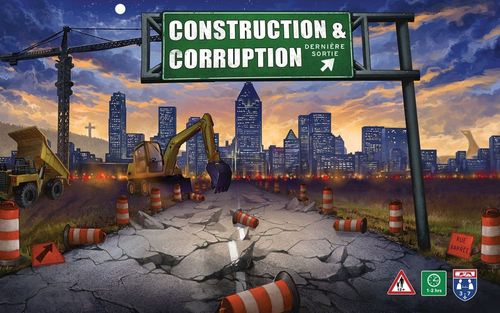
Construction & Corruption
Construction & Corruption Rulebook
Table of Contents
Table of Contents
Components
The game includes:
- One Game Board
- 3 Red City Festival Arch Pieces
- 1 Red Traffic Pylon Turn-Tracker
- 5 Red City Worker Meeples
- 15 Coloured Dice
- 18 Circular Contract Pieces
- 45 Investigation Cards
- 7 'Key to the City' Cards
- One 3-minute Timer
- One Large First Player Card
- Seven (7) coloured Sets of: 5 Worker Meeples, 5 Traffic Pylons, 8 Vote cards including Outsider mayor
- 8 Large Explanation 'Phase' Cards
- Corruption Denominations: 20x Corruption Level 1, 20x Corruption Level 2, 10x Corruption Level 3, 10x Corruption Level 4, 10x Corruption Level 5, 10x Corruption Level 6
- Money Denominations: 80x $10,000, 20x $50,000, 80x $100,000, 20x $500,000
Game Setup
- Unfold the game board onto a suitable table. Place the stack of Contracts on their designated circle on the board. Likewise, place the stack of Investigation cards on the designated zone on the board, next to the Contracts.
- Each player should begin the game with a colour set of Meeple Workers, Traffic Pylons and Vote Cards.
- Place the pile of Corruption tokens on an empty space of the map, within reach of all players; possibly making two piles – in the St Lawrence River and in Laval.
- Place the Red City Festival Arches, Red City Workers, and Keys to the City Cards off to the side together. They will come into play for the Election phase.
- Place all Red, Black and White dice off to the side together. They will eventually come into play during an Investigation phase.
- Place the Red Traffic Pylon on the year 1994 and begin the first turn, moving it to the next year at the end of each turn.
- To determine starting player, all players roll two dice. The highest roll wins the 'First Player' card. This card may be traded.
New players should also have an explanation 'Phase Card' for quick reference.
Phase: Construction
Beginning with the holder of the 'First Player' card, go clockwise around the board and distribute one contract to each player.
Each player then places their new Contract on its matching zone of the board. They also place one of their coloured Construction Pylons and a worker on their Contract to mark it as theirs.
Each player is paid $100,000 per contract, and then also adds one Corruption on each Contract. This Pay and Corruption also applies to previous Contracts.
For example, a player with three contracts (two from previous turns) is paid $300,000; a player with two is paid $200,000. Both players add one more Corruption to each of their contracts. A contract with 2 Corruption now has 3; a contract with 1 Corruption now has 2, etc. Corruption can add up fast, be careful!
You can have a maximum of 5 contracts.
Players are paid for old uncompleted Contracts, so in the following phases there is an incentive to put workers on Contracts other than your own!
Later, if opponents place a total of 3 workers on a Contract, then it will be completed on the 'Extraction' phase, and you will not be paid for it during the next 'Construction' phase!
If there aren't enough contracts to go around, simply start with the First Player and distribute one each for as many players as possible.
After the end of 2017, (the end of the game), there will be one last final Construction phase without distribution. Players are paid for the Contracts that they still have.
Phase: Corruption
Assign the remaining workers to Contracts on the board. This can be your own or other players' contracts.
Everyone must keep a minimum of one (1) of their own workers on each of their own Contracts.
There is no fixed order for placing workers. Workers can be moved by their owners again after being placed. Players may change their mind repeatedly. Bribes and promises are allowed, but not binding in any way.
Players are expected to cajole and convince each other during this phase, using money and any resources at their disposal. If negotiations drag on, they may use the timer to end the phase.
If players do not assign workers this phase, they must give $20,000 per worker in vacation pay to the city.
Any contract with three (3) workers of any color will be completed on the Extraction phase. Keep this in mind when threatening (or helping) your fellow players!
Note: On each Turn on the board, there is a corresponding total for Players and Municipal workers. Depending on the year, and their own total contracts, Players will have from 2 to 4 extra workers to place. Use this as a guide for the total workers to place during the Corruption phase. For example, in 1994 & 1998, players have three (3) workers total; minus the worker on their first contract, they will be able to place two (2) workers on the first turn's Corruption phase. If on the next turn, 1998, a player has two Contracts, they will only have one (1) worker left to place on theirs or others' Contracts.
Phase: Election
Players debate on who they want to elect to the prestigious office of mayor. Players may offer favours or money in exchange for votes. No bribes or promises are binding. The powers of the mayor offer rewards to those who work together:
- City Workers can add to the total workers assigned to a contract, and thus cause them to be completed in the next upcoming Extraction phase.
- If placed on a Contract, the Festival Arch guarantees that it does not get completed in the next Extraction phase, no matter how many workers were assigned to it.
- Games with 6 or 7 players will have two Festivals on each turn; games with 5 players or less only have one Festival.
- The city begins with one worker in 1994 & 1998, and then has two in 2001 & 2005, and finally three in 2009, 2013 and 2017.
- A player elected Mayor also receives a Key to the city. It has an end-game cash value, and cannot be lost to an Investigation.
Players choose one card from their ballot deck, and then reveal their choices simultaneously.
The player who receives the most votes wins the election, but a tie for the most votes is considered a failed vote. A failed vote, or a majority vote for the Outsider Mayor, will result in an Investigation phase. This also cancels the festival and the city workers.
The player with the most votes gets Mayoral powers for this turn and may place Red City Workers and Red Festival Arches, punishing or rewarding their foes & supporters. According to the year and the number of players, there will be more Workers and Festivals.
The Investigation phase is a risk for any player that has a lot of corruption, but it may also be an opportunity to take down your rivals. Vote accordingly!
Image caption: The Outsider Mayor Vote.
Phase: Investigation
With a tied vote, or with a majority vote for Outsider mayor, there is an Investigation phase. The City Festival & Workers are cancelled, and the Investigation forces players to roll dice for the total Corruption on all their Contracts.
Image caption: Play Investigation Cards this phase!
Players can play Investigation cards during this phase. The cards may modify the Corruption on other Players' Contracts, the type of dice rolled, Corruption on their own Contracts, or other elements of the game. They can also trade, threaten and bribe with Investigation cards.
Players roll a white dice for each Corruption, unless modified by a card. On the result of a Logo on a die, Players must return some of their money to the city.
Various coloured dice have a higher chance of returning money:
- White die: 1 of 6 faces is a Logo (1/6)
- Black die: 2 of 6 faces are Logos (2/6)
- Red die: 3 of 6 faces are Logos (3/6)
The dice total stacks, so three (3) logos means three times the amount returned. The amount returned per dice increases as the game goes on, from $50,000 to $80,000, and finally $120,000 as shown on the game board:
- 1994 and 1998: $50,000 per logo
- 2001 and 2005: $80,000 per logo
- 2009, 2013 and 2017: $120,000 per logo
Players may also choose to pay 10% (per logo) of their total money instead, but must reveal their total cash.
Players must wait for Investigation Cards to be played before rolling dice. If negotiation drags on, they may use the timer to begin the step of rolling dice. Once a player has begun rolling dice, no other players may play additional cards.
After rolling, Corruption will still remain on Contracts. It can only be removed by special cards or by their completion during the Extraction Phase.
Phase: Extraction
Any Contract that has more than three (3) Workers is completed. Any Contract with a festival is not completed, regardless of the number of crews.
Image caption: Complete.
The Festival and City workers are taken off the board. Players collect their Workers, except for a single worker that remains on each of their own Contracts that are still in play.
Completed Contracts are returned to the bottom of the Contract stack. Corruption associated with completed contracts is removed.
For each completed contract returned to the deck, its owner draws an Investigation card. They keep this card, and may play it later in the game.
Move the Red Traffic Pylon ahead by one space on the turn track.
Source note (printed wording kept as-is): the Corruption phase page states that a contract with three (3) workers of any colour will be completed in the Extraction phase, while this page says "more than three (3) Workers" is completed. The two statements are printed differently in the source and are both reproduced here unchanged.
End of the Game
The winner of Construction & Corruption is the player with the most money at the end of the game. This total is calculated by adding the combination of their cash as well as 'Keys to the City.'
The end occurs after 2017, when there is one final pay for the last Contracts still left on the board. This is like a special end-game Construction phase. No new Contracts are distributed.
Keys to the city have a cash value at the end of the game. This value increases for a player if they possess multiple keys. The first key is worth $100,000; the second key is worth $200,000; the third key $300,000; etc. A player at the end of the game with three (3) keys gains the cash value of their sum, which is $600,000. Keys may be traded and sold, but their value is only determined by their final owner's total of keys at the end of the game.
Place the Red Traffic Cone on 'Fin.' After the turn 2017 there will be one last final 'special' Construction phase without distribution. Players are simply paid for the Contracts that they still have.
Did you get away with millions of dollars, or build an empire simply to lose it all through an Investigation?
Construction & Corruption has many styles of play. Best to learn from your mistakes, and try again!
Investigation Cards
The deck contains 45 Investigation cards. The number printed at the foot of each card is shown in brackets below; these eight numbers total 45 (3 + 1 + 12 + 2 + 4 + 8 + 4 + 11), matching the component count.
Big Papa (3) Place an extra festival and two extra city workers this turn. Play this card during the Election phase.
Cut & Paste (1) Exchange this card with a random card from another player. This card can be played only once each turn.
Deep Merde (12) Target player rolls black dice instead of white dice. Add one Corruption to each of their contracts.
La Greve (2) This card does nothing.
Red Alert (4) Choose a player. For the # of contracts they own, they must roll red dice instead of black or white dice. You must do the same.
Revenue Québec (8) Choose two players. Count their money. Add one Corruption to each of their contracts.
Spic 'n Span (4) Remove 4 Corruption from any contract.
Stooleur/Snitch (11) Choose two players. Add one Corruption to each of their contracts.
Clarification: During an investigation, players may bribe and debate about what cards to play and on whom. Like other phases, if debate persists, players may agree to use the timer, in this case to begin rolling dice. Players may not preemptively roll dice before other players have had sufficient opportunity to bribe, corrupt and implicate each other.
Extra Clarification: The dice effects of cards 'Deep Merde' and 'Red Alert' remain for the rest of the game. Playing multiple 'Deep Merde' cards will continue to add Corruption for each card. Corruption added by all cards also remains until each of the contracts are completed, like normal Corruption. The target of 'Cut & Paste' cannot play all their cards to prevent the effect of the card; they must immediately give a random card to the player targeting them with the 'Cut & Paste.'