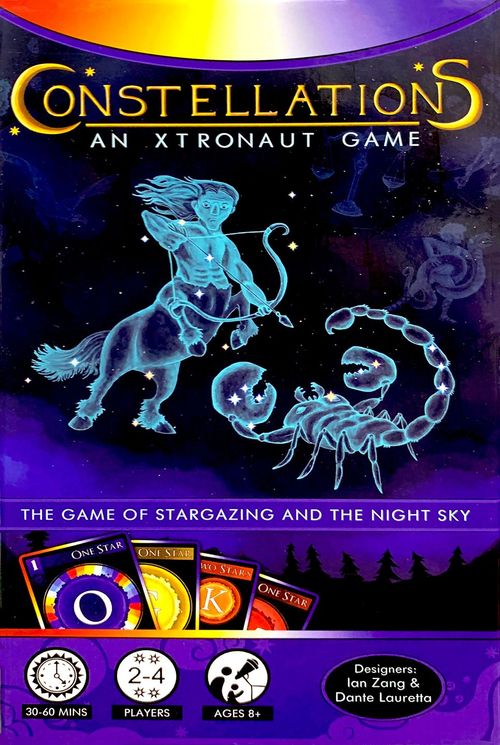
Constellations
Constellations Rulebook
Table of Contents
Table of Contents
- Components
- Game Setup
- Gameplay
- Advanced Rules
- Solo & Team Play Rules
- Stargazing Handbook
- Introduction
- Why Are Stars So Bright?
- A Star's Life Cycle: What Happens When a Star Runs Out of Fuel?
- How do Astronomers Classify Stars?
- What is the Difference Between Types of Stars?
- Xtronaut Word Bank
- Mnemonic Fun!
- What is a Constellation?
- Which Constellations are in the Zodiac?
- Which Northern Constellations are in the Game?
- Which Southern Constellations are in the Game?
- Constellations Crossword
- Quick Setup Reference
Components
36 Constellation Hexes: Each Constellation Hex has two sides: The Illustration Side and the Information Side.
The Illustration side contains original art and is used to place the hex in the sky. The Information Side of the hex guides placement strategy. This side indicates the following information: Constellation Name, Constellation Type, Star Cost to Claim Constellation, Placement Gems, Milky Way Galaxy indicator, Points Earned for Constellation, Deep Space Object (for Expansion Set), and Adjacent Constellations.
72 Star Cards: There are seven different types of Star Cards in the game, based on the real types of stars in the Universe. Star Cards come in both one-star and two-star values. Players must collect combinations of these cards to meet (or exceed) a constellation's star cost.
Star Card Frequency: The makeup of stars in this deck contains the same frequency as that of the night sky!
| Type | 1 Star | 2 Stars |
|---|---|---|
| O | 4 | 1 |
| B | 9 | 8 |
| A | 9 | 6 |
| F | 5 | 3 |
| G | 5 | 5 |
| K | 5 | 5 |
| M | 5 | 2 |
Four Score Counters: Blue Player, Red Player, Yellow Player, Purple Player.
Game Setup
Two, three, or four players can play Constellations, and there are three general options: Regular Game, Long Game, Extended Game.
To start the game, shuffle the Constellation Hexes until a Zodiac sign is on top. Place this hex in the middle of the board Illustration side up. Initial constellations will build off this hex. Reshuffle the hexes and randomly remove some of them from the game according to the chart below.
Leave the rest of the hexes Illustration side up in a pile near the board, creating the Constellation Hex Deck. Flip three hexes Information side up. These are the Available Constellations.
Shuffle the Star Cards and deal five cards to each player. Then, flip five cards face up in a row. These are the Available Stars. Leave the remaining cards face down, creating the Star Card Draw Pile.
Regular Game (20–40 minutes)
| Players | Return |
|---|---|
| 2 Players | Return 24 cards |
| 3 Players | Return 21 cards |
| 4 Players | Return 18 cards |
Long Game (40–60 minutes)
| Players | Return |
|---|---|
| 2 Players | Return 18 cards |
| 3 Players | Return 15 cards |
| 4 Players | Return 12 cards |
Extended Game (60–90 minutes)
| Players | Return |
|---|---|
| 2 Players | Return 12 cards |
| 3 Players | Return 9 cards |
| 4 Players | Return 6 cards |
Gameplay
Player Actions
Each player can take any TWO of the following actions on their turn. A player can do the same action twice.
- Draw a Star Card
- Reserve a Constellation
- Play a Constellation
1. Draw a Star Card
A player may either take one of the Available Star Cards that is face up or draw a card from the top of the Star Card Draw Pile. If the player takes an Available Star, they immediately replace it with one from the Star Card Draw Pile. There is no hand limit!
If the Star Card Draw Pile is empty, reshuffle the discard pile to create a new draw pile. In the very rare occasion that there is no discard pile to reshuffle, all players must discard half of their Star Cards (rounded up) randomly from their hands. Reshuffle those cards to create a new Star Card Draw Pile.
2. Reserve a Constellation
The player claims one of the Available Constellations and places it in front of them. Only that player may complete their Reserved Constellation. The player then flips over a new hex from the Constellation Hex Deck, so that there are always three Available Constellations. If this action uses the last hex from the deck, then the end of the game is triggered (see below).
A player may take this action if they already have an uncompleted Reserved Constellation. However, they must return the previously reserved hex back to the bottom of the Constellation Hex Deck. Players keep Reserved Constellations until they are played or until the end of the game.
3. Playing a Constellation
To play a constellation, the player discards stars into the Star Card Discard Pile to match or exceed the requirements of a single Available Constellation OR their own Reserved Constellation. A player may substitute three (or more) stars of one type in the place of a different type.
Example: Presley needs a single G-type star to play Sagittarius, but she doesn't have one. She may meet the G-star requirement by playing three (or more) B stars.
Players May Use O-stars As Wild Cards.
O-stars are massive stars that are quickly destroyed in a giant explosion called a supernova. This explosion triggers new star formation; the new star can be any type. As a result, in this game, O-Star Cards can be played as an O-star when required, or they can act as wild cards when playing a constellation.
When a player has discarded all the necessary Star Cards, they place the Constellation Hex next to another hex (or hexes) on the board, Information Side up.
Scoring
Upon playing a Constellation Hex, players score points equal to the sum of the following:
- The constellation's point value.
- Two bonus points for each matching adjacent constellation.
- One bonus point for each matching gem.
- If no gems match, the player LOSES two points.
Once you have completed score keeping, flip the hex to the Illustration side. Please note that this should be the same orientation as you used for scoring, but the resulting image may be upside down or tilted compared to the adjacent hexes (even though in the example all images are aligned with the same orientation.)
Example: Cooper plays Sagittarius next to Capricornus, Cetus, and Lupus, matching five gems. He scores 12 points for playing Sagittarius, 2 points for playing adjacent to Capricornus, and 5 points for his matching gems, for a total of 19 points! (5 + 2 + 12 = +19 Total Points)
Game End
The game ends when the last hex in the Constellation Hex Deck is added to the available constellations. Each player (including the player who triggered the end) may take one last turn, and the game ends. If during this last round, a constellation is played from the available constellations, replace it with a constellation placed in the box at the start of the game. The player with the highest score wins! If there is a tie, the player with the most cards in hand wins. In the case of a further tie, the players share victory.
Advanced Rules
Our Constellations game was designed to allow players to customize their gameplay based on the general rules described above. Here are some ideas as to how to make the game more challenging. If you come up with a house rule that you'd like to share, send it to [email protected]. We may even feature your rules on our website!
Strict Star Requirements
When playing a constellation, if a player exceeds the requirements for a constellation, the player loses one point for each star overpaid.
(Example: Dave plays a 2-B Star Card when the constellation only requires one B-type star. He loses one point. He also played two 2-K Star Cards to substitute a G. If the constellation doesn't require a K-type star, he loses one additional point.)
Match All Gems
When placing a Constellation Hex, ALL hex sides must exactly match their neighbor's gem patterns. If there are no available placement locations on the game board, then that Constellation cannot be placed.
No Substitutions
A player may NOT substitute three stars of one type in the place of a different type.
Trading
As one of their actions, players may trade with another player. The trade must involve at least one Star Card from each player but may involve any number of cards, including Reserved Constellations.
Available - Star Sweep
As one of their actions, players may remove all five of the Available Star Cards and replace them with five new ones from the top of the draw pile.
Supernova O-stars
When playing an O-type star as a wild star, the star goes supernova. After resolving the constellation, remove the O-Star Card from the game and place it back in the box.
Solo & Team Play Rules
This variant is for those wanting a more cooperative or solo challenge. In this variant, the players are attempting to piece together as accurate a sky map as possible.
Setup
Define the game boundary area. Shuffle all 36 Constellation Hexes. Place the Star Cards back in the box. They are not used.
Flip over the top Constellation Hex and place it in the center of the playing area illustration side up.
Gameplay
On each turn, the team must decide whether to play the constellation on top of the deck or place it in a face-up pile next to the draw pile. The Constellation Hex on top of the face-up pile is available for future play.
On a turn, take one hex from either the top of the draw pile or the top of the face-up pile. If possible, place it next to other constellations with the following restrictions: EVERY gem must match, and NO part of the constellation can lie outside the legal playing area. If the constellation cannot be played, place it on top of the face-up pile.
Constellations may be played in any orientation.
Points are scored for matching the desired adjacent constellations (+2 for placing adjacent to one constellation, or +4 for placing adjacent to both constellations). When placing a constellation, score points according to the chart below.
- Matching one edge: +0 points
- Matching two edges: +1 point
- Matching three edges: +2 points
- Matching four edges: +3 points
- Matching five edges: +4 points
- Matching six edges: +5 points
Continue playing hexes until the draw pile is exhausted. When the draw pile is empty, players may continue playing the face-up hexes, one at a time, until there is no legal move available for the top face-up hex.
Game End
When the last constellation is played, the game ends. The player or team loses 1 point for each constellation left in the face-up pile.
- 0–10 points: Lab Assistant
- 11–20 points: Junior Astronomer
- 21–30 points: Senior Astronomer
- 31–40 points: Lab Chief
- 41–50 points: Observatory Lead
- 51+ points: Nobel Prize Winner
Stargazing Handbook
Introduction
The creation of the first constellations is linked to stargazers in ancient Mesopotamia over 5,000 years ago. Early astronomy is also evident in China, India, Greece, Rome, and the Islamic World. Stories of incredible heroes, animals, and adventures developed over time based on the various star patterns discerned.
With the introduction of telescopes, we learned that stars have different sizes, colors, locations, and characteristics. As our tools improved, so did our knowledge of the composition of our universe. Hans Lippershey developed the first telescope in 1608 in Holland. However, it was Galileo who made the incredible advance to point it at the heavens. With this tool, he discovered the phases of Venus, the four largest satellites of Jupiter, and sunspots.
With the Constellations game, we have combined this incredible history with scientific information about our night sky. Using this handbook, you will learn about stars, how they work, their life cycle, the classifications we use to differentiate star types, and more.
Let's start with an introduction to stars – the core component of constellations.
Why Are Stars So Bright?
Stars form when giant clouds of hydrogen, the most common element in the Universe, collapse into clumps of gas and dust. A star is born when the center of these clusters get so hot they generate energy through a nuclear reaction. Stars are giant nuclear furnaces, with temperatures of millions of degrees. For most of their lives, stars burn hydrogen and produce helium. During this stage, stars are called main-sequence stars.
A star's mass determines the temperature of its stellar furnace. Higher mass means there is more matter (mostly hydrogen) in the star. Massive stars, with significant amounts of hydrogen, burn at high temperatures and live for millions of years. Small stars burn at low temperatures and live for trillions of years. The higher the temperature of a star, the brighter it is.
A Star's Life Cycle: What Happens When a Star Runs Out of Fuel?
When their hydrogen fuel runs out, stars that range in mass from one-half to ten times the Sun become red or orange giant stars. These stars start a new reaction, burning helium and producing carbon and oxygen. When this fuel runs out, the nuclear furnace turns off, and the carbon-oxygen ember glows for billions of years as a white dwarf star.
Stars that are more than ten times as massive as our Sun become red or orange supergiant stars. Their nuclear furnaces are so powerful, they continue burning elements until they produce iron, the heaviest element that can be made in the core of a star. At the end of their lives, these stars explode as a supernova. These events produce all the elements heavier than iron. The remaining stellar core becomes a neutron star or a black hole, depending on how much mass is left behind.
How do Astronomers Classify Stars?
In astronomy, we classify stars based on their patterns of light. These patterns give us amazing information for understanding each star. To see this special pattern, astronomers split light into different colors using a prism. This optic creates a spectrum exhibiting the rainbow of colors from the star.
The spectral class of a star is a short code summarizing the properties of the star such as its temperature, density, and composition. Stars are classified using the letters O, B, A, F, G, K, and M, indicating the hottest (O) to the coolest (M) types. Our Sun, for example, is a G star. You can remember this sequence with the classic mnemonic device: Oh, Be A Fine Guy – Kiss Me!
When you are playing Constellations, these classifications are especially important. Remember, treat the G stars well – we are fortunate to have such a terrific star in our Solar System!
What is the Difference Between Types of Stars?
O-type stars are very hot and extremely bright. Most of their energy output is ultraviolet light. They are the rarest of all main-sequence stars. Only 0.00001% of the main-sequence stars near the Sun are O-types. Since they are so massive, O stars burn up all their hydrogen fuel within 10 million years, then explode as a supernova. Based on this phenomenon, they are wild cards in the game!
B-type stars are very bright and blue. About 0.1% of the main-sequence stars near the Sun are B stars. These stars are ten times as massive and 1000 times brighter than the Sun. They live for 100 million years.
A-type stars are white or bluish-white. Almost 1% of the main-sequence stars near the Sun are A stars. They are twice as massive and 20 times brighter than the Sun. They live on the main sequence for about one billion years.
F-type stars are white. About 2% of the main-sequence stars in the solar neighborhood are F stars. They are slightly more massive than the Sun and four times brighter. They live for roughly three billion years.
G-type stars are yellow stars. Our sun is a G star and other G stars are similar in mass and brightness. These stars live for 10 billion years. Over 3% of the stars near the Sun are G types. Since the Sun is only four and a half billion years old, it is not even middle age!
K-type stars are orange stars that are slightly cooler than the Sun. K stars make up about 8% of the main-sequence stars in the solar neighborhood. Other K stars are orange giant or supergiant stars that have left the main sequence and burn helium for their nuclear fuel.
M-type stars are the most common in the Universe. About 80% of the main-sequence stars in the solar neighborhood are red dwarf M stars. These small stars burn at a slow rate and live for trillions of years. They are so dim that none can be seen with the naked eye from Earth. All the M stars that can be seen from Earth are red giant or supergiant stars.
Now, when you play Constellations, you will understand the meaning of the different types of stars that make up each constellation.
Xtronaut Word Bank
Asterism – a distinctive pattern of stars in the sky that is not an official constellation. Famous asterisms include the Big Dipper and the Summer Triangle.
Billion – a large number represented by a one with nine zeroes after it: 1,000,000,000.
Black Hole – a region of spacetime exhibiting such strong gravitational effects that nothing—not even light—can escape from inside it. Black holes are left behind after a massive star explodes as a supernova.
Carbon – a chemical element that is basis for organic chemistry and life. Carbon is formed when main-sequence stars burn helium as their nuclear fuel.
Dwarf Star – a star of relatively small size. Most main-sequence stars are dwarf stars. Main-sequence dwarf stars are also designated by their color. For example, the Sun is a yellow dwarf star.
Giant star – a star that has left the main sequence and started burning helium as its nuclear fuel. These stars expand to over a thousand times the diameter of the Sun.
Helium – a chemical element that exists as a gas. Helium is formed when main-sequence stars burn hydrogen as their nuclear fuel.
Hydrogen – the lightest chemical element in the Universe. Hydrogen was formed at the dawn of the Universe and is the primary nuclear fuel for stars.
Iron – a heavy chemical element that often exists as a metal. Iron is the heaviest element that can be produced in a nuclear furnace at the core of a star.
Main-Sequence Star – a star that is burning hydrogen as its nuclear fuel. Most stars in the Universe are main-sequence stars.
Million – a large number represented as a one with six zeroes after it: 1,000,000.
Neutron star - the collapsed core of a large star that was not massive enough to form a black hole. Neutron stars are composed entirely of neutrons, subatomic particles with no electrical charge.
Oxygen – a chemical element that reacts with many other elements to form solids (like rocks), liquids (like water), and gases (like carbon dioxide). Oxygen is formed inside stars that are burning helium.
Spectrum – the pattern that is formed when light is broken up into different wavelengths (colors). The spectrum of a star contains information about its temperature, density, and composition.
Supergiant Star – the biggest and brightest of the orange and red giant stars.
Supernova – the most powerful explosions in the Universe. A supernova occurs when a massive star no longer has any nuclear fuel left to burn. They leave behind a neutron star or a black hole. These powerful explosions can cause nearby clouds of hydrogen to collapse, triggering new main-sequence star formation.
Trillion – a large number represented by a one with twelve zeroes after it: 1,000,000,000,000.
White Dwarf Star – the bright core of carbon and oxygen left behind after a low-mass star finishes burning helium. White dwarfs can produce light for billions of years.
Mnemonic Fun!
A mnemonic is a silly phrase that helps you remember some sequence. See if you can come up with mnemonics to help you remember these groups of Constellations, presented in their order in the sky. Remembering these patterns will help you score big points in the Constellations game!
- Zodiac: Aquarius, Pisces, Aries, Taurus, Gemini, Cancer, Leo, Virgo, Libra, Scorpio, Sagittarius, Capricornus
- Constellations of the Sea: Eridanus, Cetus, Pisces, Aquarius, Piscis Austrinus
- Heroes of Greece: Auriga, Perseus, Cassiopeia, Andromeda, Pegasus
- Journey Through the Center of Milky Way: Vulpecula, Aquila, Ophiuchus, Sagittarius, Scorpius, Norma, Lupus
What is a Constellation?
A constellation is a group of stars forming a recognizable pattern in the night sky. Constellations are traditionally named after animals, mythological figures, symbols, or scientific instruments. Modern astronomers divide the sky into eighty-eight constellations with well-defined boundaries.
Which Constellations are in the Zodiac?
The zodiac is an area of the sky centered upon the ecliptic, the path of the Sun as seen from the Earth across the celestial sphere over the course of one year. The paths of the Moon and visible planets also remain close to the ecliptic, within the belt of the zodiac. The zodiac is divided into twelve signs. You need to find one of these Constellations to start gameplay.
Aquarius is Latin for "water-carrier". Aquarius is one of the oldest of the recognized constellations along the zodiac. It is found in a region of the sky called the Sea due to other constellations with watery associations such as Cetus, Pisces, and Eridanus.
Aries is located between Pisces to the west and Taurus to the east. The name Aries is Latin for ram. It is one of the 48 constellations described by the Greek Astronomer Ptolemy.
Cancer is Latin for crab and it is commonly represented as one. Cancer is a medium-size constellation and its stars are rather faint.
Capricornus is Latin for "horned goat". It is commonly represented in the form of a sea-goat: a mythical creature that is half goat, half fish. It is the smallest constellation in the zodiac.
Gemini was one of the 48 constellations described by Ptolemy. Its name is Latin for "twins" and its two brightest stars are named after the twins Castor and Pollux in Greek mythology.
Leo lies between Cancer to the west and Virgo to the east. Its name is Latin for lion and to the ancient Greeks it represented the Nemean Lion killed by the mythical hero Heracles.
Libra is Latin for weighing scales. It is fairly faint, with no real bright magnitude stars. It lies between Virgo to the west and Scorpius to the east.
Pisces is Latin for fish. It lies between Aquarius to the west and Aries to the east. The ecliptic and the celestial equator intersect within this constellation.
Sagittarius is Latin for the archer. It is commonly represented as a centaur with a bow. The center of the Milky Way lies in Sagittarius.
Scorpius is Latin for scorpion. It lies between Libra to the west and Sagittarius to the east. It is a large constellation located near the center of the Milky Way.
Taurus is a large and prominent constellation. It is one of the oldest constellations, dating back to at least the Early Bronze Age, when it marked the location of the Sun during the spring equinox.
Virgo is Latin for virgin. Lying between Leo to the west and Libra to the east, it is the second largest constellation in the sky (after Hydra). It can be easily found through its brightest star, Spica.
Let's learn a bit more about some of the other constellations in the game.
Which Northern Constellations are in the Game?
Andromeda is named for the daughter of Cassiopeia, in the Greek myth, who was chained to a rock to be eaten by the sea monster Cetus.
Aquila is Latin for "eagle" and it represents the bird who carried Zeus's thunderbolts in Greek mythology. The constellation is located along the galactic plane of the Milky Way.
Auriga is among the 48 constellations listed by Ptolemy. It is often depicted as a goat-herd or shepherd but also as a charioteer.
Boötes comes from the Greek word meaning "herdsman" or "plowman". It contains the fourth-brightest star in the night sky, the orange giant star Arcturus.
Cassiopeia is named after the queen in Greek mythology, who boasted about her unrivaled beauty. It is easily recognizable due to its distinctive "W" shape, formed by five bright stars. The galactic plane of the Milky Way runs through Cassiopeia.
Leo Minor is a small and faint constellation. Its name is Latin for "the smaller lion". Leo Minor was designated as a constellation by Polish astronomer Johannes Hevelius in 1687.
Lynx, named after the animal, is a constellation that was introduced in the 17th century by Johannes Hevelius. It is a faint constellation with its brightest stars forming a zigzag line.
Ophiuchus is a large constellation whose name is from the Greek for "serpent-bearer". It is commonly represented as a man grasping a snake. The galactic plane of the Milky Way passes through Ophiuchus.
Pegasus is named after the winged horse Pegasus in Greek mythology. It was one of the 48 constellations listed by Ptolemy.
Perseus is named after the Greek mythological hero Perseus. It is located near several other constellations named after Greek legends, including Andromeda and Cassiopeia. The galactic plane of the Milky Way passes through Perseus.
Ursa Major is Latin for "the great bear". The constellation's most recognizable asterism is a group of seven bright stars commonly known as the "Big Dipper".
Vulpecula is a faint constellation. Its name is Latin for "little fox". It was identified in the seventeenth century. The galactic plane of the Milky Way passes through Vulpecula.
Which Southern Constellations are in the Game?
Canis Major is Latin for "greater dog" in contrast to Canis Minor, the "lesser dog". Both figures are commonly represented as following Orion, the hunter, through the sky. The galactic plane of the Milky Way passes through Canis Major.
Canis Minor was included as an asterism in Ptolemy's 48 constellations. Its name is Latin for "lesser dog". Canis Minor contains only two bright stars, Procyon and Gomeisa.
Centaurus is one of the largest constellations. Centaurus is represented as a centaur; a creature that is half human, half horse. It contains Alpha Centauri, the closest star to the Sun. The galactic plane of the Milky Way passes through Centaurus.
Cetus refers to a sea monster in Greek mythology. Cetus is located in the region of the sky that contains other water-related constellations such as Aquarius, Pisces, and Eridanus.
Eridanus is represented as a river. It was one of the 48 constellations listed by Ptolemy. It is the sixth largest of the modern constellations.
Lupus is Latin for wolf. Lupus was one of the 48 constellations listed by Ptolemy. The galactic plane of the Milky Way passes through Lupus.
Microscopium is one of 12 constellations created in the 18th century by French astronomer Nicolas Louis de Lacaille. Its name is a form of the Greek word for microscope. In this game, it is depicted as a modern transmission electron microscope.
Norma is one of 12 constellations drawn up by Nicolas Louis de Lacaille. Its name is Latin for normal, referring to a right angle. It is often represented as a carpenter's square. The galactic plane of the Milky Way passes through Norma.
Orion is a prominent constellation that is visible throughout the world. It is one of the most conspicuous and recognizable constellations in the night sky. It is named after a hunter in Greek mythology.
Piscis Austrinus is Latin for "the southern fish". It was one of the 48 constellations listed by Ptolemy.
Sextans is a minor constellation which was introduced in 1687 by Johannes Hevelius. Its name is Latin for the astronomical sextant, an instrument that Hevelius made frequent use of in his observations.
Telescopium is one of twelve constellations named by Nicolas Louis de Lacaille. Its name is a form of the Greek word for telescope. In this game, it is represented by the Hubble Space Telescope.
Constellations Crossword
Now use your new knowledge of stars and constellations to complete the following crossword puzzle:
Across
- The Wolf
- The Goat-Herd
- Right Angle
- The Path of the Sun
- The Crab
- The Hunter
- Killed by Heracles
- Winged Horse
- The Sea-Goat
- The Water-Carrier
- Second Largest Constellation
- The Serpent-Bearer
- The Little Fox
Down
- The Scales
- Castor and Pollux
- The Ram
- The Center of the Milky Way
- Contains Alpha Centauri
- Scorpion
- The River
- Daughter of Cassiopeia
- Hubble
- Greek Hero
- Carrier of Zeus's Thunderbolts.
- The Sea Monster
Quick Setup Reference
Deal five Star Cards to each player. Set up the Starter Zodiac Constellation in the center of the play area, with the Star Card Draw Pile and five face-up Available Star Cards to one side, and the Constellation Hex Pile with three face-up Available Constellations to the other side.
Constellations Count
Regular Game (20–40 minutes): 2 Players return 24 cards; 3 Players return 21 cards; 4 Players return 18 cards.
Long Game (40–60 minutes): 2 Players return 18 cards; 3 Players return 15 cards; 4 Players return 12 cards.
Extended Game (60–90 minutes): 2 Players return 12 cards; 3 Players return 9 cards; 4 Players return 6 cards.