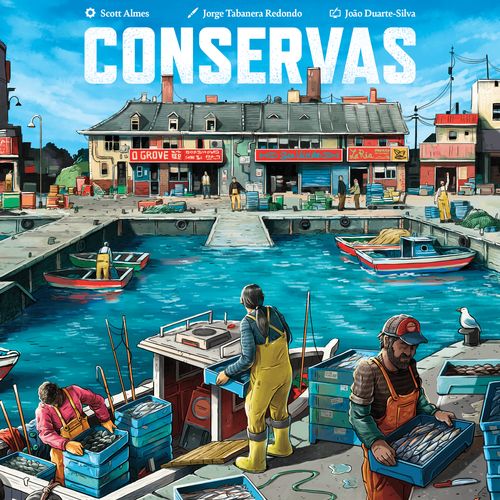
Conservas
Conservas Rulebook
Table of Contents
Table of Contents
Components
- Market Book (with 12 months to choose from)
- 18 Boat Cards
- 1 Open Water Card
- 27 Upgrade Cards
- 20 Water Tokens
- 30 Sardine Tokens
- 30 Mussel Tokens
- 20 Scallop Tokens
- 16 Octopus Tokens
- 116 Sea Tokens (in 5 types — the Water, Sardine, Mussel, Scallop, and Octopus tokens above)
- Round Marker
- 12 x €1 Tokens
- 16 x €5 Tokens
- 4 x €10 Tokens
- 1 Sea Bag (the €1, €5, and €10 tokens together are the Money Tokens)
Setup
Separate the Fish and Water tokens by type: this will be the general supply.
Separate the Money tokens into €1, €5 and €10 value piles.
Select which Month to play. We recommend following a chronological order, starting with January, but feel free to begin with whichever Month you prefer the most. Each Month has a slightly different setup.
Load the "Sea" bag according to the market, taking the Fish and Water tokens from the general supply.
Begin with the starting money specified by the market, taking the money from the general supply.
For example, 5 Sardines, 5 Scallops, and 10 Water tokens are used in the January Market. The player also starts with €10.
Place the Round Marker on the first Round Space on the Market Board.
Shuffle the Boat deck:
- Draw 2 Boats and choose 1. Place the chosen card face-up in your play area. Place the discarded card underneath the deck.
- Draw 3 Boat cards and place them face-up in a row.
- Place the rest of the cards in a face-down deck.
Set the Open Water card next to the selected Boat card.
Shuffle the Upgrade cards and place 3 face-up in a row. Place the rest of the cards in a face-down deck.
There is an area reserved for your Upgrade cards, and a separate area reserved for your Boat cards.
Gameplay Overview
Each game will be played in a series of rounds. The number of rounds depends on the chosen market month, but is typically between 7 and 10.
Each round will follow this format:
AT SEA — You will fish tokens from the Sea bag and choose what to catch in the boats and what to leave in the sea to spawn.
ON LAND — You will turn the fresh fish into conservas, and purchase new Boats and Upgrades for your company.
END OF DAY — You must pay upkeep on your boats and see if the fish have spawned.
After you have played all of the game rounds, you will then check the winning conditions.
Winning conditions typically require you to earn a certain amount of money, and achieve a sustainability goal.
The sustainability goal will require a certain amount of fish to be left in the ocean at the end of the game.
Phase 1: At Sea - Drawing Tokens
In this phase, you will draw tokens from the Sea bag and determine whether to add them to your boat or leave them in the sea. To do this, follow these steps:
- Draw 5 tokens from the Sea bag.
- Add the tokens to one of the Boat cards or the Open Water card. Tokens can only be added once to each Boat and Open Water card.
Option 1: Add tokens to the Boat
a. The tokens must be divided between the Boat (Fished) and under the boat (Deep Sea). See example below.
b. Each Boat card details how many tokens must be held on the Boat (its catch size) — the remaining tokens must be placed below the Boat. You may place either Fish or Water tokens on the Boat.
In this example, the player draws 5 tokens. The 'El Dorado' boat has a Catch Size of 2, so 2 tokens must be placed on the boat. The other 3 are placed below the boat and are considered in the 'Deep Sea'.
Option 2: Add tokens to the Open Water card
a. The Open Water card has no boat, so all the tokens added to it are considered in the 'Deep Sea'.
Tokens placed on the Open Water card are placed on top of the card. All the tokens are considered in the 'Deep Sea'.
- If all the Boats and the Open Water card are full, then this phase ends. Otherwise, go back to Step 1 and draw and place more tokens.
Steps 1 through 3 are repeated until each Boat and Open Water card have had tokens placed on them. Now it is time to proceed to the next phase: On Land.
If you are drawing tokens and you do not have enough in the bag, then you must take Water tokens from the general supply to reach your total. In the rare instance that you run out of Water tokens in the general supply, you must then forfeit the game, as you have overfished the waters.
Phase 2: In Land - Spending Tokens
After the At Sea phase is over, the player must then spend the tokens that were harvested and placed on the boat.
Only the Fish tokens are spent: Water tokens have no value. There are two ways to spend Fish tokens: sell to the market, or trade for an upgrade. You may also spend money that you have earned in order to hire more boats. You may sell conservas, trade for upgrades, or buy boats as many times as you like, and in any order.
Selling to the market as conservas
If you choose to sell tins to the market, then you are creating delicious conservas with the fish and selling them on the market.
Each market has its own layout and special rules, as described on the month's market board. However, most will follow these basic rules.
Each market has a grid with spaces that have:
- the number of fish required.
- the money earned.
This space requires 2 sardines, and then will earn the player €3.
To sell them as conservas, place the tokens 'tin' side up on the market space to show the order has been filled. Then collect the money shown.
Each space can only be filled once and you must be able to sell all of the tokens for that space at the same time. In the example below, you must have 2 Sardines harvested to fulfill that order in the same round.
When you sell the tokens, you leave 1 token of your choice on the market space to show it has been fulfilled and place the rest of the tokens back into the general supply.
The tokens remain on the market space for the remainder of the game.
Olivia has 2 Scallops on the 'El Peztidigitador' boat that she previously placed during the At Sea phase. She decides to convert them into conservas and sell them in the first space of the second row of the market. She places 1 Scallop token in the space and returns the other one to the general supply. Then she takes €2 from the general supply.
Trade Fish for Upgrades
An alternate way to spend your fish is to trade for market Upgrades. The row of face-up Upgrade cards are available to give you powerful abilities throughout the game. They allow you to earn more money, manipulate tokens, and create powerful combinations in order to best run your business.
Each Upgrade card has a cost associated with it. The costs are as follows:
- One fish of any type.
- Two fish of the same type (=).
- Two fishes of different types (≠).
An Upgrade card also shows its card name, its cost, and (below) its card effect and the phase in which the effect takes place / type of effect.
Tokens that are spent on market Upgrades are discarded back to the general pool. They are not placed back into the Sea bag. In some cases, the card will include instructions to leave the Fish token on the card. In that case, the token remains there. After payment, you collect the card and place it in your play area.
Lucía has 2 Sardines on the Quid Pro Pulpo boat that she already placed during the At Sea phase. Of the 3 Upgrade cards that are available, she likes the Secondary Nets the most as it lets her draw 8 tokens instead of 5 in each round. She decides to spend 2 Sardine tokens: she returns them to the general supply and takes the Secondary Nets Upgrade card and puts it in her play area.
Each Upgrade card also indicates which phase of the round the ability can be used in (At Sea, On Land, or End of Day). You may wish to sort your Upgrade cards by type to make it easier to keep track of which upgrades you have available.
The Upgrade cards also indicate whether they are ongoing, usable once per round, or activated only during the round they are purchased.
Cards that are used only once when purchased remain in your play area. They are not discarded and in some cases can be important when assessing winning criteria in some scenarios.
Upgrade cards are not replaced until the End of Day Phase.
Buying a Boat
You may also purchase a new Boat during this phase. Each Boat has two important costs: their purchase price and their upkeep price. The cost is paid when the Boat is first acquired and is a one-time cost. The upkeep cost is paid in every subsequent round, during the End of Day phase.
After a boat is purchased you should place it in a line with your other boats.
Do not draw a new Boat card yet - the new cards are drawn during the End of Day Phase.
Important: you don't have to pay a Boat's upkeep cost on the round in which in you purchased it, but you are required to pay it in every subsequent round.
In this example, the boat costs €5 when purchased, and in each round (except the first) the player will need to pay €1 in upkeep. Each Boat card shows the boat name, its catch size, its purchase cost, and its upkeep cost.
Phase 3: End of Day
During the End of Day phase, the following actions are taken:
-
Any left over Fish tokens on the boats are discarded to the general pool and not placed back into the Sea bag.
-
Any left over Water tokens on the boats are returned to the bag.
-
Replace any missing Boat or Upgrade cards, so each row has 3 cards. If there were no boats purchased this round, you may choose to discard all the boats and draw another 3 in their place. If the draw deck is empty, you can shuffle and draw new cards.
-
The same procedure is repeated with the Upgrade cards. If no Upgrade cards were purchased, you may choose to discard all the Upgrade cards and draw another 3 in their place.
-
Pay the upkeep costs of each Boat (including the initial one) except the Boats purchased in the current round. You cannot go below zero money. In the rare case that you cannot pay the upkeep of a Boat, discard it.
-
Fish Spawn. Look at the fish in the Deep Sea area. (The Deep Sea area consists of tokens on the Open Water card and the tokens that were not loaded onto a Boat.) There must be at least 2 Fish tokens of the same colour available for spawning. For every Fish token (not counting the first) add 1 more token of the same color to the Deep Sea area. For example, if there is:
- 1 Sardine - No new tokens added
- 2 Sardines - 1 new Sardine added
- 3 Sardines - 2 new Sardines added
- 4 Sardines - 3 new Sardines added
And so on. Then, after all the colors have bred, add all the tokens back into the bag.
-
Move the Round Marker forward one. If this is the last round, then check for the Goal conditions. Otherwise, play another round.
Goals
After all the rounds are complete, you should check whether you have met your goals. Each month will have a unique set of goals. Goals will have several parts, and they may consist of:
- Money Goal - you must have this amount of money after the round ends. (After the End of Day phase when upkeep has been paid.)
- Upgrades or Boats – this is the minimum requirement of cards you must have in these areas.
- Sustainability Goal - you must empty the bag and count the available fish. This is the minimum amount needed, unless otherwise stated.
In this example, you must have €40 at the end of the game and when you empty the bag there must be a minimum of 4 sardines and a minimum of 4 scallops.
If you have completed the goals for the market, then you have won the game! Otherwise, reset the game and try again!
For a tougher challenge, you can also try to complete the "Difficult" goals for each scenario.
Reference: Example Turn
In this example our player, Fin, will be playing a typical round. Let's pretend it is the 3rd round in the first market month, January.
Phase one: At sea
In this phase he will draw 5 tokens at a time and add them to his boats or the Open Water card. Fin currently has two boats and, as always, the Open Water card. This means he will draw three times in total.
He draws his first handful of tokens from the bag. He always draws 5 tokens unless he has upgrades that will tell him otherwise. In this first draw, he gets 2 Sardines, 1 Scallop and 2 Water tokens. He places 2 Sardines on one of his boats and leaves the rest in the sea.
He draws another 5 tokens from the bag: 1 Sardine, 1 Scallop and 3 Water tokens. He adds these to the Open Water card. That card can no longer have tokens added to it.
He draws for the third and last time, taking 5 tokens from the bag. He has 2 Sardines, 2 Scallops and 1 Water token. He adds 1 Sardine, 1 Scallop and 1 Water token to the remaining boat. The other Scallop and Sardine tokens are placed below the boat to contribute to spawning.
After drawing for the last time, Fin moves onto the next phase, On Land. This is where he will turn the Fish tokens into conservas and sell them to the market and may also buy boats and upgrades.
Phase two: On land
Fin may spend any tokens he has in his boats: they are the catch from this round. He has 3 Sardines and 1 Scallop to spend. He decides to sell 1 of the Scallops and 1 Sardine to the market. This earns him a total of €3.
For the January market, spaces must be filled left to right.
With the 2 remaining Sardines, he decides to purchase an Upgrade card. He purchases the Fish Finders Upgrade, which will give him more control over his token draws.
After he has sold what he wants to the market and purchased an Upgrade card, he may also decide to purchase a boat. This time he decides not to do so. Then Fin proceeds to the End of Day phase.
Phase three: End of Day
Here he pays upkeep on his boats, and then the fish left at sea will spawn. First, he pays the upkeep: one boat has an upkeep cost of 1 euro and the other has no upkeep cost.
The Quid Pro Pulpo has an upkeep cost, while the Pez Limoncello does not.
The fish he left at sea will now breed. He counts the fish he has left of each type that are left in the Deep Sea area. He has 2 Sardines and 3 Scallops.
At least 2 Fish tokens of the same type are needed for spawning. A new Fish token will be spawned for each Fish token already at sea (not counting the first token). So, with 2 Sardines he will gain 1 more Sardine, and with 3 Scallops he will gain 2 more Scallops. These are all placed into the bag along with any tokens left in the Deep Sea area, and any Water tokens on the Boats.
Fin has now completed his round. He moves the round marker forward by one and continues his game.
Round Structure Summary
AT SEA — Draw 5 Fish tokens from the Sea Bag and place them on an empty Boat or on the Open Water card (if empty).
IN LAND — Sell fish as conservas per the current month's market rules. Purchase new boats and upgrades for your company.
END OF DAY — Pay upkeep on your boats and see if the Fish spawn. A new Fish token will be spawned for each Fish token in the Deep Sea (minus 1).
Iconography
- At Sea / On Land / End of day — icons marking which phase an Upgrade card's effect is used in.
- Ongoing effect / Once per round / One-time effect — icons marking how often an Upgrade card's effect can be used.
- One fish of any type — a cost symbol for Upgrade cards.
- = Two fish of the same type — a cost symbol for Upgrade cards.
- ≠ Two fishes of different types — a cost symbol for Upgrade cards.
- Upkeep icon — shown on a Boat card; pay this cost during the End of Day phase.