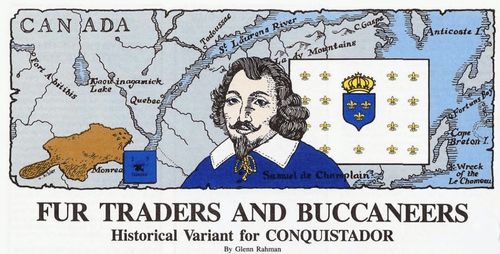
Conquistador: Fur Traders and Buccaneers
Conquistador: Fur Traders and Buccaneers Rulebook
Table of Contents
Table of Contents
- 2. Map
- 3. Pieces
- 5. Game Sequence
- 6. Operation of the Royal Council
- 7. Naval Movement
- 12. Land Attrition
- 13. Upkeep
- 14. Gold and Treasure
- 16. Special Units
- 18. Natives
- 19. Discoveries
- 20. Political Control of Zones
- 22. Scenarios
- 23. Native Alliance
- 24. The Fur Trade
- 25. The Newfoundland Fisheries
- 26. Buccaneers
- 27. Non-Player Spanish/Portuguese
- 28. Merchant Fleet Supremacy
- 29. The African Slave Trade
- Postscript
- Tables
- 2.4 Spanish/Portuguese Colonist Deployment
- 16.2a Charter Grant Table
- 23.5a Native Alliance Table
- 27.3.2a Spanish Garrison Table
- 27.5.1a Spanish Reprisals Table
- 27.5.5a Spanish Land Attack Table
- 27.10.1a Spanish Pillage Table
- 27.11.4a Spanish Galleon Treasure (results in Ducats)
- 28.3a Contraband Revenue Table
- 29.4a Slave Availability Table
- 29.12.1a Slave Sale Table
2. Map
2.1 The black hexes of the Caribbean area must be considered as green hexes and are open to colonization. While it is true that the Spanish did not concern themselves with the Bahamas and the Lesser Antilles, these islands were among the most coveted prizes in the colonial competition of the 17th and 18th centuries.
2.3 Add a new island (Barbados) in hex 2511. This island, the historical seat of the first English sugar production, cannot in all fairness be omitted.
2.4 Before the game, the colonies of the non-player Spanish and Portuguese must be set up. At the end of the 16th century, the states of Spain and Portugal were united. In the 17th century, Portugal obtained its political independence, but for the purposes of the game (unless otherwise indicated), the Spanish and the Portuguese may be considered as a single group.
Deploy green Colonist pieces in the hexes indicated at the end of these rules (Deployment of Spanish/Portuguese Colonists). They represent the main Spanish/Portuguese towns established in the late 16th and early 17th centuries.
3. Pieces
3.2 Yellow pieces are the Dutch. Green pieces are the non-player Spanish/Portuguese.
5. Game Sequence
B. Initial Naval Phase - If the Slave Trade option is used (see 29.), players who do not move units to "Guinea", do not fight or buy slaves on the spot, must Pass during the "Guinea Phase".
6. Operation of the Royal Council
6.3.2 Colonists. To represent the historical lack of French and Dutch colonists, reduce by "1" the number of Colonists due to the French and Dutch players each turn (after modification by Random Events). The number may not, however, be less than zero.
6.4.9 The English player begins the game with a "Cape Sud portolan". If they cannot obtain one normally before the end of Turn 4, all other players automatically acquire portolans at that time.
6.4.10 Ignore this event. At the start of the game, the silver mines of Pitosi (hex 4231) produce 50 ducats per game turn for any player who controls them.
6.4.15 and 6.4.16 Ignore these events. The dream of treasure cities died with Sir Walter Raleigh.
7. Naval Movement
7.1.3 Galleon fleets may be purchased from the first game turn. In the 17th century, they were no longer invulnerable. Galleon fleets in this variant have a defence factor of 50. They may never attack. If they are attacked, they are neither sunk nor captured, but any loss as defender in a naval combat is interpreted as a loss of gold for the attacking fleet. A loss of D1 results in a loss of 25% of the galleon fleet's gold; a loss of D2 results in a loss of 50%. A loss of D3 and DE results in the loss of 75% and 100% of the indicated treasure respectively. Round to the nearest 5 Ducats.
12. Land Attrition
As indicated in a previous issue of The GENERAL, the first edition of the Land Attrition Table must be corrected. It must read as follows:
Adjusted Land Attrition Level
| Die | 1 | 2 | 3 | 4 | 5 |
|---|---|---|---|---|---|
| 1 | - | - | - | - | - |
| 2 | - | - | - | - | C* |
| 3 | - | - | - | C* | S |
| 4 | - | - | C | S | CS |
| 5 | - | C | S | CS | 2CS |
| 6 | C | S | CS | 2CS | All |
12.3 In this variant, the presence of a Scout adjusts the Attrition Level of a hex. Subtract one (-1) from the die roll when checking Attrition results.
13. Upkeep
13.3 No Spanish Missionary is in play. However, this rule applies if the words "French Players" are replaced by "Spanish Player".
14. Gold and Treasure
No gold may be extracted in the Caribbean area. All continental gold hexes, except Santa Fe (1328) occupied by a Spanish colony, are already active mines (if a player captures them). All other gold hexes, including hex 1328, are undiscovered at the start of the game.
14.3 The three treasure cities begin the game plundered.
16. Special Units
16.1 Players receive the following Explorers:
England
- Richard Hawkins, enters on turn 1, leaves on turn 1
- Bartholomew Gosnold, enters on turn 2, leaves on turn 2
- John Smith, enters on turn 3, leaves on turn 4
- Henry Hudson, enters on turn 4, leaves on turn 4
France
- Marquis de La Roche, enters on turn 1, leaves on turn 1
- Francois Grave du Pont, enters on turn 2, leaves on turn 4
- Sieur De Monts, enters on turn 2, leaves on turn 4
Holland
- Jacob Mahu, enters on turn 1, leaves on turn 1
- Henry Hudson, enters on turn 2, leaves on turn 3
- Jacques Lemaire, enters on turn 4, leaves on turn 4
16.2 Charters. In the 17th century, the great age of American coastal exploration comes to an end.
Explorers continue to be numerous, but the greatest renown goes to those of the Pacific waters. For every Smith or Hudson we remember today, the American coasts saw many De Montses and Gosnolds pass by, men whose names are almost unknown even among experts, despite the value of their achievements. For the rest of the 17th century, renown belongs to the explorers of the interior. The coasts were to be the object of an influx of colonists, led by men of a different stamp.
Once the coasts were known, colonization depended on the interest and support of the government. The expression of that support was the granting of a charter.
16.2.1 At the start of each Planning phase from turn 5, a player wishing to found a colony or land Soldiers and others may roll a die on the Charter Grant Table. The die roll may be modified:
A. If on the last turn, the player's Treasury held a greater number of Ducats at the end than at the start, the player's colonial efforts showed a profit. This profit encourages the continuation of colonization. Add one (+1) to the Charter die roll.
B. If the government actively invests in the development of the New World, more charters may be made available. The player may spend five Ducats from their Treasury and add one (+1) to the die roll on the Charter Grant Table.
16.2.2 The player receives the number of Charter pieces indicated by their die roll. The presence of a Charter in an expedition allows the Colonists and other units of that expedition to land in a non-port coastal hex after a transoceanic movement. The landing of units results in the removal of the Charter piece from the map. A single Charter allows landing in only one non-port hex, but an expedition may carry more than one Charter.
16.2.3 If a ship carrying a Charter is captured or sunk, the Charter is removed from the map. This represents the loss of a vital leader, or the discouragement of the colonists.
16.4 Missionaries. The 17th century saw a concerted effort by French religious orders, in particular the Jesuits, to bring Catholicism to the Indians of Canada. For their efforts and their journeys, men such as Hennepin, Marquette and Biard are well known.
16.4, 16.4.1, 16.4.3: In these rules, replace "France" with "Spain" and "French player" with "Spanish player".
16.4.4 The conversion value of a French missionary is never used to affect combat. The French, and even less so the missionaries, were never interested in the military subjugation of the Indians.
16.4.7 The French player does not need a Missionary to land Scouts, Buccaneer leaders or Buccaneer Soldiers in areas having a Native Level.
16.4.8 The number of French Missionaries is equal to the number of Spanish Missionaries (two +3, two +2, three +1, two 0, three -1, two -2, two -3). If all Missionaries are on the map and the French player wishes to send even more to the New World, they may create a new Missionary piece of value 0 during the Planning phase. They may create only one new piece per turn.
16.4.8 The conversion value of French Missionaries affects the alliance of the Indians. See 23.3 below.
16.4.9 Ignore Missionaries when reductions of Native Level under random event no. 12 are requested.
16.5 Scouts. The French were fortunate to have a small number of remarkable frontiersmen. They traded with the Indians, lived among them, learned their customs and languages, and sometimes led them into combat. While the English colonists continued to hug the coasts, French explorers mapped the vast interior regions of North America, often accompanied only by the Indians themselves. Thanks to the efforts of these men, and to an enlightened colonial policy, France became not the competitor, but the friend and ally of the Indians living in its domain.
16.5.1 The French player receives Scouts in Europe, according to this calendar:
- Samuel de Champlain, enters turn 2, leaves turn 5
- Etienne Brule, enters turn 5, leaves turn 8
- Jean Nicolet, enters turn 6, leaves turn 10
- Sieur de Groseilliers, enters turn 12 (printed as "l2"), leaves turn 15
- Pierre Radisson, enters turn 12, leaves turn 15
- Daumont de Saint-Lussion, enters turn 15, leaves turn 15
- Nicolas Perrot, enters turn 15, leaves turn 19
- Louis Joliet, enters turn 16, leaves turn 20
- Sieur de La Salle, enters turn 16, leaves turn 19
- Sieur Duluth, enters turn 17, leaves turn 20
16.5.2 Historically, some of the Scouts defected to the English. In turn 8, Etienne Brule becomes an English Scout (to leave at the end of the turn). Radisson and Groseilliers both become English in turn 15. If these Scouts do not survive until their defection date, there is no defection. The defection (or, alternatively, the leasing) of Scouts is crucial for the English. Historically, it took the defection of Radisson and Groseilliers to allow the English to establish the Hudson's Bay Company, which proved remarkably long-lived. No Englishman was able to accomplish this task.
16.5.3 A player may rent a Scout to another player at any price and for any duration they agree upon (within the limits of the Scout's arrival and departure dates). This financial arrangement must be formalized in a treaty.
16.5.4 Scouts intrinsically are worth one Alliance Point each for attempts at alliances with the Native Level of an area. See 23. below.
16.5.5 The presence of a Scout in a hex allows one (-1) to be subtracted from the Attrition die roll (using the table in 12. above). Only one Scout may perform this function per hex. Scouts may perform this function only in areas north of the Aztec Empire.
16.5.6 The presence of a Scout (or of a Missionary, or of a Trading Post) is necessary for the operation of the fur trade in an area.
16.5.7 A Scout may not discover gold.
16.5.8 A Scout may make land discoveries.
16.5.9 A Scout may end its turn alone in a hex. If attacked, the Scout may retreat with the surviving units. If alone in a hex, the entry of enemy Colonist or Soldier units captures the Scout, unless it escapes (see 23.12).
16.5.10 A captured Scout is not killed, but must move with its captors. It may be returned to its owner for a ransom. If Attrition or Combat requires the death of a Conquistador, a friendly (non-captive) Scout in the affected stack is eliminated.
16.5.11 If the capturing units are forced to retreat during a battle, the Scout does not retreat (but is freed or captured by the victor).
16.6 Buccaneers. The seventeenth century saw the rise of the phenomenon of the Caribbean buccaneers. They were originally outlaws and vagabonds who had settled on uninhabited islands of the Spanish Caribbean to hunt wild cattle. Conflicts with the Spanish quickly transformed these rough pioneers into amphibious combatants and fierce, effective raiders. At first they recognized no authority other than their own brotherhood, but little by little the European governors crept into their fiefdoms and used them as a kind of irregular naval force. Eventually the buccaneer forces became so large and so powerful that their former patrons turned against them and banned buccaneering in the last years of the century. During their brief period of apogee, the men who led the Brethren of the Coast became legends for their luck and their audacity.
16.6.1 Players receive Buccaneer leaders according to this calendar. They arrive directly in the Caribbean ports. If no port exists when the leader is due to appear, their arrival is delayed until the Planning Segment during which such a friendly port exists.
England
- Flood, enters turn 10, leaves turn 11
- Mansfield, enters turn 12, leaves turn 14
- Morgan, enters turn 15, leaves turn 17
- Peake, enters turn 16, leaves turn 17
- Davis, enters turn 18, leaves turn 20
France
- Le Vasseur, enters turn 10, leaves turn 12
- L'Ollonois, enters turn 13, leaves turn 15
- De la Mothe, enters turn 16, leaves turn 17
- Grammont, enters turn 17, leaves turn 18
- Du Casse, enters turn 19, leaves turn 21
Holland
- Brouwer, enters turn 10, leaves turn 11
- Roc, enters turn 12, leaves turn 14
- Van Noort, enters turn 15, leaves turn 16
- Van Horn, enters turn 17, leaves turn 18
- De Graff, enters turn 17, leaves turn 21
16.6.1 Brouwer and Van Noort are fictitious names. Dutch buccaneers swarmed in the Caribbean at this time, but very few of them are named in the meagre chronicles of the period. They are included here to give the Dutch player the same chance of success in buccaneering as their historical counterpart.
16.6.2 A player may rent a Buccaneer leader to another player at any price and for any duration they agree upon (within the limits of the arrival and departure dates of the leader). This financial arrangement must be formalized in a treaty.
16.6.3 Buccaneer leaders may navigate anywhere without the Buccaneer ships and Soldiers suffering attrition, unless the purchased steps are exceeded, in which case the Buccaneer units suffer attrition in column 9+ of the Naval Attrition Table. Non-buccaneer units in the same expedition as the Buccaneer leader do not benefit from his presence. Take the normal attrition losses for these units.
16.6.4 A Buccaneer leader, at the head of Buccaneers, reduces the combat/Naval Invasion die roll by one (-1) when attacking. When attacking non-player units, the leader also reduces the die roll by one. If the leader defends against Spanish land or naval attacks, add one to the die roll.
16.6.5 A Buccaneer leader, at the head of Buccaneers, increases the dice rolls when determining the loot of a Spanish city and the treasure of a Spanish galleon (see 27.10, 27.11).
16.6.6 If a Buccaneer leader is stacked with Buccaneer units defending against a Spanish land attack or a Spanish naval attack, one (-1) is subtracted from the die roll.
16.6.7 A Buccaneer leader may retreat from combat with surviving friendly units. A Buccaneer leader may end a turn alone in a hex. If enemy Soldiers or Colonists enter a hex containing a lone Buccaneer leader, the leader is captured. A captured leader may be immediately killed or kept to be ransomed later.
16.6.8 If capturing units are forced to retreat in combat, the captive Buccaneer leader does not retreat, but is freed (or captured) by the victorious player.
16.6.9 Only a Buccaneer ship may carry a Buccaneer leader.
16.6.10 If a fleet composed solely of Buccaneers and led by a Buccaneer leader is victorious in naval combat, or gains treasure through the Spanish Galleon Treasure table, all ships lost by the enemy become Buccaneer prizes.
16.6.11 If Attrition or Combat results in the death of a Conquistador or an Explorer, a friendly (non-captive) Buccaneer leader in the affected hex is eliminated.
18. Natives
18.3 During the Native Combat Segment of the Land Phase, each player may attempt to lower the Native Level of a given Zone by attacking the Natives - if and only if this player has suffered a Native Revolt in that particular zone during the previous turn. If the player chooses not to attack the Natives during the following turn after an uprising, they may no longer do so later, unless another uprising provokes it.
The colonial powers of the 17th century rarely sought confrontation with the Indians. The English ignored them, unless an uprising had to be punished. The Dutch, and especially the French, coveted the trade goods of the Indians more than their territory, and therefore cultivated friendly relations.
18.3.1 If Random Event no. 11 or no. 13 occurs, the appropriate time to attack the Natives is the Native Combat Segment of the same turn.
18.4.6 The Native Level of the Caribbean Indians is a special case. According to the standard rules, it is normal for the Caribbean Indians to be attacked during the first turn or so and definitively eliminated. This is not historically exact. The Caribs retained many uncolonized islands and remained a powerful enemy until the middle of the 17th century. That is why we propose the following rules:
A. The Native Level on the islands of Cuba, Jamaica and Hispaniola (the three islands colonized by the Spanish) is zero. The Bahamas (2118 and adjacent hexes), the Lesser Antilles (2512 and adjacent hexes) and Puerto Rico (hex 2314) are each considered a distinct sub-zone with a Native Level of "3" each. The reduction of natives in one sub-zone has no effect on the natives of another. Likewise, the alliance of natives of one sub-zone is limited to their own sub-zone.
B. Despite the alliance, event no. 13 still occurs normally. The Caribs who rise up cease to be allies of the player against whom they rose. It is possible to ally them again later.
19. Discoveries
At the start of the game, the following discoveries have not yet been made: Hudson's Bay, Mississippi Land Expedition, and Great Lakes. In addition, every player, except England, who succeeds in passing an explorer through the Cape Sud receives 15 victory points (once). For their explorations in the previous century, England begins with 15 victory points, and France receives 15 victory points for the discovery of the St. Lawrence River by Cartier.
20. Political Control of Zones
6) A zone of the Spanish Empire is not controlled by a player unless all other conditions are met, plus the capture of all non-player colonies in the zone.
22. Scenarios
This variant covers the second century of the era of exploration, from 1595 to 1700. It may be played by two, three or four players. The resource multiplier on the game track is unchanged; the English, French and Dutch colonized wild lands that did not benefit from the work of the Iberians in the tropics. From turn 8 onward, up to one ship may be built per turn in a port of the New World.
22.1 Two-player scenario:
- Treasury: English player, 290 Ducats; French player, 240 Ducats.
- Monarchs: English player, Elizabeth I (rated for the later years) C; French player: Henri IV, B.
- Victory points: English player 15; French player 15.
22.2 Three-player scenario:
- Treasury: As above; + Dutch player, 190 Ducats.
- Monarchs: As above; + Dutch player: Maurice, B.
22.3 Four-player scenario:
- Treasury: As above; + Danish player, 200 Ducats.
- Monarch: As above; + Danish player, Christian IV, A.
22.3.1 Denmark in fact played a small but interesting role in the exploration of the New World. It explored Greenland, traded in slaves to the New World and, in 1625, founded the Danish West India Company. Its colony in the Virgin Islands remained Danish until the 20th century. King Christian IV was a competent ruler of a prosperous state. Had the war not diverted the energies of Denmark towards the continent, its presence in the West would have been much more keenly felt.
22.3.2 The pieces represent the Explorers, Colonists and Soldiers of Denmark found in the insert of this number.
22.3.3 The Danish player receives Explorers according to this historical calendar, slightly adjusted for the needs of the game:
- John Knight, enters turn 1, leaves turn 1
- Godske Lindenow, enters turn 3, leaves turn 3
- William Gordon, enters turn 4, leaves turn 4
22.3.4 Danish Colonists are reduced in number in the same way as French and Dutch Colonists (see 6.3.2).
22.3.5 There do not seem to have been any historical Danish buccaneers. The Danish player is authorized to create Buccaneer ships and Soldier detachments normally. It may rent Buccaneer leaders to other players or, optionally, accept this hypothetical calendar:
- Flindt, enters turn 10, leaves turn 12
- Carlsen, enters turn 13, leaves turn 15
- Krogh, enters turn 16, leaves turn 18
- Christensen, enters turn 19, leaves turn 20
23. Native Alliance
23.1 A player possessing a French Missionary or a Scout may choose to ally with the natives in a zone during the Native Combat Segment. If it attempts to ally with the natives in a zone, it may not attack the natives in that zone during that turn.
23.2 All enemy Soldier detachments must be withdrawn from a zone before an alliance attempt can be made with its natives.
23.3 Natives ally by means of a die roll on the Native Alliance Table. The die roll is crossed with the Alliance Points available in the zone. The negative value of a Missionary is directly converted into Alliance Points. Each Scout piece equals one Alliance Point. Each two friendly Soldier detachments equal one Alliance Point. It is not possible to have more than six effective Alliance Points in one zone.
Soldier detachments have no value in themselves; they must share the zone with a Missionary or a Scout to be counted.
23.4 The Alliance Points available in a zone are reduced by a number equal to the positive value of a Missionary, and by one for each Colonist in the zone.
23.5 The result given by the Native Alliance Table equals the number of Native Level points made friendly to one player (or more), but another player may attempt to use native alliance against them. Non-allied natives of a zone must first be allied; then the player may select Native Level points friendly to the player or players of their choice. There is no particular limit to the number of times the same Native Level points may change allegiance.
23.7 When checking revolts, a player's own friendly natives are never counted. Friendly natives of other players are counted. An annex register must be kept indicating which natives, in which regions, are friendly with whom.
23.8 A player may never attack natives who are its friends. However, in the case of random event no. 12, it must first choose to eliminate friendly Native Level points, since they would otherwise be in closer contact with it. Then the friendly Native Level points of other European powers are reduced. Non-allied points are reduced last. Scouts, Buccaneer leaders, Missionaries and Trading Posts do not have the effect of applying random event no. 12.
23.9 A player who succeeds in attacking natives may eliminate enemy natives and/or non-allied natives in the order it wishes.
23.10 Random events nos. 10, 11 and 13 cause the affected natives to become non-allied (in addition to their normal effect).
23.11 Friendly Native Level points are added to the combat strength of every friendly European unit in the zone. Losses are always borne only by European units. Friendly Native Level points are not added to the defence or attack of a port by Naval Invasion.
23.13 Friendly Native Level points are essential for the operation of the fur trade. See 24. below.
24. The Fur Trade
The importance of the fur trade in the 17th century can hardly be overstated. The English and the Dutch were mad about it; it was the decisive factor in French colonial policy, which was otherwise illogical, and which preserved nature at the expense of colonization.
24.1 These regions produce fur resources as follows:
| Zone | Ducats produced per turn (base value) |
|---|---|
| California | Two |
| East Coast | Two |
| Great Lakes | Four |
| Maritime | Three |
| Northumbega | Three |
| Northwest | Four |
| Rocky Mountains | Three |
| Saguenay | Four |
24.2 A player able to draw fur resources from a region adds the appropriate number of Ducats directly to their Treasury in the Resources segment; no ship is necessary.
24.3 A player may draw fur resources from a region if the following conditions are met:
A. The zone must contain a Native Level above zero, and at least one Native Level point must be allied to the player.
B. The zone must contain a Missionary, a Scout or a Trading Post (Trading Post) friendly to the player.
C. The player must have an Atlantic port during the Resources Segment. It must be located in a fur trade zone or be adjacent to a fur trade zone (see D. below). If it is located in a zone with effective natives, at least one Native Level point must be friendly.
D. Fur resources may "flow" to the port through any number of other fur trade zones which contain at least one friendly Native Level point, or which have no natives.
24.4 The elimination of points of natives proportionally reduces the base value of the zone. Alliances with natives who divide the loyalties of a zone divide its fur resources. (Round to the nearest Ducat, in favour of the player having the greatest Initiative.)
24.5 If two or more players have friendly natives in the same zones and fulfil all the other fur trade conditions, the fur trade Ducats are divided as follows: the player having the Initiative takes one Ducat, then the second player, and so on, up to the maximum fur resource production of the zone for that turn. When calculating available resources, keep in mind rules 24.4 and 24.6.
24.6 The base production of fur resources (24.1) is multiplied by the value of the current resource level on the turn track to determine the total value in Ducats each turn.
24.7 For a fur trade zone to produce, it must contain a friendly Missionary, Scout or Trading Post. Any number of Trading Post pieces may be built. A player may place no more than one Trading Post in a fur trade zone. A Trading Post is placed in the Planning segment, in a zone containing a friendly Native Level point. It costs nothing to place, but must be maintained at a price of one Ducat per turn. Once placed, it may no longer move. It may voluntarily be withdrawn in the Planning segment.
24.8 In case of revolt, treat the Trading Post as a Colonist for determining losses. If it is stacked only with enemy Colonists or Soldiers, the Trading Post may be ignored or removed from the map.
24.9 Reduce the base value (24.1) of a fur trade zone by one (-1) for each non-Spanish Colonist who does not exploit gold in this zone. Non-mining Colonists leave the zone. Colonists who extract gold do not affect fur resource production. The base value of the zone may be restored if the non-mining Colonists leave the zone (in effect, the land returns to its wild state and the fur-bearing fauna returns).
25.10 At the end of the game, if a fur trade zone meets the conditions to produce fur resources and the natives are all friendly with a single player, that player, if no other player meets the control conditions, has political control of the zone for 150 VP.
25. The Newfoundland Fisheries
The first treasure of the New World discovered by Europeans was the fabulous fishing banks off Newfoundland. For a long time all nations shared the banks, but in the 17th century the conditions were met for one nation to attempt total control of them.
25.1 The island of Newfoundland (0812 and adjacent hexes) must be considered a maritime sub-zone. The Native Level of Newfoundland is zero. Soldiers and Colonists of Newfoundland never suffer autochthonous revolts and never contribute to their triggering. They are ignored for the purposes of random event no. 12 and for 24.9 (Fur Trade).
25.2 A Newfoundland port may not serve for the fur trade, but at the end of the game it counts in the political control of the Maritime zone.
25.3 If there are no Colonists or Soldiers in Newfoundland, each player receives one Ducat in the Resources Segment of each game turn (multiplied by the current resource level). This represents the revenue from the shared use of the banks.
25.4 If a Colonist or Soldier exists in Newfoundland, the owning player may (but need not) declare, during a Resources Segment, that it closes or opens the fisheries to all competing nations. If the fisheries are closed, the player draws a base of three Ducats per turn (multiplied by the current resource level).
25.5 If Colonists or Soldiers of more than one nation are in Newfoundland, the fisheries are automatically open.
26. Buccaneers
Translator's note (from the French edition): "buccaneer" is rendered as "flibustier" rather than "boucanier", since flibustiers, adventurers who raided at sea and on land, fit the rules better than boucaniers, who were in fact hunters who only occasionally joined the flibustiers.
26.1 Buccaneer Soldier detachments are created during the Planning Segment in exchange for Colonist units in the Caribbean zone (The Caribbean) against Soldier units. A unit of 1 to 4 Colonists becomes a unit of 4 to 8 Soldiers. To have Buccaneer units recognized for what they are, the player may create additional and slightly different Soldier units, or mark ordinary pieces with a "B".
26.2 Any ship unit built in a Caribbean port may be considered a Buccaneer ship. To have Buccaneer ship units recognized for what they are, players may create additional and slightly different ship units, or mark ordinary pieces with a "B".
26.3 Any enemy ship taken as a prize by a naval force composed solely of Soldiers and Buccaneer ships becomes, if the player so wishes, a Buccaneer ship.
26.4 Spanish ships captured during Buccaneer attacks carried out solely by Buccaneers against the Spanish treasure fleet may become Buccaneer ships.
26.5 The construction of Buccaneer ships is limited by rule 7.1.4. Depending on the number of Colonists in the Caribbean, any number of Buccaneer Soldier detachments may be created each turn. Buccaneer ships may not be converted to ordinary ships, except as a consequence of the prohibition of buccaneering (see 26.7). Buccaneer Soldiers may not be converted to ordinary Soldiers, nor return to Colonists, unless buccaneering is prohibited.
26.6 Buccaneer Soldiers and ships must be maintained by the national Treasury. Soldiers and ships may not be maintained in Europe.
26.7 A player may begin to create Buccaneer units from turn 8. It may prohibit buccaneering (for its own units) at the end of a Resources Segment. In case of prohibition, all Buccaneer leaders are withdrawn, and Buccaneer ships become ordinary ships. All Buccaneer Soldiers in the Caribbean become Colonists in their place (4-8 become 1-4). Soldiers outside the Caribbean are eliminated. Buccaneering is automatically prohibited during the Resources Segment of turn 21.
26.8 During a Planning Segment, ships are built before Buccaneer Soldiers are created. Colonists may therefore build a ship, then transform into Buccaneer Soldiers to sail on board!
26.9 Unlike Privateer ships (Privateer - rule 16.2.4), Buccaneer ships do not need to carry Soldiers.
26.10 Buccaneers may travel at sea only on Buccaneer ships. Buccaneer ships may not transport ordinary Soldiers, Colonists, Scouts or Missionaries. If ordinary ships are available in the port of departure, mixed-unit expeditions are possible.
26.11 Gold captured by Buccaneers may not be transported to Europe in Buccaneer ships. It must be transferred to ordinary ships in a friendly port. Buccaneer ships may not collect gold in a port, unless it is gold taken from the Spanish/Portuguese or from another player.
27. Non-Player Spanish/Portuguese
With a few exceptions, every zone containing a Spanish/Portuguese unit is considered part of the Spanish (or Portuguese) Empires. These zones are handled by a series of abstract rules. In 1600, the Spanish Empire had practically ceased to grow and had become stagnant. Its New World possessions were populated and very civilized. The mines and rich Spanish cities of the tropics attracted corsairs, then buccaneers and invasions by foreign powers. Throughout the century, Spain, which gradually weakened, fought to defend its sea routes and its distant coasts against the growing hordes of predators. Its struggle was generally crowned with success, and no important territory was definitively lost to the benefit of its rivals.
27.1 The Native Level of any zone containing Spanish/Portuguese colonies (other than the Caribbean - see 18.4.6) is zero, except for the following: Rockies, Sonora, Deep South and Aracua. The Native Level in these zones is normal. Non-player colonies are never a factor in native revolts, nor in random event no. 12.
27.2 Non-player colonies are never removed from the map for any reason, even in case of combat, except in the case of Jamaica (rule 27.6).
27.3 Combat and capture of colonies
27.3.1 Non-player colonies may be attacked by players. To attack a colony, land units or an amphibious force enter the hex according to the standard rules (see 8.7 and II).
27.3.2 Before engaging in combat, the player rolls one die and consults the Spanish Garrison Table. Add +1 to the result of the die roll if the hex contains an active gold mine, or if the colony is Veracruz, Panama, Lima or Cartagena. The result is the number of Spanish Soldier detachments who will fight to defend the colony.
27.3.3 Once the garrison of the colony has been determined, the player must either make its attack immediately, or withdraw its units from the hex.
27.3.4 An attack against a non-player colony takes place normally, except that non-player colonies never retreat and are not eliminated. If non-player Soldiers are forced to retreat, they are removed from the map.
27.3.5 If a successful attack leaves a force occupying a hex of a non-player colony, the colony is considered captured. The colony remains captured as long as the player who captured it keeps, in the colony, Colonist or Soldier strength points greater than the printed strength of the non-player Colonists.
27.3.6 If the player who captured a colony must defend it against other players or against a Spanish land attack, the Iberian units present in the hex contribute nothing to the defence.
27.3.7 During capture, non-player Colonists are ignored for the collection of resources. If the colony is a port, it functions as a friendly port.
27.3.8 If the player abandons the captured colony, it reverts at the end of the turn to an ordinary non-player colony, with a possible garrison of Spanish Soldiers (see 27.3.2). If the strength of the Soldiers and/or Colonists in the colony becomes equal to or less than the printed strength of the non-player Colonists, the occupying units must immediately retreat from the hex or be eliminated.
27.3.9 If the attacking player is forced to retreat from a non-player colony, whether by combat or voluntarily (see 27.3.3), it may no longer attack the colony during this game turn. Any remaining Spanish Soldier in the colony that is evacuated is removed from the map. If another player attacks the colony during this turn, a new garrison is determined according to 27.3.2.
27.3.10 Resources (except fur resources) may not be taken in any zone containing an uncaptured Spanish/Portuguese colony.
27.4 A player must consider itself at war with Spain under the following conditions:
A. If a random event "Costly European War" occurs. If this happens, the player concerned rolls a die; if the result is 1-3, the war is with Spain. If the result is 4-6, the war is not with Spain (but the cost is nevertheless paid by the player).
B. If it has declared war on Spain during the Planning Segment and has paid the 50 Ducats required by the expense of such an undertaking.
27.4.1 No non-Buccaneer ship or Soldier detachment may ever attack a Spanish/Portuguese colony or the Spanish Treasure Fleet, unless a "Costly European War" has begun inadvertently against Spain, or unless the player has chosen to declare war on Spain/Portugal in its Planning Segment and has paid the 50 Ducats to cover the cost of the war in Europe.
27.4.2 From the following turn, Brazil ceases to be Spanish (although its Portuguese garrisons shall always be generated by table 27.3.2a). Any attack on Brazil by non-Buccaneers requires a separate declaration of war against Portugal itself (50 Ducats).
27.5 Engaging in war with Spain will often trigger "Spanish attacks" against the player's New World possessions.
27.5.1 In case of war with Spain, the player involved must roll a die on the Spanish Reprisals Table during the Native Combat Segment of the game turn.
27.5.2 Add one (+1) to the die roll for each zone of the Spanish Empire containing Colonists or Soldiers of the player, when rolling on the Spanish Reprisals Table, to calculate the number of Spanish attacks.
27.5.3 The player must choose the friendly stacks which will be the object of Spanish reprisals according to the following criteria:
A. Friendly Colonists/Soldiers occupying a non-player colony. If possible, choose enough targets to equal the number of Spanish reprisals. Choose the targets with the greatest number of Colonists.
B. Sufficient stacks of Colonists/Soldiers occupying a non-colony hex of the Spanish Empire so that their sum, together with that of the targets of section A, equals the number of Spanish reprisals. Choose the targets according to where the Colonists are most numerous.
C. Any friendly colony in the immediate vicinity of zones of the Spanish Empire, if the number of targets in categories A and B above does not equal the number obtained on the Spanish Reprisals Table. Proximity is counted in hexes from the frontier of a zone of the Spanish Empire, treating land and maritime hexes in the same way. In the Caribbean, count from the cities of Havana and Santo Domingo (non-captured). If two or more colonies are equidistant and cannot all serve as targets, choose the more important in terms of Colonists.
27.5.4 After choosing the targets of Spanish reprisals, the "Spanish attacks" are immediately carried out.
27.5.5 If the target is a port containing friendly ships, a naval battle takes place before the attack on the colony. Roll a die on the Spanish Naval Attack Table to determine the chances of combat. Having done so, roll a die on the appropriate column of the Naval TRC (Combat Results Table). Remove the friendly ships as defender's losses; ignore the attacker's losses. If a friendly ship survives the naval attack, the Spanish attack has been beaten off and the colony is spared. If all friendly ships are eliminated by the Spanish naval attack, the colony immediately suffers a Spanish land attack.
27.5.6 To carry out a Spanish land attack on a target, roll a die on the Spanish Land Attack Table to determine the chances of the attack. Then go to the land TRC (Combat Results Table) and make a roll in the appropriate column. Remove the friendly units as defender's losses; ignore the attacker's losses.
27.6 Jamaica (Jamaica) is a special case. Historically, Spanish culture there was completely supplanted by that of its conquerors. Consequently, if the port of Jamaica is captured, all Spanish units on the island are eliminated. Henceforth Jamaica is no longer considered part of the Spanish Empire.
27.7 Hispaniola contains a normal Spanish port colony. However, it is this port alone which is considered part of the Spanish Empire.
27.9 From turn 10, Brazil no longer forms part of the Spanish Empire, and the forces found in Brazil are no longer subject to Spanish reprisals. They may instead be subjected to the Portuguese Revolt. Historically, the Dutch conquered Brazil, but a patriotic guerrilla eventually wore out the Dutch occupants and forced them to withdraw.
27.9.1 During any Native Revolt Segment, from turn 1, any player having Colonist or Soldier units in Brazil must check whether a Portuguese Revolt occurs. A result of 1-6 causes a Portuguese Revolt, but the die roll is modified by minus one (-1) for each friendly Soldier unit in the zone. Despite the Soldiers, a natural result of "6" will always cause a revolt.
27.9.2 Resolve the Portuguese Revolt on the Native Revolt Table.
27.9.3 At the end of any Revolt Segment during which there is no detachment of friendly Soldiers in Brazil, all Colonists of that nationality are eliminated in Brazil.
27.10 Captured Spanish/Portuguese colonies may be sacked.
27.10.1 During the Resources Segment of the game turn, any Spanish/Portuguese colony that was captured during the turn in progress may be put to Pillage. To determine the amount of pillage, go to the Spanish Pillage Table and roll a die. Add one (+1) to the die roll if the colony contains an active gold mine, or if the colony is Veracruz, Cartagena, Lima or Panama. Deploy the gold loot immediately.
27.10.2 If the group or expedition which pillaged the colony contains at least one detachment of non-Buccaneer Soldiers, the amount of loot taken from the pillaged colony is doubled. This represents the gold taken directly by representatives of the government and kept out of the wasteful hands of the buccaneers. For this to be possible, a formal war must exist between the non-player country (Spain or Portugal) and the player's nation.
27.10.3 Only one player may pillage the same colony during the same game turn.
27.10.4 Two players may not pillage the same colony during the same game turn.
27.10.5 Loot may be loaded on board available ships in a captured port during the same Segment as the capture.
27.10.6 A non-player colony captured by another player occupying it may not be pillaged.
27.11 Throughout the 17th century, the Spanish treasure fleet, increasingly exposed, continued to be the prey of warships and pirates. It was never as vulnerable as in the contrary winds of the Florida Straits.
27.11.1 An expedition may attack the galleon fleet by spending 3 additional movement points in hex 2120 and rolling a die on the Spanish Galleon Treasure table.
27.11.2 Deploy the number of Gold Ducats indicated on the Spanish Galleon Treasure table with just enough ship units to guard the captured treasure. These ship units may be Caracks and/or Caravels, not galleon fleets. Treat them as prize ships.
27.11.3 If there is an asterisk beside the Ducats indicated by the die roll, the Spanish escort offers combat. If the Spaniard offers combat, the player may choose to withdraw without taking any Treasure and continue its voyage, leaving the hex. If the player's expedition chooses to fight, a Spanish naval attack is immediately launched against it.
27.11.4 To fight a naval combat with the Spanish, roll a die on the Spanish Naval Attack Table to obtain a luck factor. Go to the Naval TRC (Combat Results Table) and roll a die on the column of the indicated probability. Remove friendly ships as the defender's losses; ignore the attacker's losses.
27.11.5 For each friendly ship lost, reduce the base amount of the Treasure indicated by 25% (D1: -25%, D2: -50%, D3: -75%, DE: -100%), rounded to the nearest 5 Ducats. [A stray "39" printed after this paragraph in the source is a page artefact and is omitted.]
27.11.6 If you are at war with Spain and one or more ships of the expedition are not Buccaneers, double the indicated amount of the Treasure. Also take sufficient prize ships to transport the Treasure.
28. Merchant Fleet Supremacy
The 17th century witnessed the first great struggle of the European nations for mastery of the world's trade routes. The Dutch took an early lead, becoming the common carriers for a large part of the colonial world. The English quickly contested their hegemony, and a series of Dutch wars, fought with shifting alliances, eventually made English maritime power the foremost.
28.1 Players must establish an off-map zone to represent the combat and storage zone of Dutch fleets, the "Command of the Seas" (Commandement des Mers), each time the Dutch nation is played.
28.2 Combats may be fought in the Command of the Seas zone, respecting the rules of section 8 of the rules.
28.3 The player having the most ships in the Command of the Seas zone obtains the following advantages:
A. Any other player having one or more Colonists on an island of the Caribbean must transfer an amount equal to two (2) Ducats multiplied by the current Resource multiplier (on the registration track) directly to the Treasury of the dominant player in the Command of the Seas zone (after the collection of Resources, but before Maintenance).
B. To represent trade with the non-player colonies, the dominant player in the Command of the Seas zone may roll a die on the Contraband Revenue Table. As the volume of trade progressively increased during the first years of the century, the die roll is modified. Subtract six from the die roll on turn 1, five on turn 2, and so on, until turn 7, when zero is subtracted. The player receives the designated number of Ducats directly in its Treasury during the Resources Segment.
28.4 The Dutch begin with three Caracks in the Command of the Seas zone, free of charge. Moreover, for each Carack that they build and place (directly) in the Command of the Seas zone, they receive a corresponding free Carack, up to a maximum of seven free corresponding constructions.
28.5 All nations may build ships directly in the Command of the Seas zone. All nations may also freely move ships found in European ports to the Command of the Seas zone during the Planning Segment. However, ships may not be moved out of the Command of the Seas zone once they are there.
28.6 Ships found in the Command of the Seas zone require no maintenance.
28.7 A player with more (offensive) naval strength in the Command of the Seas zone than the combined strength of its two richest rivals (in Ducats in the Treasury at the start of the Resources Segment) adds +1 to its Contraband die roll this turn. If a player has more naval strength in the Command of the Seas zone than all of its rivals in a four-player game, it may add +2 to its Contraband die roll this turn.
29. The African Slave Trade
The Spanish and Portuguese began to introduce African slaves into the New World in the 16th century. The first labour force of slaves, the Indians, was in rapid decline in the face of European diseases and the rigours of the Iberian colonial policies. But it was only when other European powers entered the Caribbean and discovered the value of the culture of sugar that the trickle of African captives turned into a flood. All the colonial powers, including the Swedes and the Danes, finally set up permanent trading bases on the West African coast to facilitate the transfer of Africans to tropical America, where labour was scarce.
29.1 If no Colonist unit is available in an unused national colour, players may create a reserve of Colonist units to represent slave workers. All players may draw from the same reserve.
29.2 A "Guinea" sub-segment begins with the transoceanic phase. Expeditions may sail to an "off-map" zone which must be considered as being two (2) steps of distance from European ports.
29.3 After players have moved units to the Guinea zone or have passed, naval units (ignoring Soldiers) may fight in the Guinea zone, initiating combat in Initiative order.
29.4 After combat (if it took place), players in Initiative order may roll a die on the Slave Availability Table to determine the maximum number of Slave units that may be purchased this turn. To purchase a Slave unit, sufficient space must be available on the ship to carry the purchased units and all regular units of the expedition. Slaves may not be maintained off-map. The price of a Slave unit is one (1) Ducat per unit.
29.4.1 The price of a Slave purchase is increased by competition. For each rival who declares its intention to purchase Slave units during the current turn, one Ducat is added to the total purchase price (for example, three Slaves cost four Ducats if another player wishes to buy).
29.5 The number of Slave units available during a turn is modified in two ways:
A. For each rival who has bid up, or declares its intention to bid for, slaves during the current turn, reduce the Slave availability die roll by one (-1).
B. If the player has built a "Trading Fort" in Guinea (see 29.11), one (+1) may be added to the Slave Availability die roll. The permanent organisation of markets along the coasts allowed merchants to be more methodical in the search for and purchase of captives.
29.7.1 Expeditions which begin in Europe and go to Guinea must add 2 steps to the total distance (calculated from the map) travelled.
29.7.2 Expeditions beginning in "Guinea" and going to any hex between rows 2100 and 2800 must add one (+1) step to the distance printed on the map.
29.7.3 Expeditions beginning in "Guinea" and going to a hex south of rows 2100 and 2800 (inclusive) on the Atlantic coast are supposed to have travelled the printed distance.
29.7.3 Expeditions beginning in "Guinea" and going to any hex south of the row of hexes 2800 may reduce the printed distance on the map by (-1) step.
29.8 Slave units act as Colonists, with these exceptions:
A. Slaves may draw resources only from green hexes situated between hex rows 1500 and 4700 (inclusive). Elsewhere, Slaves produce no revenue.
B. Slaves have no combat value. They do not retreat with friendly units.
C. Slaves have a changeable allegiance. They become friends of any player who occupies their hex with its own Colonists or Soldiers after the voluntary or forced withdrawal of all other Soldiers and Colonists of the hex.
D. Slaves may be exchanged or sold between players at any mutually agreed price. They may embark or disembark in enemy ports for this purpose.
E. Slaves must begin the Resources Segment stacked with a Soldier or a Colonist, or be eliminated. (It is assumed they have run away.)
F. Slave units do not count as Colonists for forming Ports.
G. Slave units never become Buccaneers.
29.9 Slave units may be eliminated when Land Attrition necessitates the withdrawal of Colonists. Slave units are counted when determining the limit of five Colonists for the production of resources of a hex. Slave units are taken into account in calculating the probability of a native revolt.
29.10 Slavery had a depressing effect on free labour. Consequently, in each hex containing both Slave units and Colonists, one Colonist does not draw any resource from the hex. This unproductive Colonist does not count toward the limit of five productive units the hex can hold.
29.11 Each player may build a Trading Fort in "Guinea". It does so by sending at least one ship to the Guinea region and spending 10 Ducats, announcing that it is establishing a permanent African base.
29.11.1 Each player who builds an African fort in Guinea creates a permanent African port. Ships and other units (except Colonists) may begin and end their turn in Guinea. All ships and other units located in the Guinea zone during the Maintenance Segment must be maintained.
29.11.2 A fort in Guinea may not be attacked or destroyed. The Fort itself has no maintenance cost.
29.12 Instead of keeping them for their own use, a player may sell Slave units, either to other players or to non-player nations.
29.12.1 To sell Slaves to non-players, Slave units must be physically transported either from a zone of the map, or from Guinea, to a Spanish/Portuguese port in the zone described in 29.8A. Roll a die on the Slave Sale Table to find the price offered per Slave in Ducats. If the result is too low to suit the player, the expedition may go to another non-player port and try again. An expedition may propose to sell Slaves at a maximum of three non-player ports in one turn. Ducats received are added directly to the player's Treasury.
29.12.2 If the Slave Sale Table gives a "1-N", no price is offered. Instead, the Spanish/Portuguese navy attacks the trading expedition (since trade with their European rivals was forbidden by the Iberian princes). The expedition is immediately subjected to a "Spanish naval attack" (see 27.11.4).
29.12.3 To sell Slave units to another player, the units are transported (or delivered) to a colony belonging to the buyer. The agreed price is paid directly from one Treasury to the other immediately after the transfer of control. Units moved by one player may not be moved again by another player in the same turn.
29.12.4 A player may combine delivery of Slaves to friendly ports with delivery of Slaves to non-players and to other players in the same expedition.
29.13 Slaves captured on prize ships become the property of the player who captured them.
Postscript
In 1700 (the date at which our simulation ends), most of the colonizing powers had fallen into poverty as a result of wars and mismanagement. England and France keep their energy, but squander it in endless conflicts with one another across the world. Already one of the four French and Indian Wars had taken place. The seventy-five years that follow will see the expulsion of the French from the American continent and the American Revolution, an event which will officially put an end to the first age of Western colonialism.
Those interested in Mr. Rahman's variant for CONQUISTADOR will find pieces suitable for the new characters, as well as the Danish unit and slave markers, on the insert. Please note that the French, Dutch and British pieces follow the same colour scheme as in the original game. The pieces for charters and trading posts are neutral brown, while those for slave units are black on white.
Tables
2.4 Spanish/Portuguese Colonist Deployment
| Hex | City name | Founding date | Number of units |
|---|---|---|---|
| 4410 | Asuncion | 1536 | 1 |
| 3904 | Bahia/Itabuna | 1549/1537 | 2 |
| 3017 | Bogota | 1538 | 2 |
| 4811 | Buenos Aires | 1580 | 1 |
| 2714 | Caracas | 1567 | 2 |
| 2817 | Cartagena | 1533 | 5 |
| 4612 | Cordoba | 1573 | 1 |
| 1928 | Durango | 1563 | 1 |
| 2524 | Guatemala | 1527 | 1 |
| 2220 | Havana | 1515 | 2 |
| 2418 | Jamaica | 1509 | 1 |
| 4013 | La Paz | 1548 | 2 |
| 3719 | Lima | 1535 | 5 |
| 2816 | Maracaibo | 1571 | 1 |
| 2127 | Mexico City | 1521 | 5 |
| 3601 | Natal/Parahiba | 1597/1583 | 2 |
| 2619 | Panama | 1519 | 5 |
| 4003 | Porto Seguro | 1537 | 1 |
| 4213 | Potosi | 1544 | 2 |
| 3319 | Quito | 1537 | 1 |
| 1920 | St Augustine | 1565 | 1 |
| 3520 | San Miguel | 1532 | 1 |
| 1328 | Santa Fe | 1601 | 1 |
| 4716 | Santiago/Valparaiso | 1541/1544 | 2 |
| 2316 | Santo Domingo | 1496 | 1 |
| 4406 | Santos | 1532 | 2 |
| 4414 | Tucuman | 1565 | 1 |
| 2126 | Veracruz | 1519 | 5 |
| 4204 | Victoria | 1537 | 1 |
16.2a Charter Grant Table
| Die roll | 1 | 2 | 3 | 4 | 5 | 6 | 7 | 8 |
|---|---|---|---|---|---|---|---|---|
| Number of Charters received | 0 | 0 | 1 | 1 | 1 | 2 | 2 | 3 |
23.5a Native Alliance Table
Columns: Alliance Points. Rows: die roll. Cells: number of allied natives. "K" is as printed in the source table.
| Die roll | 1 | 2 | 3 | 4 | 5 | 6+ |
|---|---|---|---|---|---|---|
| 1 | 2 | 3 | 3 | 4 | 4 | 5 |
| 2 | 1 | 2 | 2 | 3 | 3 | 4 |
| 3 | 0 | 1 | 1 | 2 | 2 | 3 |
| 4 | 0 | 0 | 1 | 1 | 1 | 2 |
| 5 | 0 | 0 | 0 | 1 | 1 | 1 |
| 6 | K | K | K | 0 | 0 | 1 |
27.3.2a Spanish Garrison Table
Columns: number of Colonists in the non-player colony. Rows: die roll.
| Die roll | 1 | 2 | 5 |
|---|---|---|---|
| 1 | 0 | 1 | 1 |
| 2 | 0 | 1 | 1 |
| 3 | 1 | 1 | 2 |
| 4 | 2 | 2 | 2 |
| 5 | 2 | 2 | 3 |
| 6 | 3 | 3 | 3 |
| 7 | 3 | 4 | 4 |
27.5.1a Spanish Reprisals Table
| Die roll | 1 | 2 | 3 | 4 | 5 | 6 | 7 | 8 | 9+ |
|---|---|---|---|---|---|---|---|---|---|
| Number of targets | 0 | 1 | 1 | 2 | 2 | 3 | 4 | 5 | 6 |
27.5.5a Spanish Land Attack Table
| Die roll | 1 | 2 | 3 | 4 | 5 | 6 | 7 or more |
|---|---|---|---|---|---|---|---|
| Column of the TRC | 5-1 | 4-1 | 3-1 | 2-1 | 1-1 | 1-2 | 1-3 |
27.10.1a Spanish Pillage Table
Columns: number of Colonists in the colony. Rows: die roll.
| Die roll | 1 | 2 | 5 |
|---|---|---|---|
| 1 | 0 | 5 | 10 |
| 2 | 5 | 10 | 15 |
| 3 | 10 | 15 | 20 |
| 4 | 15 | 20 | 25 |
| 5 | 20 | 25 | 30 |
| 6 | 25 | 30 | 35 |
| 7 or more | 30 | 35 | 40 |
27.11.4a Spanish Galleon Treasure (results in Ducats)
Columns: strength of the expedition, ships only. Rows: die roll. An asterisk (*) marks a Spanish naval attack, as printed.
| Die roll | 2 | 8-16 | 24-32 | 40-48 | 56+ |
|---|---|---|---|---|---|
| 1 | 0 | 0 | 0 | 0 | 0 |
| 2 | 0 | 0 | 5* | 10* | 15* |
| 3 | 0 | 0 | 10 | 15 | 20 |
| 4 | 0 | 5* | 15* | 20* | 25* |
| 5 | 5 | 15 | 20 | 25 | 30 |
| 6 | 10* | 15* | 25* | 30* | 35* |
| 7 or more | 15 | 25 | 35 | 40 | 50 |
28.3a Contraband Revenue Table
| Die roll | -1 or less | 0 | 1 | 2 | 3 | 4 | 5 | 6 | 7 | 8 |
|---|---|---|---|---|---|---|---|---|---|---|
| Ducats obtained | 0 | 0 | 5 | 10 | 15 | 20 | 25 | 30 | 35 | 40 |
29.4a Slave Availability Table
| Die roll | -1 | 0 | 1 | 2 | 3 | 4 | 5 | 6 | 7 |
|---|---|---|---|---|---|---|---|---|---|
| Number of slave units | 0 | 1 | 2 | 3 | 4 | 5 | 6 | 7 | 7 |
29.12.1a Slave Sale Table
| Die roll | 1 | 2 | 3 | 4 | 5 | 6 |
|---|---|---|---|---|---|---|
| Price | N | 1 | 2 | 3 | 4 | 5 |
"N" is as printed in the source table; see 29.12.2 for the result it denotes.