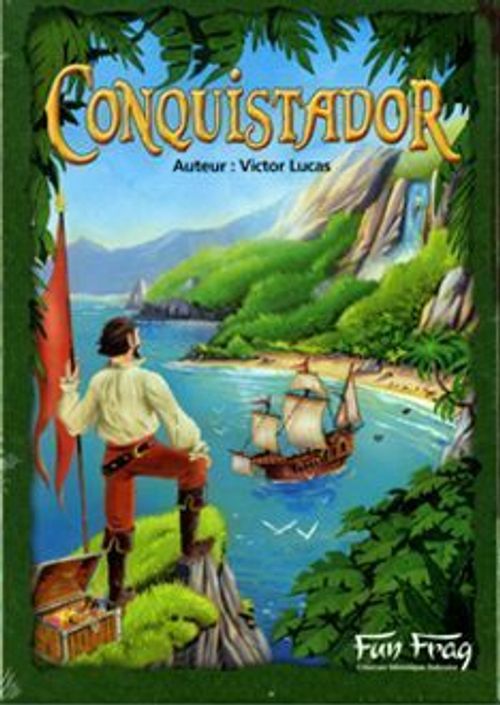
Conquistador (2001)
Conquistador (2001) Rulebook
Table of Contents
Table of Contents
Goal of the Game
Own as many territories as possible, and strategically assign them "development" cards in order to score the most points.
Number of Players
2, 3 or 4.
Components
- 1 die
- 107 cards, divided as follows:
- 15 "territory" cards, depicting ports or islands, with a coefficient of 1 to 3 depending on their importance.
- 54 "development" cards of 6 different types:
- Natural resources: water, fruit, animals, spices.
- Colonists: to develop a territory, it must be populated.
- City: building is essential to make the territory prosper.
- Army: it protects a territory against invaders.
- Trade: an activity essential to the expansion of a territory.
- Governor: a man of authority who administers the territory.
- 8 "revolt" cards: revolts prevent the development of a territory.
- 30 "cannon" cards: conquistadores can acquire territories with these cards, but also use them to defend.
Setup
Each player receives two "territory" cards: one with coefficient 1 and one with coefficient 2, and places them in front of him, face up. After shuffling the remaining cards, deal 7 to each player. The rest is placed face down to form the draw pile. The first player is chosen at random; the others follow in clockwise order.
On each turn, draw a card from the draw pile and play a card:
- either to place or develop a territory,
- or to attack a territory,
- or to discard, if nothing better can be done.
Using the Cards
"Territory" Cards
There are three types of territory. Depending on their strategic importance, their natural resources or their commercial tradition, they have been assigned coefficients from 1 to 3.
"Territory" cards are the cards that will be placed, one by one, face up on the table, and that you will try to develop by assigning them "development" cards. Each territory can support up to six different "development" cards.
The higher a territory's coefficient, the more its "development" cards are worth.
Example: A territory with coefficient 3 multiplies by 3 the number of "development" cards assigned to it.
"Territory" cards must be placed face up in front of each player.
At the end of the game, each territory scores points for the CONQUISTADOR according to its coefficient, the number of "development" cards assigned to it, and the way those cards follow one another (see "Scoring").
"Development" Cards
There are six different "development" cards, numbered from 1 to 6. When a player plays a "development" card, he assigns it to one of his territories by placing it on that territory:
- either directly on the "territory" card, if there is no "development" card yet;
- or on the last "development" card placed.
Each card must overlap the one before it, so that all players can easily see its value.
The first "development" card assigned to a territory may bear any number. Each following card must show a number higher than the last card placed.
Example: If the first card placed is the development "3", the next card must bear the number 4, 5 or 6.
Once the "6" card has been placed, no further "development" card can be placed on that territory. To optimise the sequences of "development" cards already placed, it is possible to reorganise them during the game using "cannon" cards (see below).
"Cannon" Cards
There are 5 different cards, depicting 1 to 5 cannons.
These cards can be used in three ways:
- to attack an opponent or to defend against an enemy attack,
- to reorganise your development,
- to cancel a "revolt" card.
Attack and Defence
A territory blocked by a revolt cannot be attacked.
When a player wants to seize a territory belonging to an opponent, after drawing a card from the draw pile, he places a "cannon" card on the coveted territory and rolls the die.
The attacked player must defend immediately. He has three options:
-
He may refuse the combat.
In that case, he automatically loses the territory and the corresponding "development" cards.
-
He may defend himself with a "cannon" card.
To do so, he places a "cannon" card, face down, beside the one played by his opponent, and rolls the die. Both cards are turned over, and each player adds the result of his die to the number of cannons on his card. The player with the highest total wins the combat. In case of a tie, the defender wins.
The attacker then rolls the die again to determine whether he takes 1 to 6 cards from the territory.
Example: A territory with 4 "development" cards is attacked. If the attacker rolls 3, he removes 3 cards from the territory. To take this territory for himself, he must roll at least 5 on the die. If he has no territory to which he can assign the "development" cards he has acquired, he is obliged to discard them.
-
He may defend himself only with the die.
If he has no "cannon" card, he must prove it by showing his cards to the attacker. The combat then proceeds as explained above.
The "cannon" cards played are discarded, and the defender draws a card to complete his hand, which must always be 7 cards. The attacker's turn is then over.
Reorganisation
To reorganise certain "development" cards, a player must play a "cannon" card whose value is 4 or higher. This "cannon" card is then discarded.
The player takes all or some of the cards placed on one of his territories and assigns them to one or more of his territories, respecting the rules for assignment in ascending order of the cards. Cards he cannot use are discarded.
"Revolt" Cards
These cards have two functions:
- They block the development of a territory, when placed on the sequence of a territory. The player who owns that territory cannot assign it any new developments as long as this card has not been cancelled. A blocked territory cannot be attacked.
- They also make it possible to cancel a "revolt" card that blocks one of your territories. In that case, both cards are discarded.
Tips:
- It is possible to temporarily block one or more of your own territories in order to avoid enemy attacks.
- It is also possible to cancel a "revolt" card present on an opponent's territory, so that you can attack it afterwards.
Note: at the end of the game, territories still blocked by a revolt do not receive the bonus points (see "Scoring").
End of the Game
When the draw pile is exhausted, players continue to play all the cards in their hands.
A player may no longer attack an opponent with a "cannon" card, nor block one of his territories with a "revolt" card, once the players have fewer than four cards in hand. When all the cards have been played, each player calculates his points.
The winner is the player with the most points.
Scoring
At the end of the game, each player calculates the points his territories give him.
For each territory:
- Multiply the number of "development" cards by the territory's coefficient (1x, 2x or 3x).
Bonus: a bonus is applied if the territory is not blocked by a "revolt" card:
- 15 points, if the territory has 6 "development" cards;
- 9 points, if the territory has 5 cards in sequence (example: 1, 2, 3, 4, 5 or 2, 3, 4, 5, 6);
- 4 points, if the territory has 4 cards in sequence (example: 1, 3, 4, 5, 6 or 2, 3, 4, 5, etc.).
Finally, add all the points together to determine the winner.
Adaptations
To play with two players:
With two players, use 12 "territory" cards instead of 15, and remove one "development" card of each type. Before the start of the game, give each player 3 "territory" cards: one with coefficient 1, one with coefficient 2 and one with coefficient 3.
To play in teams:
With four players, it is possible to play either individually or in teams of two. In that case, the two players of the same team must sit facing each other. During the game, all the territories of a team are managed jointly and are placed in front of one of the two players.
Combat:
When one player of a team attacks by placing a "cannon" card, face down, on an opposing territory, his teammate must decide whether he also takes part in the combat. If so, he must place a card, face down, beside that of his teammate, and then one of the players rolls the die.
The attacked team, whatever the number of cards played by the attacker, may defend itself either with one card, played by one of the two players, or with two cards (played by both players), but only one of the players rolls the die.
To determine the result of the combat, each team adds the number of cannons on its two cards and the result of the die, then the procedure described in the basic rule is followed.
Variants
Read only once the game is fully mastered.
The variants described below may be used separately or together during a game.
Variant 1: Military Development
Applies to individual play or team play.
To be able to attack an opponent, a player must have placed an army (card "4") on one of his territories. This remains acquired for the rest of the game, even if at some point the player no longer has an army. The attacked player, however, may defend himself even without an army.
Variant 2: Combat Without a Die
Applies to individual play or team play.
Course of combat:
In this variant, players do not use the die to determine the forces that fight. Each player plays a card face down and the basic rule is applied. If the defender has no "cannon" cards, he is obliged to refuse the combat and he loses his territory and the corresponding "development" cards.
Variant 3: Military Alliance
Applies to individual play.
When a player is attacked, he may ask another player for help and negotiate with that player the exchange of one of his cards for a "cannon" card. This alliance is, of course, one-off, and nothing prevents these players from attacking each other afterwards.
Variant 4: Exchange of Development
Applies to individual play.
During one of his turns, after drawing a card and before playing one, a player may negotiate with his opponents to try to obtain a development that interests him in exchange for another. For example, the player may say: "I am looking for a city, and I am offering a resource or a trade."