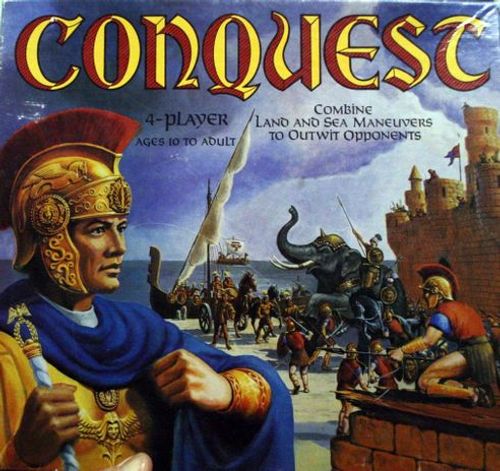
Conquest
Conquest Rulebook
Table of Contents
Table of Contents
Description
Conquest is played on a game board printed with a land and water map. Each side of the map has a cluster of five red spaces, which is the capitol. Each player has 20 land pieces and 6 ships which move about on the map. Numerous spaces on land and in the water are connected by roads or sea lanes designating where the pieces and ships may move. Land pieces may move from one island to another across connecting bridges. Ships may sail under the bridges.
How to Play
The object of the game is to either occupy all five spaces in your opponent's capitol or capture all of his pieces. Each player chooses a side of the board and places his pieces in the capitol and nearby spaces as marked on the game board. Spaces at sea near the capitol are also marked for the starting position of the ships.
The first player begins by making 10 moves. After that each player makes 20 moves per turn. A move is made by going from one space to an adjacent space following the roads or sea lanes. Each piece is limited to 2, 6 or 8 moves per turn as noted below. You may move 20 pieces once, or 4 pieces 5 times, or move any combination of pieces to total 20 moves. The moves of the pieces need not be consecutive. You may pass your turn before making all 20 moves.
Moves
Soldiers: Move one or two spaces per turn. They may mount an elephant or chariot and get a free ride. They may also make a capture when dismounting. Mounting or dismounting is always a soldier move. The soldier must move to mount or dismount, while the elephant or chariot remains in place. Mounting an elephant or chariot may be done from a dismounted position only. Two soldiers cannot occupy the same space unless they are riding an elephant or on board a ship or galleon.
Elephants: Move from one to six spaces per turn. Elephants may carry one or two soldiers. Elephants cannot be captured by soldiers.
Chariots: Move from one to eight spaces per turn and may carry one soldier.
Knights: Move from one to six spaces per turn, and may move through spaces occupied by your own men, counting these spaces as you go. They must land on an unoccupied space or make a capture on their last move. Knights may not move through a space occupied by an opponent.
Ships: Move from one to six spaces per turn. Ships may capture other ships at sea in the same manner as pieces do on land. Sea spaces close to shore marked with an anchor join a land space, making a seaport or dock. Land pieces may board ships or disembark at these ports only. Of course, land pieces cannot move into the water, nor can they transfer from one ship to another at sea. Ships may carry either an elephant, knight, chariot, or two soldiers. (The elephant may be carrying two soldiers and the chariot may be carrying a soldier.)
Galleons: Move one to eight spaces per turn, may carry the same cargo as a ship.
When two soldiers are riding an elephant, either soldier may dismount first. When one or two soldiers are on a ship, an elephant or chariot cannot board the ship until the soldiers have moved off. An elephant may move up to a port, two soldiers on the ship may then mount the elephant in two moves, and the elephant may board the ship carrying the soldiers. A ship carrying an elephant and two soldiers may come to port, and either or both soldiers may disembark first while the elephant remains on board. However, if the elephant gets off he must carry the soldiers with him.
Capture and Recapture
You capture your opponent's piece by moving onto his space and replacing him with your own piece, as is done in Chess. Any piece may capture any other piece EXCEPT soldiers may not capture elephants.
A "recapture" is a defensive capture made during the opponent's turn. If you capture an opponent's piece you must stop and allow him to capture ("recapture") on that space, provided he can do so in only one or two moves. If he takes two moves to recapture, both moves must be necessary to the recapture and he cannot make a separate capture en route. After a recapture you may go on with the rest of your 20 moves. If you make a capture on your last move, your opponent does not get a free recapture, as it is now his turn and he must start counting his moves.
If a recapture is not made, you may continue to move that piece which made the capture as if it were its first move. However, you may not exceed your original allotment of 20 moves per turn.
You may capture an opponent's ship (or galleon) with a land piece while it is at port, simply by moving aboard. This ship is then immediately converted to your own fleet and may be moved on the same turn. If a ship at port is occupied, it can still be captured by your land piece, removing its cargo from the board and converting the ship to your own use. Land pieces cannot capture ships at sea.
When you make a capture your opponent has the option of recapturing in any way he can in one or two moves, or he may refuse to recapture. Sometimes, refusing to recapture is the best defense.
The White soldier has just made a capture. Black may recapture with either the soldier or the elephant. Black cannot recapture with the knight as he cannot jump over an enemy piece. Nor may Black dismount the soldier and then recapture with the elephant as that is making an unnecessary move.
If White was on his 18th or 19th move, or if the White elephant has but one move left, Black should refuse to recapture as his elephant is then safe from attack.
If White made the capture on his last move, it is then Black's turn and he must immediately start counting his moves. If he then captures, White can recapture.
The White knight has just made a capture. Black may recapture with either the chariot, soldier on the chariot, soldier on the right, or the knight. Black may also recapture with the elephant on the ship, or either soldier on the elephant by first bringing the ship to port. If there was a White ship at that port, Black could not recapture the knight with the elephant or soldiers, as he cannot make a separate capture of the ship en route.
Nor may Black move the chariot down one space and then recapture with its soldier as that would be taking an irrelevant move (not necessary to the recapture).
Occupation of the Capitol
For every space you occupy in the enemy capitol, your opponent loses four moves per turn. For example, if you occupy three spaces in his capitol he will have only eight moves on his next turn. You immediately regain four moves when you capture an enemy piece in your capitol. Note that each space in the capitol has only one connecting road. You cannot move directly from one space to another within the capitol, as these spaces are not connected with each other.
The game is won when one player has captured all of his opponent's land pieces or occupies all five spaces in the opposing capitol. If each player takes ten consecutive turns without capturing a piece, the winner is the player who has occupied the most spaces in the enemy capitol. A draw may be agreed upon at any time.
Advice and Strategy
Try to plan all moves before making your first move. It is suggested that each player count his moves straight through from 1 to 20. Do not start counting anew each time you start to move a different piece. Cooperate with your opponent to help keep track of the moves. You may record your moves using the numbering system in the Puzzle Book.
Your first four or five turns should be spent in mobilizing forces, loading your ships and getting them out to sea, loading your elephants and marching them toward the bridges or seaports. It is best to move your pieces out in groups so that they are in a protective formation at the end of your turn. Remember, an attack can come from any direction, land or sea. Most mistakes are made by overextending your forces. If your pieces are scattered and unprotected your opponent can quickly wipe them out, as each capture allows him to move his piece as if it were its first move. All ten soldiers can be carried into battle by mounting them on your elephants and chariots. Don't leave them behind as it will take many turns to march them to the front.
Don't neglect your navy on your first few turns. It is an advantage to have the first ship in the center. You have to be a good Admiral as well as a good General to play Conquest. You can lose all your ships and still win but you will have a difficult game.
In one sample position, White is outnumbered 4 to 2, and it appears as if the Black ships safely protect one another — but there is a winning attack: Sail the White ship left and up 2 spaces between Black's galleon and ship. Next, sail your galleon down and around to the left to capture Black's galleon with the knight in 7 moves. Notice Black cannot recapture in two moves as he cannot make a separate capture of your ship en route. Your galleon may now move another 8 spaces having made a capture. Then play ship captures ship with the chariot. Black is now lost. If he recaptures, your galleon can then capture both Black vessels as they no longer protect each other. If he refuses to recapture, you simply play ship captures ship with elephant (Black recaptures) and galleon captures ship with knight. You now have the last land piece and thus have won the game.
Puzzle Books
With this game you will find Puzzle Book #1. It is designed to improve your skill by demonstrating various tactical maneuvers and strategies. You will also find the problems highly entertaining. Puzzle Book #2 is for advanced players and is available by direct mail for $1.00 postpaid.
Advanced Games of Conquest
This is the first in a series of Conquest games, each of which has a different gameboard. Each game will vary in size and complexity, and some are designed for four players. Also, some games utilize additional pieces, such as catapults, dromedaries, and siege engines. One family game has an intriguing and unique element of luck.
4-Player Conquest is already on the market and is probably available at the same place where you found this game. It is the only 4-player strategy game in which all players not only get into the fray immediately, but maintain a high level of interest and involvement to the end. No one can afford to lay in the bushes hoping the others will fight among themselves and deplete their forces. Passive play is virtual suicide. There is only one winner per game, and no "second place." The other three are all equal losers. Average playing time is two and a half to three hours.