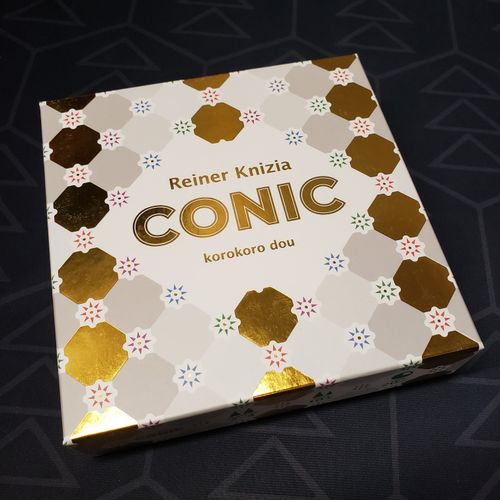
Conic
Conic Rulebook
Table of Contents
Table of Contents
Components
- 1 game board
- 48 player chips (11 number chips x 4 colors / 1 Star chip x 4 colors)
- 7 Neutral chips
- 4 chip racks (1 of each color)
- 1 Cone
- 1 Rule sheet
Setup
- Place the game board in the middle of the table.
- Each player chooses a color and receives 1 chip rack and 12 player chips of that color.
- Place all of your player chips on your chip rack, making sure that the numbers are not visible to other players.
- Place all Neutral chips together next to the game board.
- Place the Cone on either end of the center row (with 4 spaces) on the game board.
Now, the setup is complete!
How to Play
The game is played over 16 rounds. Each round proceeds as follows.
1. Choose a Chip
Each player picks one of their player chips from their chip rack and places it face down in front of themselves. When all the players have placed their chips, they flip to reveal the chips at once.
Star Chip: Each player who has played their Star chip immediately returns it into the box and picks another chip from their chip rack. When everyone who played their Star chip has picked a replacement chip, they all flip to reveal these chips at once. (The Star chip is a powerful chip that allows you to pick a chip after seeing the number chips played by the other players.)
2. Battle
The player who played the highest-number chip wins the round. The winner places the number chip(s) they played face down on the space with the cone (the final battle area). Meanwhile, move the cone in the final battle area to the side of the game board.
Other players return the chips they played into the box. These chips will not return to their chip racks, so they cannot be picked during the rest of the game.
This is the basic flow of the game, with the following exceptions.
Exception 1: "0" Chip — As an exception, the chip numbered "0" is returned to the chip rack, not into the box. Thus, you can pick your "0" chip as many times as you like during a game. If everyone has played "0", place 1 Neutral chip instead of a player chip in the final battle area.
Exception 2: Giant Killing — If both "1" and "10" are included in the revealed chips, "1" counts as being the highest number.
Exception 3: Playoff — In case of a tie in the highest-number chips, the tied players play a playoff to determine the winner of the round. Other players return the chips they played into the box (except for "0") and do not participate in the playoff. In the case of Giant Killing, the players who played "1" play a playoff.
In the playoff, pick from your rack a different chip from the one picked in "Choose a Chip" and place it face down in front of yourself. When all participants in the playoff have placed their chips, they flip to reveal their chips at once, and the player with the highest-number chip wins and places the chip they played in the playoff in the final battle area. The playoff may be repeated a number of times (the chip which won the final playoff is placed in the final battle area).
3. Choose the Next Final Battle Area
The player who won the current round and placed their chip in the final battle area chooses the final battle area for the next round. Choose any empty space without any player chip or neutral chip in it and place the Cone there. If there was no winner this round (a neutral chip was placed), the winner of the previous round continues to choose the next final battle area.
Play 16 rounds of the game flow from "1" to "3", and the game ends when all spaces are filled after 16 rounds. Then proceed to scoring.
Scoring
Each player acquires points according to 2 systems, namely "Row Majority" and "Adjacency Bonus".
Row Majority
The player who has placed the most number chips in each row receives the points of that row. In case of a tie in the number of chips, the tied players each add up the numbers on their chips placed there, and the player with the highest number receives the points. If that is also a tie, no one receives any point from that row. The points from each row are, from the outer rows in toward the center: 1 point, 2 points, 3 points, 4 points, 3 points, 2 points, 1 point (regardless of whether or not a neutral chip is placed).
Adjacency Bonus
You get an Adjacency Bonus from each space where your player chips are most adjacent to each other.
About Being Adjacent: The spaces in the same row do not count as being adjacent, because they are directly linked. You get an Adjacency Bonus of 1 point for each of your chips that are most adjacent to each other.
Add up these two types of points and the player with the highest score wins the game. In case of a tie, the tied player with the most chips remaining in their chip rack wins the game. If that is also a tie, add up the numbers on each tied player's chips on the board and the player with the highest number wins the game. If that is also a tie, the tied players share the victory.