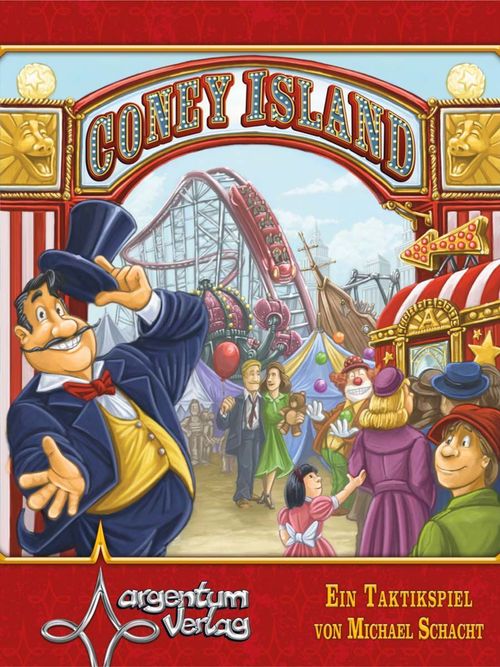
Coney Island
Coney Island Rulebook
Table of Contents
Table of Contents
Components
- 1 bag
- 1 game board (24 building sites)
- 4 player boards
- 12 Building site tiles (7x showing 3 Building spots and 5x showing 4 Building spots)
- 5 Character tiles
- 10 Grand attraction tiles (2x size one, 3x size two, 3x size three, and 2x size four)
- 36 Showman tiles (3 per player color and shape, i.e. 9 total per color)
- 20 News-paper tiles (10 per color, pink and white)
- 20 Money tiles
- 24 building materials (12 per color, red/white)
- 4 scoring pieces
- 1 starting player token
We apologize for any missing or damaged components. For replacements, please contact our sales department at [email protected]
Setup
Setup for the 4-player game:
-
Place the game board in the middle of the table.
-
Separate the Grand attraction tiles by size. For each size individually, stack the tiles on top of each other in order of their printed Attraction points. The tile with the highest number of Attraction points goes on top of its stack. The Attraction points side of each tile needs to be face-up.
-
Separate the News-paper tiles by color, then shuffle each pile individually (face-down) and form a stack. Place the stack of pink tiles on top of the stack of white ones. Place the resulting stack next to the game board.
-
Place the Money and Character tiles (character side face-up) next to the game board. The Money tiles form the Bank.
-
Shuffle the 12 Building site tiles (face-down) and place them as one stack next to the game board. Take 4 tiles from top of the stack and randomly place them on the 4 marked Building plots in the middle of the game board.
-
Determine a starting player. This is the player who has not been to an amusement park for the longest period of time. Put the Building materials into the bag. Give the bag and the starting player token (a black tophat) to the starting player.
Deal each player:
- a player board
- the 9 Showman tiles matching the color of his player board; he then places these tiles on the 3 cars on his board, ignoring the illustrations on the tiles, but matching the printed shape; the leftmost (unshaped) spot of each car stays empty.
- a scoring piece that will track his Attraction points during the game; stack the scoring pieces of all players on space 5 of the scoring track
- 2 Money tiles
- 1 random Building material drawn from the bag
Changes to the 3-player game
Remove 1 News-paper tile of each color from play. Also, remove 1 Building site tile with 4 Building spots from play. Put the pieces of the unneeded player color back in the game box.
Changes to the 2-player game
Remove 2 News-paper tiles of each color from play. Also, remove 2 Building site tiles with 4 Building spots from play. Both players take 1 player board each and the Showman tiles of 2 colors. Instead of placing 9 tiles of one color on his player board, each player places 5 tiles of one and 4 tiles of the other color, alternating colors while placing tiles, but always matching shape. The left-over Showman tiles are removed from play.
Other changes to the 2-player game will be specifically mentioned throughout the rules.
Flow of Play
The starting player begins the game. Players take turns in clockwise order until one of the game end conditions is met. Once this happens, complete the current round, so that all players had the same number of turns. The player with the highest score of Attraction points wins the game.
A player's turn goes through the following two phases:
- Income phase
- Action phase
A player may not interchange these phases! He first has to finish the Income phase before taking any action.
Income Phase
In this phase, the active player receives income from the cars on his player board. Each empty spot of a car shows the income the player will get. As the leftmost spot of each car is empty from the beginning of the game, each player will always receive income.
The car on top provides 1 Attraction point per empty spot. For each such spot, immediately move the active player's scoring piece up 1 space on the scoring track.
Each of the first three spots of the middle car provides 1 Money tile. The active player receives 1 such tile from the Bank per visible Money tile on his middle car. The last spot of the middle car provides another Attraction point. If this spot is empty, immediately move the active player's scoring piece up 1 space on the Promenade.
Each of the first three spots of the bottom car provides 1 Building material. The first spot shows a question mark. This indicates that the active player draws a random Building material from the bag. If the next two spots are empty, the active player may choose the Building material and then draw it from the bag (if both are empty, he may choose any 2 Building materials). If the last spot of the bottom car is empty, the active player may take an action one more time during the Action phase. (As a general rule, each action may only be taken once during the Action phase — see "Action Phase")
Please note: Apart from this, a player may receive additional Attraction points in the Income phase if certain conditions are met (see "Extra income" in chapter "Action phase").
IMPORTANT: At no point in the game may a player have more than 5 Money tiles or more than 5 Building materials (limitation rule). A 6th Money tile is never taken. When a player receives Building materials, he first takes them as usual, then reduces their number to 5 by putting excess Building materials back in the bag. As a reminder, the limitation rule is printed in a sign on the player board.
Action Phase
In this phase, a player may take any of the 3 Main actions printed on the bottom of his player board. Additionally, he may take up to 5 Minor actions if he owns the appropriate Character tile. There is one Character tile for each Minor action.
Important: Each of the up to 8 actions may only be taken once per Action phase.
The active player may take the Main and Minor actions in any order. He may as well pass on any of these actions and only go through the Income phase during his turn.
The Main Actions
1. Place a Building site tile
The active player takes a Building site tile from top of the stack and turns it face-up. He then places the tile on an empty Building plot on the game board adjacently (side by side) to another already placed Building site tile.
Finally, he pays 1 or 2 money tiles into the Bank depending on the printed price on the Building plot he placed the tile on. The more expensive Building plots provide one of the following bonuses for the active player:
- immediately receive 2 or 3 Attraction points (move the scoring piece accordingly)
- draw a random Building material from the bag (mind the limitation rule!) that may be used during the current Action phase
- draw a Building material of your choice from the bag (mind the limitation rule!) that may be used during the current Action phase
- take an action one more time during the current Action phase (if you have already taken that action) or take an action twice (if you have not taken that action, yet)
A player may not take this action if he has not sufficient funds to place a Building site tile on the game board.
2. Place a Showman tile
The active player takes ONE Showman tile from his player board and places it on an empty Building spot of a Building site tile on the game board. The player may choose which car he takes the Showman tile from, but he always has to take the leftmost one of that car.
He also has to pay the Building costs according to the printed price on the left of the car (put the Building materials back in the bag). Showman tiles on the top car cost 1 red Building material, tiles on the middle car 1 red and 1 white one, and tiles on the bottom car 1 red and 2 white ones each. Due to the different shapes of the Showman tiles, players can always tell which car they were taken from.
No more Showman tiles on a car: placed on the game board, the active player may pay the Building costs again, then take an own Showman tile (of that shape) off the game board and place it on another empty Building spot. (Transcribed as printed — the English edition's sentence appears to drop its opening clause; the sense is that when a car is empty but the player has tiles of that shape on the board, he may pay again and relocate one of them.)
Showman tiles may be placed on any empty Building spot regardless of other already placed Showman tiles on the game board. However, you may never build on grass (neither Showman nor Grand attraction tiles). These are no Building spots.
Extra income
When a player manages to place 4 of his Showman tiles in a 2x2 square (spanning over one, two or four Building site tiles), he immediately scores 2 Attraction points (move his scoring piece accordingly). Moreover, this player receives an extra 2 Attraction points during each of the following Income phases as long as this square persists. As soon as any one of the Showman tiles forming the square has been overbuilt, this player will not receive any more extra Attraction points for this square during the Income phase.
Please note: A player may score more than one such square as long as these do not overlap.
In the 2-player game: A player may score squares that contain both of his colors.
Easier game: Beginners may ignore the Extra income rule.
3. Place a Grand attraction tile
The active player takes the topmost Grand attraction tile from any of the four stacks. He then pays the Building costs depending on the size of the taken tile (put the Building materials back in the bag):
- size one: 2 red Building materials
- size two: 1 red and 2 white Building materials
- size three: 2 red and 2 white Building materials
- size four: 2 red and 3 white Building materials
He then places the taken tile (horizontally or vertically) on top of already placed Showman tiles on the game board. He may overbuild his own or his opponents' tiles (he may also overbuild just his opponents' tiles). The Grand attraction tile may not be placed over empty spots (i.e. a Grand attraction tile of size three must cover exactly three Showman tiles). The numbers on the Grand attraction tiles indicate how many different player colors must or may be involved:
- 1: this tile may only be placed on top of the Showman tiles of a single color
- 1+: this tile must be placed on top of one or more colors (up to 4 depending on the size of the Grand attraction tile)
- 2: this tile must be placed on top of exactly two colors
- 2+: this tile must be placed on top of at least two colors (up to 4 depending on the size of the Grand attraction tile)
Please note: The people in the illustration on the Grand attraction tile mirror these conditions: the lushly drawn guys indicate the minimum amount of colors involved, and the pale ones indicate how many more colors may be involved.
In the 2-player game: The numbers refer to the colors needed to be involved. For example, a Grand attraction tile with a printed "2" needs to be placed over the Showman tiles of two colors — both of which may belong to the same player.
Afterwards, players receive Attraction points:
The active player receives a number of Attraction points equal to the printed value on the left sign on the Grand attraction tile. Each player whose Showman tiles have been overbuilt receives a number of Attraction points equal to the printed value on his overbuilt Showman tiles (the question mark on the right sign on the Grand attraction tile reminds you of this). This number is equal to the number of Building materials paid for that tile.
Finally, players take their overbuilt Showman tiles off the game board and place them back on their player board. Each such tile needs to be placed on the rightmost empty space of its proper car (i.e. matching the shape).
In the 2-player game: The players need not to alternate colors when returning the Showman tiles on their player boards.
After a Grand attraction tile has been placed, the income of some players will be decreased!
Finally, flip the Grand attraction tile, so you can see its illustration.
The Minor Actions
In order to take such an action, the active player needs to own the corresponding Character tile(s). By paying 2 Money tiles into the Bank, the active player may take any Character tile on the table (if he takes it from another player, this player will not receive any sort of compensation). The acquisition of a Character tile does NOT count as an Action! The active player may use its action on the same turn he has acquired the tile. Once purchased, a Character tile stays in front of the player until another player acquires it on his turn. Until that happens, the owning player may take its action without paying 2 Money tiles again.
Please note: Due to the limitation rule, a player cannot acquire more than two Character tiles on the same turn. However, he may own all the Character tiles if he acquired them over several turns.
Please note: Usually, the Minor actions may not be taken more than once per turn either. As a reminder, you may wish to flip the Character tile after usage.
4. Migrant worker
Pay 1 Money tile into the Bank to draw a random Building material from the bag.
5. Police officer
Lose 1 Attraction point (move the scoring piece accordingly) to draw a random Building material from the bag.
6. Patron
Exchange 1 Building material for another. Put 1 Building material back in the bag and draw 1 Building material of the other color.
7. Promoter
Pay 1 Money tile into the Bank to receive 2 Attraction points (move the scoring piece accordingly).
8. Journalist
Pay 1 Building material (back in the bag) to take a News-paper tile from top of the stack. These News-paper tiles are worth 1-3 Attraction points at the end of the game.
Remember: You may take the Main and Minor actions in any order.
Repeat an Action
Usually, each action may only be taken once per Action phase. However, this symbol allows you to take an Action one more time.
There are three ways to gain this advantage:
-
When the last space of the bottom car on a player's board becomes visible, from then on, as long as the space was visible during the Income phase, this player may take any one Main or Minor action one more time during his turn.
-
When placing a Building site tile on a Building plot with that symbol, the active player may take any one Main or Minor action one more time (if he has already taken that action) or take an action twice (if he has not taken it, yet).
-
On his turn, a player may remove any one of his News-paper tiles from play to take any one Main or Minor action one more time. This may only be done once per turn, but you may do it with a News-paper tile acquired on the same turn.
Game End
The game ends when one or more of the following conditions are met at the end of a player's turn:
-
Any player has got at least 60 Attraction points (regardless of whether he keeps that score or falls below it again).
-
There is only one stack of Grand attraction tiles left (regardless of the number of tiles left in this stack: e.g. only the stack of Grand attraction tiles of size three is left)
-
The stack of News-paper tiles is empty.
-
All Building site tiles have been placed on the game board and there are only 12/10/8 Building spots left with 2/3/4 players.
Complete the current round. The player on the right of the starting player (this is the player owning the starting player token) takes the last turn, so that all players had the same number of turns. (The game ends immediately if one of the game end conditions is met at the end of the player's turn sitting to the right of the starting player.)
Afterwards, there is a final scoring.
Final Scoring
At the end of the game, all players may receive additional Attraction points or lose some on top of those received during the game:
News-papers: Each player flips his News-paper tiles and adds up the printed Attraction point values (1-3 points per tile). Move the scoring pieces accordingly.
Showman tiles on the game board: Each player loses 2 Attraction points for each of his Showman tiles left on the game board. (The printed Attraction point values on these tiles do not matter anymore.)
In the 2-player game: Players lose points for both of their colors.
The player with the highest score of Attraction points wins the game (scores of more than 80 points are unusual, but welcome). Break ties by counting the number of left-over Money tiles plus Building materials (the more the better). If there still is a tie, the tied players share the victory.
Things Players Tend to Forget / Tips for Easier Play
- You may wish to pass the bag to the active player, so you can see whose turn it is.
- Do not mix up the Income and Action phases!
- No player may ever have more than 5 Money tiles or more than 5 Building materials!
- Usually, an action can only be taken once per turn.
- You may take actions in absolutely any order.
- You may get rid of a News-paper tile to take an already taken action one more time.
- Flip a Character tile after you have taken its Minor action.
- A player never gets paid when he loses a Character tile.
- You may move a Showman tile on the board if a) all the tiles of that shape are already placed and b) you pay its Building costs again.
- Forming a square of own Showman tiles is worth 2 Attraction points now and in any future Income phase as long as the square persists.
- Check how many colors need to be involved when placing Grand attraction tiles.
- The orientation of the Showman and Grand attraction tiles on the board is irrelevant.
- That bag contains the Building materials, not the Money tiles.
- Using the Patron, you may pretend that one of your Building materials is of the other color.
- There are 24 Building plots on the board, but only 12 Building site tiles — only half of the game board will be ever in use.
Tips and Tricks by the Travelling People
Like in our previous releases, there are many ways to influence the game: from your own tactics or strategy through player interaction to influencing the game end. For all of you who do not wish to explore the game by themselves, we have collected some tips and tricks for a successful game. If you want to explore these paths by yourself, do not read any further.
Each of the three Income options provides its own strategy:
- top car: gather a lot of Attraction points early; at the same time, force the game to an end; the Promoter action and forming squares on the board support that path
- middle car: get money to effectively use the Minor actions: get Attraction points with the Promoter and Journalist actions, or Building materials with the Migrant worker and Police officer actions; at the same time, you deny these to your opponents; collect the bonuses for placing Building site tiles; at the same time, influence the addition of Building spots
- bottom car: use Building materials to place a lot of your own Showman tiles; at the same time, build the Grand attractions; consequently, collect more income and extra Attraction points by over-building your own Showman tiles.
By interchanging these paths and optimizing the Minor actions and bonuses you can increase your chances for success even more.
Another successful path may be collecting a lot of News-paper tiles (you can score a lot of Attraction points with these). Please note, the top half of the stack is filled with tiles worth 2 or 3 Attraction points, the bottom half provides only 1 or 2 points per tile. However, at the beginning of the game, you may wish to use your resources to place Showman tiles on the board rather than buying News-papers… On the other hand, you take influence on the game end and may take actions twice during your turn.
Be careful when playing your Showman tiles. Do you wish to be left alone, i.e. have a steady income, the option to form squares, or over-build your own tiles? Or do you rather want others to over-build your tiles to gain extra Attraction points off your turn? Keep in mind: 7 out of the 12 Building site tiles show a grass field that cannot be built over.
The number of colors needed to place a Grand attraction tile increases towards the bottom of a stack: at the beginning of the game, you can over-build your own Showman tiles to gain a lot of Attraction points (at the same time losing income!) or your opponents' tiles to decrease their incomes. However, towards the end of the game, you will necessarily need other players around you to build Grand attractions — hopefully, your tiles will not be isolated from other colors by that time…
Pay attention when placing Grand attraction tiles. Cleverly placed, over-building certain Showman tiles may be rendered impossible, thus, resulting in negative points at the end of the game.
Also, timing plays a major role in the game when it comes to place Showman tiles on the board that you want to get rid off towards the end of the game to avoid losing points. Removing a tile too early, thus, reducing your income, may hinder your further progress, but missing the time to remove it at all results in a loss of Attraction points.
Finally, always keep an eye on your opponents! They cannot play strong unless you let them!