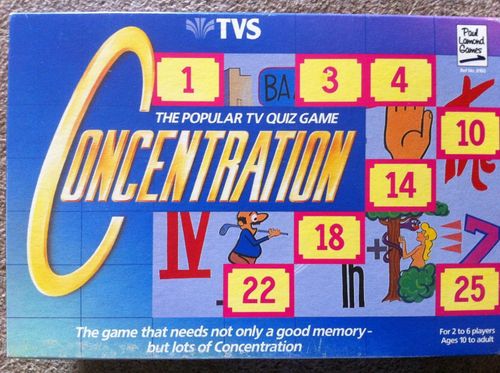
Concentration
Concentration Rulebook
Table of Contents
Table of Contents
Assembly
To assemble your Concentration Puzzle Game Console, simply follow the instructions as shown below in the diagram.
- Fold side flaps back.
- Side bottom flaps up and snap A into B.
- Each end should look like the illustration when completed.
Game Rules
"Concentration" is played just like the classic TV game show. Each player tries to uncover matching pairs of prize or valuable gift cards, which are removed from the "Concentration" board and put on their rack. As the cards are taken away, parts of a hidden "Rebus" or Word Puzzle appear. There is a deck of 60 different puzzles for the Molded Puzzle Console.
The Object of the Game
The object of the game is to be the player, or team, to solve the puzzle and win the prizes in their rack. One of the big features of this game is the surprise that all the players get as they try to locate the prize cards in matching pairs. Therefore, so that no one knows what the numbered slides cover, set up the game as follows:
Setup
- Look at the picture of the Molded Puzzle Console on this box cover. It shows the slides in place, each with a puzzle card behind it.
- Before you play a new "Rebus" or word puzzle, these slides must be in place, and the solution slide closed.
- Carefully break apart the numbered slides and prize cards. The prizes are shuffled and placed face down on the table. The numbered slides are left face up.
- Turn slide Number 1 FACE DOWN on table. Place a prize card FACE DOWN upon with the hole at the top. Holding them together, slide them into the upper left panel in the plastic window, with the Number 1 showing.
- Do the same with Slide Number 2 and place it in the next panel... Continue until the 25 numbered slides and prize cards cover the whole window. Now you are ready to...
- With "Concentration" logo rebus towards front of stack, insert the full stack of rebus cards into the game console.
- Once you have played a round of Concentration, you may play again by re-inserting the prize/number tiles and THEN taking out the previous rebus puzzle and placing it at the back of the console.
You are now ready to play again!
- Once you come all the way back around to the "Concentration" logo card, flip the cards over and re-load, for another 30 rounds of CONCENTRATION!
Playing the Game
- The game is played by two players or two teams. When three or five play, one player is Master of Ceremonies as on Television.
- The player who has rack Number 1 has first turn.
- The player pulls out the numbered slides only from any two panels of their choice on the "Concentration" Board. This will show two prize cards.
- If the two prizes Do Not Match, they are covered up again by replacing the slides, and your turn ends... At all times players should CONCENTRATE on what prizes are uncovered and where they are located on the board.
- Player Number 2 takes slides from two panels.
- When a player uncovers two matching prizes, they leave the number slides off the board and take the two prize cards out and place them in one of the slots in your rack.
- When the cards are removed, a portion of the puzzle appears under the window. The player who uncovered the prizes, and only that player, may take one guess at the solution of the puzzle... or you may pass if you choose. Usually players pass until a good portion of the puzzle is showing.
- If you make a guess, the Master of Ceremonies secretly opens the slide, and looks at the solution. If there is no Master of Ceremonies, the slide is opened ONLY enough to see the FIRST LETTER OR TWO OF THE SOLUTION. This is so as not to spoil the game by letting the players see the answer ahead of time. For example: A player guesses "Abraham Lincoln". The first letter showing under the solution slide is a "C". You have guessed wrong. Close the slide and continue playing.
- If you pass or guess wrong (either way) YOUR TURN CONTINUES and you may remove two or more slides, and try again if the prize cards under them match. A player's turn ENDS only after you uncover two prizes that DO NOT MATCH... with this exception...
- "WILD" Cards: When one of the two cards uncovered is a "Wild" Card, play as if it the other card. If a player uncovers a "Wild" Card and a Prize Card, you would call it a matching pair and put them in your rack, make a guess, etc. The "Wild" Card is also used in the same way when paired with a "Take" Card. If a player uncovers 2 "Wild" Cards, you must pull out 2 more slides and remove all 4 Cards. The Cards are used as above. You make one guess, etc., and your turn continues as any other matching pair.
Winning the Game
When a player makes a guess, which is the CORRECT SOLUTION, they win the game and are given the value in "Dollars" for all the prizes in their rack. If the player has no prizes there, they receive $100.00. The loser receives nothing for the prizes in their rack. Shuffle all the Prize Cards, replace them again with the numbered slides, slide in the next puzzle, and start a new game. After playing 3 games, the player with the most money is THE WINNER.
NOTE: Because of the "Wild" Cards, the last two (and sometimes three) prize cards on the board often will not match. If the Puzzle is not solved when this happens, the player who uncovered the last matching pair may remove the unmatched cards and make one guess. If he guesses incorrectly the other player may make one guess. The first to guess correctly WINS. If both give the incorrect answer, the game ends in a draw. The prizes are removed from their racks, and a new game is started.