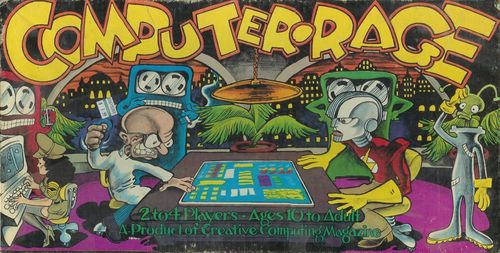
Computer Rage
Computer Rage Rulebook
Table of Contents
Equipment
The complete Computer Rage set consists of the playing board, twelve playing pieces (3 each red, blue, green, yellow), three binary dice (1 each red, blue, and green), and a set of "Interrupt" cards.
Setup
The board is placed on a table and the Interrupt cards are shuffled and placed in position at the center. Each player selects a color and places three round playing pieces (disk packs), called "Programs", on the three input symbols of the same color.
The Dice
Moves in the game are controlled by the rolling of three "binary dice." These dice are different from ordinary dice in that they contain only the numbers 0 and 1. Each die represents a power of two, the red die representing four, the blue two, and the green one. Numbers are interpreted by reading the three dice in red-blue-green sequence as a binary (base two) number. Thus the red-blue-green sequence of 1-0-1 equals 4+0+1, or 5. A roll of the three binary dice may result in any number from 0 to 7 according to the following table:
| RED | BLUE | GREEN | NUMBER |
|---|---|---|---|
| 0 | 0 | 0 | 0 |
| 0 | 0 | 1 | 1 |
| 0 | 1 | 0 | 2 |
| 0 | 1 | 1 | 3 |
| 1 | 0 | 0 | 4 |
| 1 | 0 | 1 | 5 |
| 1 | 1 | 0 | 6 |
| 1 | 1 | 1 | 7 |
The Board
There are several different symbols on the board, each of which is explained in more detail later. Regardless of the size or shape of a symbol, they all have the same position value in that a dice roll of 5 indicates a possible move to the symbol 5 symbols ahead of the symbol currently occupied by a program disk pack.
To Begin Play
All players roll the dice one time; the player with the highest roll will go first. Ties are broken by extra rolls if necessary. After the first player has completed his turn, the play continues with players taking consecutive turns in clockwise order.
The Play
At the beginning of each turn a player rolls the dice. He then selects any one of his programs (playing pieces) and moves it ahead the indicated number of symbols, subject to the restrictions of each symbol type as listed below:
"Input" symbols: All programs begin on an Input symbol. Only the programs corresponding to the color of an Input symbol may occupy that symbol. Only one program may occupy an Input symbol at any one time.
"Process" symbols: Most of the symbols on the board are of this type. Only one program may occupy a Process symbol at any one time.
Process symbols connected to the Input and Output areas and bordered by heavy lines are marked as being a "Channel" (A and B at the Input, C and D at the Output). There is an additional restriction on programs in a Channel in that only one program may be in a Channel (on any of the three process symbols) at any one time, and a further restriction that if a Channel is occupied, no other program may pass through it.
Process symbols with the lightning bolt symbol indicate that an "Interrupt" has occurred. A player whose program lands on an Interrupt takes the top card from the Interrupt deck and follows the instructions on the card. All cards are returned face down to the bottom of the deck after the instructions have been completed.
"Decision" symbols alter the path taken by a program. Just before leaving a Decision symbol, the player rolls a single die; his program then continues on the 0 or 1 branch according to the die. (Note that this single die roll is in addition to the regular three dice roll.) Only one program may occupy a Decision symbol at any one time.
"Check Points" are located throughout the board. They differ from other symbols in that any number of programs may occupy a Check Point at any time.
"Output Queue" is located immediately before the Output Channels and is identical in function to a Check Point described earlier.
"Output" symbols: All programs end their journey on an Output symbol. Only the programs corresponding to the color of an Output symbol may occupy that symbol. Only one program may occupy an Output symbol at any one time. In order to land on and occupy an Output symbol, a player must roll a number which will permit his program to advance the exact number of symbols indicated by the roll of the dice; he may not advance a lesser number of symbols.
General
All moves must be made to a connected symbol in the direction of the connecting arrow. (The only exceptions to this are when directed otherwise by an Interrupt card, or after landing on a symbol that is already occupied.)
Whenever a program lands on an occupied symbol (other than a Check Point or the Output Queue), the arriving program must immediately move back to the nearest Check Point in the direction of the Input section. If no Check Point exists in that direction, the program must return to an Input symbol.
On each turn, a player must move one of his programs the number of symbols indicated by the dice, if any of his programs may be legally moved. Only occupied channels or the restriction on landing on Output symbols give rise to illegal moves. A move to a symbol that is already occupied is not illegal (although the program must return to a check point). Thus if a number greater than zero is rolled one program must be moved unless all programs are prohibited from moving by the Channel and Output symbol restrictions.
A program may move less than the number of symbols indicated by the dice only if by doing it can land on the Output Queue.
Programs may pass other programs as they advance; the only exception to this rule is that no program may pass through an input or output channel when that channel is occupied by another program.
Winning
The first player to get his 3 programs on his 3 output symbols wins the game.