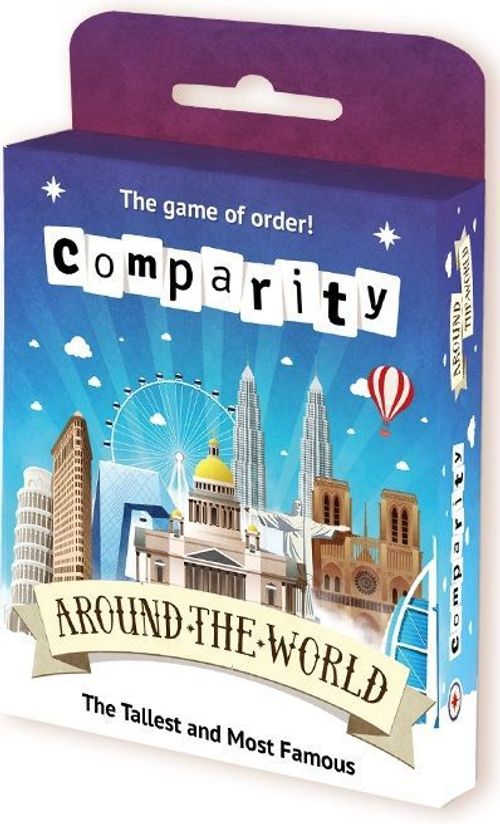
Comparity: Around the World
Comparity: Around the World Rulebook
Table of Contents
Table of Contents
Game Cards
The board game Comparity has 100 cards containing world-famous landmarks, from ancient churches to ultramodern skyscrapers made of glass and concrete. All the cards are double-sided. The back side has only the picture, name, and location of the landmark, and the front side (the "face") of the card contains the year of construction and height in meters. Whenever you are shuffling and dealing out the cards, keep them face down. You can only look at the front side when the player checks the card during his turn (see below).
Note that we are not using real existing cards in our examples, to keep from familiarizing you with the front sides of real game cards.
Years and Meters
Traditionally, the height of a building can be measured differently: to the roof, to the highest architectural element, to the antenna etc. We always indicate the height of a landmark from ground (water) level to its highest point a roof, spire, or antenna as of 2015. In addition, all monument heights also include a pedestal. In all questionable cases, we use data from the Council on Tall Buildings and Urban Habitat.
The date of construction is the date when the landmark acquired its current appearance. It is difficult to name the exact year of construction for some cards; in these cases, we indicate an approximate date and note this on both sides of the card.
- Calendar icon, exact year of construction
- Greyed calendar icon, approximate year of construction
Preparing for the Game
First, decide which order you will be placing the cards in: chronological (by year) or by height (height of landmark). In the first case, you define which landmark was built earlier; in the second, which landmark is taller. These rules describe the second case. To play in chronological order, just use the years of landmark construction instead of the height.
Shuffle the cards and deal 7 cards out to each player. The players do not pick their cards up but rather place them face down on the table in front of them. Don't look at the faces of any cards (this includes your cards, other players' cards, and the cards in the deck).
Now you need to make a game deck. The number of cards in it depends on the number of players:
- 2 payers — 15 cards (printed as "payers" in the source)
- 3 payers — 20 cards (printed as "payers" in the source)
- 4 payers — 35 cards (printed as "payers" in the source)
- 5 payers — 40 cards (printed as "payers" in the source)
Stack the required number of cards and place them in a deck face down on the edge of the table so that all players can reach the deck. You can put the rest of the cards away; you will not need them in this game. Place the top card of the deck in the center of the table face down. This will be the first card in the play area. The player who has visited the tallest building in real life starts first.
How to Play
Players take turns in clockwise order, starting with the first player. During your turn, you can either play one of your cards into the play area, or check any of the face-down cards in the play area. Next your turn goes to the next player, your neighbor on the left. The person who gets rid of all his cards first wins.
For the sake of simplicity, let's call the cards lying face down in the game area "closed cards" and the cards lying face up "open cards." "Opening a card" means turning it face up. Two cards that touch at the edges (whether horizontal or vertical edges) are called "adjacent cards." If cards touch only at the corners (diagonally), they are not considered adjacent cards.
A) Playing a Card
Chose (printed as "Chose" in the source; read as "Choose") one of your cards and place it face down next to any card in the game area (to the left, right, top, or bottom of any card). You can also play your card so it ends up adjacent to several cards at the same time (see the rules for Duet and Trio below). When choosing a place for your card, remember that the height increases from left to right and from bottom to top. In other words, cards with taller landmarks should be to the right of and above your card, and cards with shorter landmarks should be to the left of and below your card. Cards lying in the game area cannot be swapped.
Example: You want to play Lincoln Cathedral. In the play area, you currently have Dome of the Rock and Nabemba Tower in the same row and Kalyan Minaret under Nabemba Tower. You are sure that Lincoln Cathedral is taller than the Dome of the Rock and shorter than Nabemba Tower, but you can't fit it in between them. You could place your card to the right of Kalyan Minaret, but you are not sure that Lincoln Cathedral is taller, so you place your card above the Dome of the Rock.
(Diagram omitted: the play area showing Lincoln Cathedral placed above the Dome of the Rock, with the lower-to-higher arrows.)
Duet Rule
If you play your card so that it ends up lying adjacent to two cards in the play area, the next player must either draw one card from the deck or check a card in the game area. After that, he plays as usual.
Trio Rule
If you play your card so that it ends up lying adjacent to 3 cards in the play area, then the Duet rule takes effect as described above. However, if the next player decides not to check — or checked but did not find any violations — you can place one of your cards right away, and neither the Duet nor the Trio rule takes effect this time. Very rarely, you can place your card so that it ends up being next to 4 cards. There are no special rules for this event and the regular Trio rule takes effect.
B) Checking a Card
Reveal one of the closed cards in the game area. If there are no open cards next to this card, you will have to reveal one of the adjacent cards. If there is an open card next to it, you don't need to reveal an adjacent card, though you can if you want to. In other words, you must reveal the card you are checking and can reveal one adjacent card, after which at least one card next to the checked card must be open.
Then check to make sure the height is still increasing from left to right and bottom to top in the play area. Do this by comparing the height on each pair of adjacent cards in the play area. It doesn't matter who revealed the cards and when. If two open cards are not next to each other (for example, they are separated by another card or only touch corners), you do not have to compare their height.
Example: (Diagram omitted: a play area of open and closed cards showing Mercury City Tower, Torre Foster, Minaret, Colossus of Rhodes and others, with check marks on the adjacent pairs that are in order and a prohibition sign on Mercury City Tower and Torre Foster.)
There is only one violation in this example: Mercury City is taller than Torre Foster and should be on the right side. The Dome of the Rock and Spassky Tower cards are only touching corners, so their height does not need to be compared. The Kalyan Minaret and Colossus of Rhodes are the same height, so they can go in any order. The Twin Towers of the World Trade Center are clearly taller than the Minaret, but they are still closed, so they are not compared.
If you fail to find any violations in the height arrangement of the landmarks, draw two cards from the game deck as a penalty for failing to trust the other players.
If you find at least one violation in the height order of the cards, the previous player (your neighbor to the right) must draw three cards from the game deck as a penalty even if that player wasn't the one who broke the rules. Then swap the open cards that are in violation.
Example: To fix the violation, just swap Mercury City Tower and Torre Foster.
If you can't swap cards without creating new violations, simply discard one of the cards that were played incorrectly.
Example: If you swap the Twin Towers of the World Trade Center and the Kalyan Minaret, you create a new violation, since the Twin Towers are taller than the Colossus of Rhodes. So instead, just discard the Twin Towers card.
If discarding a card causes the play area to break apart, immediately play one of your cards to reconnect the two sides. This card is played face-down, and the Duet and Trio rules do not come into effect.
Example: If you swap Nabemba Tower and Kalyan Minaret, you create a new violation, since Nabemba Tower is taller than the Colossus of Rhodes. So instead discard Nabemba Tower. This breaks the play area apart; to fix it, place the Space Needle between Lincoln Cathedral and Torre Foster.
If the Game Deck Runs Out of Cards
If you need to draw cards and the game deck is empty, you get the cards you need from other players. First your neighbor to the left selects one of his cards and passes it to you, and then the next player moving clockwise does the same, and so on until you have the required number of cards.
End of the Game
The first player to play their last card to the play area immediately wins. As you play this game, you will end up seeing many of the cards' faces and are likely to remember the dates and heights for those particular buildings. Your next game will be more fun if you exclude the cards you are already familiar with. If at the end of the game there are still cards that have not been revealed, do not turn them over. Instead, shuffle them in with the unused cards and use this deck of unused cards the next time you play. Set all the cards that were used in the game aside. Do not return them to the deck until there are no more cards left that have never been revealed in a game.