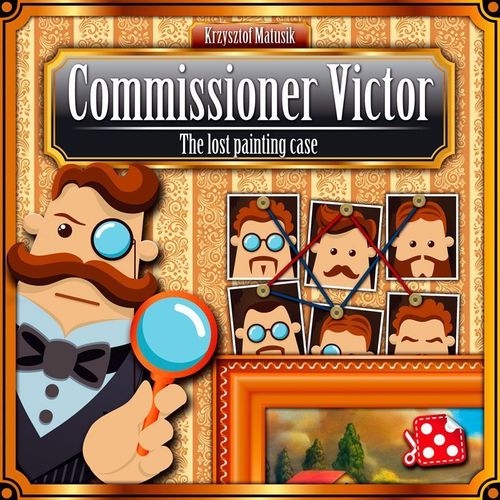
Commissioner Victor: The lost painting case
Commissioner Victor: The lost painting case Rulebook
Table of Contents
Table of Contents
Box Contents
Or elements which you will get as a detective to help in the investigation.
- 32 Suspect Tiles: These tiles show descriptions of suspects in the theft. As a detective, you will use them to determine the real perpetrator. On the tiles' faces, you can see descriptions of suspects with three main features: hair style, eyes, and facial hair.
- 4 Commissioner Victor Tiles: Tiles depicting Commissioner Victor.
- 8 Innocence Counters: These counters will be used to mark suspects that you think are innocent. They come in four colors: yellow, red, green, and blue.
- 22 Identity Counters: Counters in a neutral color used for the minigame: "Identity" is described further in the rules.
- Rulebook
What You Need to Read at the Beginning
Or code of conduct with handling sensitive papers that just got to your desk.
If this is your first contact with Commissioner Victor and the Case of the Lost Art, then you need to read the following chapters of this rulebook before you begin: Game Goal, Game Setup, Rules of the Game, and End of the Game. After you read them, you will know the game's outline and the most important thing, knowing how to gather points!
Game Goal
Your task as detectives is to find the perpetrator of the theft of a valuable painting from the museum. To do this, you need to sit in the boardroom, where you will need to crack the evidence gathered by the officials during long interrogations of witnesses, and in order to find the thief, use not only the evidence, but also your experience and instinct. You will have to compete with each other during the investigation and try to convince the others that you are right, especially since you will most likely consider different suspects. Unfortunately, when a detective is sure, there is little that can change his mind. In the end, what really matters is catching the right criminal!
During the game you will place and move the suspect tiles on the game field. At the end of the game, you will get points for each set of features, in columns and rows, that match the last tile that stays in your hand. The more features you match this way, the more the evidence will prove that your suspect is guilty. So, try to place tiles with features important to you in the right spot with each of your moves. Of course, other players will most likely try to disrupt your plans by placing descriptions with features that match their own suspects. That's why you get innocence counters, thanks to which, you can block movement of the tiles on the game field.
You need to close the conference before Commissioner Victor demands a full report!
Game Setup
Or how to prepare the boardroom for the conference.
First of all, pick a comfortable place to play. A clean, flat surface the size of a small table would be perfect. This will be your game field.
Prepare the Suspect Tiles. Depending on the number of players, you will need to discard some tiles to the box without looking at their faces. They will not be used in the game.
- If you are playing a 2-player game, discard 5 tiles to the box.
- If you are playing a 3-player game, discard 4 tiles to the box.
- If you are playing a 4-player game, discard 3 tiles to the box.
- Form a stack on the game field with as many Commissioner Victor tiles as players taking part in the game. Two tiles with two players, three tiles with three players and four tiles with four players. Shuffle the remaining suspect tiles and put them on this stack facedown and in a way that prevents the players from seeing the descriptions of the suspects.
- Take the top tile from the suspect stack and put it faceup in the middle of the game field.
- Then each player draws 3 tiles from the suspect stack and keeps them in their hand in a way that prevents the other players from seeing the descriptions.
- Distribute the Innocence Counters. Each player chooses counters in one of the available colors and takes them according to these rules:
- If it is a 2-player game, then each player gets two innocence counters.
- If it is a 3 or 4-player game, then each player gets one innocence counter.
(Illustration: game ready for 3 players.)
Flow of the Game
Or how the conference will go in summary.
During the game, the players will perform their actions in a clockwise order. The player who most recently read a good crime story will begin. If you have trouble with determining that, then you can choose a starting player at random. After a player performs their action, they pass the turn in a clockwise order.
Starting from the first player, each of you will perform the following actions:
- The player takes back their innocence counters from the tiles in the game field.
- The player chooses one of their suspect tiles from their hand and places it in the game field adjacent to at least one tile already in the field.
- (Optional) Before or after placing a tile, the player can move one free tile already in the game field to another place in the game field so it is adjacent to at least one tile. You cannot move tiles with innocence counters.
- The player chooses tiles in the game field and places their innocence counters on them.
- The player then draws a tile from the suspect stack and passes the turn to the next player.
The game lasts until the game field is filled with tiles. There will be 25 of them in total. Then the game ends and you can proceed to scoring. Scoring is described in detail further on.
DETECTIVE GUIDE - FIRST SUSPECT: While holding first suspect tiles in hand, you should choose one of them - it will be your first suspect. Hold it in hand and do not place it, at least for a first couple of rounds. Try to play tiles with at least one feature matching your first suspect. It will enable you to score. Of course, it can happen that one of the tiles that you draw during the game will fit the situation on the board better. The suspect can change, so you can keep new suspect tile and try to gather points for him.
Detailed Descriptions of the Actions
Or, in detail, what exactly you can do and what to avoid doing.
(1) Taking off Innocence Counters
Your first action in a turn will be taking off your innocence counters from the tiles located in the game field. You need to do this in order to not obstruct your own moves.
- You don't perform this action on the first turn because you do not have any counters on the field yet.
- The moment a player has a Commissioner Victor tile in front of them, they cannot take off their counters anymore. Such a player skips this action.
Rule of the Square: The game field cannot exceed the dimensions of a 5x5 square of tiles after placing or moving suspect tiles.
(2) Adding a tile to the Game Field
The players must abide by the Rule of the Square when placing or moving tiles. You must place a tile so that it neighbors with one, two, three, or four tiles which will form columns and rows; it will become the first, second, third, fourth, or fifth tile in any given column or row. You cannot place a tile in a way that would make it or any other tile the sixth tile in a column or row.
You must be careful to preserve the 5x5 frame after each move or tile placement. This means you cannot place or move a tile outside of the square outline marked by rows and columns filled by 5 tiles.
(Illustration: where tiles can be moved without violating the square rule.)
(3) Moving the Tile in the Game Field
During your turn, you can move one suspect tile already in the game field to another spot. This action is optional. The player does not have to perform it if they do not want to. The player can move a tile either before or after placing a tile.
You cannot move a given tile if:
- There is an innocence counter on that tile,
- The tile is blocked, that means it has four neighboring tiles,
- Moving the tile would break the consistency of the game field: meaning the tiles would form two or more separate clusters,
- The game field is filled: meaning it already has 25 tiles in it.
(Illustration: which tiles can be moved.)
DETECTIVE GUIDE - GAME FIELD: As detectives you must be careful not to cover any tracks. That's why it is so important to keep the game field in orderly fashion. To make playing easier, each time you place or move a tile, imagine a 5x5 square, which encircles the game field. If moving or placing a tile would make this tile leave this square, then you cannot make such a move.
(4) Placing Innocence Counter/s
As a detective, you have a special innocence counter at your disposal (two if playing a 2-player game). Thanks to this, you can prevent chosen suspect tiles from being moved by other players. Clever use of this counter will help you on the way to victory.
You can place your innocence counter on a tile that already has an innocence counter on it. A player cannot place innocence counters if they have a Commissioner Victor tile in front of them.
(5) Drawing a Suspect Tile
As the last action of your turn, you draw a suspect tile from the stack. After drawing a tile, the player passes play to the next player in clockwise order. When a player draws a Commissioner Victor tile, they place it in front of themselves. From now on, they cannot place or take innocence counters on or from the game field.
REPORT!
Commissioner Victor approaches the boardroom and demands that all detectives show him the guilty perpetrator. When the suspect tiles run out, you will begin to draw Commissioner Victor tiles that lie underneath at the bottom of the stack. When a player draws one, he or she places it visible in front of themselves. From now on, this player cannot take innocence counters off the game field nor place them on it. The players continue to play their turns and place tiles into the game field. The game ends when each player has only one tile left in hand.
When the suspect stack runs out, the players will skip the "draw a suspect tile" step and just pass the turn to the next player instead. If a player has only one tile left in hand, then he or she has played their last turn and will not get to play another turn.
Scoring and End of the Game
The game ends the moment the game field is filled. That is if you have a square filled with 25 tiles. At the end of the game each of you will have one tile left in hand. This tile automatically becomes your prime suspect. All you have to do now is count the gathered evidence.
Players will get points for every feature matching the description of their prime suspect which occurs at least 3 times in a row or column. Count all combinations of matching features in all columns and rows.
- If a feature occurs 3 times in a row or column, then the player gets 1 procedural point.
- If a feature occurs 4 times in a row or column, then the player gets 3 procedural points.
- If a feature occurs all 5 times in a row or column, then the player gets 5 procedural points.
If an innocence counter of a player lies on a tile with no features matching their prime suspect, then it means that the detective protected an innocent person and gets 1 procedural point.
The player with the most procedural points at the end of the game is the winner! If two or more players have the same amount of points, then it is a draw. You tracked not only the perpetrator, but also his accomplices!
Scoring Example
By analyzing the picture, we can see how many points the player with Ola Nordmann as the last tile got at the end of the game.
Ola Nordmann became a Prime Suspect. We check each row and then each column in search for features matching the features of the Prime Suspect.
- First row: 3 tiles with the same hairdo, 1 point.
- Third row: 3 tiles with glasses, matching eye feature, 1 point.
- Fourth row: 3 tiles with the same hairdo, 1 point.
- First column: 4 tiles with glasses, matching eye feature, 3 points.
- Fourth column: 5 tiles with the same facial hair, 5 points.
- Fifth column: 3 tiles with the same hairdo, 1 point.
Player got 12 points in total.
Minigame: Identity
"Identity" is a minigame designed for two players. You can play it without knowing the rules of Commissioner Victor: The Lost Painting Case.
Having good access to information is really important in a detective's job. That's why you need informers which will demand full anonymity for their own safety.
In case of a tough investigation, just like this case of lost art, when everyone feels the pressure of superiors, you want to find the guilty by any means necessary. You will even risk getting to the whistleblower of your colleagues to get closer to finishing the case. It will not be easy to uncover the informer's identity, but perhaps a good conversation will help.
Game Goal
Your goal is to uncover the informer's identity which is only known to one member of the detective team. You will talk to them and use your talent and experience in interrogations (represented by playing tiles) to get as many features as possible.
Game Setup
First of all, pick a comfortable place to play. A clean, flat surface the size of a small table would be perfect. This game is really compact, so you can even play while traveling.
- Prepare Suspect Stack. Take all the suspect tiles and shuffle them. Then form a facedown stack with them. Place the stack so that both players have free access to it.
- Draw Suspect Tiles. Each player draws five suspect tiles from the stack and keeps them secret from the other player. Then each player chooses one tile to be their informer, placing it facedown in front of themselves.
- Take Innocence and Identity Counters. Each player takes two innocence counters in their chosen color and places them in front of themselves. These will be used for marking duels that you won.
- Then put the identity counters in an easily accessible place. They will be used for marking features that match the informer.
Game Rules
The game is divided into turns in which you will ask questions about features of the informer one after another by playing suspect tiles. Choose the starting player (preferably at random).
Even Turns Rule: It is important that you play the same amount of turns. The first player takes a Commissioner Victor tile and places it in front of themselves. In case the starting player guesses first, his opponent has one last chance to find out who the informer is. This would result in a draw.
Starting from the first player, you will play your turns by performing the following actions:
- The player chooses and plays a suspect tile by placing it faceup in front of themselves. This equals the question: "How many features from this tile match your informer?"
- The opponent checks their tile with their informer's description and places identity counters on the just played tile in an amount equal to the number of matching features. They can place one, two, or zero counters.
- There can be a maximum of three revealed suspect tiles in front of each player. The moment any player plays the fourth tile, he or she has to choose and discard one of their tiles that lie in front of themselves. Then they are free to place another tile.
- Then the active player can try to guess the identity of their opponent's informer. Each attempt consists of presenting a description of the informer to your opponent by describing one feature from each of the categories: hair style, eyes, and facial hair. All features are listed at the end of this rulebook; we recommend you to use them during the game.
- If all features match, then the attempt is successful. If the attempt is successful and the active player started the game (they have a Commissioner Victor tile), then their opponent has one more try to end the game in a draw. If the active player does not have a Commissioner Victor tile in front of themselves (they were not the first player), then they win the game! If there is even one feature that did not match, then the attempt is failed and the active player loses the game.
- If the player did not make an attempt at guessing the identity, then they take a tile from the suspect stack and pass play to their opponent. If the active player just guessed the informer's identity correctly and is the starting player, then they pass the turn to their opponent without drawing a tile.
End of the Game
There are three scenarios possible in each game: the identity was guessed by one player, both players, or one player failed in an attempt to guess correctly. If both players guessed correctly, then the game ends in a draw and no player gains an advantage. If the identity was guessed by only one player, then this player takes one of their innocence counters to mark a gained victory point.
If a player fails in an attempt to guess an identity, then their opponent gains a victory point. The game lasts until one player gets two victory points and is declared the winner.
Feature Names
Feature names listed at the end of the rulebook (as printed, with illustrations): sleek, playboy, curly, matchstick, shaggy, eagle eye, hypnotizer, scientist, sheriff, lumberjack, smooth, macho.