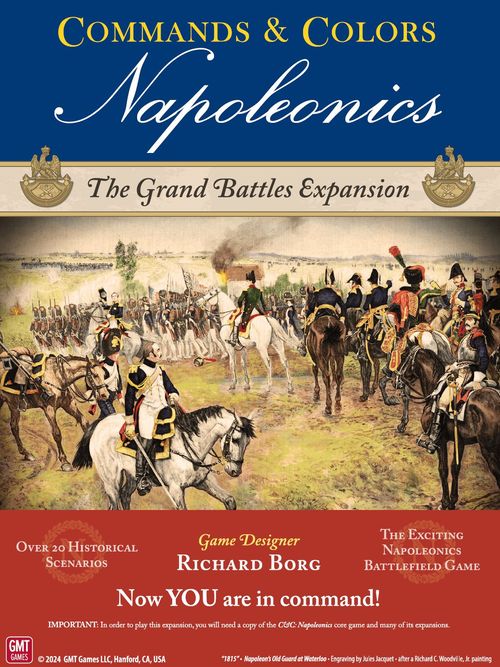
Commands & Colors: Napoleonics Expansion #7 – The Grand Battles
Commands & Colors: Napoleonics Expansion #7 – The Grand Battles Rulebook
Table of Contents
Table of Contents
- 1. Introduction
- 2. Contents
- Units and Leaders
- Victory Banner Explanations
- Temporary Victory Banner Objective Hex
- Temporary Victory Banner Objective Hex (Turn Start)
- Temporary Group Victory Banner Objective Hexes
- Temporary Group Victory Banner Objective Hexes (Turn Start)
- Temporary Majority Victory Banner Objective
- Temporary Majority Victory Banner Objective Hexes (Turn Start)
- Permanent Victory Banner Objective Hex
- Permanent Victory Banner Objective Hex (Turn Start)
- Breakthrough Objective
- Time Pressure Objective
- Garrison Markers
- 3. UNITS & BLOCKS
- 4. EPIC BATTLE RULES
- Multi-Section Command cards (Recon in Force, Coordinated Advance, Flank Attack and Forward)
- EPIC Courier Rack
- EPIC Corps Command Stars (also used in Grand Battle scenarios)
- EPIC Squares
- EPIC with 4 Players
- Tactician cards
- National Counters (one-on-one)
- EPIC Card Drawing at the End of a Turn
- Command cards (4 players)
- Tactician cards (4 players)
- National Counters (4 players)
- 5. GRAND BATTLES
- National Counters (Grand Battle)
- Tactician cards (Grand Battle)
- Grand Battles Game Turn
- Command Card Played From Corps Commander's Hand (Grand Battle)
- Grand Battles Corps Commander Initiative
- Grand Battles Courier Rack
- Grand Battles Corps Command Stars
- Grand Battles Squares
- Grand Battles Card Drawing at the End of a Turn
- 6. ICONIC COMMANDERS
- 7. SCENARIOS
1. Introduction
The Commands & Colors: Napoleonics game system allows players to effectively portray smaller historical actions and now with these rules Napoleonic Grand size battles as well. The scale of the game is flexible and varies from battle to battle. In some scenarios, a unit may represent an entire division, while in others a unit may represent a single regiment or battalion. During play, the Command cards drive movement, while creating a "fog of war", and the battle dice will resolve combat quickly and efficiently. The stylized battlefield maps emphasize the important terrain features and highlight the historical deployment of forces in scale with the game system. Finally, the Napoleonic tactics you will need to execute to gain victory conform remarkably well to the advantages and limitations inherent to the various Napoleonic national armies of the day and the actual battlefield terrain features on which they fought.
The Grand Battles is the seventh expansion for GMT's Commands & Colors Napoleonics game system. The expansion features a total of 10 Grand Battle scenarios and 10 EPIC engagements.
The Grand Battles battlefield is 11 hexes deep by 26 hexes wide and is best played with eight players, four on each side. There are two Grand Battle mounted map boards (left and right) included in the expansion. As a special bonus, two Grand Battle extended scenarios are preprinted on a double-sided paper map, Waterloo 18 June 1815 and Borodino 7 September 1812. The historical background and battle notes for these two preprinted extended scenarios can be found on two identical Historical Background and Battle Notes cards. Again please note, the Grand Battles rules have been slightly modified from the La Grande Battles rules originally presented in EPIC Napoleonics expansion #6.
The Napoleonic EPIC battlefield is 11 hexes deep by 20 hexes wide and can be played by two, four, six and even eight players. Furthermore, if you and a friend have not tried playing an EPIC Napoleonic scenario one-on-one, you will find that EPIC Napoleonics actually really does play out very well with just two players.
To experience the maximum enjoyment with these two Napoleonic game formats, both EPIC and Grand Battles, all scenarios are best played using the Command card and Tactician card decks that were part of the Generals, Marshals & Tacticians expansion #5. It is also important to note, in order to play most of these Napoleonic scenarios, players will need a copy of the Commands & Colors: Napoleonic core game and many of its expansions (Spanish Army, Russian Army, Austrian Army, Prussian Army, Generals, Marshals & Tacticians, EPIC Napoleonics and The Grand Battles).
Again as stated previously in our EPIC Napoleonics expansion, it is not the intention of GMT or the designer to require a player to buy multiple copies or all the expansions to play some of the scenarios found in this expansion. The hope is that two friends, both of whom own copies of the Napoleonic game and the expansions, could come together with their games, set up one of these larger scenarios and share in the fun with their friends.
Finally, players will also find in this expansion a number of new units: Austrian Militia Cavalry, Russian Guard Heavy Cuirassier Cavalry and British Highland Infantry.
Overall this expansion is jam-packed with plenty of new, exciting and challenging game play concepts. It is important to note, however, that although the scope and scale of your Commands & Colors Napoleonic game has increased substantially, the basic rules of play and how to gain victory have remained the same.
2. Contents
Component List
- 1 Rule Booklet
- 1 Grand Battle mounted map board (2 parts left & right)
- 4 Double-sided Grand Battle Scenario cards (8 Grand Battle scenarios)
- 1 Double-sided Grand Battle Extended Scenario preprinted map (2 Extended Grand Battle scenarios)
- 2 identical double-sided Grand Battle Extended Scenario Historical Background and Battle Note cards
- 5 Double-sided EPIC Scenario cards (10 EPIC Battle scenarios)
- 12 Double-sided individual National Unit Reference Cards (two of each of the following: French, British, Austrian, Prussian, Russian, and Spanish)
- 2 Terrain Effects summary cards
- 1 Terrain Tile Punchboard
- 15 double-sided Terrain Tiles
- 1 Counter & Marker Punchboard
- 54 Victory Banner counters (9 French, 9 British, 9 Austrian, 9 Prussian, 9 Russian, 9 Spanish)
- 18 Garrison counters (3 French, 3 British, 3 Austrian, 3 Prussian, 3 Russian, 3 Spanish)
- 12 Square markers #5 & #6 (2 French, 2 British, 2 Austrian, 2 Prussian, 2 Russian, 2 Spanish)
- 3 Spanish Guerrilla counters
- 3 Russian Mother Russia counters
- 3 Prussian Iron Will counters
- 3 Hungarian +1 Battle Bonus counters
- 3 French Conscripts
- 1 Cardstock Courier Rack assembly
- 8 Silk-screened Battle Dice
Note: There will be a few spare blocks.
Battlefield Map Boards
To create an EPIC size battlefield of 11 hexes deep by 20 hexes wide, players will need to set the two EPIC mounted map boards, which are found in the Commands & Colors EPIC Napoleonics expansion #6, side by side when playing an EPIC size battle scenario.
To create the Grand Battle battlefield of 11 hexes deep by 26 hexes wide, players will need to set the two Grand Battle mounted map boards, included in this expansion, side by side.
Scenario Cards
The 10 EPIC scenarios are on five 11x12 inch scenario cards and eight of the 10 Grand scenarios are on four 11x17 inch scenario cards.
Grand Battle Extended Preprinted Maps
The remaining two preprinted Grand Battle extended scenario maps, Waterloo 18 June 1815 and Borodino 7 September 1812, are 11 hexes deep by 28 hexes wide. Because the battlefield is already printed with all the terrain and the unit deployments are noted, the time it takes to set up these scenarios is minimal. The historical background and battle notes for these two preprinted extended battles can be found on two double-sided Extended Battle cards.
Applying the Stickers
Apply appropriate unit stickers to the fronts and backs of the blocks for each unit. Place the French unit labels on the dark blue blocks, Austrian unit labels on the white blocks, British unit labels on the red blocks, Portuguese unit labels on the brown blocks, Spanish unit labels on the yellow blocks, Prussian unit labels on the medium gray blocks and Russian unit labels on the dark green blocks. We suggest that you separate the blocks by color, then sort blocks by size.
Start with the French units. Pull out 12 small size dark blue blocks. Find the French Line Infantry stickers on sheet 2. Peel and place a sticker on the front and back of the 12 small size dark blue blocks. When you run out of the 12 blocks, move onto the French Militia Infantry. Pull out 4 small dark blue blocks. Find the French Militia Infantry stickers on sheet 4. Peel and place stickers on the front and back of the 4 small dark blue blocks. When you run out of the 4 blocks, move on to the French Foot Artillery unit that needs 3 rectangular dark blue blocks. Keep going in this fashion until all the French units and leaders are completed. Then move on to the Austrian white unit blocks. It will take a little time, but it will be worth the effort!
A few extra blocks and stickers are supplied as spares.
The unit-sheet illustrations on page 4 of the source (each nation's unit icons with their unit and block counts) are not reproduced; the counts are on each National Unit Reference Card and in the Component List above.
Units and Leaders
Units and Leaders
Each unit is composed of a certain number of blocks. The number of blocks in a unit may vary by unit type and Nation and is detailed on their National Unit Reference Card.
A General, Marshal or Field Officer of any rank (hereafter referred to as a Leader) is represented by one rectangular block. A single Leader block is not considered a unit.
Units and Leaders Visual Identification Aids
This expansion uses several unit-class icons to assist players with set up and unit recognition. The complete list of icons follows for player reference.
- Flaming grenade icon: Grenadier infantry: upper left or right of each sticker for the following unit types—Grenadier, Guard Grenadier, Old Guard
- Bugle icon: Light Infantry: upper left or right of each sticker for the following unit types—Light, Rifle Light, Guard Light, and Young Guard
- Cavalry helmet icon: Heavy Cavalry: upper left or right of each sticker for the following unit types—Heavy, Guard Heavy, Heavy Cuirassier, Guard Heavy Cuirassier
- Horse head icon: upper left or right of each sticker for the following unit types—Horse Artillery.
Infantry (Line, Highland, Reserve and Militia), Cavalry (Light, Guard Light, Light and/or Militia Light Lancers and Cossack) and Foot Artillery (Regular and Guard) classes of units do not have a special icon.
Terrain Tiles
The Terrain Tiles represent a wide range of terrain features and are placed on the battlefield to recreate the historical scenario.
Victory Banner Counters
Victory Banner counters will track a player's quest for victory. Although additional counters for each nation are provided in this expansion, a scenario's Victory Banner count may still exceed the number of available counters. Players will need to improvise, and may opt to use a coin or the opposition player's last block of an eliminated unit, to track victory.
Infantry in Square Counters
The square counters, numbered 5 and 6, are used to track infantry units that have formed square on the battlefield. There are two counters for each Nation, "Square 5" and "Square 6". For updated rules for these counters, see the "EPIC Square and The Grand Battles Square" rule sections.
Courier Rack
The cardstock Courier Rack is used in both EPIC and Grand Battle scenarios. The rack is placed next to the deck of Command cards at one end of the map.
Prior to a battle, the Courier Rack may need to be assembled.
Battle Dice
The expansion includes eight custom dice with one of six images laser-printed on each face. The faces show Sabers, Infantry, Cavalry, Artillery and Flag results.
Victory Banner Explanations
To reduce the amount of text in a scenario's briefing notes, the following terms are used to describe some common Victory Banner Objective Hex conditions:
Note: All Turn Start Victory Banners (temporary and permanent) are awarded at the start of a player's turn. All other Victory Banners (temporary and permanent) are awarded during a player's turn when earned. All Temporary Victory Banners, whether gained at turn start or during the turn, are lost at the moment the condition for its award is no longer fulfilled.
Temporary Victory Banner Objective Hex
The Victory Banner in this objective hex is gained immediately when the appropriate side occupies the hex. The Victory Banner is held only as long as a unit of the appropriate side holds the hex. If the unit vacates the hex for any reason (movement, retreat or elimination) during its own turn or during the opponent's turn, the Victory Banner is immediately lost and placed back in play in its original position on the objective hex.
Note - When a unit occupies the hex and is ordered and the unit moves off the hex, the banner is not lost if another unit is ordered and it moves onto the hex during the same turn.
Temporary Victory Banner Objective Hex (Turn Start)
The Victory Banner in this objective hex is gained when a unit of the appropriate side occupies the hex at the start of its turn. If the unit vacates the hex for any reason (movement, retreat or elimination) during its own turn or during the opponent's turn, the Victory Banner is immediately lost and placed back in play in its original position on the objective hex.
Note - However when a unit occupies the hex and is ordered and the unit moves off the hex, the banner is not lost if another unit is ordered and it moves onto the hex during the same turn.
Temporary Group Victory Banner Objective Hexes
A number of hexes together form a Group Victory Banner objective. The appropriate side that occupies all of the objective hexes will immediately gain one or more Victory Banners. As long as all objective hexes are occupied, the Victory Banners will count. If any hexes in the group are not occupied for any reason (movement, retreat or elimination) during its own turn or during the opponent's turn, the Victory Banners for the group are immediately lost.
Temporary Group Victory Banner Objective Hexes (Turn Start)
A number of hexes together form a Group Victory Banner objective. The appropriate side that occupies all of the objective hexes at the start of its turn will gain one or more Victory Banners. As long as all objective hexes are occupied, the Victory Banners will count. If any hexes in the group are not occupied for any reason (movement, retreat or elimination) during its own turn or during the opponent's turn, the Victory Banners for the group are immediately lost.
Temporary Majority Victory Banner Objective
The Victory Banner for this group of objective hexes is immediately gained when the appropriate side has units occupying an absolute majority of hexes in the group at the start of its turn. Absolute majority means to occupy more of these objective hexes than your opponent. Occupying one hex when your opponent occupies none, for example, would be an absolute majority. The Victory Banner is retained as long as the side has an absolute majority. The Victory Banner is immediately lost when a side no longer has an absolute majority.
Temporary Majority Victory Banner Objective Hexes (Turn Start)
The Victory Banner for this group of objective hexes is gained when the appropriate side has units occupying an absolute majority of hexes in the group at the start of its turn. Absolute majority means to occupy more of these objective hexes than your opponent. Occupying one hex when your opponent occupies none, for example, would be an absolute majority. The Victory Banner is retained as long as the side has the absolute majority. The Victory Banner is immediately lost when a side no longer has an absolute majority.
Permanent Victory Banner Objective Hex
The Victory Banner in this objective hex is gained immediately when the appropriate side occupies the hex. The Victory Banner, once gained, is not returned or put back in play, even if the unit later vacates the hex for any reason (movement, retreat or elimination).
Permanent Victory Banner Objective Hex (Turn Start)
The Victory Banner in this objective hex is gained when the appropriate side occupies the hex at the start of its turn. The Victory Banner, once gained, is not returned or put back in play, even if the unit later vacates the hex for any reason (movement, retreat or elimination).
Breakthrough Objective
When a player's Victory Banner objective requires his forces to achieve a Breakthrough, each unit that exits the battlefield from an opponent's baseline hex, gains that player one Permanent Victory Banner. To exit, the unit must be ordered and move off the battlefield. A unit must start its turn on an opponent's baseline hex to exit off the battlefield and thereby gain a Permanent Victory Banner.
Time Pressure Objective
When Time Pressure rules are in effect against the attacker, the defending player, after playing a "Scout (Left, Centre or Right)" Command card, may take a Permanent Victory Banner and draw one Command card instead of using Corps Command Stars and drawing two Command cards at the end of his turn. Taking a Permanent Victory Banner, instead of using Corps Command Stars and drawing two Command cards is not allowed, if doing so would give the player his final Victory Banner to win the battle.
Garrison Markers
An Infantry unit with two or more blocks that occupies any building, church, castle, walled garden or walled farm hex at the start of the turn, and is ordered to move out of that hex, may leave a Garrison marker in the hex. One Line Infantry block is taken from the army pool of blocks not deployed in the scenario and is placed on the hex along with a Garrison marker. The departing Infantry unit does not lose a block in order to create the Garrison. A qualifying Infantry unit may form multiple Garrisons during the course of a scenario.
A Garrison block and its marker is treated like an Infantry unit with the following exceptions:
- A Garrison block may not move.
- A Garrison block will battle with 1 die. Command and Tactician cards, however, can modify its battle dice.
- A Garrison block may not battle the turn it is placed.
- A Garrison block does not receive any National modifiers.
- A Garrison block may not ignore a flag for any reason and is eliminated when a flag is rolled against it.
- A Garrison block, when eliminated, does not count as a Victory Banner.
- A friendly unit when ordered may enter a Garrison hex. When the unit enters, the Garrison marker and Infantry block are removed. The entering unit does not gain a block when the Garrison is removed.
- A friendly unit may retreat onto a hex with a Garrison. When the unit enters, the Garrison marker and Infantry block are removed. Note - This rule has been updated and supersedes the previously published Garrison rule.
- A Garrison block may not form square.
- A Garrison block does not provide support.
Important Note: A Garrison marker with an Infantry block by definition meets the requirement of occupying a hex. Therefore, a Garrison marker with its Infantry block will fulfill a victory objective condition that requires a building, walled garden or walled farm to be occupied by that side's army.
3. UNITS & BLOCKS
New Units
- Austrian Militia Cavalry—3 units (12 blocks)
- Russian Guard Heavy Cuirassier Cavalry—1 unit (6 blocks)
- British Highland Infantry—2 units (8 blocks)
Austrian Militia Cavalry
- Map ID code: MLC
- Blocks in Unit: 4
- Movement in Hexes: 3
Battle:
- Melee and Battle Back: 1 die per block, no saber hits except vs lone leaders
Morale: Retreat 3 hexes for each flag
Notes: May retire and reform when melee attacked by infantry or attacked by infantry/artillery Combined Arms
Russian Guard Cuirassier Heavy Cavalry
- Map ID code: GCU
- Blocks in Unit: 6
- Movement in Hexes: 2
Battle:
- Melee and Battle Back: 1 die per block, plus 1 die
- Ignore one hit when attacked in ranged combat by infantry
- A Lancer unit will not reroll flag results when in melee combat against Cuirassiers
Morale: May ignore 2 flags, if unit does retreat, retreat 1 hex for each flag
Notes: May retire and reform when melee attacked by infantry or attacked by infantry/artillery Combined Arms.
British Highland Infantry
-
Map ID Code: HI
-
Blocks in Unit: 4
-
Movement in Hexes: 1
-
When ordered by Force March Command card unit may move two hexes and still melee combat
Battle:
- Range Fire Standing: 1 die per block, plus 1 die
- Range Fire Moving: dice equal to ½ number of blocks round up
- Melee and Battle Back: 1 die per block
Morale: May ignore 1 flag, if unit does retreat, retreat 1 hex for each flag
4. EPIC BATTLE RULES
Players should use the Command card deck (green deck) and Tactician card deck (red deck) from the Generals Marshals & Tacticians expansion in all EPIC Napoleonics scenarios.
Command cards which specify one or more sections are still referred to as Section Command cards.
Command cards which do not specify any section are referred to as Tactic Command cards.
Tactician cards still play per rules in Generals, Marshals and Tacticians.
The EPIC battlefield contains the same three sections found on the standard battlefield - Left, Center and Right. The width of the EPIC battlefield sections and the depth of the battlefield however have increased.
In a one-on-one EPIC Napoleonics game, each player assumes the role of the Commander in Chief (CIC). Each CIC has a hand of Command cards per the scenario's Battle Notes. There are some variances in card play from standard C&C Napoleonics.
On each turn, the CIC must select and play one Command card from his hand to order units in one section of the EPIC battlefield. Also on that turn, the CIC must select one Command card from the Courier Rack to order units in another section of the EPIC battlefield.
The CIC may also select and play two Multi-Section Command cards on the same turn.
- When the CIC selects two Multi-Section Command cards, both Multi-Section Command cards are played face up by the CIC and will order units in the sections of the EPIC battlefield as stated on the card.
- Multi-Section Card Play Examples:
- A Coordinated Advance played along with a Probe Center will order 1 unit on the left section, 4 units in the center and 1 unit on the right section.
- A Recon in Force played along with a Fire and Hold, will order 1 unit in each section and the section where the Fire and Hold card is played will also order 4 units in the section to fire and hold.
- A Recon in Force played along with a Flank Attack will order 3 units on the left section, 1 unit in the center and 3 units on the right section.
- A Coordinated Advance played along with a Recon in Force will order 2 units on the left section, 3 units in the center and 2 units on the right section.
- Multi-Section Card Play Examples:
Section Command cards (Scout, Probe, Attack, Assault) must be played in the section listed on the card.
- When the CIC selects two Section Command cards they must be for two different sections of the EPIC battlefield.
Special Note: In the event that all the Command cards on the Courier Rack and all the Command cards in a CIC's hand are for the same section, the CIC, after showing his opponent the cards in his hand to confirm that all cards are for the same section, may play two Section Command cards in the same section on the turn.
Multi-Section Command cards (Recon in Force, Coordinated Advance, Flank Attack and Forward)
Multi-Section Command cards are not played onto a section. Multi-Section Command cards are instead, played face up in front of the CIC and will order the units in the sections of the EPIC battlefield as stated on the card.
- When the CIC selects a Multi-Section Command card and a Section Command card, the Section Command card is played in the section listed on the card and the Multi-Section Command card is played face up by the CIC and will order units in the sections of the EPIC battlefield as stated on the card.
- When the CIC selects a Multi-Section Command card and a Tactic Command card, the Tactic card is played in one chosen section and the Multi-Section Command card is played face up by the CIC and will order units in the sections of the EPIC battlefield as stated on the card.
Tactic Command cards (cards that do not refer to a specific section) now play similarly to Section Command Cards and are playable in only one battlefield section, but the CIC is allowed to choose the section. Units are no longer ordered across all sections when a Tactic card is played.
- When the CIC selects two Tactic Command cards, they must be played in two different sections of the EPIC battlefield.
- When the CIC selects a Section Command card and a Tactic Command card, they must be played in two different sections of the EPIC battlefield.
- When the CIC selects a multi-section Command card and a Tactic Command card, one or more units will be ordered in each section by the multi-section Command Card, and up to the number of units specified on the Tactic Command card may also be ordered in the section.
Important Note: When ordering units in the same section with a Tactic and a Multi-Section Command card, it will be very important to track which units are being ordered by the Tactic Command card's special action (in the case of the above example, Fire and Hold) and which units are just ordered. It is suggested that players use the battle dice to keep track, marking units being ordered by a Tactic Command card's special action with a saber and other units with their die symbol.
- A Command card that orders units Equal to Command is equal to the number of Command cards in the CIC player's hand including the Command card just played from his hand.
- Units ordered by a Take Command card may extend into another section, but a unit may only be ordered one time during a turn.
EPIC Courier Rack
Pre-battle: After both CIC players have been dealt their Command cards, five additional Command cards are dealt and placed face up in the Courier Rack so that those five Command cards are visible to both players. Each turn, one card is taken from the rack by the CIC player that is taking his turn, so the choice of cards a player has each turn is reduced, until there are only two cards remaining on the rack. The rack is then filled back to five cards before the next player's turn, and the card selection process from the Courier Rack will start again.
Courier Rack Card Selection Example:
The Courier Rack will start the battle with 5 cards.
- Turn 1 player A will take one of the 5 cards from the rack, leaving 4 cards.
- Turn 2 player B will take one of the 4 cards from the rack, leaving 3 cards.
- Turn 3 player A will take one of the 3 cards from the rack, leaving 2 cards.
When there are only 2 cards on the Courier Rack, the rack is replenished up to 5 cards, before the next player's turn. The player that just completed his turn will draw his Command card(s) first and then the cards on the Courier Rack are replenished.
- Then on Turn 4 player B will take one of the 5 cards from the rack, leaving 4 cards.
- Turn 5 player A will take one of the 4 cards from the rack, leaving 3 cards.
- Turn 6 player B will take one of the 3 cards from the rack, leaving 2 cards.
When there are only 2 cards on the Courier Rack, the rack is replenished up to 5 cards, before the next player's turn.
The selection of cards from the Courier Rack follows this procedure until one side obtains victory.
Note: When the Elan Command Card is played the Command cards on the Courier Rack remain on the rack and are not part of the shuffle.
EPIC Corps Command Stars (also used in Grand Battle scenarios)
Command cards that have 3 Stars (Scout, Elan, Leadership, and Take Command) will allow a player to order up to 3 additional units and/or leaders to make a March Move.
- A unit or leader ordered to March Move, must be in the same section of the battlefield in which the Command card is being played.
- A unit or leader may not be ordered to March Move when adjacent to an enemy unit or leader.
- A unit or leader ordered to March Move may move up to its normal movement allowance.
- A unit ordered to March Move may not battle.
- A unit or leader ordered to March Move may not move, or end its movement, adjacent to an enemy unit or leader.
- A March Move cannot order a unit to come out of square.
- A unit or leader ordered to March Move may not have a Tactician card played on the unit or leader this turn.
Important Note: When ordering units to March Move, it will be very important to track which units are being ordered normally and which units are ordered to March Move. It is suggested that players use the battle dice to keep track, marking March Move units with a flag and other units with their die symbol.
Stars Not Used: When a player chooses not to order any units and/ or leaders to March Move, the player may draw one Tactician card at the end of the turn.
EPIC Squares
Because of the scope of an EPIC Napoleonics battle, the CIC may still have a unit form square, even when only holding one Command card in his hand. The rules for forming and coming out of square, along with how Command cards are selected from a player and placed on the Square Track and the use of square counters, remain the same.
In the case where Square Track spaces #1 to #4 already have cards, place the square counter #5 on the unit going into square and set the Command card selected next to the #4 Square Track space. The same procedure is followed when the army already has five units in square. Place square counter #6 on the unit going into square and set the Command card next to the fifth place Command card.
In an EPIC battle, the number of units that can be in square at the same time is one less than the CIC's starting number of Command cards.
EPIC with 4 Players
In an EPIC Napoleonics game with 2 players on a side, both players will for the most part follow the same one-on-one EPIC battle rules.
Tactician cards
In a one-on-one battle, the number of Tactician cards each CIC player will take at the start of a battle is indicated in the scenario Battle Notes.
National Counters (one-on-one)
In an EPIC Napoleonics one-on-one game:
- The CIC will roll the Pre-Battle Russian Roll.
- The Prussian Iron Will counters listed in the scenario Battle Notes are given to the CIC.
- The Spanish Guerrilla counters listed in the scenario Special Rules are given to the CIC. The CIC must then assign the Guerrilla counters to a section of the Epic battlefield. If a section of the battlefield does not have at least four Spanish units, a Spanish Guerrilla counter cannot be placed in the section of the battlefield at the start of a battle. Also see "Spanish Guerrilla Action Clarifications" rules section.
EPIC Card Drawing at the End of a Turn
- The CIC draws one Command card for his hand.
- When one or more Scout Command card(s) are played, the CIC will draw two cards instead of one, choose one to keep for his hand and discard the other.
- When a Command card instructs a Tactician card to be drawn at the end of the turn, the CIC will draw the Tactician card. It is possible that the CIC may be entitled to draw more than one Tactician card at the end of a turn.
- When the Elan Command card is played by either player, at the end of that turn after the decks of cards are shuffled, both players will draw one Tactician card.
- At the end of the turn, when drawing Command cards and/or Tactician cards, these cards should be drawn prior to replenishing the Courier Rack cards.
- Always remember, replenish the Courier Rack back to five Command cards when only two cards remain.
One player on each side assumes the role of (CIC) while the other player acts as his sub-commander. The CIC has a hand of Command cards per the scenario's Battle Notes. Each turn, the CIC will select a Command card from his hand and will also select one Command card from the Courier Rack. The CIC will play one of the cards selected and the other card is used by his second in command. In this format, players are not locked into commanding one specific section every turn and will normally find themselves switching sections they command during the course of a battle.
Multi-Section Command cards (Recon in Force, Coordinated Advance, Flank Attack and Forward) are not given to a player. Multi-Section Command cards are instead, played face up by the CIC and will order units in the sections of the EPIC battlefield as stated on the card.
Players should make sure all movement is completed for all battlefield sections, before any battling starts. Players are advised to conduct unit battles simultaneously, if feasible, to speed up play. When units in two sections have the opportunity to battle the same enemy unit, the players must coordinate to determine the order of these attacks.
Command cards (4 players)
When one or more Scout Command card(s) are played, the CIC will draw two cards instead of one, choose one to keep for his hand and discard the other.
Tactician cards (4 players)
In an EPIC Napoleonics game with 2 players on a side, all Tactician cards listed in the scenario Battle Notes are given to the CIC.
National Counters (4 players)
In an EPIC Napoleonics game with 2 players on a side:
- The CIC will roll the Pre-Battle Russian Roll.
- The Prussian Iron Will counters listed in the scenario Battle Notes are given to the CIC.
- The Spanish Guerrilla counters listed in the scenario Special Rules are given to the CIC. The CIC must then assign the Guerrilla counters to a section of the Epic battlefield. If a section of the battlefield does not have at least four Spanish units, a Spanish Guerrilla counter cannot be placed in the section of the battlefield at the start of a battle. Also see "Spanish Guerrilla Action Clarifications" rules section.
EPIC with 6 Players
In an EPIC Napoleonics game with 3 players on a side, all players will for the most part follow the same one-on-one and two players per side EPIC battle rules.
One player on each side assumes the role of (CIC) while the other two players act as his sub-commanders. Each sub-commander player on a side is assigned one section of the battlefield to command for the entire battle. The CIC commands the unassigned section for the entire battle, usually the center section.
The CIC has a hand of Command cards per the scenario's Battle Notes. Each turn, the CIC will select a Command card from his hand and will also select one Command card from the Courier Rack. The CIC may keep one card to play and give one card to one of his sub-commanders, or give both cards away, one card to each of his sub-commanders and not play a card this turn.
Multi-Section Command cards (Recon in Force, Coordinated Advance, Flank Attack and Forward) are not given to a player. Multi-Section Command cards are instead, played face up by the CIC and will order units in the sections of the EPIC battlefield as stated on the card.
Initiative Roll (6 players)
Important Note: This is an update to the previous initiative roll rules.
During a turn, when a player does not receive a Command card to play on the turn, or a Multi-Section card does not order any units in his section, or a Take Command card does not order any units in his section, the player may act on his own initiative and roll two battle dice. The roll will determine what units are ordered.
- A unit symbol rolled will order one unit of that type.
- An Infantry symbol orders one infantry unit.
- A Cavalry symbol orders one cavalry unit.
- An Artillery symbol orders one artillery unit.
- A Flag symbol orders one unit of the player's choice to March Move.
- A Saber symbol orders one unit that is adjacent to an enemy unit or leader to melee combat.
Note: When two of the same symbols are rolled, the player will also draw one Tactician card.
Tactician cards (6 players)
In an EPIC Napoleonics game with 3 players on a side, each player will receive one Tactician card at the start of the battle. In addition, the Tactician cards listed in the scenario Battle Notes are divided equally between the three players. When the Tactician cards cannot be divided equally, the CIC will assign any extra cards to himself or to his sub-commanders.
A Tactician card that a player holds may only be played on units in the section he is commanding, but can be used against enemy units that are ordered against his units, even if the enemy units are not in his section.
National Counters (6 players)
Pre-Battle Russian Roll - In an EPIC Napoleonics game with 3 players on a side, each player will have one Pre-Battle Russian Roll die. In addition, Pre-Battle Russian Roll dice listed in the scenario Special Rules are divided equally between the three Corps Commander players. When the Pre-Battle Russian Roll dice cannot be divided equally, the CIC will assign any extra dice to himself or to his sub-commanders.
Note: If the section of the battlefield a player commands does not have Russian units, the player cannot make a Pre-Battle Russian Roll.
Prussian Iron Will - In an EPIC Napoleonics game with 3 players on a side, each player will receive one Prussian Iron Will counter. In addition, the Prussian Iron Will counters listed in the scenario Battle Notes are divided equally between the three players. When the Prussian Iron Will counters cannot be divided equally, the CIC will assign any extra counters to himself or to his sub-commanders.
Note: If the section of the battlefield a player commands does not have Prussians units, the player cannot receive any Iron Will counters.
Spanish Guerrilla counters - In an EPIC Napoleonics game with 3 players on a side, the Spanish Guerrilla counters listed in the scenario Special Rules are divided equally between the three players. When the Spanish Guerrilla counters cannot be divided equally, the CIC will assign any extra counters to himself or to his sub-commanders.
Note: If the section of the battlefield a player commands does not have at least four Spanish units, the player cannot receive any Spanish Guerrilla counters.
EPIC Card Drawing at the End of a Turn (6 players)
- The CIC draws one Command card for his hand.
- When one or more Scout Command card(s) are played, the CIC will draw two cards instead of one, choose one to keep for his hand and discard the other.
- When a Command card instructs a Tactician card to be drawn at the end of the turn, the player that played the Command card will draw the Tactician card.
- When a Command card has three stars, but a player chooses not to order any units and/or leaders to March Move, the player may draw one Tactician card at the end of the turn.
- When the Elan Command card is played by either player, at the end of that turn after the decks of cards are shuffled, all players both sides will draw one Tactician card.
EPIC with 8 Players
In an EPIC Napoleonics game with 4 players on a side, players will for the most part follow all previous EPIC battle rules.
One player on each side assumes the role of (CIC) while the other three players act as his Corps Commanders. Each Corps Commander is assigned one section of the battlefield to command for the entire battle. The CIC does not have direct command of a battlefield section, but will hand out Command cards for his army and oversee and will direct the battle.
The CIC has a hand of Command cards per the scenario's Battle Notes. Each turn, the CIC will select a Command card from his hand and will also select one Command card from the Courier Rack. The CIC gives one card to one of his Corps Commanders and gives the other card to one of his other Corps Commanders.
Multi-Section Command cards (Recon in Force, Coordinated Advance, Flank Attack and Forward) are not given to a player. Multi-Section Command cards are instead, played face up by the CIC and will order units in the sections of the EPIC battlefield as stated on the card.
Tactician cards (8 players)
In an EPIC Napoleonics game with 3 Corps Commanders and a CIC player, each Corps Commander will receive one Tactician card at the start of the battle. In addition, the Tactician cards listed in the scenario Battle Notes are divided equally between the three Corps Commander players. When the Tactician cards cannot be divided equally, the CIC will assign any extra cards to his Corps Commanders.
Note: The CIC does not hold any Tactician cards.
A Tactician card that a player holds may only be played on units in the section he is commanding, but can be used against enemy units that are ordered against his units, even if the enemy units are not in his section.
Initiative Roll
During a turn, when a player does not receive a Command card to play on the turn, or a Multi-Section card does not order any units in his section, or a Take Command card does not order any units in his section, the player may act on his own initiative and roll two battle dice. The roll will determine what units are ordered.
- A unit symbol rolled will order one unit of that type.
- An Infantry symbol orders one infantry unit.
- A Cavalry symbol orders one cavalry unit.
- An Artillery symbol orders one artillery unit.
- A Flag symbol orders one unit of the player's choice to March Move.
- A Saber symbol orders one unit that is adjacent to an enemy unit or leader to melee combat.
Note: When two of the same symbols are rolled, the player will also draw one Tactician card.
National Counters (8 players)
Pre-Battle Russian Roll - In an EPIC Napoleonics game with 3 Corps Commanders and a CIC player, each Corps Commander will have one Pre-Battle Russian Roll die. In addition, Pre-Battle Russian Roll dice listed in the scenario Special Rules are divided equally between the three Corps Commander players. When the Pre-Battle Russian Roll dice cannot be divided equally, the CIC will assign any extra dice to his Corps Commanders.
Note: If the section of the battlefield a player commands does not have Russian units, the player cannot make a Pre-Battle Russian Roll.
Prussian Iron Will - In an EPIC Napoleonics game with 3 Corps Commanders and a CIC player, each Corps Commander will receive one Prussian Iron Will counter. In addition, the Prussian Iron Will counters listed in the scenario Battle Notes are divided equally between the three Corps Commander players. When the Prussian Iron Will counters cannot be divided equally, the CIC will assign any extra counters to his Corps Commanders.
Note: If the section of the battlefield a player commands does not have Prussians units, the player cannot receive any Iron Will counters.
Spanish Guerrilla counters - In an EPIC Napoleonics game with 3 Corps Commanders and a CIC player, the Spanish Guerrilla counters listed in the scenario Special Rules are divided equally between the three Corps Commander players. When the Spanish Guerrilla counters cannot be divided equally, the CIC will assign any extra Spanish Guerrilla counters to his Corps Commanders.
Note: If the section of the battlefield a player commands does not have at least four Spanish units, the player cannot receive any Spanish Guerrilla counters at the start of a battle. Also see Spanish Guerrilla Action New Clarifications rules section.
EPIC Card Drawing at the End of a Turn (8 players)
- The CIC draws one Command card for his hand.
- When one or more Scout Command card(s) are played, the CIC will draw two cards instead of one, choose one to keep for his hand and discard the other.
- When a Command card instructs a Tactician card to be drawn at the end of the turn, the player that played the Command card will draw the Tactician card.
- When a Command card has three stars, but a player chooses not to order any units and/or leaders to March Move, the player may draw one Tactician card at the end of the turn.
- When an Elan Command card is played by either player, at the end of that turn after the decks of cards are shuffled, all players both sides will draw one Tactician card.
Spanish Guerrilla Action Clarifications
For all Epic and Grand Battle scenarios, when playing with the 90 card deck of Generals Marshals & Tacticians Command cards, the rules regarding how to gain a Guerrilla Action counter are revised.
When a player plays a Scout Command card, one Guerrilla Action counter is gained at the end of the turn in the section the Scout card was played as long as the following conditions are all met.
- Instead of drawing two Command cards as stated on the Scout command card at the end of the turn, the CIC player only draws one Command card, but the player playing the Scout card still gains one Tactician card.
- The 3 Corps Command Stars may not have been used to March Move units or used to draw a Tactician card.
- The section the Scout card was played must have at least four Spanish units in the section to draw a Guerrilla Action counter.
The rules for how a Guerrilla Action counter is played are amended as follows:
- A Spanish Guerrilla counter held in a section may only be played to attempt to nullify a Command card played in this same section.
- A multi-section Command card (Recon in Force, Coordinated Advance, Flank Attack and Forward) may not be stopped by the play of a Guerrilla Action counter.
- A player's initiative roll to ordered units may not be stopped by the play of a Guerrilla Action counter.
- Only one Guerrilla Action counter may be played on the French player's turn in an attempt to stop one French Command card being played.
- The French player may attempt to stop the Guerrilla Action by rolling a saber on one die.
5. GRAND BATTLES
The Grand Battles rules found in this expansion have been slightly modified from the La Grande Battles rules originally presented in EPIC Napoleonics expansion #6. Basically, we found after playing through these larger battle scenarios a number of times, that the updated rules will allow each player to become more involved and have greater control during the entire battle.
The Command card deck (green deck) and Tactician card deck (red deck), from the Generals Marshals & Tacticians expansion, should be used in all Grand Battle scenarios.
A Grand Battle game is best played with eight players. One player on each side assumes the role of Commander in Chief (CIC) while the other players act as his Corps Commanders.
A Grand Battle battlefield is divided into six sections (2 left, 2 center, 2 right). Each Corps Commander is assigned two sections of a Grand Battle battlefield (2 left or 2 center or 2 right) to command for the entire battle. The CIC does not have direct command of a battlefield section, but will hand out Command cards for his army and oversee and direct the battle.
In a Grand Battle game the CIC has a hand of Command cards per the scenario's Battle Notes. Each Corps Commander also has a hand of Command cards. The number of Command cards each Corps Commander will have at the start of a battle is listed in the scenario's Battle Notes. Deal the proper number of Command cards to each CIC and Corps Commander at the start of the battle.
National Counters (Grand Battle)
In a Grand Battle game, each Corps Commander will have or receive the number of Pre-Battle Russian Roll dice, Prussian Iron Will counters, or Spanish Guerrilla counters as listed in the scenario Battle Notes.
A Spanish Guerrilla counter that a Corps Commander holds may only be played in an attempt to nullify a Command card played by his opponent in the sections he commands.
Note: When playing a Scout card, a Corps Commander may only gain a Spanish Guerrilla counter, when a player's battlefield sections he commands have at least four Spanish units.
Tactician cards (Grand Battle)
In a Grand Battle game with 3 Corps Commanders and a CIC player, each Corps Commander will receive the number of Tactician cards as listed in the scenario Battle Notes. This is a change from the Epic Battles rules.
A Tactician card that a player holds may only be played on units in the sections he is commanding, but can be used against enemy units that are ordered against his units, even if the enemy units are not in his sections.
Tactician cards play normally per Generals, Marshals and Tacticians rules.
Grand Battles Game Turn
Each turn, the CIC will select a Command card from his hand and will also select one Command card from the Courier Rack. The CIC gives one card to one of his Corps Commanders and will give the other card to one of his other Corps Commanders.
- The two Command cards selected must be given to two different Corps Commanders.
- Section Command cards must be given to the Corps Commander in the section listed on the card.
- Tactic Command cards (cards that do not refer to a specific section) may be given to any Corps Commander.
- A Command card that states "Equal to Command", orders the number of units and or leaders that is equal to the number of Command cards the CIC has in his hand at the start of the turn.
- A Command card that is received from his CIC, will order units across both of the two sections the Corps Commander player commands. Exception: When the CIC gives a Force March card to a Corps Commander, only infantry units in one section of the Corps Commander are ordered.
- A Multi-Section Command card (Recon in Force, Coordinated Advance, Flank Attack and Forward) is also given to any Corps Commander in a Grand Battle game. A Multi-Section Command card is not played face up in front of the CIC as in the EPIC rules, it is given to a Corps Commander.
Multi-Section Command cards Recap - In a Grand Battle game, each Corps Commander is in command of two sections. When looking at the player's two sections, one section is on his left and one section is on his right. A Corps Commander does not have a center section. When a Corps Commander plays a Multi-Section Command card all center section orders are therefore either played for the left section or right section of the Corps Commander choice. A Multi-Section Command card (Recon in Force, Coordinated Advance, Flank Attack and Forward), the Multi-Section Command card is played as follows:
- A Recon in Force Command card will order one unit in the Corps Commander's left section, one unit in the Corps Commander's right section and the one order for the unit in the center can be given to a unit in either section, left or right. The Recon in Force card will therefore order 2 left and 1 right or 1 left and 2 right units.
- A Coordinated Advance Command card will order one unit in the Corps Commander's left section, one unit in the Corps Commander right section and the two orders for the units in the center can be given to a unit in either section, left or right. The Coordinated Advance card will therefore order 3 left and 1 right or 1 left and 3 right units.
- A Flank Attack Command card will order two units in the Corps Commander's left section and 2 units in the Corps Commander's right section.
- A Forward Command card will order two units in the Corps Commander's left section, two units in the Corps Commander's right section and the two orders for the units in the center can be given to a unit in either section, left or right. The Forward card will therefore order 4 left and 2 right or order 2 left and 4 right units.
Command Card Played From Corps Commander's Hand (Grand Battle)
A Corps Commander must play one of the Command cards he holds when he does not receive a Command card from the CIC. A Corps Commander must follow these rules when playing a Command card from his hand:
- A Left Section Command card must be played in his left section and only orders units in his left section.
- A Right Section Command card must be played in his right section and only orders units in his right section.
- The Corps Commander chooses whether a Center Section Command card will be played to order units in either his left section or right section.
- A Tactic Command card (cards that do not refer to a specific section) will order units across both of the two sections the Corps Commander commands. A Force March Command card is an exception. A Force March Command card played by a Corps Commander will only order infantry units in one of the Corps Commander's sections.
- A Command card that states "Equal to Command", orders the number of units and or leaders that is equal to the number of Command cards the Corps Commander has in his hand prior to playing the card, plus an additional one. For example: when the Corps Commander has a hand of 3 Command cards he will order 4 units and/or leaders, etc.
- A Multi-Section Command card (Recon in Force, Coordinated Advance, Flank Attack and Forward) will order units across both of the two sections the Corps Commander commands.
Multi-Section Command cards Recap - A Corps Commander does not have a center section. When a Corps Commander plays a Multi-Section Command card all center section orders are therefore either played for the left or right section of the Corps Commander's choice. A Multi-Section Command card (Recon in Force, Coordinated Advance, Flank Attack and Forward), the Multi-Section Command card is played as follows:
- A Recon in Force Command card will order one unit in the Corps Commander's left section, one unit in the Corps Commander's right section and the one order for the unit in the center can be given to a unit in either section, left or right. The Recon in Force card will therefore order 2 left and 1 right or 1 left and 2 right units.
- A Coordinated Advance Command card will order one unit in the Corps Commander's left section, one unit in the Corps Commander right section and the two orders for the units in the center can be given to a unit in either section, left or right. The Coordinated Advance card will therefore order 3 left and 1 right or 1 left and 3 right units.
- A Flank Attack Command card will order two units in the Corps Commander's left section and 2 units in the Corps Commander's right section.
- A Forward Command card will order two units in the Corps Commander's left section, two units in the Corps Commander's right section and the two orders for the units in the center can be given to a unit in either section, left or right. The Forward card will therefore order 4 left and 2 right or order 2 left and 4 right units.
Grand Battles Corps Commander Initiative
Corps Commander Initiative rules have been amended as follows:
- When a Corps Commander receives a Command card from the CIC, that Command card must be played on the turn received. The Corps Commander does not draw a replacement Command card at the end of any turn when a Command card is received from the CIC.
- When a Corps Commander player does not receive a Command card from the CIC, a Corps Commander must play one of the Command cards he holds and draw a replacement Command card at the end of the turn.
- If a Corps Commander does not hold any Command cards to play at the start of a turn, he may not order any units or leaders this turn unless he receives a Command card from the CIC. Since the Corps Commander's hand size started and ended the turn at zero, he may not draw a replacement Command Card.
For Example: when the Corps Commander has a hand of 2 Command cards he may order 3 units and/or leaders. When the Corps Commander has a hand of 3 Command cards he will order 4 units and/or leaders, etc.
Important Note: Placing units in square is truly a double-edged sword. Unit survival must be balanced against a Corps Commander's diminished ability to move and combat effectively while units are in square.
Grand Battles Courier Rack
The Courier Rack rules for a Grand Battle game are basically the same as in the rules in the EPIC Courier Rack section. They are repeated here for player convenience.
Pre-battle: After both CIC players have been dealt their Command cards, five additional Command cards are dealt and placed face up in the Courier Rack so that those five Command cards are visible to both players. Each turn, one card is taken from the rack by the CIC player that is taking his turn, so the choice of cards a player has each turn is reduced, until there are only two cards remaining on the rack. The rack is then filled back to five cards before the next player's turn, and the card selection process from the Courier Rack will start again.
Courier Rack Card Selection Example:
The Courier Rack will start the battle with 5 cards.
- Turn 1 player A will take one of the 5 cards from the rack, leaving 4 cards.
- Turn 2 player B will take one of the 4 cards from the rack, leaving 3 cards.
- Turn 3 player A will take one of the 3 cards from the rack, leaving 2 cards.
When there are only 2 cards on the Courier Rack, the rack is replenished up to 5 cards, before the next player's turn.
The player that just completed his turn will draw his Command card(s) first and then the cards on the Courier Rack are replenished.
- Then on Turn 4 player B will take one of the 5 cards from the rack, leaving 4 cards.
- Turn 5 player A will take one of the 4 cards from the rack, leaving 3 cards.
- Turn 6 player B will take one of the 3 cards from the rack, leaving 2 cards.
When there are only 2 cards on the Courier Rack, the rack is replenished up to 5 cards, before the next player's turn.
The selection of cards from the Courier Rack follows this procedure until one side obtains victory.
Note: When the Elan Command Card is played the Command cards on the Courier Rack remain on the rack and are not part of the shuffle.
A CIC may not normally be able to play two Section Command cards in the same section, however, when all the Command cards on the Courier Rack and all the Command cards in a CIC's hand are for the same section, the CIC after showing his opponent the cards in his hand, to confirm that all cards are for the same section, may play two Section Command cards in the same section on the turn.
Grand Battles Corps Command Stars
Command cards that have 3 Stars (Scout, Elan, Leadership, and Take Command) will allow a player to order up to 3 additional units and/or leaders to make a March Move.
- A unit or leader ordered to March Move, must be in the same section of the battlefield in which the Command card is being played.
- A unit or leader may not be ordered to March Move when adjacent to an enemy unit or leader.
- A unit or leader ordered to March Move may move up to its normal movement allowance.
- A unit ordered to March Move may not battle.
- A unit or leader ordered to March Move may not move, or end its movement, adjacent to an enemy unit or leader.
- A March Move cannot order a unit to come out of square.
- A unit or leader ordered to March Move may not have a Tactician card played on the unit or leader this turn.
Important Note: When ordering units to March Move, it will be very important to track which units are being ordered normally and which units are ordered to March Move. It is suggested that players use the battle dice to keep track, marking March Move units with a flag and other units with their die symbol.
Stars Not Used: When a player chooses not to order any units and/ or leaders to March Move, the player may draw one Tactician card at the end of the turn.
Grand Battles Squares
In a Grand Battle game, for each side the number of units that can be in square at the same time is equal to each CIC's starting number of Command cards.
When a Corps Commander wishes to form square with one of his units, place a numbered square counter on the unit and one of the Corps Commander's Command cards is drawn at random from his hand by his opponent. The Command card drawn from the Corps Commander's hand is placed on the army Square Track.
Important Notes:
- A CIC may not use the last Command card he has in his hand to form a square. A CIC must always hold at least one Command card in his hand.
- Any card drawn from the CIC hand or a Corps Commander's hand to form square does not count as a card played for purposes of drawing a replacement card at the end of the turn.
- A unit in square must be destroyed or ordered out of square to return the card on the Square Track to the owning player's hand.
The rules for coming out of square remain the same for a Command card on the Square Track. When a unit comes out of square or is eliminated, note if it is the Corps Commander's card, which is returned to the Corps Commander or if it is the CIC's Command card, which is returned to the CIC's hand.
Grand Battles Card Drawing at the End of a Turn
When a Corps Commander does not have any Command cards and the Corps Commander wants a unit to go into square, he must ask the CIC for help. The CIC may refuse the Corps Commander's request or allow one Command card to be drawn at random from the CIC's hand of Command cards. In this case, the Command card drawn from the CIC's hand is placed sideways on the army Square Track space and the numbered square counter is placed on the unit.
In the case where Square Track spaces #1 to #4 already have cards, place square counter #5 on the unit going into square and set the Command card selected next to the #4 Square Track space. The same procedure is followed when the army already has five units in square. Place square counter #6 on the unit going into square and set the Command card next to the fifth place Command card.
- The CIC draws one Command card for his hand.
- When the Corps Commander played a Command card from his hand, the Corps Commander draws one Command card for his hand.
- When one or more Scout Command card(s) are played on a turn, the CIC will draw two cards instead of one, choose one card to keep for his hand and discard the other card.
- At the end of a turn, when the Command card played instructs a player to draw a Tactician card, the Corps Commander that played the Command card will draw a new Tactician card and will add it to his hand.
- When a Command card has three stars, but the Corps Commander chooses not to order any units and/or leaders to March Move, the player may draw one Tactician card at the end of the turn.
- When an Elan Command card was played by any player on either side, at the end of that turn after the decks of cards are shuffled, all Corps Commanders on both sides will draw one Tactician card.
- At the end of the turn, when drawing Command cards and/or Tactician cards, these cards should be drawn prior to replenishing the Courier Rack cards.
- Always remember, replenish the Courier Rack back to five Command cards if only two cards remain.
6. ICONIC COMMANDERS
This expansion presents a preview and a taste of possible Iconic Commander actions that are coming in the future Iconic Commanders & Leaders of Honor expansion.
A scenario Battle Notes will indicate when an Iconic Commander is in command at this battle. For example, the French Army Commander Napoleon will have (Iconic) following his name.
Note: In this expansion, the number of Iconic Actions are modified and limited.
- French - When Napoleon is the scenario's Iconic CIC, because of his ability to devise a battle plan, the French player will draw one additional Command card at the start of a battle, and after reviewing all the cards, choose one card to discard before the start of the battle.
- When Napoleon is the scenario's Iconic CIC, because of his excellent grasp and flow of a battle, after the play of one or more Scout Command cards, the French player, when drawing two new Command cards, can keep both cards and discard one Command card from his hand.
- British - When Wellington is the scenario's Iconic CIC, because of his keen eye and use of terrain, the British player prior to the battle may redeploy up to 4 hexes of units. For Example: One unit could redeploy up to 4 hexes or two units 2 hexes each or four units 1 hex each, or other combinations.
- Prussian - When Blücher is the scenario's Iconic CIC, he commands that the enemy is to be given "No Quarter". Therefore, when an enemy unit is forced to retreat, the Prussian player may spend one Iron Will counter and eliminate one of the retreating unit's blocks. Note: This action could eliminate the enemy unit.
- Austrian - When Archduke Charles or Archduke John is the scenario's Iconic CIC, any three Austrian line infantry units are considered Hungarian line infantry and are deployed before battle with 5 blocks and a Hungarian +1 marker which remains with each unit until the last unit block is removed. Each Austrian unit with the +1 marker battles with 1 extra die in all Ranged and Melee combats.
- Russian - When Kutuzov is the scenario's Iconic CIC, all Mother Russia dice rolls before the battle by the CIC or Corps Commanders are increased by one die.
7. SCENARIOS
When setting up a game, players should pay close attention to which scenario type that is selected EPIC battle or Grand Battle. Each of these requires a different size battlefield game board.
Players should also pay close attention to the units deployed in a scenario. Some scenarios have more than one Coalition army fighting against the French forces.
After placing the Terrain Tiles onto the battlefield as indicated by the scenario map, it is recommended that players set up their forces by nationality, initially setting up the leaders and one block of the required unit type for each unit. Use the board's borders and flank boundaries (dotted lines) to quickly locate the correct hexes. Then complete each nationality's Infantry, Cavalry and Artillery unit with its required number of blocks as detailed on the National Unit Reference Card or as presented in the various rules.
Note: Each unit symbol on the map represents an entire unit. Players should follow the following letter coding for each National unit symbol, when more than one Coalition army is deployed:
- A-Austrian
- P-Prussian
- B-British
- R-Russian
- S-Spanish
Some Examples:
- A-GRZ stands for Austrian Grenzer Light Infantry unit
- B-LN stands for British Line Infantry unit
- R-LC stands for Russian Light Cavalry unit
- P-LT stands for Prussian Light Infantry unit
The letter P- also stands for Portuguese, but because the Portuguese units on the scenario map have a dotted line around them, the unit lettering system should work.
Note: Portuguese Blocks will be used primarily as Allied units in the Grand Battles Waterloo Scenario. When used as Allied units continue using Portuguese values as shown on the National Unit card where they are found.
Scenario List
(10 Epic Scenarios and 10 Grand Battle Scenarios)
- 8 February 1807 Eylau - EPIC #13
- 10 June 1807 Heilsberg - EPIC #14
- 14 June 1807 Friedland - EPIC #15
- 28 March 1809 Medellin - EPIC #16
- 22 April 1809 Eggmuhl - Grand Battle #3 (Day 2)
- 14 June 1809 Raab - Grand Battle #4
- 28 July 1809 Talavera - Grand Battle #5
- 27 September 1810 Bussaco - Grand Battle #6
- 22 July 1812 Salamanca - Grand Battle #7
- 7 September 1812 Borodino - Grand Battle Extended #1 with Printed Map
- 26 August 1813 Dresden (Day 1) - EPIC #17
- 27 August 1813 Dresden (Day 2) - EPIC #18
- 16 October 1813 Mockern - Grand Battle #8
- 27 February 1814 Orthez - Grand Battle #9
- 10 April 1814 Toulouse - EPIC #19
- 10 April 1814 Toulouse (Heights of Calvinet) - Grand Battle #10
- 16 June 1815 Ligny - EPIC #20
- 16 June 1815 Quatre Bras - EPIC #21
- 18 June 1815 Waterloo - Grand Battle Extended #2 with Printed Map
- 19 June 1815 Wavre - EPIC #22
The individual scenario cards, Battle Notes and the Historical Background and Battle Notes cards for the two preprinted extended scenarios are separate components and are not reproduced in this rulebook.
In order to play the variety of battles included in this expansion, players will need at least one copy of the Commands & Colors: Napoleonic core game and many of its expansions (Spanish Army, Russian Army, Austrian Army, Prussian Army, Generals, Marshals & Tacticians, EPIC Napoleonics and La Grande Battle).