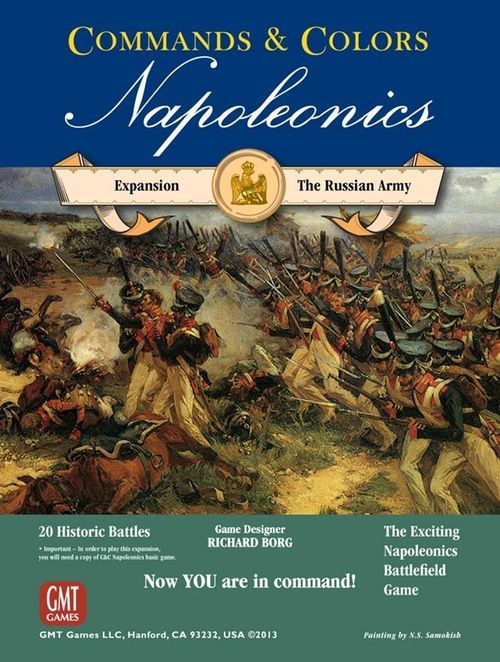
Commands & Colors: Napoleonics Expansion #2 – The Russian Army
Commands & Colors: Napoleonics Expansion #2 – The Russian Army Rulebook
Table of Contents
Table of Contents
- Contents
- National Unit Reference Chart
- Abbreviated National Unit Reference Chart
- Units and Commanders
- Visual Identification Aids
- Infantry in Square Table and Markers
- Victory Flag Tokens
- Explanations of Victory Flags
- Full-Strength Markers
- 3. New Units and Commanders
- 4. New Game Mechanic
- 5. Terrain
- Commanders
- National Characteristics Chart – French
- Artillery Chart
- Dice in Ranged and Melee Combat – Russian
- Terrain Hex Effects Table
- Scenarios
- Czarnovo – 23 December 1806
- Golymin – 26 December 1806
- Pultusk – 26 December 1806
- Mohrungen – 25 January 1807
- Plain of Eylau, Russian Rearguard – 7 February 1807
- Eylau – 8 February 1807 (8:00 to noon)
- Eylau – 8 February 1807 (Murat's Cavalry Charge)
- Heilsberg (Initial Phase) – 10 June 1807
- Friedland – 14 June 1807
- Borodino – 5 September 1812 (Schevardino Redoubt)
- Borodino – 7 September 1812 (Village of Borodino)
Contents
One sheet containing:
- 1 table for Russian infantry in square
- 4 Russian square markers
- 9 Russian tokens representing victory flags
- 6 full-strength markers
3 sheets of terrain tokens, printed on both sides.
4 sheets of labels.
1 booklet with the rules and scenarios.
220 blocks: dark green Russian units and blue French units, including:
- 130 small dark green and blue blocks for infantry units
- 55 medium dark green and blue blocks for cavalry
- 35 rectangular dark green and blue blocks for commanders and artillery
There are also some spare blocks in both colors.
National Unit Reference Chart
Each of the major powers that fought in the Napoleonic Wars has a National Unit Reference Chart. This chart details:
- The unit types and their placement codes on the map.
- The type of sticker for each indicated unit.
- The number of blocks that make up each unit.
NOTE: Not all nations had the same organization, so the number of blocks in a specific unit may differ.
- The movement of the unit in hexes.
- The specific Battle Dice modifiers for the unit and the Command card dice modifiers.
- Morale changes.
- Notes for the nation.
Abbreviated National Unit Reference Chart
This expansion also contains two Abbreviated Unit Reference Charts, with reduced graphics, so that they can be reproduced on a single sheet.
Units and Commanders
Each unit is made up of a certain number of blocks. This number may vary by unit type and nation, and is indicated on the National Unit Reference Charts.
A General, Marshal or Officer of any rank (all called commanders) is represented by a rectangular block. A single commander block is not considered a unit.
Visual Identification Aids
To help players place and recognize units, many class icons have been introduced in this expansion.
- Flaming grenade icon: Grenadier infantry. Placed in the upper left or right corner of each sticker for the following unit types – Grenadiers, Guard Grenadiers, Old Guard.
- Horn icon: Light infantry. Placed in the upper left or right corner of each sticker for the following unit types – Light, Light Fusiliers, Guard Light and Young Guard.
- Cavalry helmet icon: Heavy cavalry. Placed in the upper left or right corner of each sticker for the following unit types – Heavy, Guard Heavy, Cuirassiers.
- Horse-head icon for Horse Artillery: Placed in the upper left or right corner of each sticker for the following unit types – Horse Artillery, Guard Horse Artillery.
Line infantry and Militia, light cavalry (Light, Guard Light and Light Lancers) and foot artillery (Foot and Guard Foot Artillery) are differentiated by the absence of an icon.
Infantry in Square Table and Markers
The two infantry-in-square tables and the numbered markers are used to indicate the infantry units that formed square in the battle.
[Table image: Infantry in Square Table]
[Marker image: Square markers]
Victory Flag Tokens
These tokens represent Victory Flags and indicate the players' progress toward victory.
Various scenarios in this expansion have a Victory Flag count of 10. When Victory Flags are indicated with tokens, after the ninth token has been reached, the next enemy unit eliminated, although not indicated by a token, will be the tenth Victory Flag.
Explanations of Victory Flags
To reduce the text in the scenario notes, the following terms are used to describe some common victory conditions with Objective Hex Victory Flags.
Objective Hex – Temporary Victory Flag The Victory Flag in this objective hex is obtained immediately when a unit of the appropriate side occupies the hex. The Victory Flag is held and captured only as long as a unit of the appropriate side holds the hex. If the unit leaves the hex for any reason (movement, retreat or elimination) during its turn or during the opponent's turn, the flag is immediately lost and returned to play in its original position on the objective hex.
Objective Hex – Temporary Victory Flag (Start of Turn) The Victory Flag in this objective hex is obtained immediately when a unit of the appropriate side occupies the hex at the start of its turn. If the unit leaves the hex for any reason (movement, retreat or elimination) during its turn or during the opponent's turn, the flag is immediately lost and returned to play in its original position on the objective hex.
Group Temporary Objective Hex Victory Flag A number of hexes together form a Group Victory Flag. The appropriate side occupying all of the objective hexes obtains one or more victory flags. As long as all the objective hexes are occupied, the Victory Flags count; if any hex of the group is left unoccupied for any reason (movement, retreat or elimination) during its turn or during the opponent's turn, the flags for the group are immediately lost.
Group Temporary Objective Hex Victory Flag (Start of Turn) A number of hexes together form a Group Victory Flag. The appropriate side occupying all of the objective hexes at the start of its turn obtains one or more victory flags. As long as all the objective hexes are occupied, the Victory Flags count; if any hex of the group is left unoccupied for any reason (movement, retreat or elimination) during its turn or during the opponent's turn, the flags for the group are immediately lost.
Group Temporary Objective Hex Majority Victory Flag The Victory Flag for this group of objective hexes is obtained immediately when the appropriate side has units occupying an absolute majority of the hexes of a given group. An absolute majority means occupying more of these objective hexes than the opponent. Occupying one hex while the opponent occupies none, for example, counts as an absolute majority. The Victory Flag is kept as long as that side has the absolute majority. It is lost immediately when a side no longer has the absolute majority.
Group Temporary Objective Hex Majority Victory Flag (Start of Turn) The Victory Flag for this group of objective hexes is obtained immediately when the appropriate side has units occupying an absolute majority of the hexes of a given group at the start of its turn. An absolute majority means occupying more of these objective hexes than the opponent. Occupying one hex while the opponent occupies none, for example, counts as an absolute majority. The Victory Flag is kept as long as that side has the absolute majority. It is lost immediately when a side no longer has the absolute majority.
It is important to note that a Start-of-Turn Victory Flag is always determined at the start of a player's turn, and the Victory Flag can be lost immediately during that player's turn or the opponent's turn.
Objective Hex – Permanent Victory Flag The Victory Flag for this objective hex is obtained immediately when the appropriate side occupies the hex. The Victory Flag, once obtained, is not returned or put back into play, even if the unit subsequently leaves the hex empty for any reason.
Objective Hex – Permanent Victory Flag (Start of Turn) The Victory Flag for this objective hex is obtained immediately when the appropriate side occupies the hex at the start of its turn. The Victory Flag, once obtained, is not returned or put back into play, even if the unit subsequently leaves the hex empty for any reason.
Full-Strength Markers
These markers are used to designate Russian units that are brought up to full strength in relation to the pre-battle "Mother Russia" die roll. A full-strength marker is placed on an infantry and/or artillery unit when a block is added to the unit. The marker stays with the unit and moves together with it. It is not transferable and cannot be removed to absorb the loss of a block. When the unit is eliminated, the marker is also removed along with the unit's last block. A unit with a full-strength marker, when it recovers, may regain blocks up to its original full strength.
3. New Units and Commanders
Russian Line Infantry
- Map identification (ID) code: LN
- Blocks in the unit: 3
- Movement in hexes: 1
- Battle:
- Stationary Ranged Fire: 1 die per block
- Moving Ranged Fire: dice equal to ½ the number of blocks, rounded up
- Stationary Melee and Counterattack: 1 die per block
- Morale: may ignore 1 flag; if it retreats, it retreats 1 hex per flag
Russian Light Infantry
- Map identification (ID) code: LT
- Blocks in the unit: 3
- Movement in hexes: 1 or 2, and does not fight
- Battle:
- Stationary Ranged Fire: 1 die per block + 1 die
- Moving Ranged Fire: dice equal to ½ the number of blocks, rounded up + 1 die
- Stationary Melee and Counterattack: 1 die per block
- Morale: may ignore 1 flag; if it retreats, it retreats 1 hex per flag
Russian Grenadier Infantry
- Map identification (ID) code: GR
- Blocks in the unit: 4
- Movement in hexes: 1
- Battle:
- Stationary Ranged Fire and Counterattack: 1 die per block
- Moving Ranged Fire: dice equal to ½ the number of blocks, rounded up
- Melee: 1 die per block, plus 1 die
- Morale: may ignore 1 flag; if it retreats, it retreats 1 hex per flag
Russian Guard Light Infantry
- Map identification (ID) code: GLT
- Blocks in the unit: 4
- Movement in hexes: 1 or 2, and does not fight
- Battle:
- Stationary Ranged Fire: 1 die per block + 1 die
- Moving Ranged Fire: dice equal to ½ the number of blocks, rounded up + 1 die
- Stationary Melee and Counterattack: 1 die per block
- Morale: may ignore 2 flags; if it retreats, it retreats 1 hex per flag
Russian Guard Grenadier Infantry
- Map identification (ID) code: GG
- Blocks in the unit: 4
- Movement in hexes: 1
- Battle:
- Stationary Ranged Fire and Counterattack: 1 die per block + 1 die
- Moving Ranged Fire: dice equal to ½ the number of blocks, rounded up + 1 die
- Melee: 1 die per block, plus 1 die
- Morale: may ignore 2 flags; if it retreats, it retreats 1 hex per flag
Russian Militia Infantry
- Map identification (ID) code: MI
- Blocks in the unit: 4
- Movement in hexes: 1
- Battle:
- Stationary Ranged Fire: 1 die per block
- Moving Ranged Fire: dice equal to ½ the number of blocks, rounded down
- Stationary Melee and Counterattack: 1 die per block; does not hit with sabres except against commanders alone
- Morale: retreats 3 hexes per flag
Russian Light Cavalry
- Map identification (ID) code: LC
- Blocks in the unit: 4
- Movement in hexes: 3
- Battle (Melee only): 1 die per block
- Morale: retreats 1 hex per flag.
- Note: may retreat and reform when attacked in melee by infantry or attacked by Combined Arms infantry/artillery.
Russian Heavy Cavalry
- Map identification (ID) code: HC
- Blocks in the unit: 4
- Movement in hexes: 2
- Battle (Melee only): 1 die per block, plus 1 die
- Morale: retreats 1 hex per flag.
- Note: may retreat and reform when attacked in melee by infantry or attacked by Combined Arms infantry/artillery.
Russian Cuirassier Heavy Cavalry
- Map identification (ID) code: CU
- Blocks in the unit: 4
- Movement in hexes: 2
- Battle (Melee only): 1 die per block, plus 1 die
- Morale: may ignore 1 flag; if it retreats, it retreats 1 hex per flag.
- Note: May retreat and reform when attacked in melee by infantry or attacked by Combined Arms infantry/artillery. Ignores one hit when attacked by ranged fire from infantry. Ignores one hit when attacked at range by infantry.
Russian Guard Heavy Cavalry
- Map identification (ID) code: GHC
- Blocks in the unit: 6
- Movement in hexes: 2
- Battle (Melee only): 1 die per block, plus 1 die
- Morale: may ignore 2 flags; if it retreats, it retreats 1 hex per flag.
- Note: may retreat and reform when attacked in melee by infantry or attacked by Combined Arms infantry/artillery.
Russian Guard Light Cavalry
- Map identification (ID) code: GLC
- Blocks in the unit: 4
- Movement in hexes: 3
- Battle (Melee only): 1 die per block
- Morale: may ignore 2 flags; if it retreats, it retreats 1 hex per flag.
- Note: may retreat and reform when attacked in melee by infantry or attacked by Combined Arms infantry/artillery.
Russian Cossack Light Cavalry
- Map identification (ID) code: COS
- Blocks in the unit: 2
- Movement in hexes: 3
- Battle (Melee only): 1 die per block; does not hit with sabres except against commanders alone. Ignores the melee dice reduction in forest terrain.
- Morale: retreats 3 hexes per flag.
- Note: may retreat and reform when attacked in melee by infantry or attacked by Combined Arms infantry/artillery. When the unit is eliminated, it does not count as a Victory Flag.
Russian Foot Artillery
- Map identification (ID) code: FA
- Blocks in the unit: 3
- Movement in hexes: 1 and does not fight
- Battle: see the base rules on artillery
- Morale: retreats 1 hex per flag.
Russian Horse Artillery
- Map identification (ID) code: HA
- Blocks in the unit: 3
- Movement in hexes: 1 and fights; 2 and does not fight
- Battle: see the base rules on artillery
- Morale: retreats 1 hex per flag.
Russian Guard Foot Artillery
- Map identification (ID) code: GFA
- Blocks in the unit: 3
- Movement in hexes: 1 and does not fight
- Battle: see the base rules on artillery
- Morale: may ignore 2 flags; if it retreats, it retreats 1 hex per flag.
Russian Commander
- Map identification (ID) code: star
- Movement in hexes: 3 if alone; if assigned to a unit, it moves as that unit does.
- Battle: if alone, it cannot fight. If assigned to a unit, it modifies the number of dice a unit rolls when a Command card is played – the unit rolls one extra die.
- Morale:
- If alone = none (it must retreat after surviving melee, and will attempt to flee through enemy units if its retreat path is occupied by them)
- The unit to which the Commander is assigned may ignore one flag; if the unit retreats, the Commander must accompany it.
4. New Game Mechanic
Pre-Battle "Mother Russia" Die Roll
The Russian army took a long time to mobilize and was often committed to battle before all its units had reached full strength. The Russians also preferred to fight defensively behind entrenchments.
When the pre-battle "Mother Russia" rule is in effect, before the start of the battle the Russian commander rolls as many dice as he has Command cards.
- For each infantry symbol rolled, add one block to a line infantry unit to bring it up to full strength (4 blocks), and place a full-strength marker on the unit. The added block increases the unit's combat dice by one.
- For each cavalry symbol rolled, place a unit of Cossacks (2 blocks) on an empty hex (no unit) adjacent to an already deployed Russian unit.
- For each artillery symbol rolled, add an artillery block to an artillery unit to bring it up to full strength (4 blocks), and place a full-strength marker on the unit. The added block does not increase the unit's combat dice.
- For each sabre symbol rolled, place an available Field Fortification (with only 2 covered sides) in a hex containing an infantry or artillery unit. If the unit is already in a terrain hex, replace the terrain hex with one that contains the terrain and the field fortification.
- For each flag symbol rolled, add a block to a light infantry unit to bring it up to full strength (4 blocks), and place a full-strength marker on the unit. The added block increases the unit's combat dice by one.
OR
For each flag symbol rolled, you may choose to perform one of the four actions described above, unless the action is prohibited in the scenario notes:
- At most 1 block may be added to a unit, in total.
- Normally, in a scenario where the Russian army is already deployed in field fortifications, a sabre symbol does not place field works. This is indicated in the scenario notes with the wording "The Mother Russia pre-battle rule is in effect. Sabre dice rolls have no effect." Cossack cavalry may not be deployed if the cavalry symbol is rolled if the scenario notes state "Cavalry dice rolls have no effect."
5. Terrain
Field Fortifications with 2 and 4 Sides
This expansion includes Fortifications with 2 and 4 sides. They have all the characteristics of 3-sided Fortifications except for the number of hex sides covered. Note that an infantry unit in a Field Fortification hex cannot form square when it is attacked by cavalry through a hex side with field fortification. However, an infantry unit in a Field Fortification hex can form square when it is attacked by cavalry through a hex side that has no field works.
Church
A Church has all the characteristics and effects of a Town terrain. In addition, a unit in a Church hex may ignore one flag. Consult the base terrain rules for further details.
Marsh
Movement: An infantry, cavalry or commander unit entering a Marsh hex must stop and may not move further that turn. A Marsh hex is impassable terrain for artillery units. An infantry unit may not form square in a Marsh hex.
Combat: A unit may fight in the turn in which it moves into a Marsh hex. A unit in a Marsh hex reduces the dice it rolls in combat by 1 in both ranged fire and melee.
When attacking an enemy unit or commander in a Marsh hex, a unit rolls 1 die fewer in melee, but ranged combat remains unchanged.
Line of Sight: A Marsh hex does not block line of sight.
Lake
Normally, Lake hexes are impassable terrain. A Lake hex does not block line of sight.
Frozen Lake
Movement: A unit or commander entering a Frozen Lake hex must stop and may not move further that turn. An infantry unit may not form square in a Frozen Lake hex.
Combat: A unit may fight in the turn in which it moves into a Frozen Lake hex. A unit in a Frozen Lake hex reduces the dice it rolls in combat by 1 in both ranged fire and melee.
When attacking an enemy unit or commander in a Frozen Lake hex, a unit rolls 1 die fewer in melee, but ranged combat remains unchanged.
Line of Sight: A Frozen Lake hex does not block line of sight.
Ranged Combat Table
Dice roll (across the top) / target type in range (down the side)
| Attacker \ Dice result | Infantry symbol | Cavalry symbol | Artillery symbol | Sabre | Flag |
|---|---|---|---|---|---|
| Infantry unit | Assign one hit | – | – | – | Assign one retreat. Note 2 |
| Cavalry unit | – | Assign one hit – Note 3 | – | – | Assign one retreat. Note 2 |
| Artillery unit | – | – | Assign one hit | – | Assign one retreat. Note 2 |
| Commander alone in a hex | – | – | – | – | – |
Melee Combat Table
Dice roll (across the top) / target type (down the side)
| Attacker \ Dice result | Infantry symbol | Cavalry symbol | Artillery symbol | Sabre | Flag |
|---|---|---|---|---|---|
| Infantry unit | Assign one hit. | – | – | Assign one hit. Note 5 | Assign one retreat. Notes 2, 8 |
| Cavalry unit | – | Assign one hit. | – | Assign one hit. Note 5 | Assign one retreat. Notes 2, 8 |
| Artillery unit | – | – | Assign one hit. | Assign one hit. Note 5 | Assign one retreat. Notes 2, 8 |
| Commander alone in a hex | – | – | – | Assign one hit. Note 5 |
Note 1: Some terrain types reduce the number of dice rolled.
Note 2: Some units of this class may ignore one or more Flags. See the National Characteristics Chart. Some terrain types allow units to ignore one flag.
Note 3: Cuirassiers ignore one hit from infantry.
Note 4: If the unit to which the commander is assigned suffers one or more hits but remains on the battlefield, the commander makes a loss check. Roll two dice. If two Sabres are obtained, the commander is hit and eliminated. Otherwise he survives and remains assigned to the unit.
If the unit is eliminated, the commander makes a loss check. Roll one die. If a Sabre is obtained, the commander is hit and eliminated. Otherwise the commander survives and must retreat 1, 2 or 3 hexes.
Note 5: Light Fusilier units and all Militia units do not hit with sabres in melee, except when rolling against a commander alone.
Note 6: Flags are ignored. Commanders alone are not hit in melee but retreat 1, 2 or 3 hexes.
Note 7: The assigned commander allows the unit to ignore one flag.
Note 8: Light Lancer cavalry always re-rolls one flag, except against Cuirassiers.
Commanders
Chart columns: French / Russian (commander icons), Blocks, State, Movement in hexes, Battle modifiers, Morale changes, Notes.
| Blocks | State | Movement in hexes | Battle modifiers | Morale changes | Notes |
|---|---|---|---|---|---|
| 1 | Alone | 1, 2 or 3 hexes | Must retreat after surviving melee * | None | * Must attempt to escape through enemy units blocking the retreat |
| 1 | Assigned to a unit | As the unit | The unit rolls +1 die when the Command card is played | May ignore 1 flag | None |
National Characteristics Chart – French
| Unit | Blocks per unit | Movement | Battle modifiers | Range | Stationary fire | Moving fire | Melee |
|---|---|---|---|---|---|---|---|
| Line Infantry (LN) | 4 | 1 | Rolls 1 extra die in melee. | 2 | 1 die per block | ½ die per block, rounded up per hex | 1 die per block +1 die against infantry |
| Light Infantry (LT) | 4 | 1 / 2 no combat | Rolls 1 extra die in ranged combat. | 2 | 1 die per block +1 die | ½ die per block, rounded up +1 die | 1 die per block |
| Grenadier Infantry (GR) | 4 | 1 | Rolls 1 extra die in melee. Ignores 1 flag. |
National Characteristics Chart – French: Artillery
| Unit | Blocks per unit | Movement | Battle modifiers | Range | Stationary fire | Moving fire | Melee |
|---|---|---|---|---|---|---|---|
| Foot Artillery (FA) | 3 | 1 | Cannot move and fight. | 5 | See Artillery Chart | NO | See Artillery Chart |
| Horse Artillery (HA) | 3 | 1 / 2 no combat | May move 1 hex and fight, but may not fire at range 4 in that case. | 4 | See Artillery Chart | See Artillery Chart | See Artillery Chart |
| Guard Foot Artillery (GFA) | 3 | 1 | Cannot move and fight. Rolls 1 extra die in melee. Ignores 2 flags. |
Artillery Chart
Foot Artillery & Guard – Range 5 hexes (4 hexes if reduced to 1 block). Number of blocks: 2-3 (upper figure in each hex) and 1 (lower figure). The figure in each hex is the number of battle dice rolled at that distance. Distance 1 is Melee; distances 2 to 5 are Ranged Combat.
| Distance (hexes) | 1 (Melee) | 2 | 3 | 4 | 5 |
|---|---|---|---|---|---|
| 2-3 blocks | 4* | 3 | 2 | 1 | 1 |
| 1 block | 3* | 2 | 1 | 1 | – |
* Guard foot artillery rolls one extra die in melee.
Horse Artillery – Range 4 hexes (3 hexes if reduced to 1 block). Number of blocks: 2-3 (upper figure) and 1 (lower figure).
| Distance (hexes) | 1 (Melee) | 2 | 3 | 4 |
|---|---|---|---|---|
| 2-3 blocks | 3* | 2 | 1 | 1/0** |
| 1 block | 2* | 1 | [not legible – covered by the "Fire" caption in the printed chart] | – |
* Guard horse artillery rolls one extra die in melee. ** May not fire at range 4 if it moves (value 0 when it has moved). † May not move and fight.
Editor's note: in the printed horse-artillery chart, the 1-block figure at range 3 is covered by a "Fire" caption and is not legible in the source file. It is left blank rather than guessed; check the Spanish alternate printing before relying on it.
Note printed beneath the French chart: British infantry units that move one hex and engage in ranged combat roll a number of dice equal to half the number of blocks remaining, rounded up.
Dice in Ranged and Melee Combat – Russian
| Unit | Ranged combat dice – STATIONARY | Ranged combat dice – MOVED | Melee dice |
|---|---|---|---|
| Line Infantry | 1 per block | ½ # of blocks, rounded up | 1 per block |
| Light Infantry | 1 per block + 1 | ½ # of blocks, rounded up + 1; 2 hexes, no combat | 1 per block |
| Grenadier Infantry | 1 per block | ½ # of blocks, rounded up | 1 per block + 1 |
| Guard Light Infantry | 1 per block + 1 | ½ # of blocks, rounded up + 1; 2 hexes, no combat | 1 per block |
| Guard Grenadier Infantry | 1 per block + 1 | ½ # of blocks, rounded up + 1 | 1 per block + 1 |
| Militia Infantry | 1 per block |
Terrain Hex Effects Table
Melee / Fire modifier: if only one number is given, it applies to both types of combat. Columns for battle dice reduction are Infantry (Fant), Cavalry (Cav) and Artillery (Art).
| Terrain | Effect on movement | Battle dice reduction – Fant | Cav | Art | Blocks line of sight? | Can infantry form square? | Effect on defender's morale |
|---|---|---|---|---|---|---|---|
| Marsh – moving or fighting into | Must stop | -1 / 0 | -1 / NO | -1 / 0 | NO | NO | – |
| Marsh – moving or fighting out of | None | -1 | -1 | NO | |||
| Church – moving or fighting into | Must stop ⁴ | -2 |
Footnotes (as printed):
- Melee / Fire modifier: if there is only one number, it applies to both types of combat.
- 4 A unit may not fight in the turn in which it moves into a Church hex.
- 5 A cavalry unit that receives orders from a "Charge" Command card and fights in or out of a Church hex does not receive additional battle dice.
- 9 The effects on movement, combat and morale apply only when moving or attacking through a hex side with Field Fortifications.
- 9 (exception) An infantry unit in a Field Fortifications hex may form square when attacked by cavalry through a hex side that has no field fortification.
Editor's note: the printed chart gives no text for footnotes 6, 7 and 8 as numbered; the footnotes above are transcribed as printed.
Scenarios
The map of each scenario is printed in the source booklet and is not reproduced here; only the scenario notes are transcribed.
Czarnovo – 23 December 1806
Notes
Russian army
- Commander: Ostermann-Tolstoy
- 4 Command cards
French army
- Commander: Napoleon (III Corps of Davout)
- 6 Command cards
- Moves first
Victory 7 Victory Flags
Special rules
- The two Bridge hexes are a Group Temporary Objective Hex that gives a Victory Flag to the side occupying both Bridge hexes at the start of its turn.
- The two Czarnowo town hexes are a Group Temporary Majority Objective Hex that gives a Victory Flag to the side occupying the absolute majority of the Czarnowo town hexes at the start of its turn.
- At the start of its turn, the French obtains one Victory Flag for each Russian field fortification hex that is not occupied by a Russian unit. As long as the field fortification remains unoccupied, the French keeps the Victory Flag.
- The Narew River is impassable.
- The Wkra watercourse is fordable.
- The Mother Russia pre-battle rule is in effect. Sabre dice rolls have no effect.
Golymin – 26 December 1806
Notes
Russian army
- Commander: Golitsyn
- 5 Command cards
French army
- Commander: Augereau
- 5 Command cards
- Moves first
Victory 8 Victory Flags
Special rules
- The Russian obtains a Victory Flag for each Russian unit, excluding commanders, that exits the battlefield from any hex on the Russian side in the left section of the Russian army.
- The Mother Russia pre-battle rule is in effect.
Pultusk – 26 December 1806
Notes
Russian army
- Commander: Benningsen
- 5 Command cards
French army
- Commander: Lannes
- 5 Command cards
- Moves first
Victory 10 Victory Flags
Special rules
- The 4 hexes of the Mostachin Wood are a Group Temporary Majority Objective Hex that gives a Victory Flag to the side occupying the absolute majority of those hexes at the start of its turn.
- The French obtains one Temporary Victory Flag for each hill hex occupied on the ridge behind the Mosin Heights at the start of the turn.
- The French obtains one Temporary Victory Flag for each town hex occupied at the start of the turn.
- The Bridge hex is a Permanent Victory Flag Objective that is worth one flag to the French when occupied at the start of the turn.
- The Narew River is impassable.
- The Mother Russia pre-battle rule is in effect.
Mohrungen – 25 January 1807
Notes
Russian army
- Commander: Markov
- 4 Command cards
French army
- Commander: Bernadotte
- 4 Command cards
- Moves first
Victory 7 Victory Flags
Special rules
- Flanking Force: Place a Russian Commander block in the hex in the lower right corner of the battlefield; it represents a cavalry formation outflanking the enemy. The Russian advances the Commander block one hex along the French baseline toward Mohrungen each time a "Scout" Command card is played by either side, or when the Russian plays a Leadership Command card. When the block enters a Mohrungen hex, the Russian immediately obtains 3 Victory Flags. The block representing the flanking force cannot be eliminated, and its movement is not blocked when units or commanders occupy a baseline hex.
- Each of the 4 town hexes of Pfarrersfeldchen is a Temporary Victory Flag Objective, each worth 1 Victory Flag at the start of the turn to the French.
- The lakes are frozen.
- The Mother Russia pre-battle rule is in effect. Sabre dice rolls have no effect.
Plain of Eylau, Russian Rearguard – 7 February 1807
Notes
Russian army
- Commander: Bagration
- 5 Command cards
French army
- Commander: Soult
- 5 Command cards
- Moves first
Victory 7 Victory Flags
Special rules
- The French achieves an Immediate Victory if one of its units occupies any Eylau town hex at the start of its turn.
- The lakes are frozen.
- The Mother Russia pre-battle rule is in effect.
Eylau – 8 February 1807 (8:00 to noon)
Map legend: Church = Chiesa; Windmill = Mulino a Vento
Notes
Russian army
- Commander: Benningsen
- 5 Command cards
French army
- Commander: Napoleon
- 6 Command cards
- Moves first
Victory 7 Victory Flags
Special rules
- The French obtains a Temporary Victory Flag for each Eylau town hex it occupies at the start of the turn.
- The French obtains a Temporary Victory Flag for each hill hex occupied by the Russian side of the battlefield (4 hexes or closer to the Russian baseline) at the start of the turn.
- The lakes are frozen.
- The Mother Russia pre-battle rule is NOT in effect.
Eylau – 8 February 1807 (Murat's Cavalry Charge)
Map legend: Church = Chiesa; Windmill = Mulino a Vento
Notes
Russian army
- Commander: Benningsen
- 5 Command cards
French army
- Commander: Napoleon
- 6 Command cards
- Moves first
Victory 9 Victory Flags
Special rules
- The Russian obtains a Temporary Victory Flag for each Eylau town hex it occupies at the start of the turn.
- The Russian obtains an immediate victory when 5 French cavalry units are eliminated. Each Eylau town hex occupied counts as one eliminated cavalry unit when checking for immediate victory.
- The French obtains an immediate victory when all three Russian artillery units have been eliminated.
- The lakes are frozen.
- The Mother Russia pre-battle rule is NOT in effect.
Heilsberg (Initial Phase) – 10 June 1807
Notes
Russian army
- Commander: Benningsen
- 5 Command cards
French army
- Commander: Napoleon
- 6 Command cards
- Moves first
Victory 8 Victory Flags
Special rules
- Each town hex of Langwiese and Beverinck is a Temporary Victory Flag for the French at the start of the turn.
- The Russian obtains a Temporary Victory Flag for each town hex it occupies, and begins the battle with a Victory Flag because it occupies a town hex.
- The Alle River is impassable.
- The Bevernick stream does not block movement, but has the battle restrictions of a fordable stream.
- The Mother Russia pre-battle rule is in effect.
Friedland – 14 June 1807
Notes
Russian army
- Commander: Benningsen
- 5 Command cards
French army
- Commander: Napoleon
- 6 Command cards
- Moves first
Victory 8 Victory Flags
Special rules
- The Alle River is impassable.
- The Mill stream is fordable. Fords do not block movement.
- The Mother Russia pre-battle rule is in effect.
Borodino – 5 September 1812 (Schevardino Redoubt)
Russian army
- Commander: Gorchakov
- 5 Command cards
French army
- Commander: Compans
- 6 Command cards
- Moves first
Victory 10 Victory Flags
Special rules
- The French obtains a Victory Flag for each town hex that the Russian does not occupy at the start of the French turn.
- The Russian obtains a Victory Flag at the start of its turn when a Russian unit occupies the Schevardino Redoubt.
- The French obtains two Victory Flags at the start of its turn when a French unit occupies the Schevardino Redoubt.
- The French obtains a Victory Flag for each French unit that exits the battlefield from any Russian baseline hex.
- The Mother Russia pre-battle rule is in effect. Cavalry and sabre results have no effect.
Borodino – 7 September 1812 (Village of Borodino)
Russian army
- Commander: Dokhturov
- 5 Command cards
French army
- Commander: Eugene
- 5 Command cards
- Moves first
Victory 7 Victory Flags
Special rules
- The two Borodino hexes are a Group Temporary Majority Objective Victory Flag worth one flag to the side occupying the absolute majority of these hexes at the start of its turn.
- The French obtains a Victory Flag at the start of its turn for each French unit occupying a hill hex on the Russian side of the river.
- The Russian obtains a Victory Flag for each Russian cavalry unit that exits the battlefield from a French baseline hex.
- The Kalatsha River is fordable. Fords do not block movement.
- The Mother Russia pre-battle rule is in effect. Cavalry and sabre results have no effect.
Borodino – 7 September 1812 (Utitza)
Notes
Russian army
- Commander: Tutchkov
- 5 Command cards
French army
- Commander: Poniatowski
- 5 Command cards
- Moves first
Victory 7 Victory Flags
Special rules
- The two Utitza hexes are a Group Temporary Majority Objective Victory Flag worth one flag to the side occupying the absolute majority of these hexes at the start of its turn.
- The Mother Russia pre-battle rule is in effect. Cavalry and sabre results have no effect.
Borodino – 7 September 1812 (Raevski Redoubt)
Notes
Russian army
- Commander: Kutuzov
- 5 Command cards
French army
- Commander: Napoleon
- 6 Command cards
- Moves first
Victory 10 Victory Flags
Special rules
- Semyanovskaya is a Temporary Victory Flag worth one flag to the side occupying it at the start of its turn.
- The French obtains a Temporary Victory Flag for each Field Fortification hex that the Russian does not occupy at the start of the French turn.
- The Semenovka stream is fordable. The stream does not block infantry movement or cause any battle restriction for infantry units.
- The Mother Russia pre-battle rule is in effect. Cavalry and sabre results have no effect.
Polotsk – 18 October 1812
Notes
Russian army
- Commander: Wittgenstein
- 5 Command cards
- Moves first
French army
- Commander: Saint-Cyr
- 5 Command cards
Victory 8 Victory Flags
Special rules
- The two Polotsk hexes are a Temporary Victory Flag worth one flag each to the Russian at the start of its turn.
- The Mother Russia pre-battle rule is in effect. Cavalry and sabre results have no effect.
Maloyaroslavets – 24 October 1812
Notes
Russian army
- Commander: Dokhturov
- 5 Command cards
- Moves first
French army
- Commander: Eugene
- 5 Command cards
Victory 10 Victory Flags
Special rules
- The 5 hexes of Maloyaroslavets are a Group Temporary Majority Objective Victory Flag worth two flags to the side occupying the absolute majority of these hexes at the start of its turn.
- The Church is a Temporary Victory Flag worth one flag to the Russian at the start of its turn.
- The Bridge is a Temporary Victory Flag worth one flag to the Russian at the start of its turn.
- The Luzha River is impassable.
- The Mother Russia pre-battle rule is in effect. Sabre results have no effect.
Krasnoi – 17 November 1812
Notes
Russian army
- Commander: Kutuzov
- 8 Command cards*
- Moves first
* The asterisk is printed in the source after the card count; no footnote text accompanies it in the printed scenario.
French army
- Commander: Napoleon
- 6 Command cards
Victory 7 Victory Flags
Special rules
- The Russian loses one Command card, chosen at random, for each unit of Davout's line that exits the battlefield.
- The 6 units of Davout's line each begin the battle with 2 blocks. The French obtains a Victory Flag when two of the units of Davout's line exit the battlefield from the designated French baseline hex. One more flag is obtained for each line unit that subsequently exits.
- The Russian obtains a Victory Flag for every 2 units of Davout's line eliminated.
- The village of Uvarovo is a Temporary Victory Flag worth two flags to the side occupying it at the start of its turn.
- The Bridge is a Temporary Victory Flag worth one flag to the Russian at the start of its turn.
- Both streams are fordable, but have no battle restrictions.
- There is no Mother Russia die roll.
Crossing of the Berezina – 27/28 November 1812
Notes
Russian army
- Commander: Wittgenstein
- 5 Command cards
- Moves first
French army
- Commander: Napoleon
- 6 Command cards
Victory 7 Victory Flags
Special rules
- The Berezina River is impassable.
- The Mother Russia pre-battle rule is in effect. Sabre results have no effect.
Champaubert – 10 February 1814
Notes
Russian army
- Commander: Olsufiev
- 4 Command cards
French army
- Commander: Marmont
- 5 Command cards
- Moves first
Victory 5 Victory Flags
Special rules
- French line infantry is conscripted and does not receive an additional melee die when attacking enemy infantry.
- There is no Mother Russia die roll.
Montmirail – 11 February 1814
Notes
Russian army
- Commander: Sacken
- 5 Command cards
- Moves first
French army
- Commander: Napoleon
- 6 Command cards
Victory 6 Victory Flags
Special rules
- French line infantry is conscripted and does not receive an additional melee die when attacking enemy infantry.
- The Petit Morin stream is fordable.
- The Mother Russia pre-battle rule is in effect. Sabre and cavalry results have no effect.
Craonne – 7 March 1814
Notes
Russian army
- Commander: Voronzov
- 5 Command cards
French army
- Commander: Napoleon
- 6 Command cards
- Moves first
Victory 10 Victory Flags
Special rules
- French line infantry is conscripted and does not receive an additional melee die when attacking enemy infantry.
- The Mother Russia pre-battle rule is in effect. Sabre and cavalry results have no effect.