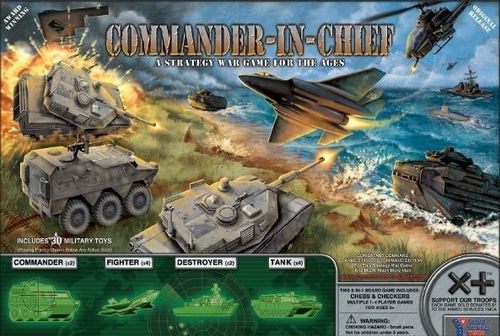
Commander-In-Chief
Commander-In-Chief Rulebook
Table of Contents
Table of Contents
Components
- 30 Playing Pieces (military toys)
- 30 Platform Bases (stackable spinning tops / triangle puzzle game markers)
- 10 Aerial Platform Bases (tic-tac-toe markers)
- 1 One Minute Sand Timer
- 1 Double Sided Game Board
- 1 Game Rules
- 2 Quick Start Guides
Object of the Game
To capture your opponent's Commander. (In this version of the game, the players decide per game whether to have set time limits for each move.)
... or ...
To outscore your opponent, as determined by summing the values per side of the captured playing pieces. (In this version of the game, each move and the overall length of the game have set time limits.)
... or ...
To force a concession of defeat from your opponent. (A player (team) can concede defeat at any point during the game in either of the two game options listed above.)
Board Set Up
Commander-In-Chief is a game that is played warring two opposing armed forces represented by specially designed playing pieces that are mounted on Platform Bases and placed on a game board comprised of sixty four alternating dark and light colored squares arranged in eight lines of eight squares each, i.e., the traditional checkerboard. The square board is set up for play orientated in a diamond shape so that a dark colored square is always positioned at the top and bottom of the board, as the single square in the First row closest to each player's seated position. Progressing toward the center of the board, the Second row per side contains two light colored squares; the Third row per side contains three dark colored squares, and so on and so forth.
All sixty four squares on the board are given their own alphanumeric name ranging from "a1" to "h8" as defined on the included game board by the intersection of a letter and a number assigned to each line. Collectively, this nomenclature is used as a system for notating the placements and movements of the playing pieces in the game. For proper set up, the single square in the First row at the bottom of the board must be Square "a1".
Due to this unique set up of the traditional checkerboard, a brief explanation of the playing pieces' directional movements is necessary. Orthogonal player moves (Forward, Backward, Left and Right) are moves that connect dark to dark and light to light colored squares to each other across their single mating point; whereas diagonal player moves (Forward Left, Forward Right, Backward Left and Backward Right) are moves that connect dark and light colored squares to each other across their mating borderline. To summarize, the playing pieces' directional movements can be described in relation to each player's seated position via any one of the following eight independent directions: Forward, Forward Left, Forward Right, Left, Right, Backward, Backward Left or Backward Right.
The battlefields of the game are Through the Air, On Land and In the Sea (Air, Land and Sea). The playing pieces can only move within their designated battlefields. The fifteen squares per side that are occupied by the players' playing pieces at the start of the game (thirty total) represent the Land areas of the board. The thirty four squares that are unoccupied squares at the start of the game represent the Sea areas of the board. While each square uniquely represents either a Land area or a Sea area of the board, every square (Land or Sea) simultaneously represents an Air area of the board. Additionally, the game board is double sided so that the game can be played on either a dark and light colored or multicolored checkerboard.
The eight specially designed playing pieces (thirty total) are set up on the game board per side as follows: First row – Commander; Second row – Fighter, Fighter; Third row – Tank, Bomber, Tank; Fourth row – Submarine, Helicopter, Helicopter, Submarine; Fifth row – Amphibian, Amphibian, Destroyer, Amphibian, Amphibian. The two opposing armed forces are distinguishable by color, one dark and one light. The starting position of the Commander of the light colored armed forces is always Square "a1". The playing pieces are mounted on either Platform Bases (if they compete On Land or In the Sea) or Aerial Platform Bases (if they compete Through the Air); Commanders, Bombers and Destroyers are distinguished as leaders of their respective divisions within the armed forces by adding a second Platform Base underneath them. Once the board is set up, each player (team) as Commander-In-Chief of one of the two armed forces must command the services of their fifteen playing pieces toward victory.
Game Play
Commander-In-Chief is a strategy war game for two (to four) players. To begin play, one player (team) selects the dark and one player (team) selects the light colored armed forces to be in command of throughout the game. Each player places their playing pieces on the game board in their starting positions. When ready, the players take alternating turns moving their playing pieces one by one about the board, either to an unoccupied square or to an opponent occupied square, and in the latter case, capturing opponent's playing piece from that square as only one playing piece may occupy any given square at any single moment in time. Once a playing piece is captured, it is permanently removed from the game. The playing pieces can only move along straight, unobstructed paths, unless stated otherwise. The playing pieces that can Go Under or Go Over can jump (go around) other playing pieces. Jumping playing pieces does not result in their capture. Only one playing piece may be moved on a single turn and the player (team) with the dark colored playing pieces always moves first. The players must move on their turn. A turn is officially over when a player physically releases contact with one of their playing pieces at a new position. Play evolves, turn by turn, from the beginning of the war through the game's eventual completion with each player analyzing the current battlefield situation, adjusting their game plan accordingly and executing commands (movements of the playing pieces) in a collective effort to achieve the game's objective.
In the team version of the game, one player is in command of the five Air playing pieces and one player is in command of the ten Land and Sea playing pieces. Thus, if this game option is exercised, Commander-In-Chief can be played by three or four players if one or both sides decide to form a team. The player in command of the ten Land and Sea playing pieces always moves first. In team game play, in addition to the two armed forces alternating turns, the players within a team must alternate turns, if possible. Once play begins, teammates cannot discuss strategy.
To record point totals for scoring purposes, each player (team) adds together the values for all the playing pieces they have captured per the following point ranking system: Amphibian – 1 point, Tank – 2 points, Submarine – 3 points, Destroyer – 3 points, Helicopter – 4 points, Fighter – 4 points, Bomber – 5 points, Commander – 7 points.
A one minute sand timer is included for play requiring time limits (per move – one minute and per game – X minutes (or turns) as arbitrarily agreed to per game by the players). From the beginning of or at any point during the game, the players can use the sand timer as a tool to enforce the per move and/or per game time limits.
Playing Piece Moves
The rulebook's diagrams for these pieces (example positions, multi-blocking examples and starting positions) are not reproduced here.
Amphibians
Amphibians compete – On Land and In the Sea. Amphibians can move one square in any one of three forward directions (Forward, Forward Left or Forward Right). Amphibians are unique in that if an Amphibian reaches its opponent's Land, it becomes a King Amphibian. King Amphibians are distinguished from Amphibians by adding a second Platform Base underneath them. If an Amphibian becomes a King Amphibian, its mobility changes. King Amphibians can move one or two squares in any direction along a straight path, either orthogonally to the players (Forward, Backward, Left or Right) or diagonally to the players (Forward Left, Forward Right, Backward Left or Backward Right).
Submarines
Submarines compete – In the Sea. Submarines can move one or two squares in any one of six directions along a straight path, either horizontally to the players (Left or Right) or diagonally to the players (Forward Left, Forward Right, Backward Left or Backward Right). Submarines have a restriction on their first move of the game. To launch into water, their first move of the game must be one square Forward. Submarines are submersible warships that can jump (Go Under) other playing pieces during a two square move and thus, not be blocked by other playing pieces that would otherwise obstruct the completion of a two square move.
Destroyers
Destroyers compete – In the Sea. Destroyers, also known as Commanders of the Sea, can move one square in any direction, either orthogonally to the players (Forward, Backward, Left or Right) or diagonally to the players (Forward Left, Forward Right, Backward Left or Backward Right). Like Submarines, Destroyers have a restriction on their first move of the game. To launch into water, these surface combatant warships' first move of the game must be one square in any one of three forward directions (Forward, Forward Left or Forward Right).
Tanks
Tanks compete – On Land. Tanks can move one or two squares in any one of four directions along a straight path, diagonally to the players (Forward Left, Forward Right, Backward Left or Backward Right). Tanks can block; thus they cannot be jumped by ANY playing pieces. Tanks are restricted to movement On their own Land only.
Helicopters
Helicopters compete – Through the Air. While Helicopters are unique in that they are not restricted to movement only along a straight path via any one of the eight independent directions (Forward, Forward Left, Forward Right, Left, Right, Backward, Backward Left or Backward Right), they must move a distance of exactly two squares. Helicopters can move to any one of sixteen squares that are at a two square radial distance away from their previous position. Helicopters, via short range low altitude attacks, can jump (Go Over) other playing pieces during their two square move and thus, not be blocked by other playing pieces that would otherwise obstruct the completion of a two square move. The playing pieces that can block jumping prevent a Helicopter's movement along a straight path as well as movement to the two available object squares bordering that same straight path. Two unique examples of multi-blocking are shown below where minus signs represent playing pieces that can block.
Fighters and Bombers
Fighters and Bombers compete – Through the Air. Both Fighters and Bombers are stealth warplanes that move in exactly the same manner, with one exception. Fighters and Bombers can move either one, two or three squares in any one of four directions along a straight path, orthogonally to the players (Forward, Backward, Left or Right) or one or two squares in any one of four directions along a straight path, diagonally to the players (Forward Left, Forward Right, Backward Left or Backward Right). The exception: Only Bombers, via long range high altitude attacks, can jump (Go Over) other playing pieces during a multiple square move and thus, not be blocked by other playing pieces that would otherwise obstruct the completion of a multiple square move; whereas Fighters can be blocked from completing a multiple square move if other playing pieces obstruct their movement. Also, like Tanks, Bombers can block; thus they cannot be jumped by ANY playing pieces.
Commanders
Commanders compete – On Land and In the Sea. Commanders are amphibious vehicles that can move either one square in any direction, On their own Land and In the Sea, either orthogonally to the players (Forward, Backward, Left or Right) or diagonally to the players (Forward Left, Forward Right, Backward Left or Backward Right) or one or two squares in any direction along a straight path, On their opponent's Land, either orthogonally to the players (Forward, Backward, Left or Right) or diagonally to the players (Forward Left, Forward Right, Backward Left or Backward Right). Any movement between a Land area and a Sea area of the board is limited to a one square move.
Draw
Any game that ends in a tie or where no one player (team) can win is called a draw, neither a win nor a loss for either side. Also, if the players choose not to continue a game for any reason, they may agree to call it a draw.
Advanced Options
In the advanced options version of the game, Commander-In-Chief is played with various combinations of enhanced playing pieces. The advantage of an enhanced playing piece is that it must be attacked twice to be removed from the game. In advanced options game play, each player (team) can independently enhance from zero to five of their fifteen playing pieces. The two opposing armed forces do not have to have the same enhancements. Each player (team) must decide per game how many and which of its playing pieces to enhance. The enhanced playing pieces are distinguished from the regular playing pieces by adding a second Platform Base underneath them during board set up. In advanced options game play, Commanders, Bombers and Destroyers only receive a second Platform Base added underneath them if they are chosen as enhanced playing pieces. When a player uses a turn to attack an enhanced playing piece, no playing pieces physically move. An attack on an enhanced placing piece consists of an offensive player officially detailing a target attack and a defensive player removing the second Platform Base from underneath the enhanced playing piece being attacked. Once a playing piece loses its enhancement, its capture occurs according to regular game play instructions.
In advanced options game play, additional Platform Bases underneath an Amphibian can represent that the Amphibian is an enhanced Amphibian, a King Amphibian or an enhanced King Amphibian. For clarification, enhanced Amphibians are distinguished from Amphibians by adding a second Platform Base underneath them while King Amphibians are distinguished from Amphibians by adding an opponent's Platform Base underneath them. Finally, enhanced King Amphibians are distinguished from Amphibians by adding a second Platform Base and an opponent's Platform Base underneath them. The players never use their opponent's Platform Bases during regular game play.
Alternate Game Configurations
The players' ability to enhance from zero to five of the fifteen pieces per side creates thousands of unique military scenarios between the two opposing armed forces. Also, through advanced options game play, an imbalanced number and/or combination of enhanced playing pieces can be used to even the playing field between players of various skill levels. For example, one player (team) could enhance the Commander, the Bomber, the Destroyer and the two Fighters while the other player (team) does not. Under another scenario, one player (team) could enhance the two Fighters and the two Helicopters while the other player (team) enhances the Commander, the two Fighters and two of the Amphibians. Military themes can also be the basis for enhancements. For instance, one player (team) could enhance the five playing pieces that compete Through the Air while the other player (team) enhances the two playing pieces that compete strictly On Land combined with the three playing pieces that compete strictly In the Sea. Yet another option could be for the players to simply enhance the two Commanders. Via playing piece enhancements, the players are given the freedom to create the game they want to play.
For additional game play options and much, much more visit www.Commander-In-Chief.com.