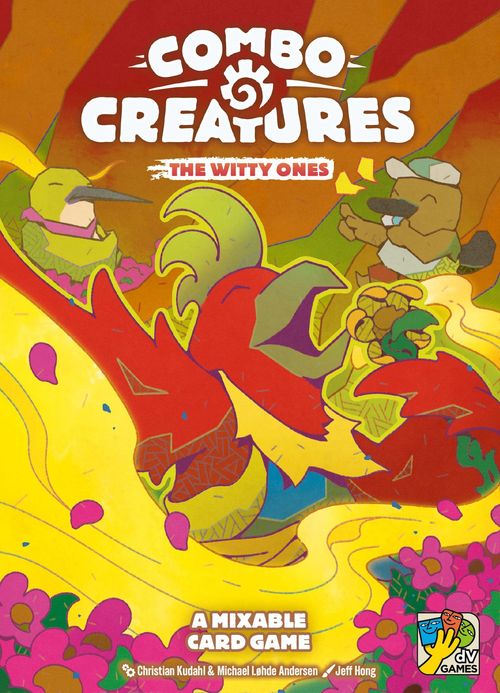
Combo Creatures: The Witty Ones
Combo Creatures: The Witty Ones Rulebook
Table of Contents
Table of Contents
Contents
- 120 Creature cards
- 70 Starter deck cards (this deck is identified by a disclaimer card)
- 50 extra creature cards
- 12 Randomizer cards
- 1 First Player token
- 12 Dividers
- Quick guide
- This Rulebook
Creature sets included in this box: Builder, Captain, Clockmaker, Coach, Cultist, Detective, Florist, Painter, Performer, Politician, Tax Collector, Traveler.
Cards
Each card has a type (A) and an illustration (B). A number of coins is shown in the top left of the card (C) and the bottom right of the image (D) as a reminder.
Coins indicate 2 things: 1) how many cards it costs to play that creature and 2) their value in points at the end of the game.
The symbol (E) before the name shows the box this creature belongs to. In Combo Creatures, you can mix cards from different boxes to experiment with new decks! The symbols help you sort the cards out when you're finished.
The symbol (F) in the bottom right of the card is used for deck construction (see Deck Construction Rules).
Finally, each card has an ability which you may use when you play it (G).
Each creature type comes as a set of 10 mostly identical cards. Those cards differ only in the number of coins shown:
- 2 cards show 3 coins,
- 3 cards show 2 coins,
- 5 cards show 1 coin.
Each creature set also has a matching Randomizer card (do not shuffle these into the deck).
Setup
- If this is your first game, take the Starter deck, shuffle it, and skip the next step.
- Choose 7 sets of Creature cards to play with. Shuffle the 7 chosen sets into a deck (the deck will have 70 cards). Follow the rules explained below in the Deck Construction box to form the deck.
- Optional: Find the 7 Creature Randomizer cards matching those in play and place them to one side of the table as a reminder for the creature abilities in play.
- Deal each player 5 cards from the deck into their hand. Keep the cards in your hand secret until played.
- Reveal 5 cards in the center of the playing area. This display of cards is called The Wild.
- Whoever has visited a forest most recently is the starting player, who takes the token and flips it to the front side.
Play area: the Wild in the center; each player has an area for their played cards, a personal discard pile, a hand of cards, and (for the first player) the First Player token. Other players' areas are on the sides.
Deck Construction Rules
You can mix creature sets and try new decks! Just follow these simple rules:
-
Each deck must be composed of 7 creatures. All 10 cards of a creature type (i.e., the whole set) must be part of the deck.
- Always pick 2 creatures showing the square symbol.
- Always pick 5 creatures showing the spiral symbol.
(Symbols can be found in the bottom right of the cards.)
-
Alternatively, use the Randomizer cards to randomize which sets to play with, following the same limitations.
-
You can choose creatures from any of the Combo Creatures boxes. Experiment by mixing different boxes and win by finding the best combo!
Gameplay
The game is played in turns in clockwise order, starting with the first player. During your turn, you can take one of two actions:
A. Draw
Draw 2 cards from the top of the deck and/or the Wild in any combination (2 from the deck, 2 from the Wild, or 1 from each). Don't refill the Wild immediately after taking a card.
Hand Limit: Your hand is limited to 8 cards. If you already have 8 cards, you cannot choose Draw as your action but must Play instead. Also, if you ever get to draw multiple cards and reach the limit before you're done, you must stop and you don't get to draw the rest of those cards. Plan carefully!
B. Play
Play a creature from your hand face up in front of you. To do so, follow these steps:
- Pay: Discard a number of cards from your hand equal to the number of coins shown on the creature you want to play. Put the discarded cards in a personal face-down discard pile in front of you. You cannot look at the discarded cards.
- Play: Put the creature you are playing in front of you. If you previously played a creature of the same type, stack them so the new one is on top, slightly offset so all the coins on each card remain visible.
- Use the ability: You may now use the ability of the creature you just played if you wish - all abilities are voluntary so you can skip it if you don't want to use it. If you do use an ability, simply follow the text on the card in the order written. You must carry out as much of the ability as you can, even if you would prefer to skip part of it! For example, if an ability says that you must discard a card, you have to discard if you have any cards in your hand.
Sometimes, performing an ability will result in you playing more than one creature in a single turn. Whenever you play a creature in front of you (either as your action or the result of an ability), you can use that creature's ability as well, unless noted otherwise. Creatures that allow you to play other cards will specify if you need to pay for those cards (by discarding cards from your hand) or if they are free.
If you are unable to pay for any card in your hand, you cannot choose Play as your action but must Draw instead.
After you finish your turn, refill the Wild with cards drawn from the deck until there are again 5 cards. Then the next player in clockwise order plays their turn.
Drawing from an empty deck
If the deck is empty and you need to draw a card or refill the Wild, gather up all the personal discard piles of every player, shuffle them together, and form a new deck to draw from.
Game End
The end of the game is triggered when a player plays their 8th card in front of them. The first player turns the token to the other side, and all players proceed to finish the current round (so that everyone has played the same number of turns). Then, play another full round: When the first player starts their last turn, put the token near the Wild to remind everyone that this will be their final turn of the game.
After everyone has performed their final turn, each player tallies their score. Each coin shown on the creatures you have played in front of you is worth 1 point. Then, for each card in your hand, check if you have played at least 2 creatures of the same type in front of you. If you have, those cards in your hand are worth 1 additional point each (regardless of the number of coins shown).
The player with the most points wins! Ties are broken in favor of whoever has played more cards. If the tie persists, victory is shared.
Scoring Example
Each creature in front of you is worth 1 point per coin shown on the card. In the example, the played creatures (a stack of Florists and Politicians, a Politician and a Tax Collector, showing 4, 5 and 2 coins) are worth 11 points.
Each card in your hand is worth 1 point (regardless of coins shown), if you have played at least 2 creatures of the same type in front of you. In the example the hand holds 3 cards: 3 points.
Final score: 11 + 3 = 14
Notes on Abilities
If a card refers to "your creatures", it always refers to the cards in front of you (and not the ones in your hand or discard pile). In any other location they are referred to as a "card" and not as a "creature".
Remember that your hand of cards is secret. If an ability requires you to reveal a card, show it to the other players and then return it to your hand.
Sometimes the text of an ability includes some symbols. These symbols are explained below:
- DRAW: Draw the indicated number of cards from the deck and add them to your hand. (Remember the hand limit!)
- TAKE: Take the indicated number of cards from the Wild and add them to your hand. (Remember the hand limit!)
- PLAY: Play the indicated card in front of you.
- A single card, or an X number of cards, from your hand.
- A single card, or an X number of cards, from the deck.
- A single card, or an X number of cards, from the Wild.
- A card's coin cost. Either 1, 2, or 3.
Source note: the creature-set list under Contents was read from the page layout; the printed icons that distinguish the Starter deck sets from the extra sets could not be extracted as text. The scoring example's card counts are described from the printed illustration.