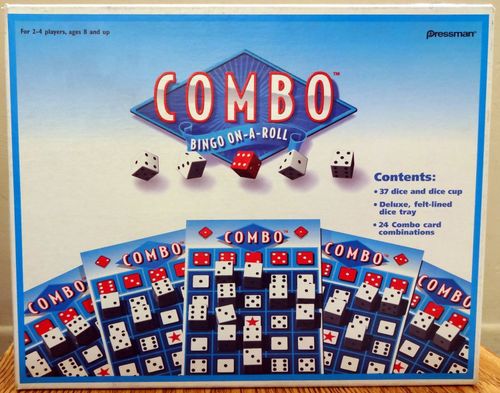
Combo (1997)
Combo (1997) Rulebook
Table of Contents
Table of Contents
Contents
12 double-sided Combo cards, 36 white dice, 1 red die, dice tray, red circle, dice cup, label sheet.
Object
Be the first player to reach 300 points.
During a round, the first player to get a complete row of dice–vertically, horizontally or diagonally–on their card scores 100 points. Any other player that is able to get four dice in a row scores 50 points. Any other player that is able to get three dice in a row scores 25 points.
Set Up
Carefully remove the red circle from the label sheet and place it in the tray. Remove the Combo label and place it on the tray as shown on the package back.
Divide the white dice equally among the players. Each player selects a Combo card. Each player rolls the red die. The player with the highest roll goes first, then play moves to the left.
The Cards
The cards are laid out in a Bingo format and the following illustration explains a few other points about the cards.
Illustration 1
Callouts printed with Illustration 1:
- After your roll, look at the number on the red die first. Then look at this row on your card to find that number.
- Once you've found the matching red number on your card, look at the white dice under that red number and see if any of the white dice that you rolled match any of the dice in that row.
- The number on the top of your Combo card is a number column that you DON'T have on your card. If you're lucky, you won't roll this number on the red die!
- The star in the center of the card counts as a free space and does not have to be covered by a die.
Playing
To start your turn take the red die and three of your white dice and roll them into the tray. The red die will show you what column on your card the white dice must be placed. If any of these white dice match, you must place at least one of them. You can place two or all three of them as long as they match.
Illustration 2
In the example at left, the player rolled a red four and a white one, three and five.
The one can be placed on the card. The three can be placed in one of two spots. The five cannot be used on this roll. This player must place at least one of the white dice on his card. In this case, he could place the one and/or the three and, if he wishes, he could re-roll the red die and the white five.
After placing a die on your card, you may end your turn or pick up the remaining dice you rolled and re-roll them (along with the red die). This may be risky (See "Stealing a Player's Dice"), but it may be worth the risk!
If you are able to place all three white dice on your card you may pick up three more from your pile and roll them (along with the red die) and continue your turn. As long as you can place at least one die on your card, you can keep rolling and taking turns. Once a player ends his turn, the red die is passed to the player to his left and play continues as before.
Illustration 3A
In this example the player rolled a red five and a white four, six and three.
This player decides to place the white four and six. He may now quit his turn or re-roll the white three and the red die. He decides to re-roll. The results are shown in Illustration 3B.
Illustration 3B
On his second roll, the player rolled a red one and a white four.
Since this die can be placed on his card, he must place it. He may now end his turn or take three more white dice from his pile and roll them along with the red die. He decides to take three more dice and roll.
Stealing a Player's Dice
If you roll the red die so that it matches the number at the very top of your Combo card (ie. If the player in our example now rolls a red three) OR if you take a turn and only roll a number(s) that you cannot place on your card, each of the other players may, in turn, take one of the white dice that you rolled and place it on their card if they can. Starting with the player to your left, they look at the column that matches the number on the red die and choose–if they can–one of the white dice you rolled. It is possible that not all the other players will have a chance to steal a die. Any dice that are not taken by the other players are then returned to you and your turn is over.
Once a player ends his turn, the red die is passed to the player to his left and play continues as before.
Running Out of Dice
If you run out of dice on your turn, your turn is over. But, on your next turn, you may pick 1, 2 or 3 dice off your card and roll them along with the red die just as before. All the same rules (ie: "Stealing") apply.
Ending a Round & Scoring
Once a player gets a bingo–5 dice in a row vertically, horizontally or diagonally (the star can count as a die) – he calls out "Combo!" and the round is over. That player scores 100 points.
All the other players check to see if they have four-in-a row– which scores 50 points– or three-in-a-row– which scores 25 points. If they do, they score for the highest one only. For example, if a player has both a four-in-a-row and a three-in-a-row, he scores only for the four-in-a-row.
Winning the Game
As soon as a player scores 300 points, (even if it occurs in the middle of a round) the game ends and that player is the winner.
Note: If a player scores two bingos on his card in the same round (five-in-a-row both horizontally and vertically, or diagonally, etc.) he automatically wins the game.