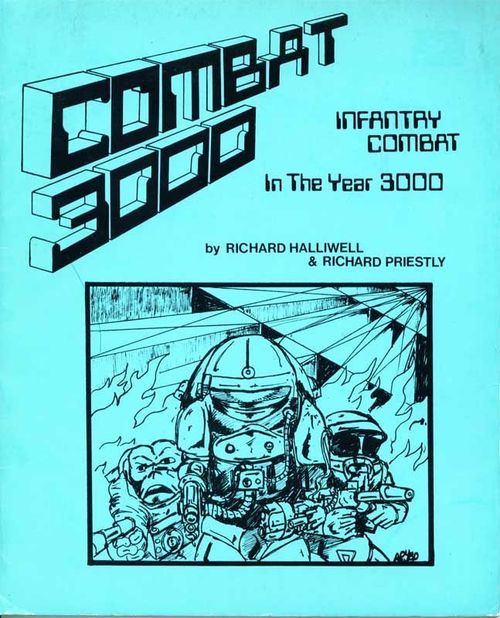
Combat 3000: Infantry Combat in the Year 3000
Combat 3000: Infantry Combat in the Year 3000 Rulebook
Table of Contents
Table of Contents
- Using These Rules
- Game Equipment
- Creatures and Equipment
- The Rules
- Appendices: Optional Rules
- The Lists
- Quick Reference Sheet
Using These Rules
Differing types of games demand rules with differing levels of detail. The following suggestions are made in the light of the designers' experience and play testing.
Large games: For large games, or when first introduced to the rules, ignore the reloading and breakdown rules except for one or two shot weapons. Assume that all figures may fire any weapon that they are carrying.
Small actions and skirmishes: For these use all the rules.
Small skirmishes and role-playing games: Use all the basic rules with the exception that players' figures may ignore target priorities, game orders and morale tests, but are, of course, forbidden to respond to events they do not know about. Non-playing characters should be controlled with the use of orders, and should use the target priority and morale test rules.
Game Equipment
Scales
a) Time: one turn is approximately equal to 2 to 6 seconds of action.
b) Figures: one figure represents one man or creature.
c) Ground: 1 cm. equals 1 metre.
The Game Turn
a) The game is divided into turns, each representing between 2 and 6 seconds of elapsed time.
b) During each turn a figure may EITHER carry out an action OR fire OR move OR engage in close combat. The exception to this is that a figure may carry out an action OR fire while walking.
c) Each turn is divided into phases which must be taken in the following sequence:
- ORDERS*
- CLOSE COMBAT
- MOVEMENT
- FIRING
- ACTIONS**
* Players record in advance any intended action.
** The results of other actions that have been ordered now occur.
d) These phases would, in real life, happen at the same time. However, as with all games, an ordered sequence of play is essential, and the previous sequence, the designers have found, produces the best results.
e) All actions are taken at the same time, i.e. all order writing, movement etc. is simultaneous.
Equipment Needed to Play
The following equipment is required to play the game:
- Tape measure divided in mm's.
- A pair of decimal dice (1 to 10), and one ordinary die (1 to 6).
- Pencil and paper for orders.
- Figures.
Figures
Figures should preferably be mounted on circular bases which represent the amount of room that figure needs in which to fight. The size will obviously depend upon the figure, but as a basis humans should be mounted on 20mm. diameter bases, i.e. the size of a new penny.
Creatures and Equipment
Creatures
Each type of creature will have what is called a 'figure profile'. This comprises a list of personal characteristics appropriate to a species. In role-playing games this will apply to individuals as well.
The four characteristics are:
a) ACCURACY: this modifies the percentage required to hit a target, and for some species this may be a negative value. The normal variation should not exceed +50% or -50%, with the average human having an 'accuracy' figure of zero.
b) STRENGTH: a high strength increases the chance of surviving a hit. The normal variation should be within + or - 5, with an average human strength value of zero.
c) DEXTERITY: this modifies the time taken by a figure to reload, and will also contribute to its close combat actions. The normal variation should be within + or - 3, with the average human dexterity value being zero.
d) REFLEX: this modifies the time taken to react and fire, and will also affect close combat actions. The normal variation should be between + and - 2, with a human reflex value of zero.
In addition to the above four characteristics, a figure profile should also include, as a fifth factor, the figure's normal movement rate. Humans will have a walk rate of 5cm. per move.
Weapons
Each variety of weapon is classified by the following characteristics, or 'weapon profile'. Each weapon's profile is expressed as a series of letters and numbers.
a) CODE NUMBER: this is the number given to each weapon in the weapon charts.
b) TYPE PREFIX: this is a general description of the type of weapon:
- HT: High trajectory weapon.
- H: Heavy weapon.
- L1, L2, L3: Launcher weapon with a calibre of 1, 2 or 3.
- P: Pistol.
- S: Shoulder arm, or any weapon which requires two hands to hold and fire it.
- HTo: The weapon may only fire HT and may not fire direct fire, e.g. a mortar.
- A: The weapon may fire area fire, for example a machine gun.
c) ACCURACY: a plus or minus figure given as a percentage which modifies the chance of a hit.
d) EFFECT: again a plus or minus percentage figure which modifies the basic 'to kill' chance.
e) RELOADING TYPE: this indicates if and how a weapon is loaded. Abbreviations used are:
- Mag: Magazines used.
- Pos: Uses a power source.
- Bar: Once fired a new shot must be loaded into the barrel.
- Inf: Infinite repeater; the weapon does not need reloading.
'Inf' weapons have no need for sections f. and g. below, but instead a new section is added. In place of f. the figure is for the number of turns during which the weapon must not be fired, i.e. if the number is '0' then the weapon may be fired each turn; if a 1, every other turn only.
f) AMMUNITION SUPPLY: this is the number of shots that a weapon may fire, or the number of bursts for an automatic weapon, before it requires reloading. The ammunition supply for a 'Bar' weapon will be equal to the number of barrels it has. The reloading time given will be that for one barrel only. Partial loading, i.e. only one barrel or a few of the barrels, is permitted.
g) RELOADING TIMES: this indicates the number of turns to reload the weapon.
h) BREAKDOWN: this indicates the reliability of the weapon and is a number of 1 or more. A totally reliable weapon, which has still to be invented, would have a breakdown factor of zero.
Ammunition
(Grenades are classed in this way.)
a) CALIBRE: this is expressed as either 1, 2 or 3.
b) DIAMETER: this figure gives the area of effect in cm's, where a zero indicates an armour piercing projectile.
c) EFFECT: see section 2d. (Weapons) above.
d) ACCURACY: for a 'self guiding' projectile this will be a plus or minus percentage figure which modifies the 'to hit' figure. If the projectile has no built in guidance system then nothing is written.
Close Combat Weapons
a) HANDLING: this indicates the ease with which the weapon may be used for close combat and is represented by a plus or minus figure.
b) EFFECT: as for section 2d. (Weapons) above.
Sights
The prefix 'WS' (wide spectrum) indicates that the sight is sensitive to a wide spectrum of light.
a) ACCURACY: again a plus or minus percentage figure to modify the chance of hitting.
b) ILLUMINATION: the ability of the sight to see a target during periods of darkness or poor visibility. 'WS' sights will normally have a plus figure.
c) REFLEX: modifies the reflex of the firer and indicates whether it slows down or speeds up the aiming procedure.
Weapon Mounts
The prefix 'WS' indicates that the mount is equipped with sights sensitive to a wide spectrum of light.
a) ACCURACY: as above.
b) ILLUMINATION: as above.
c) REFLEX: as above.
Vehicles
Vehicle descriptions will have the following prefixes:
- Amph: It is amphibious.
- Fly: It is capable of flight.
a) MOVEMENT CLASSES: these can be:
- Tracked
- Half tracked
- Two wheeled
- Four wheeled
- Multi-wheeled (i.e. more than 4)
- Hover.
b) ACCELERATION: this number represents the rate at which vehicles can accelerate, and is given in terms of cm's per turn.
c) MAXIMUM SPEED: this is given in cm's.
d) ARMOUR CLASS: this figure represents the degree of difficulty in penetrating its armour.
e) TROOP CARRYING CAPACITY: this is given in terms of the number of troops it can carry. Weapons are classified as follows:
- M class weapons = 1/2 a trooper.
- H class weapons = 1 trooper.
f) WEAPONS: the number of weapons that the vehicle carries and the type of mount. Each mount must be determined at the start of the game and written on the vehicle's record sheet, as should the type of sights employed, and the weapon's horizontal and vertical traverses in degrees per turn and the maximum traverse.
Droids
a) PREFIXES: these are as follows:
- SNT: The droid is fully sentient and can make decisions. It has an imagination and dexterity and can be used as a character in role-playing games.
- ACT: The droid is active and can be ordered to perform actions.
- PAS: The droid is passive and can perform only pre-programmed tasks, and will become active only under a set of pre-programmed conditions, i.e. an automatic defence system.
b) PROGRAM RUNNING TIME: this indicates the number of turns the droid may be programmed for. If this is a permanent program then indicate this by writing 'P' on its record sheet.
c) ACTIVATION TIME: this is the length of time that it takes, in turns, for a robotics engineer to program the unit.
Robots will then carry the relevant classification as to their type, and will be classified in the same way as other creatures, i.e. with Accuracy, Strength, etc. Where relevant they should also be given additional classifications for their equipment. E.g. PAS, Sights WS +10%, 0 (weapon No 1), 'Creature' 0.0.0.+1, Move 1.
Armour
A figure or vehicle is counted as armoured if it is completely covered in armour. An armour rating is a plus figure, normally above 5, but as the rules cover only light and relatively light weapons it is recommended that an armour value of +12 should not be exceeded.
Partial Armour
If a figure wears only partial armour then the value of this armour is deducted from the 'kill' throw. Each piece of partial armour is assigned a value which is a plus figure, i.e. a helmet would be +1.
The Rules
Orders and Actions
Game Orders
In games where players control more than one figure each, they must write game orders for each figure before the game starts. In ambush type games no orders may be written for the 'surprised' side. Figures who are fired on and who have no orders must move to the nearest cover and will fire according to target priorities (see later section). Small units of men need only be given one set of orders which covers the actions of the whole group.
Game orders should be fairly brief but detail the objectives, routes and target priorities etc. E.g.:
Unit 1: Move through ravine, take and hold the landing pad.
Unit 2: Move to cover on ridge crest. Give supporting fire to Unit 1. Fire speculatively on buildings A and B.
Commanders
Where players control more than one figure, then one of these figures must be detailed as the commander of the group. All game and new orders will originate from this figure. If the commander is killed then another friendly player takes command of the group, or if there are no other friendly players then the original player nominates a second figure as the new group commander. To avoid any confusion in this respect a chain of command should be indicated in the group's game orders.
Record Sheets and Actions
In order to keep an accurate record of the actions carried out, or to be carried out, by each figure, the following record sheet should be used. It records the figure's code number, name, profile, what it is carrying, the weapon in hand, spare ammunition, the turn number and the actions.
In the 'Orders' phase of each move the code number for any intended action or firing should be written in the 'Actions' section. If the figure fires a weapon, write 'F' and the weapon's code number, remembering that a shoulder arm weapon may be carried in one hand but needs two hands to fire it. Firing is not ordered if it is normal fire, but only if it is speculative fire. Normal fire does not need to be ordered; it is merely recorded after it has taken place in the fire phase.
If the figure is stunned, write '5' for each turn that the stun is to last, and cross out one '5' at the end of each subsequent turn. The full number of turns stunned should be written even if the figure is already stunned.
In the 'weapons in hand' section the code number of both the weapon and its ammunition should be indicated. Once ammunition is loaded into the weapon it should be crossed off the spare ammunition column.
Aiming
Aiming figures may neither move nor fire. Write 'A' followed by the target code number (or description) in the actions column. A figure may not count the turn in which he fires as one spent aiming.
Covering
A figure may be ordered to cover either a vertical object such as a window or door, or an area of ground 16cm. square. Covering figures may not move but may fire at a target which presents itself in the covered area without having to become 'aware' of it. Write 'C' followed by a description of the area being covered in the actions section.
Speech
Speech will not interfere with any other action but may not be attempted whilst running. A human can speak up to six words per turn. For other creatures, if it has not already been determined, decide the rate by throwing a percentage dice, counting 0 as ten, and then throw again for each '0' thrown. Speech will be heard by all figures within 15cm. unless they are in a vehicle or enclosed space with closed doors and windows, or wearing a helmet. Write whatever is being said in the 'actions' section of the record sheet.
A figure may shout only two words in a turn, and these will be heard within 45cm.
Re-Loading
Reloading takes as long as is given in the weapon's profile. This time includes the time to take up the fresh ammunition. Subtract from the loading time the dexterity rating of the loading figure, but this time may never fall below 1.
- M weapons: may have an extra crewman, which reduces the loading time by 2 turns.
- H weapons: may have up to two extra crewmen. One will reduce the loading time by 2 turns, and two will reduce it by 3 turns.
Reloading may be attempted while stationary or while in a moving vehicle only, as this action precludes both movement and firing. In the actions section of the record sheet write 'R' and the weapon's code number and the ammunition that is being loaded, e.g. R19/102.
A figure will need at least two hands free to reload.
Breakdowns and Repairs
A breakdown or jamming occurs when a figure fires and scores a number equal to or less than the weapon's breakdown number with its 'to hit' dice. Each move a figure may attempt to repair a jammed weapon by throwing one percentage dice and adding the figure's dexterity rating. If the result is over 8 then the weapon is repaired and may be used next time. If the result is less than three then the weapon cannot be repaired and no further attempts need be made.
Repair attempts must be made whilst stationary or at the walk, and the figure may not fire while attempting a repair. Two hands are required to attempt a repair.
To attempt to repair, write 'Rep' and the weapon's code number in the 'actions' section of the record sheet, the repair dice being thrown during the 'action' phase.
Communications
If figures are equipped with communicators, radios etc. it will be necessary, before the game starts, to make out a communications network plan. Figures with throat mikes and earpieces, wrist radios etc. may be part of a communications 'net'. A net is formed by members of a small unit, and in military forces by commanders of the same rank. Therefore in small units all members may communicate freely with one another, but not with members of another group. Unit commanders, however, may communicate with friendly commanders. The overall commanding figure may communicate with all his sub-commanders and also with any 'off-board' units or supporting units.
Communication via a network is treated as normal speech, but all figures on that net will hear it. Only one figure may use the net at a time.
Figures with wrist radios will need to have one another hand free to operate it.
Communications outside of an established net may become necessary, e.g. if a unit commander or overall commander is killed. A link in such cases is established by throwing an 8, 9 or 10 on one decimal dice during the action phase. Figures using communicators may not run.
Action Times
This list gives an action code; where actions involve equipment, its code should be indicated. The second column details the action, and the third column gives the number of turns that action will take. The fourth column details the number of hands involved, which must be free to perform that action. If a 'W' is indicated in the remarks column, then this action may take place whilst walking. If an 'F' appears, then the figure may fire with any spare hand but counts as distracted. If both an 'F' and 'W' appear, then the figure may either walk OR fire, but not both, while carrying out this action.
| Code | Action | Turns Reqd. | Hands Reqd. | Remarks |
|---|---|---|---|---|
| C | Crouch | 1 | 0 | |
| FP | Fall prone | 1 | 0 | |
| SU | Stand up from prone or seated | 1 | 0 | |
| RU | Rise from crouch | 0 | 0 | W or F |
| UL | Open lock with a key | 2 | 1 | |
| OD | Open unlocked door | 1 | 1 | |
| SW | Smash window | 1 | 0 | |
| DC | Draw a close-combat weapon | 1 | 1 | W or F |
| DP | Draw a holstered pistol or grenade | 1 | 1 | W or F |
| DR | Draw a rifle from holster or 'slung' position | 2 | 2 | W or F |
| SR | 'Sling' rifle over shoulder | 2 | 2 | |
| SC | Scabbard close-combat weapon | 2 | 1 | W |
| SP | Scabbard or holster pistol | 2 | 1 | W |
| D | Draw small object from a belt or pocket or vice versa | 2 | 1 | W |
| SV | Start vehicle with a key | 2 | 2 | |
| DB | Deploy bipod-mounted weapons | 2 | 2 | |
| MM | Mount and start a small machine | 2 | 2 | |
| MH | Mount a horse or animal of similar size | 3 | 2 | |
| UW | Unhook weapon being towed | 3 | 2 | |
| DH | Don a helmet | 2 | 2 | W |
| RH | Remove a helmet | 2 | 1 | |
| PW | Pick up a weapon | 1 | 1 | |
| DHW | Deploy a heavy weapon | 6* | 2 | |
| CW | Climb through an opening such as a window | 2 | 1 | |
| DW | Drop weapon | 0 | 0 |
* This takes 4 moves to deploy with 1 extra crewman, three moves with two extra.
Dropping weapons and other small objects takes no time and interferes with neither actions nor close combat, movement or firing.
Close Combat
Moving Into Close Combat
Any move intended to bring a figure into contact with the base of another is called 'a charge'. Charges may be made at either the walk or run rates, but while charging a figure may NOT fire. It may, however, draw a close combat weapon or pistol, or drop weapons. Charges are declared at the beginning of the close combat phase of each turn.
Immediately a charge is declared, the charged figure(s) must state which of the following options are to be taken:
- RUN AWAY without firing.
- STAND and attempt to fire.
- COUNTERCHARGE without firing.
- STAND and receive the charge.
If the charged figure had any action ordered, other than dropping weapons, then it may only run or stand.
If the charged figure fires, then it may only do so with those weapons it has in its hands at the time. Weapons it has ordered to drop are assumed to have already been dropped. If the figure can fire, subject to the normal rules given in the firing section, it does so before the charging figure is moved, and out of the normal sequence of the turn.
Although it is not necessary to throw for fire phasing for the normal uses, it must still be done to check whether the charged figure manages to get off a shot. Once this and any firing has been carried out, then the two figures, if appropriate, are moved into contact. Remember that this movement and any firing has taken place out of sequence, and these actions represent the figures' efforts for the whole turn, i.e. they may carry out no other actions in that turn. The first phase of close combat will take place in the next turn.
E.g. A charging figure will be able to drop a shoulder weapon and draw a sword, and will be ready to fight in the next combat phase.
If the charger fails to make contact with a running opponent he may carry on as normal in the next turn, or may continue the charge again, but he may not fire.
Figures Involved
If, at the beginning of the close combat phase, any figures are in base to base contact and either of them wishes to fight, then close combat takes place. All figures involved are those in base to base contact, therefore one figure may have to fight more than one opponent.
Strike Phase
The close combat phase, like the firing phase, is split into six sub-phases, each representing less than a second of real time. To determine the order in which blows are struck, throw a normal die for each figure and modify the score as follows:
- Deduct the figure's dexterity rating.
- Deduct the figure's reflex rating.
- Deduct the figure's weapon handling rating.
- Add 1 if fighting more than one opponent.
Each figure now has a number between 1 and 6. Totals less than 1 count as 1, and totals more than 6 indicate that the figure may not strike a blow.
Effect
Take each sub-phase in turn. Throw two decimal dice and add the scores together for each figure. Modify each score as follows:
- Deduct opponent's reflex rating.
- Deduct opponent's dexterity rating.
- Deduct opponent's strength rating.
- Deduct the value of any personal armour worn by the opponent.
- Add own strength rating.
- Add any weapon's rating.
If the result is 12 or higher, then the blow kills.
Improvised Weapons
If the figure has no close combat weapon then he must improvise. The performance details for these are:
| Weapon | Strike phase / Effect |
|---|---|
| Fist | 0 / -3 |
| Shoulder arm as club, or club | -2 / -1 |
| Claws | +1 / +1 |
Notes:
a) Two-handed weapons used in one hand only mean a strike phase addition of +1, and 2 will be lost from the weapon's effect.
b) If a figure has two weapons he may use both. Each weapon is thrown for separately, deducting 2 from the strike phasing and 2 from the effect of each.
Surprise Attacks
If the charging figure reaches a target figure before that figure becomes aware of him, or if he cannot fight back anyway (i.e. caught while running away, stunned or webbed etc.), then a free blow is struck, the charging figure ignoring the 'strike' phase detailed above.
Movement
During the move phase each player moves his pieces simultaneously.
Some figures will not be allowed to move, i.e. those which have been engaged in close combat, those performing actions which prevent movement, and those attempting to fire (except for a walk where permissible).
- WALK: the walk distance is given in the figure's profile.
- RUN: the run distance is three times the walk distance. Running figures may not fire.
- CRAWLING: the crawl rate is half the walk rate and may only be attempted by a figure already prone. Some figures may be physically incapable of crawling, such as insectoids etc.
- CLIMBING: stairs and slopes are climbed at half the normal walk rate or run rate. Creatures without sufficient spare limbs may not be able to cope with more difficult climbs or scalings. These creatures should be noted under special characteristics at the start of the game.
Ropes may be climbed by figures with both hands free, at the rate of 1cm. per turn, and are descended at up to 2cm. per turn. A very steep surface may be climbed at the walk rate minus the throw of a normal dice minus 2. Vertical surfaces which have at least some handholds may be climbed at the walk rate minus the throw of a decimal dice.
Difficult Terrain
Figures moving across broken ground, including dense scrub and forest floors, do so at half rate.
Vehicles
The distance a vehicle may move is determined by its previous turn's move rate. Vehicles may either increase this 'previous turn rate' by the vehicle's acceleration rate (up to its maximum possible speed), or decrease it by half a maximum move rate. If the surface is slippery or loose then the speed reduction is by a quarter maximum move rate only.
Hover vehicles may reduce speed at a rate of one quarter of their maximum move rate.
Vehicles in Difficult Terrain
Hover vehicles ignore any obstacles which are less than 2 metres high. Movement by other vehicles up steep slopes halves their movement, as does movement through broken ground. If the driver has to avoid obstacles such as friendly troops, boulders, trees or bushes, then the maximum speed is 10cm. per turn plus 2 x the driver's dexterity plus reflex ratings.
Tracked, half-tracked and wheeled vehicles may move over sparse vegetation such as hedges or thick scrub provided they move at no more than 10cm. per move. When moving through such vegetation they will clear a path through it their own width and leave a trail.
Tracked and multi-wheeled vehicles may move over linear obstacles up to 1½ metres high, taking three turns to traverse them.
Firing
Visibility and Awareness
A figure may only react to other figures that it is aware of. To do so he should be able to see them, or have equipment which will tell him. Humans can see and be aware of events which occur within a 60° arc of vision either side of straight ahead. Figures are always assumed to be looking in the direction that they are facing. Aliens can have a different arc of vision, but unless stated at the beginning of the game it will be assumed to be the same as for humans. The distance at which targets may be discerned in the open depends upon the target size and the light conditions. Vision arcs can be indicated on the figure's base if desired.
The following table gives vision ranges (distance in cm's):
| Target Size | Bright | Normal | Bad | Night/Darkness |
|---|---|---|---|---|
| -3 | 35 | 25 | 2 | 1 |
| -2 | 75 | 50 | 10 | 2 |
| -1 | 150 | 100 | 25 | 5 |
| 0 | 700 | 500 | 250 | 25 |
| +1 | 1500 | 1000 | 500 | 50 |
| +2 | 7500 | 5000 | 2500 | 75 |
| +3 | 15000 | 10000 | 5000 | 100 |
Target Size Modifier
Targets behind cover will present only a small proportion of their anatomy, and so will present a modified target size. To determine this, use the target templates. Determine which template will just cover the target entirely. So a figure's head and shoulders will generally be a -2 target, i.e. the smallest template that will fit entirely over the visible parts.
Templates are always used at right angles to the observing figure, so targets at extreme angles will appear smaller.
Figures behind cover who fire will give away their position and will be visible at their full normal target size. A figure who is 'covering' an area (see covering rules) will see things in that area up to three times the distance they otherwise would. Therefore head and shoulder targets which would normally be visible at 50cm. in normal light will be visible at up to 150cm. from a figure which is 'covering' the area it is in.
Weapon Use
A figure may only fire weapons that are held in its hands at the beginning of the fire phase. The following are the types of weapon classification:
- P Type: This may be fired with one hand.
- S Type: This may be fired with one hand but is normally fired two-handed. If fired one-handed there will be a reduction in accuracy.
- M Type: This may only be fired from the shoulder when stationary or from a prone position. They may also be fired from a fixed mount. All M type weapons require two hands to fire them.
- L Type: These may only be used when stationary. They may be fired from a fixed mount. 'L' type weapons are fired two-handed unless they are 'LP' type weapons (pistol launchers), in which case they may be fired with one hand only.
- H Type: This may only be fired from a fixed mount or turret.
A fixed, turret or ground mount may be used to mount any weapon class, no matter how small.
Grenades are thrown one-handed, but because of the exertion involved this prevents any other firing.
Normally a figure may only fire one weapon per turn. However, a figure may fire as many weapons as it has in its hands, provided that they are all fired at the same target, at less than 30cm. range, and the firer did not move this turn. There is an accuracy reduction for this.
Note: if a figure has been ordered to draw another weapon this turn, there will be an accuracy reduction, and the drawn weapon will not be available until the end of the action phase. Generally humans are right-handed unless the player states otherwise, and any weapons fired with the 'wrong hand', i.e. the left hand, will suffer an accuracy reduction.
Special Conditions Precluding or Inhibiting Firing
a) A figure that is performing an action which inhibits firing may not fire.
b) A figure which makes certain kinds of movement may not fire, i.e. running, crawling or climbing.
c) Figures involved in close combat during the close combat phase may not fire in the fire phase of that turn.
d) A figure that was 'hit', but not killed, in any sub-phase prior to the sub-phase in which it was to fire, may not in fact do so.
e) A figure caught in the blast area of an explosive weapon in a sub-phase prior to the sub-phase in which it was to have fired may not do so. In this case, and also in case d) above, it helps to remove the figure's fire phase marker.
Target Eligibility
Troops may only fire at eligible targets, as follows:
a) The firer was aware of the target at the beginning of the current turn. Thus if the target did not appear until the 'actions' phase or the 'movement' phase, or even the 'fire' phase, or was not in the firer's arc of vision at the beginning of the turn, then the target is not eligible. The exception is with 'covering' fire.
b) A straight line of sight may be traced between the firer and target at the beginning of the fire phase.
c) A straight line of sight may be traced between the firer and target at the beginning of the sub-phase being fired in. Thus for example, if the firer is timed in sub-phase 5 and a baffler explodes to block the line of sight in phase 4, then the target is no longer eligible and may not be engaged.
d) There are no friends within 3cm. of any point along the line of sight. This does not apply to 'HT' fire, as this will pass over them and so there will be no danger of harming friends. Troops firing from an elevation or to an elevation have a clear line of sight if they are firing with a line of sight which passes at least 5cm. over the heads of friends, or if these friends are directly below the firer.
e) Troops firing area effect weapons, or shot at with a blast area weapon (i.e. launcher explosives, flamethrowers, grenades etc.), may not aim at any point within 6cm. of friendly troops. This does not apply in role-playing games to a player's character figure.
f) Weapons firing 'HT' either speculatively or indirectly do not need to trace a line of sight to their target point. However, vertical obstacles cast a 'shadow area' behind them which is as long as the obstacle's height. 'HT' weapons may not fire into this dead ground area.
Target Priorities
The target that a firer will select will be determined as follows:
a) Self defence: if the firer is in a building being attacked by the enemy at short range or point blank range with explosives, grenades, flamethrowers or plasma guns, then he must fire at these; otherwise:
b) Self defence: any enemy firing at him within point blank range must be fired at in return.
c) Any enemy firing that the figure has been ordered to treat as a priority target.
d) The nearest enemy firing on the figure.
e) The nearest enemy firing on friends.
f) The nearest enemy in any other circumstances.
Troops must fire at any class of target which is a self defence priority. This will over-ride any 'action' orders, which will be ignored under these circumstances. Troops ignore, as priorities, any enemy troops that they cannot harm.
In role-playing games where one person controls one figure, all target priorities can be ignored.
Firing Procedure (General)
At the beginning of the fire phase players must decide and declare the targets for each of their figures which are to fire.
A normal die is then thrown for each figure firing, and the score indicates the fire sub-phase in which that figure fires, this score being modified by the figure's reflex rating.
Firing is not simultaneous, i.e. figures firing in sub-phase 1 do so first, then sub-phase 2 figures, and so on to sub-phase number 6. Figures killed or hit in an earlier sub-phase may not fire in a subsequent sub-phase.
Fire phase markers numbered 1 to 6 should be made, and the appropriate number placed by each figure firing.
The results of each successive sub-phase's hit are determined by using a modified percentage system. See the 'to hit' section. Whenever a hit is scored, the effects are diced for immediately.
Any kills, stuns, knock-outs etc. determined from hits are acted upon immediately, and figures lose any chances of firing. Figures killed in the same sub-phase as that in which they were to fire do so without penalty, and are removed after firing.
All hits and their results are recorded on the figure's record sheet.
Fire Modes
Figures may fire in the following modes:
- Normal Fire: the firer fires at a single target with a straight line of sight.
- Aimed Fire: the firing figure spends at least one previous turn stationary and aiming at its target. After it fires, however, subsequent shots, unless aiming time is allowed again, will not be classed as 'aimed' unless both the firer and its target remain stationary.
- Speculative Fire: this is only possible with those weapons with an area effect, i.e. 'A' type weapons, and ammunition which has a blast area. Speculative fire must be ordered in either game orders or by a commander figure. Speculative fire occurs when firers engage a point or an area in their line of sight in the hope of killing hidden enemy troops. All hidden figures in the area of effect are diced for as normal, but there is an accuracy reduction.
- Indirect Fire: this is only possible with 'HT' type weapons and is similar to speculative fire. The basic difference is that the target must be a point which can be identified, to which the firer cannot trace a line of sight.
Weapon Fire Modes
Weapons may be fired in the following modes:
-
Area Fire: weapons with an 'A' prefix may be fired as area fire, the area of effect being 7½cm. wide by 20cm. deep. A template of these dimensions should be made from card, and when firing, the template is placed in any position with the long sides parallel to the line of fire. All figures in this area are diced for to determine hits and kills in the usual way, but with an accuracy reduction.
-
Launcher Fire: 'L' fire applies to those weapons or ammunition that affect an area, and does not apply to the same weapons firing ammunition with '0' area effect. Dice for hits as usual, and if the shot hits, then place an effect template, of the correct diameter, over the point of contact. Dice for effect on all figures in this area. If the shot misses, then determine the actual point of contact as follows:
Throw a normal dice:
- 3 or 6: OVER
- 1 or 2: UNDER
- 3: LEFT
- 4: RIGHT
(As printed, the deviation key lists a 3 both for OVER and for LEFT, and the printed diagram gives both; the printed key is transcribed as it stands.)
Now throw one decimal dice, the score of which indicates the distance in cm's from the target point. Place the template over this point and dice for any figures in the area as normal. If the point of aim is on a vertical plane, i.e. a window in a wall for example, then treat a throw of 5 or 6 deviation as above the target and a 1 or 2 as below it. If the shot falls above or below the target then halve the deviation distance thrown on the decimal dice. Shots falling to the right or left are as normal for deviation.
-
High Trajectory Fire: the procedure for this type of fire is as for 'Launcher' fire above; however, only 'HT' type weapons may fire over obstacles. 'HTo' weapons are almost always mortars (Medium High Trajectory Only). These weapons take two turns to change targets.
Grenade Throwing
Troops with a strength factor of 0 or less may only throw grenades of calibre '1' types. With a strength factor of +1 to +3, calibre '2' types may be thrown. If the strength factor is greater than +3, then calibre '3' types may be thrown.
The maximum distance that a grenade can be thrown is 30cm. plus the figure's strength factor multiplied by 5 in cm's (for a negative strength factor this will be a reduction). Throwing utilises the same procedure as for 'L' type weapons firing, but the deviation throw, if any, will be a normal and not a percentage die.
Note that because of deviation the maximum grenade range may in fact be exceeded by up to 6cm.
Covering Fire
Troops may be ordered to cover an area or object that they are aware of, and they remain stationary and perform no other actions, including firing. The size of the area which can be covered is 8cm. x 2cm. or 4cm. x 4cm., or any similar pattern that adds up to an area of 16cm². Such areas will include any doors or windows etc. that lie within them.
A figure ordered to cover an area may ignore target eligibility and target priorities as detailed previously. However, this only applies to targets in the 'covered' area, and any target which presents itself in that area may be engaged as normal without the firer having to become aware of it.
Scanning
Troops carrying weapons fitted with sights may scan areas in order to detect hidden enemy figures. This covers the same area and has the same limitations as covering fire. Scanning troops will be able to locate and become aware of troops in the scanned area up to three times the distance normally allowed for location.
'WS' sights may 'see through' loose cover and count all lighting conditions as normal.
Scanning must be ordered before it may be carried out.
Firing Procedure
Firing is not simultaneous, but the order of firing is determined by the 'phase' dice described previously. Each such fire phase is split into six fire sub-phases. To determine which of these sub-phases the figure fires in, throw one normal dice, subtract the figure's reflex factor, and then add or subtract any of the following which applies:
- +2 'Panic Fire': firing whilst charged.
- +2 Firing an 'H' class weapon.
- +1 Firing an 'M' class weapon.
- -2 Aimed fire.
- -2 Fired at the same target last turn.
- Any sight or mount modifier that may apply for the weapon in use.
Figures whose fire phase score is 7 or more may not fire in that turn, but will get the -2 for firing at the target if they attempt to fire again next turn. Scores of 0 or less are treated as 1. Each figure is thrown for independently, and for each weapon firing.
All sub-phase 1 firing is dealt with first, followed by sub-phases 2 to 6. Figures hit or killed in a sub-phase prior to their intended fire sub-phase may not fire.
Firing Factors
Determining a Hit
Having established the firing order, the chance of a hit must now be determined. The basic percentage chance of a hit from normal fire is 50%, which represents an average shot in good circumstances. This percentage is modified by the following:
Range
- Point blank (up to 15cm.): +20%
- Short (15cm. to 30cm.): 0
- Medium (30cm. to 75cm.): -15%
- Long (over 75cm.): -25%
- In addition there will be -10% for each full metre.
Target Movement
- Moved up to 10cm.: -5%
- Moved 10cm. to 20cm.: -10%
- Moved 20cm. to 30cm.: -15%
- Moved over 30cm.: -20%
- Target is falling prone: -5%
Target Situations
- Target flying: -15%
- Target behind glass: -5%
Target Size: add the target's modifier.
High Trajectory Fire (HT)
- Firing HT with 'S' or 'P' weapons: -15%
- Firing HT with a deployed 'M' or 'H' class weapon: -5%
Indirect Fire
- Firing indirect: -5%
Firing 'P' Type Weapons or 'S' Type Weapons One-Handed
- At point blank range: +8%
- At medium range: -10%
- At long range: -18%
Same Target
- Fired at same target last move: +5%
Own Actions
- Drawing a close combat or 'P' type weapon this move: -12%
- Firing whilst speaking: -6%
Firer's Movement
- Walking: -10%
- On vehicle which moved up to 30cm.: -15%
- On vehicle which moved over 30cm.: -15%
- Firer moved over difficult terrain: -10%
- Firer firing from a vehicle which is moving through difficult terrain: -10%
Aimed Fire
- Aimed fire: +15%
- 2nd or 3rd move spent aiming: +5%
- Add any sight accuracy rating.
Speculative Fire
- 'A' class weapons firing speculatively: -10%
Area Fire
- Firing 'A' class weapons at an area: -10%
Throwing
- Throwing grenades, knives etc.: -10%
Weapon Use
- Firing 'S' type weapons one-handed: -15%
- Firing weapon with the wrong hand: -12%
- Firing two or more weapons at once: -12%
Conditions
- Bright: +5%
- Normal: 0
- Bad: -15%
- Night/Darkness: -30%
Optional Rule
- Each wound point sustained by firer: -5%
Aimed Fire at Night: add any sight 'night' bonus (not the normal bonus as given above).
Accuracy: add the firer's accuracy rating, the weapon's accuracy rating, any ammunition accuracy rating, and any weapon mount accuracy rating. The above modifiers can be negative values.
Now throw two percentage dice, counting the red dice score as 'tens' and the black dice score as 'units'. If the score is equal to or less than the modified percentage probability, then the shot hits the target; otherwise it has missed. If the percentage dice throw is equal to or less than the weapon's 'breakdown factor', then the weapon has broken down and does not fire.
Hits
Kills
Each hit scored may produce a kill or 'KO'. This will depend on the armour of the target:
If the target is unarmoured or carries only partial armour, then throw two decimal dice and add the scores together. Add or subtract the following:
- Add the weapon's effect factor.
- Subtract the target's strength factor.
- Subtract the value of the partial armour carried.
If the final result is 12 or more, then the shot has killed and the target figure is removed.
Hits on Armoured Targets
For completely armoured targets to be affected, first the armour must be penetrated. To pierce the armour a hit must have an effect of at least '0'. To determine this, throw one ordinary dice and add the weapon's effect. If the value is higher than the target's armour value, then the armour is pierced.
If the target is a figure, then use the above 'kills' section and throw again, remembering to add the weapon's effect but not the target's armour value.
If the target is a vehicle, then for each point that the penetration dice score exceeds the vehicle's armour points value, throw one percentage dice and consult the following table:
| Percentage Dice Score | Effect |
|---|---|
| 1 or 2 | None |
| 3 | Immobilised |
| 4 | A weapon destroyed (dice to see which) |
| 5 | A crewman killed (dice to see which) |
| 6 | All power lost |
| 7 to 0 | Knocked out - all lost |
Special Weapons Effect
Any explosive weapon which detonates in a confined area has its effect increased by 3. A confined area is defined as any enclosed space into which the area effect template cannot be fitted completely.
Gas and smoke weapons spread by one extra template length per turn after the turn in which they were fired. Place cotton wool sections to represent the gas or smoke; these are placed in the movement phase of each turn. The spread of these clouds will always be down wind, and they will last for 10 turns unless otherwise specified.
If these weapons are fired into buildings, then they will spread through open doorways and windows etc., and will also travel through any ventilation system.
Flying
Figures and vehicles may fly by the use of flight packs or similar propellant equipment. If so equipped, then the figure or vehicle is allotted a 'fly movement' rate (FM rate). This rate comprises four numbers:
-
MAXIMUM SPEED: the maximum distance that may be travelled in any one turn, in cm's.
-
ACCELERATION/DECELERATION: the maximum rate at which the flyer may increase or decrease its speed in any one turn. This will be in cm's and will generally be the same figure. If there are variations between the two rates, then indicate this on the record sheet.
-
PITCH VARIATION: the distance a flyer may climb or dive or deviate to the right or left in any one turn.
E.g. Profile of 20/10/09 moving at 12 cm. Possible moves are to anywhere along these lines: up 9cm.; down 13.5cm. (9cm. plus 50% when diving); ahead 12cm.; left 9cm.; right 9cm.
Note that a figure may add 50% of the normal pitch variation when diving.
-
MINIMUM SPEED: the minimum speed of a flyer in cm's. The flyer cannot move slower than this rate, and may not land or take off faster or slower than this rate. If this rate is a '0' then this indicates that the equipment enables a flyer to hover.
While flying, a figure may carry out any actions that it normally could while walking.
Note that a record should be kept of the figure's or vehicle's height from the ground.
Robotics
There are three basic types of robots: SNT, PAS and ACT.
SNT Droids
These are fully sentient thinking machines after the 'Star Wars' mould. Because they are creatures, they should be classified as if they were of flesh and blood, having accuracy, strength, dexterity and reflex characteristics. If droids have any special equipment built into them (as opposed to being carried by them), then this should be listed in the droid's profile. The following is an example of an SNT type:
SNT/ +5%. 0. 0. 0. 5cm/ Sights +10%. 0. 0. / Weapon No 1.
This indicates that the robot is fully sentient (SNT), with creature characteristics of +5 accuracy, strength 0, dexterity 0, and reflex 0. Movement is 5cm. per turn. The droid has a built in sight with a characteristic of +10%, an accuracy of 0, and a night operation bonus of 0, which does not affect its reflex times. It is also equipped with a laser built into it, i.e. weapon No 1, and players should state where this weapon is situated on the model. SNT droids are normally used as creatures, and must obey target priorities in the normal way, and will conform to morale tests.
PAS Units
Passive robot systems are programmed at the beginning of the game with conditional orders. For example, 'if the enemy approach within 15cm. then explode' is such an order, and might be given to a computerised mine. These units should be given the full range of creature characteristics and equipment in the same manner as SNT units. However, PAS units may only obey the written orders of their program, and they will interpret these literally in all cases. They will only obey their written orders and will ignore ALL other instructions. They will always fire at targets that they are programmed to fire at and at no others, and will therefore ignore target priorities unless more than one 'ordered' target presents itself, in which case priorities should be used. PAS units will ignore all morale tests.
ACT Units
Active robotic systems are those which have been programmed to accomplish general tasks, and as such they do not need a precise program, i.e. they are already programmed to accomplish whatever task they are ordered to do. The main advantage of these units is that they perform any task that they are ordered to do by an appointed controller, and to the best of their ability. They will obey these orders until they receive new ones; such new orders will be acted upon immediately the controller has given them. They will not be subject to morale tests, and will obey target priorities but can be ordered to ignore them. All orders will be obeyed literally.
Profiles for these units are determined as for the previous units.
ACT Controllers
Controllers are any figures that are appointed as such by the player. However, as this would normally require training in robo-systems, such controllers will cost extra on the points system.
Controllers are assumed to have communication devices which enable them to be in direct contact with the robot. All orders to and reports from the robot are given or received at normal speaking rates. These controllers may only give orders to ACT units, and may not attempt to program or re-program other types of units.
Program Loss
Any robot system that is stunned will lose its program, and as such will carry out no further actions until re-programmed.
Inter-Communication
There is a 50% chance that any robo-engineer can communicate with any friendly OR enemy ACT unit and effectively take control of it. This basic chance is modified by -10% for every full 10cm. he is away from the unit. This attempt requires both hands to be free and will take a full turn without any other actions.
Note: If you are playing role-playing type games, or games which form part of a series, then SNT units may be run as characters and may be re-programmed with the same personality if need be, e.g. if they are stunned and lose their program.
Morale
Morale in any science fiction wargame is particularly difficult to construct due to the increased complications of alien beings. Furthermore, figure manufacturers being what they are, aliens tend to receive second billing to the more 'profitable' human figures, so ranges come and go leaving a vast number of alien races but very few actual figures. It would be lunacy for a set of rules to cater for these as regards morale. Therefore, as an alternative, the designers leave morale matters entirely up to the players. However, they do include at this point two instances of alien reaction tests that they found necessary during play testing. Human morale tests should be used to test reactions of humans and, where necessary, human programmed robots.
Human Morale Test
This test should be taken by figures under the player's control, but where one player is represented by one figure morale tests are not required. In all other cases, morale tests are taken to represent the self preservation instincts of a player's figure during a skirmish etc., and of non-player figures in a role-playing game.
Tests are taken when:
-
A figure is hit.
-
A friendly figure is killed within 30cm. and in sight.
-
A friendly figure breaks within 30cm. and in sight.
-
Any member of your unit is killed.
Tests will be taken at the end of the turn and by individual figures.
Morale Status
Figures will have a morale status which varies from 'Overconfident' to 'Terrified', with an average of 'Steady'. Troops normally start the game as 'Steady'.
The following is the list of morale states, from highest to lowest:
- Overconfident
- Confident
- Steady
- Shaky
- Poor
- Scared
- Terrified
The Morale Test
First throw one ordinary dice, and add or subtract the following:
| Modifier | Value |
|---|---|
| In cover | +2 |
| No enemy within 30cm. | +1 |
| Not under fire | +1 |
| Currently advancing | +1 |
| Friends within 30cm. advancing | +1 |
| Friendly fighting vehicles within sight | +1 |
| Each member of unit killed this turn* | -2 |
| Unit leader killed this turn | -3 |
| Unit under fire from 'H' class weapons | -1 |
| Stationary in the open | -1 |
| Currently retreating | -1 |
| Enemy within 30cm. and in sight, who are advancing | -1 |
| Friends within 30cm. and retreating | -1 |
| Each member of the unit killed before this turn | -1 |
| Unit leader killed in a previous turn | -2 |
| Unit leader with the unit | +2 or -2 |
* This applies to a small military unit and to other similar units.
Result
| Result | Effect |
|---|---|
| 6 or more | Morale status goes up by one category. |
| 3, 4 or 5 | Morale status remains the same. |
| 1 or 2 | Morale status goes down one category. |
| 0 or less | Morale status goes down by two categories. |
Thus for example, a 'Confident' figure who has a morale test result of -3 has its morale status reduced to 'Shaky'.
A figure's morale status will affect its actions in the following ways:
- Overconfident: must advance a minimum of at least its walk rate. If carrying a close combat weapon it must charge the nearest enemy within run distance.
- Confident: must advance at a minimum of at least walk rate to the nearest cover, then test again.
- Steady: act as ordered.
- Shaky: may not advance if under fire or into close combat. Will turn and run if charged by enemy troops who have a higher strength rating.
- Scared: as 'Shaky', may not advance from cover; must retreat to cover if in the open.
- Terrified: if under fire, hide; break if not in cover.
Broken Troops
Broken troops will run to the nearest cover (to their rear), where they may test again.
A voluntary test may be taken by troops at the end of any turn in which they are in cover and they are not under fire. However, once a voluntary test has been taken they may not take another for five turns.
Note: these rules assume that individuals are being tested. However, in order to save time it is possible to test a group of similar figures who are in identical circumstances, e.g. two men crouched behind a hedge and under fire. Players should state that such a test is being taken before the test begins.
The Mandiblax Reaction Test
This test is intended to reflect the very tight 'clannish' social structure of these creatures, whose family is dominant, and its members will fight on through death and universal holocaust as long as the 'family' remains intact.
The test is taken when any member of the family is killed; the whole family will test.
Throw an ordinary dice. The score has the following results:
- 1: Half the group will halt for two moves and carry out no actions. The other half will give stationary covering fire as required.
- 2 to 5: No effect.
- 6: They will go into the famed (and feared) 'Mandiblax Death Rage'. This is a cross between extreme xenophobia and rabies, and will result in the whole group advancing at the run rate towards the enemy. While in this state, however, firing WILL be allowed, and their reflex factors will be increased by +2 for the duration of this state. This state will end when the group has killed one enemy for each member of the group.
The Tree People Reaction Test
The 'Tree People' are not in fact trees, but are called such because they are 10ft. high and 8ft. wide and resemble an Owl Bear. Their colouring is an assortment of lurid greens and reds. These people are pretty stupid but are very socially conscious and care nothing for personal injury in front of others of their own kind. They have no military organisation, regarding such things as decadent, and so are tested as individuals.
Under normal conditions these people must obey the following rules:
a) ALWAYS charge the enemy wherever possible.
b) In any turn they must EITHER:
i) Fire at least one weapon; ii) Advance at least at the walk; iii) Carry out both of the above actions at the same time.
On occasions these people have second thoughts, and therefore each should be tested whenever he is hit by fire (or in close combat). Throw a normal dice. If the result is a 6, then he will not obey the above list of actions and may carry out any other action he wishes for the next six turns. If the result is a 5, then he acts as he wishes for only three turns. Any other score and he must carry on as normal.
Generalised Reaction Test
This test has not been designed for any specific alien, but can be used for any. As a test it is fairly general and luck-oriented, and being simple will suit large-scale games.
The test is taken on groups of up to 4 figures and will be taken when the unit first comes under fire, or whenever a figure from that unit is killed.
To test, throw a normal dice and subtract one from the score for each casualty suffered by the group that turn. Subtract a further one if the leader of the group is dead, and if the group is below half its original strength.
Result:
- 1: Move to the nearest cover and remain there for two moves, then test again.
- 2 to 5: No effect.
- 6: Charge any enemy within 'run' distance; if none, then no effect.
Note: All morale tests are taken at the end of a turn, and their results apply in the next turn onwards.
Destruction
This section deals with activities such as demolition, breaking down doors and sabotage etc. The weapons capable of exercising reasonable destructive power are those firing explosive or armour piercing shot of calibre '2' or more, 'H' type weapons which have an effect of at least +3, and all Disrupter weapons. In this section these are referred to as 'destructive weapons'.
All constructions should be classified as follows. This includes buildings, walls and doors etc.
- Light: light construction made from wood, brick, plaster or cement.
- Heavy: heavy construction made of the same materials as above but much thicker, such as pillboxes and fortress walls.
- Armoured: employing armour plate, and these will be given 'armour values' similar to vehicles.
Note: all buildings should be sub-divided into rooms and passages, and where necessary sub-dividing walls should also be classified. All effects apply to these sub-divisions.
Effects
Light: any hit by a destructive weapon will knock down a door, and cause a breach 4cm. square in a light wall. A light room will collapse on a throw of 8, 9 or 10 when a single percentage dice is thrown. All occupants of a collapsed room are treated as being hit with an effect of +3, and those who are not killed, wounded or stunned can escape outside by the nearest exit.
Heavy: heavy constructions are reduced to a light construction after three hits with a destructive weapon.
Armoured: these will only be affected by shots which penetrate. An armoured door which is penetrated will be classed as knocked down. A 2cm. square breach will be caused in any wall which is penetrated, and any occupants of that room will be diced for as if they were in an armoured vehicle. A result of 'KO' means that the room collapses, with the same effect as a light room above.
Composite Buildings
A composite building is one with more than one room. When half of the ground floor rooms have collapsed, the building becomes 'unsafe'. For any further hits which result in a collapsed room, throw a percentage dice; a score of 8, 9 or 10 and the whole building will collapse, with an effect of +8 on any occupants.
Doors
A light door may also be knocked down by figures coming into contact with it. It will take five turns, less the figure's strength rating (in turns), to knock it down.
Light door locks may be shot off with any weapon which has at least a +1 effect. Locks will normally be a -3 size target.
Heavy door locks may be shot off as above, but with a weapon of at least +3 effect.
Armoured door locks may be shot off by weapons which have an effect equal to the value of the door's armour value.
Sabotage
In order to immobilise a vehicle or weapon, a figure must be adjacent to it and have access to it or the vehicle's engine. To gain access, throw one percentage dice; the result will equal the number of turns, less the figure's dexterity rating, taken. Sabotaged equipment may be repaired by dicing again and subtracting 1 from the dice throw, the result equalling the number of turns required to effect the repairs.
Laser Cutting Weapons
Any laser weapon within 4cm., or an 'H' class laser on a mount within 20cm. and stationary, will cut through any opaque wall or door. They can cut through two metres of light wall, one metre of heavy wall or door, or half a metre of +4 armour. Armour of different values is cut through in proportion to that of +4, i.e. one metre of +2, two metres of +1, or a quarter metre of +8 etc. Cutting takes one full turn.
Appendices: Optional Rules
The rules in this section are included in order that more detail may be introduced into games where each player controls very few figures. Any of these rules may be used.
Wounds and Kills
For each hit throw two percentage dice and modify the result as indicated in the 'hits' section, but substitute the following results:
- 11: One wound point.
- 12: Two wound points.
- 13: Three wound points.
- 14: Four wound points.
- 15: Killed.
For each wound point a figure sustains, reduce its strength factor by 1. Thus a figure with a +2 factor that sustains three wound points will have a new strength factor of -1. This modified factor is used wherever the strength rating is called for, thus wounded figures will be less capable of inflicting blows and will be easier to kill.
On suffering a second wound point, deduct 1 from the figure's reflex rating.
On suffering a third wound point, deduct 1 from the figure's dexterity rating.
On suffering a fourth wound point, subtract a further 1 point from both factors.
The above is in addition to the reduction in the figure's strength factor.
Immediately a figure suffers wound points, throw two ordinary dice and add the scores together. Add one to this score for each wound point sustained, and then subtract 6; the final total equals the number of turns that the figure is stunned, which does not include the turn in which the wounds were received.
Further Wounds
Ignore the tactical factors list for deduction of wounds for wounded shooters, but keep all other aspects outlined in the above section. Each time a hit causes a wound, throw one percentage dice and consult the following table to determine the part of the body hit. Note that the following table is based on a human target and should be modified to suit non-human creatures.
| Result | Area Hit |
|---|---|
| 1 to 5 | Body |
| 6 | Left leg |
| 7 | Right leg |
| 8 | Left arm |
| 9 | Right arm |
| 0 | Head |
If the target figure is partially concealed by hard cover, e.g. a wall, and the weapon firing on it is neither 'H' class nor explosive, then parts of the body concealed by the cover are not susceptible to hits. Keep throwing the dice until some unconcealed part is hit.
Effects of a Hit
| Area Hit | Effect |
|---|---|
| Body | No other effect than those outlined in the 'Wounds and Kills' section. |
| Leg | 1 wound point: walk rate reduced by 1cm. 2 wound points: walk rate reduced by 2cm., and use of the limb is lost. |
| Arm | 1 wound point: -15% on accuracy if using this hand to fire, and double the time taken for actions involving this limb. 2 wound points: use of the limb is lost. 3 wound points: limb lost. |
| Head | 1 wound point: treble the stun times of the wound. 2 wound points: figure killed. |
The effect of wound points on particular areas is cumulative, so a figure with one head wound point suffering another will be killed. For each hit, dice for the number of periods stunned as usual.
Stunned Figures
When a figure is stunned it will drop all weapons and equipment that it is carrying in its hands at the time, as it falls.
Weapon Damage
When a figure is killed or wounded, any weapons it drops may be damaged or destroyed. Throw one ordinary die and consult the following table:
| Dice Score | Under Explosive Weapon Fire | Under Other Types of Fire |
|---|---|---|
| 1 or 2 | No effect | No effect |
| 3 | Damaged | No effect |
| 4 | Damaged | No effect |
| 5 | Destroyed | Damaged |
| 6 | Destroyed | Destroyed |
Weapons dropped from a height of 5cm. are diced for on the 'other types of fire' column, adding one to the score for each extra full 5cm. of fall, up to a maximum of 3.
The weapon may be repaired by using the same system as clearing a jammed one.
Firing Through Walls
This is only possible with weapons that will penetrate the wall, i.e. a +2 effect weapon against a 'light wall'. If the weapon penetrates, then determine the area of the wall in cm's and the number of figures, and their attitude, that are behind the wall. A standing figure will represent a 2 x ½ cm. area, a crouched figure will be 1 x ½ cm. area, and a prone figure ½ x ½ cm.
E.g. A rifle with a +4 effect fires at a wall of a wooden shack. It hits the target and penetrates. There is one figure standing and one figure crouching behind the wall, and the wall's area is 3 x 5 cm. The wall's total area is therefore 15cm², the standing figure's area is 1cm² and the crouching figure's area is ½ cm². Therefore there is a 1 in 15 chance of hitting the standing figure and a 1 in 30 chance against the crouching figure. This represents a 7% and 3% chance respectively.
Fire at walls will be regarded as speculative fire. The effect of hits through walls, on figures behind, will be THREE lower than the weapon's normal effect against a light wall, or the difference between the wall's armour value and the weapon's effect value against other types of walls.
Encumbrance
These rules will limit the amount of equipment that a figure may carry. A figure carrying 6 encumbrance points worth of equipment may only move at 'walk' rate, and no figure may carry more than 10 points worth, modified by its strength rating.
Weapon Points Values
| Weapon Type | Points Value | Extra Magazine Points Value |
|---|---|---|
| P | 1 | ½ |
| S | 2 | ½ |
| M | 4 | 1 |
| Close Combat | 1 | - |
Grenades
| Type | Points Value |
|---|---|
| Type 1 | 1/3 |
| Type 2 | ½ |
| Type 3 | 1 |
Magazines for an 'L' type weapon will be twice the number of points as for the normal type. If the weapon is a 'Bar' type, then a box of ammunition is 1 point. However, if the weapon is a 'Bar' launcher, then each round is classed as a grenade as detailed above, which normally means that this type of weapon carries less ammunition than a 'Mag' type weapon.
Modified Strength Rating for Encumbrance
The maximum number of encumbrance points that a figure can carry will be modified by its strength rating x2. If this rating is a minus, then it is subtracted from the basic 10 given previously. If it is positive, then it may be added to the basic 10, i.e. a figure with a strength rating of +2 may carry 14 encumbrance points worth of weapons etc.
Key to Lists
Creatures
- Accuracy rating
- Strength rating
- Dexterity rating
- Reflex rating
- Walk move (cm's)
Printed example: +20. -1. +2. +2. 8.
Weapons
- Type prefix
- Accuracy (see section 2c. of The Rules: Weapons)
- Effect (see section 2d.)
- Reloading type (Mag, Pos, Bar or Inf)
- Ammunition supply
- Reloading time
- Breakdown number
Printed example: S. +5.0. Pos.5.2.2.
Ammunition
- Calibre
- Diameter of blast circle
- Effect
- Accuracy modifier
Printed example: 2. 15. +1. +20.
Close Combat Weapons
- Handling bonus
- Effect
Printed example: +2. +2.
Sights and Weapon Mounts
- Prefix
- Accuracy
- Night time accuracy
- Reflex modifier
Printed example: WS.+10.+10. 0.
The Lists
These lists give plenty of creature, weapon, ammunition etc. types, and while they are adequately comprehensive they are not intended to be exclusive. New types may be devised, classified and a points cost agreed upon by the players.
The weapons given in the lists are best described as infantry support and infantry weapons only. The really heavy and strategic stuff is not included.
The costs given are points for the standard game, and these are equivalent to the cost in 'Credits' or 'Crds'. For comparison, a credit is worth between three and five pounds sterling.
Notation
In order to save space a few changes are made to the standard notation system. These are:
- 'X': means that there is something special about this weapon; consult its entry.
- 'Pak': a reloading type. It means the user must wear a manpack or similar, and hence no reload can normally be carried.
Some pieces of equipment are accredited to definite sources. These are:
- 'MM': stands for Military Mercantile, a large, powerful and wealthy arms cartel. They will sell weapons to anyone who has the money.
- 'Ixtyl': weaponry from the planet of the same name. Their products are often the result of some very high technology but are not available in vast quantities. Ixtyl weapons are not standard issue to any regular army.
- 'Ormand': a nomadic race who indulge in a fair bit of trading and raiding. They do not manufacture the weapons they sell, but acquire them from sources unknown.
In the ammunition lists some types are given one listing for the range of three calibres. In these cases, for recording, write the code number for the type then the calibre, e.g. 1132. Ammunition may be bought either as grenades or as ammunition: write either 'G' or 'A'. Grenades may not be used as ammunition and vice versa.
Creatures
HUMANS: 0. 0. 0. 0. 5. Points cost = 300. Manufactured by Asgard, Garrison, Minifigs and Citadel miniatures.
TRIMOTES: +5. +2. +1. -1. 4. Points cost = 375. Arc of vision: 45° either side of direction faced. These figures have three arms; all are counted as 'right' hand for firing. They may fire three 'P' type weapons or 1 'S' and 1 'P' type, and are subject to the normal restrictions and penalties laid out in the 'weapons use' and percentage hit modifiers sections. The single left hand gives a +2 effect to any weapon wielded by it. Manufactured by Asgard.
MANDIBLAX: +20. -1. +2. +2. 8. Points cost = 600. Arc of vision: 60° either side of direction faced. Special morale test given (see The Mandiblax Reaction Test). Manufactured by Asgard.
ZARQUIN: -5. 0. -1. -1. 5. Points cost (per Hatch) is 400 plus 175 for each individual member. Arc of vision: 90° either side of direction faced. The designers suggest that these are used as follows: Organise the figures into 'Hatches' of between three and twenty figures. Each member of the Hatch is in complete telepathic contact with each other from birth. Individual creatures develop, and indeed have no conception of personal identity. Instead the Hatch will develop its own corporate identity. It is this non-corporal identity that the player represents.
Notes on play:
- Because of the contact, the player will be aware of everything that each individual figure will see. Individual figures ignore target priorities and there is no need for writing game orders.
- Zarquin have never developed speech; they may only communicate with each other and psychic beings.
Manufactured by Minifigs.
Weapons
Cost is given in points. The profile reads: type prefix, accuracy, effect, reloading type, ammunition supply, reloading time, breakdown number (see The Rules: Weapons).
| Code | Name | Profile | Cost |
|---|---|---|---|
| 1 | Light Laser | S. +5. 0. Pos. 5. 2. | 210 |
| 2 | Laser Rifle | S. +5. +1. Pos. 5. 2. | 230 |
| 3 | Heavy Laser | S. +2. +3. Pos. 6. 3. | 300 |
| 4 | Assault Laser | S. +5. +4. Pos. 4. 3. | 340 |
| 5 | Pulse Laser | SA. +10. 0. Pos. 4. 3. | 260 |
| 6 | Boron Laser | S. +5. +2. Pos. 8. 2. | 260 |
| 7 | Laser Pistol | P. 0. -1. Pos. 4. 2. | 170 |
| 8 | Heavy Assault Laser | M. +5. +5. Pos. 6. 4. | 400 |
| 9 | Light Laser Cannon | M. -7. +6. Pos. 8. 6. | 425 |
| 10 | Heavy Laser Cannon | H. -10. +8. Pos. 20. 10. | 750 |
| 11 | MM5 Rifle | S. +5. +2. Mag. 10. 4. | 250 |
| 12 | MM6 Automatic Rifle | S. +10. +2. Mag. 5. 4. | 300 |
| 13 | MM7 High Velocity Rifle | S. +10. +4. Mag. 15. 5. | 425 |
| 14 | MM8 Light Machine Pistol | SA. +30. -1. Mag. 4. 4. | 380 |
| 15 | MM9 Machine Pistol | SA. +20. +1. Mag. 6. 4. | 395 |
| 16 | MM12 Machine Gun | MA. +20. 0. Mag. 10. 4. | 400 |
| 17 | MM14 Machine Gun | MA. +15. +2. Mag. 12. 4. | 450 |
| 18 | MM16 Grenade Launcher | SL1. Hto. 0. X. Mag. 6. 5. | 200 |
| 19 | MM18 Grenade Launcher | SL2. Hto. -2. X. Bar. 1. 3. | 230 |
| 20 | MM21 Launcher | SL1. +2. X. Mag. 6. 5. | 230 |
| 21 | MM22 Launcher | ML2. 0. X. Mag. 5. 6. | 300 |
| 22 | MM23 Launcher | ML2. -5. X. Bar. 1. 3. | 150 |
| 23 | MM30 Launcher | ML3. -10. X. Bar. 1. 3. | 250 |
| 24 | Ixtyl 'Organiser' | ML1. -5. X. Bar. 6. 3. 2. | 250 |
| 25 | Ixtyl Autoblaster | X. 0. +2. Inf. | 350 |
| 26 | Ixtyl Hunting Blaster | S. +5. +4. Inf. 0. | 550 |
| 27 | Ixtyl Assault Pistol | PL2. -5. X. Bar. 1. 4. 5. | 140 |
| 28 | Pistol | P. -5. -1. Mag. 8. 3. | 140 |
| 29 | Revolver | P. -5. 0. Bar. 6. 2. 2. | 140 |
| 30 | Magnum 1044 | P. +5. +4. Mag. 10. 4. | 375 |
| 31 | Busrt Pistol (as printed) | PA. +15. +2. Mag. 1. 4. 2. | 225 |
| 32 | Needler | P. -10. +2. Mag. 1. 6. | 60 |
| 33 | 50mm. Recoiless Pistol | PL2. -15. X. Mag. 2. 6. | 175 |
| 34 | Hand Phaser | PX. 0. X. Pos. 4. 3. | 300 |
| 35 | Phaser Rifle | SX. +5. X. Pos. 7. 3. | 400 |
| 36 | Plasma Gun | SX. +10. +8. Pak. 3. 10. 2. | 600 |
| 37 | Neutron Rifle | SX. +2. +3. Pos. 10. 5. | 350 |
| 38 | Distruptor Rifle (as printed) | SX. 0. X. Pos. 6. 4. | 375 |
| 39 | Disrupter Pistol | PX. -7. X. Pos. 4. 3. | 300 |
| 40 | Disrupter Cannon | HX. +6. X. Pos. 15. 5. | 700 |
| 41 | Shotgun | SX. +10. +1. Bar. 2. 3. 2. | 80 |
| 42 | Crossbow | S. -5. -1. Bar. 1. 5. | 20 |
| 43 | Launcher Crossbow | SL1. -10. X. Bar. 1. 6. 4. | 50 |
| 44 | Bow | SX. -15. -3. Bar. 1. 2. | 15 |
| 45 | Rifle | S. 0. 0. Mag. 12. 4. | 150 |
| 46 | Mortar | ML1. Hto. -5. X. Bar. 1. 1. | 200 |
| 47 | Mortar | ML2. Hto. 0. X. Bar. 1. 1. | 280 |
| 48 | Mortar | ML3. Hto. 0. X. Bar. 1. 2. | 320 |
| 49 | Howitzer | HL3. HT. +5. X. Bar. 1. 3. | 600 |
| 50 | 25mm. Cannon | MA. +18. +4. Mag. 10. 5. | 625 |
| 51 | Flame Thrower | SX. +15. +5. Pak. 4. 10. | 450 |
| 52 | Hand Stunner | PX. 0. 0. Pas. 4. 5. | 175 |
| 53 | Ormand Blast Pistol | P. 0. +3. Inf. 0. | 385 |
| 54 | Ormand Hammerstaff | SX. -10. +6. Bar. 1. X. 10. | 100 |
| 55 | Needle Rifle | SX. +8. 0. Mag. 40. 5. | 295 |
Weapon notes (printed):
- 24 Ixtyl 'Organiser': May fire one or all barrels at the same target; all shots land in the same place.
- 25 Ixtyl Autoblaster: The weapon is strapped to the forearm. May be used as a 'P' weapon or, when stationary, with both hands free, as an 'S' type. Takes three turns to strap on and two to unstrap.
- 30 Magnum 1044: 'The most powerful handgun in the Galaxy.'
- 32 Needler: Very small, 6cm. long. Silent and flashless. Maximum range 15cm.
- 34 Hand Phaser: Has two effect settings. Kill has an effect of +2. Stun has an effect of 0. Wounds stun for 1-6 times ten turns. Takes one turn, with two hands, to change the setting.
- 35 Phaser Rifle: Same rules as 34, but kill has +4 effect, stun +2.
- 36 Plasma Gun: Effects an area 7.5cm. wide x 20cm. deep; treat as 'L' fire. For every jam throw 1-6 dice; a result of 5 or 6 and the pack explodes, killing the wearer. Maximum range 40cm.
- 37 Neutron Rifle: Effects only living creatures, not armour or buildings etc.
- 38 Distruptor Rifle: May be fired either on a tight or a wide focus. On tight focus it counts as a normal weapon with an effect of +3. On wide focus it effects a 15cm. diameter circle at -1. Treat this as 'L' fire. It takes no time to change the settings.
- 39 Disrupter Pistol: Same effect as the rifle above.
- 40 Disrupter Cannon: Same effect as rifle above, but tight focus has +6 effect; wide focus effects a 20cm. circle at +2.
- 41 Shotgun: Accuracy and effect factors are for up to 20cm. range. Between 20cm. and the maximum range of 60cm. the factors are -5 and -1.
- 43 Launcher Crossbow: Improvised weapon to take all 1 calibre ammunition.
- 44 Bow: Add firer's strength factor to effect given.
- 46 Mortar: Minimum range 60cm.
- 47 Mortar: Minimum range 75cm.
- 48 Mortar: Minimum range 100cm.
- 51 Flame Thrower: Effects an area 5cm. wide x 10cm. deep; treat as 'L' fire.
- 52 Hand Stunner: Wounds or kills; stun for 1-10 dice times ten turns.
- 54 Ormand Hammerstaff: May be used in melee as a normal staff. When fired it discharges massive energy burst. Counts as a Destructive Weapon. It is a one shot weapon; its first shot is its last. The breakdown number reflects the chance that you've been sold a used staff.
Ammunition: Replacement Costs
This section first gives the cost of replacement magazines, power sources and rounds. The magazines for 'L' class weapons are empty ones; the shells inside have to be paid for separately. The code number corresponds with the weapon.
| Code | Cost | Code | Cost | Code | Cost |
|---|---|---|---|---|---|
| Pos 1 | 15 | Mag 16 | 50 | Pos 39 | 28 |
| Pos 2 | 18 | Mag 17 | 50 | Pos 40* | 75 |
| Pos 3 | 25 | Mag 18 | 10 | 41 | 8 |
| Pos 4 | 28 | Mag 20 | 12 | 42 | 6 |
| Pos 5 | 20 | Mag 21 | 18 | 43 | 5 |
| Pos 6 | 20 | Mag 28 | 10 | Mag 45 | 15 |
| Pos 7 | 12 | Mag 30 | 20 | Mag 50 | 45 |
| Pos 8 | 35 | Mag 31 | 18 | Pak 51 | 35 |
| Pos 9 | 40 | Mag 32 | 6 | Pos 52 | 14 |
| Pos 10 | 75 | Pos 34 | 20 | Mag 55 | 30 |
| Mag 11 | 20 | Pos 35 | 30 | Mag 12 | 30 |
| Mag 13 | 38 | Pak 36 | 50 | ||
| Mag 14 | 40 | Pos 37 | 28 | ||
| Mag 15 | 40 | Pos 38 | 35 |
* = 20 rounds carried.
Shells and Grenades
| No. | Name | Profile | Cost |
|---|---|---|---|
| 101 | Explosive | 1. 10. 0. | 15 |
| 102 | Explosive | 2. 15. +1. | 30 |
| 103 | Explosive | 3. 20. +2. | 45 |
| 104 | Armour Piercing (not available in grenade form) | 1. 0. +2. | 10 |
| 105 | Armour Piercing (not available in grenade form) | 2. 0. +4. | 20 |
| 106 | Armour Piercing (not available in grenade form) | 3. 0. +6. | 30 |
| 107 | Flare | 1. X. X. | 35 |
| 108 | Anit-Matter | 2. 10. X. | 175 |
| 109 | Mininuke | 2. 20. +3. | 60 |
| 110 | Mininuke | 3. 20. +5. | 80 |
| 111 | Imploding Nuclear | 2. 15. +5. | 100 |
| 112 | Imploding Nuclear | 3. 20. +7. | 150 |
| 113 | Baffler | 1. 15. X. / 2. 20. X. / 3. 30. X. | 40 / 60 / 80 |
| 114 | Neutron | X. 2. 15. +2. | 60 |
| 115 | Web | 1. 6. X. / 2. 10. X. | 30 / 45 |
| 116 | Grappler | 1. X. X. / 2. X. X. | 25 / 25 |
| 117 | Scrambler | X. 2. 15. X. / X. 3. 20. X. | 60 / 75 |
| 118 | Thermite Stick - Grenade only | 1. 15. +2. | 25 |
| 119 | Thermite Arrow - Bows only | Bow. 15. +2. -15% | 30 |
| 120 | Stasis Shell - Grenade type only | 1. 10. X. | 50 |
| 121 | Self Guiding Explosive - Not available in grenade form | 1. 10. 0. +15. / 2. 15. +1. +20. / 3. 15. +2. +25. | 30 / 50 / 80 |
| 122 | Self Guiding Armour Piercing - Not available in grenade form | 1. 0. +2. +15. / 2. 0. +4. +20. / 3. 0. +6. +25. | 30 / 45 / 60 |
| 123 | Knock Out Gas | 2. 15. X. / 3. 15. X. | 40 / 40 |
| 124 | Haluconogen Gas | 1. 15. X. / 2. 15. X. / 3. 15. X. | 75 / 75 / 75 |
| 125 | Ormand Vortex Grenade - Grenade form only | 2. 15. X. | 200 |
Shell and grenade notes:
- 101-103 Explosive: the profile is calibre, diameter of area of effect (cm's), effect.
- 107 Flare: Illuminates 15cm. radius, counted as 'Bright'. Any figures who have the point of impact in their arc of vision and within 10cm. of this point are blinded for 1-6 dice times 5 turns.
- 108 Anit-Matter: Destroys all matter within an area of effect.
- 113 Baffler: Emits ionised gases, wide spectra radiations etc. Prevents any creature or device tracing a line of sight through area of effect. When used, put calibre number at the end of the code number, e.g. 1132 for the 2 calibre shot.
- 114 Neutron: Effects only living creatures.
- 115 Web: All creatures in area enmeshed in a strong sticky web. May be cut free by a laser within 4cm., taking 10 turns. Stupid or untrained figures will struggle and strangle themselves.
- 116 Grappler: Magnetic spike with thin but strong rope attached. Will catch well enough to be climbed on any surface on a 1-6 dice throw of 3, 4, 5 or 6.
- 117 Scrambler: Blanks out the programme of any robot in the blast area, otherwise no effect.
- 118 Thermite Stick: Improvised charge. On every throw, if the unmodified 'To Hit' score is 01 or 02, the charge explodes in the thrower's hands. If the score is between 03 and 15 it fails to go off.
- 119 Thermite Arrow: Treat a bow firing this as 'L' fire. Consists of thermite stick strapped to arrow; same malfunction throws as 118.
- 120 Stasis Shell: Freezes time in an area of effect. Nothing may move or act in the area and nothing may enter or leave. Lasts for 6 turns including that of its impact.
- 123 Knock Out Gas: Any figure in effected area at the beginning of the fire phase is knocked out (stunned) for 20 turns.
- 124 Haluconogen Gas: Any figure in the area of effect at the end of a turn is affected. Throw a 1-6 dice:
- 1 or 2: Figure does nothing at all. If it has moved out of the area the effects wear off.
- 3: Figure collapses for 20 turns.
- 4: Fires at nearest figure at -15% accuracy.
- 5: Moves in an entirely random direction (including out of windows etc.).
- 6: Moves and fires as 4 and 5 above.
- 125 Ormand Vortex Grenade: On impact a Vortex of 15cm. diameter is created. All matter within this area disappears. The Vortex itself will remain for as long as it stays stable. Dice (1-10) at the end of each move:
- 1, 2 or 3: Remains stable.
- 4: Doubles in diameter and disappears next move.
- 5: 'Calves': place another template in the same position and dice for each separately.
- 6: Vortex shrinks to half radius.
- 7: Vortex disappears and reappears in a randomly selected position next turn.
- 8, 9 or 10: Vortex disappears.
Close Combat Weapons
| No. | Name | Profile | Cost |
|---|---|---|---|
| 201 | Sword | 0. 0. | 15 |
| 202 | Two-Handed Sword | -2. +1. | 14 |
| 203 | Laser Sabre | +2. +2. | 50 |
| 204 | Monofilament Sword | 0. +3. | 45 |
| 205 | Knife | +1. -1. | 15 |
| 206 | Monofilament Knife | +1. +1. | 30 |
| 207 | Throwing Knife | 0. -1. | 20 |
| 208 | Disrupter Mace | -2. +6. | 60 |
| 209 | Laser Pike | X. +2. | 45 |
| 210 | Power Staff - Two handed weapon | +1. +1. | 30 |
| 211 | Shock Staff - Two handed weapon | X. +1. +2. | 50 |
| 212 | Whip | -1. -2. | 7 |
| 213 | Laser Whip | -1. +2. | 30 |
| 214 | Neuron Whip | X. -1. 0. | 30 |
| 215 | Chain Saw - Two handed weapon | -3. +2. | 20 |
| 216 | Spear | -1. 0. | 10 |
| 217 | Throwing Spear | -1. -1. | 12 |
| 218 | One-Handed Axe | -2. -1. | 10 |
Close combat notes:
- 207 Throwing Knife: May be thrown with an accuracy of -7 and effect of -2. Same ranges as grenades.
- 209 Laser Pike: Handling bonus is +3 in the first round of close combat, -2 thereafter.
- 211 Shock Staff: Wounds or kills; stun for 1-10 times ten turns.
- 214 Neuron Whip: Wounds and kills; stun for 1-10 times ten turns.
- 217 Throwing Spear: May be thrown with an accuracy of -5 and effect of -1. Same ranges as grenades.
- 218 One-Handed Axe: May be thrown with an accuracy of -10 and effect of -2. Same ranges as grenades.
Sights
| No. | Name | Profile | Cost |
|---|---|---|---|
| S301 | Telescope | +7. 0. 0. | 60 |
| S302 | Sniperscope | WS. +10. +15. 0. | 150 |
| S303 | Screenscope | WS. +8. +15. +1. | 400 |
S303 Screenscope: Consists of a 15cm. screen with cross hairs and range readout, which gives range to a point on the cross hairs to plus or minus a scale metre. May be used in normal fire. It is an exception, in that the accuracy bonus is not only received during aimed fire.
Equipment
| No. | Name | Description | Encumbrance | Cost |
|---|---|---|---|---|
| E1 | Hand Torch | Illuminates a cone 30cm. long and 15cm. wide at the head. This cone is counted as 'Normal' light. | 1/3 | 2 |
| E2 | Searchlight | Must be mounted; illuminates a circle 20cm. diameter within 200cm. This circle is counted as 'Bright'. Needs 2 hands to operate. | 20 | |
| E3 | Wrist Communicator | May use up to 4 wavebands. | 30 | |
| E4 | Hand Communicator | Like walky-talky. Up to 6 wavebands. | 1/3 | 15 |
| E5 | Throatmike and Earcom | Up to 3 wavebands. Normally fitted to helmet. | 45 | |
| E6 | Communicator | Small box with hand mike/speaker. Up to 12 wavebands. May be used for distant communication, e.g. to ships. | 1/2 | 60 |
| E7 | Ronson Micro-Laser | Same size and used as a cigarette lighter. Allegedly 100% reliable, gives 1000 lights. | 4 | |
| E8 | 20 metre length of web thread | Very thin and light, strength 1/2 metric tonne. | 1/3 | 15 |
| E9 | Stash Sack | Small, strong and very flexible bag. Capacity 2 cubic metres. | 3 | |
| E10 | Times Guide to Small Arms | Small computer-book. Will give the profile for any weapon (normally players aren't allowed to look at the weapons lists). | 7 | |
| E11 | Scanner | Small box the size of a 20 pack of cigarettes. May be used to scan the same area as can be covered. Sensitive to wide spectra light, so has the same capabilities as other WS equipment. Sighting distance = 5 times normal. | 35 | |
| E12 | Delay Fuse | May be fitted to any grenade, charge or ammunition. May be set to delay detonation by up to 30 turns after impact or setting. Takes one turn with two hands to set. If not set it will have no effect, explosion on impact. | 2 | |
| E13 | Scrambler | May be fitted to any communication device. Has 1000 possible settings. The only troops able to understand what is said will be those whose communicator also has a scrambler set to the same number setting. | 20 | |
| E14 | Polarising Visor | Gives wearer immunity against flares. | 20 | |
| E15 | Snoopervisor | Gives wearer wide spectra vision. Counts all light as 'normal' and may see through loose cover. | 150 | |
| E16 | MM100 Helmet | Gives +1 partial armour and is fitted with E5, E15 and E16 (sic, as printed). Standard equipment for human regular armies. | 200 | |
| E17 | Proximity Fuse | Detonates charge when any heat source, such as a creature, enters charge area of effect. | 10 | |
| E18 | Flight Pack | Flying moves are 70/10/9/0. Has enough liquid fuel for 15 mins. of flight. Refuelling costs 50 crds. Modify cost: users strength x 150 points. | 1000 | |
| E19 | Speed Pill | Alters creature's profile as follows: -5. 0. +1. +2. +3. It takes 10 turns to start having any effect, then lasts for 100 turns. Fatal to Mandiblax. | 45 | |
| E20 | Sleep Pill | Knocks out in 3 turns. Remains asleep for 12 hours. Dissolves completely and instantly in water and alcoholic drinks. | 15 | |
| E21 | Truth Capsule | Takes 30 turns to have any effect, then creatures will honestly answer all questions for a further 30 turns. | 35 | |
| E22 | Glowlobe | Illuminates 30cm. diameter circle, counted as 'normal' light. Has no 'off' switch and lasts for 100 years. | 1/3 | 35 |
| E23 | Holztman Effect Shield | Belt or small box. Protects wearer from any object travelling at a high velocity or an energy beam. Does not stop thrown and hand-wielded weapons. Prevents wearer firing. Takes 1 turn and 1 hand to switch on and off. | 1800 |
* Encumbrance points value.
Vehicles
As there are few, if any, serious SF vehicles available, scratch building and conversions have to be the main source. The vehicles listed are, therefore, only examples.
| No. | Name | Description | Cost |
|---|---|---|---|
| V1 | Atomic Chopper | Two wheeled. Acceleration 40, maximum speed 200cm. No armour or weapons. Crew of 2. | 500 |
| V2 | Hover Jeep | Hover. Acceleration 20, maximum speed 100cm. Armour 6, carries 1 weapon (19 - Launcher) pivot mounted 0. 0. 0. 360°/30°. Carries 4 figures. | 950 |
| V3 | Light Tank | Amph, Tracked. Acceleration 10, maximum speed 60cm. Armour 10, carries 1 weapon (10 - Heavy Laser Cannon) +5. 0. +1. 360°/30°. Crew of 3. Weapon and turret powered by vehicle's motor. | 6500 |
Armour
Partial Armour
| Code | Name | Effect | Encumbrance | Cost |
|---|---|---|---|---|
| 701 | Helmet | +1 | 1/3 | 20 |
| 702 | Sheild (as printed) | +2 - close combat only | 1/2 | 10 |
| 703 | Laser Sheild (as printed) | +2 | 1/2 | 45 |
| 704 | Plasteel Breastplate | +2 | 1/2 | 50 |
| 705 | Breastplate | +2 - close combat only | 1 2/3 | 20 |
Full Personal Body Armour
Full armour, unlike partial armour, is complete and covers every inch of the wearer's body. The suit is designed as a composite unit and cannot be split. Types and cost are:
| Code | Name | Effect | Encumbrance | Cost |
|---|---|---|---|---|
| 801 | Body Armour | *1 | -3 | 600 |
| 802 | Powered Armour | *2 | +2 | 1200 |
- *1 Body armour is a complete encasement. Because of this the target will be treated as if it were an armoured vehicle, and so the armour has to be penetrated before the kill can be thrown for. The value of this armour is +3. Wearing it will be cumbersome, so the figure's profile will be: Dexterity -1, Reflex -1, Movement -2.
- *2 Powered armour is like the above but has built in 'bionics' to help combat the added weight etc. The armour value is +12. Profile modifications are: Accuracy 0, Strength +2 (close combat only), Dexterity -1, Reflex 0, Movement 0.
Weapon Mounts
| Code | Name | Profile | Cost |
|---|---|---|---|
| M401 | Bipod: 'M' or 'S' weapons only | -5. 0. +1. | 20 |
| M402 | Tripod: 'M' or 'S' weapons only | +7. 0. +1. | 35 |
| M403 | MM350 Wheeled mount: 'H' weapons only | +10. 0. -1. | 100 |
| M404 | MM400 Wheeled mount: 'H' weapons only. Fitted with range finders, wide spectra scopes and power traverse. | WS. +15. +10. +2. | 500 |
| M405 | Self Stabilising Bipod: 'M' or 'S' weapons only. Fitted with wide spectra scope; mount locks on firing. | WS. +10. +10. 0. | 175 |
Quick Reference Sheet
The printed Combat 3000 Q.R. Sheet repeats the tables transcribed above (the Action Times table, the visibility table, weapon use, the close combat strike and effect tables, the further wounds and effects of a hit tables, the firing procedure and fire factors, the morale tests, statuses and results, and the generalised reaction test). It adds one instruction that is not elsewhere in the text, for using the target size templates:
Target size templates. Place the target size opening, i.e. the +2, over the target. If the whole of the target does not fit into this area, then it is classed as a +1 target. If the target is smaller, then try the next size down, i.e. the +1; if this is still too large, continue down the sizes until the correct one is found. Targets not fitting the -2 area are -3's.
The printed sheet's templates are the -2, -1, 0, +1 and +2 sizes, to be cut out from the sheet.